By John H. Corcoran | Smart Business Revolution | Last updated: October 2026 · 15-minute read
Key Takeaways
- IT companies need both SEO and GEO because business owners now use AI tools alongside Google to find and evaluate providers.
- The right agency should show case studies from IT services companies, not just ecommerce or local retail clients.
- Trust signals like certifications, vendor partnerships, case studies, and detailed service pages are essential for both search rankings and AI citations.
- A green flag versus red flag comparison is one of the fastest ways to disqualify agencies that are not the right fit.
- Reporting should go beyond traffic numbers to include qualified leads, consultation requests, and AI visibility metrics.
- DIY SEO and GEO can work for a solo consultant, but companies with 10 or more employees almost always get better results by hiring a specialized agency.
- Smart Business Revolution’s compounding authority model positions IT company leaders as trusted experts through content that earns AI citations, then compounds those mentions into inbound conversations over time.
Choosing the right SEO and GEO agency is one of the most consequential marketing decisions an IT company or MSP can make in 2026. According to the Search Engine Journal 2026 SEO Trends report, generative AI has reshaped search behavior: quality, trust, and audience value now drive visibility across both traditional search engines and AI tools.
For IT companies, the stakes are higher than most industries. Your buyers increasingly start their search in ChatGPT, Perplexity, or Gemini rather than Google. If your firm is not showing up where those buyers are looking, you are invisible to a growing share of your market.
This guide walks through how to evaluate an SEO and GEO agency for an IT company, what questions to ask before signing, and how to tell a strategic partner from a vendor who will take your retainer and deliver reports you never read.
Executive Summary
Most IT company owners did not build their business to become search engine optimization experts. They built it to deliver managed IT services, cybersecurity, cloud migrations, and help desk support. But in 2026, the way businesses find IT providers has fundamentally changed. Traditional SEO still matters, but it is no longer enough. Business owners now ask AI tools to recommend IT companies, and the firms that get recommended are the ones that have invested in both SEO and GEO.
This creates a two-front challenge. On one side, you need your website to rank for terms like “managed IT services Denver.” On the other, you need ChatGPT, Perplexity, Gemini, and Claude to cite your firm when someone asks “who is the best managed IT provider for a 50-person professional services firm?” Agencies that specialize in only one of these fronts leave you exposed on the other.
Smart Business Revolution’s multi-LLM AI visibility model monitors how ChatGPT, Perplexity, Gemini, and Claude each describe your brand, then engineers content and citations to close the gaps that matter for B2B buyers. This article breaks down what to look for in an agency, how to spot red flags before signing, what an engagement costs, and the questions to ask to make sure you are hiring a partner who understands the IT services market.
Table of Contents
- 1. Why IT Companies Need Both SEO and GEO
- 2. How Business Owners Use AI Tools to Find IT Providers
- 3. What an SEO and GEO Agency Should Do for an IT Company
- 4. Trust Signals That Matter Most for IT Companies
- 5. Red Flags When Hiring an Agency
- 6. How to Measure Results
- 7. What an Engagement Typically Includes and Costs
- 8. DIY vs Agency: When an IT Company Should Hire Help
- 9. Questions to Ask Before Hiring
1. Why IT Companies and MSPs Now Need Both SEO and GEO
Traditional SEO optimizes your website to rank higher on Google for keywords like “managed IT services.” Generative engine optimization (GEO) ensures AI tools like ChatGPT, Perplexity, Gemini, and Claude cite your business when users ask for IT provider recommendations. Firms that invest in only one leave a growing share of their market to competitors who invest in both.
Consider an operations manager at a 50-person law firm searching for a new IT provider in 2026. She types “best managed IT provider for law firms near me” into Google, scans the first page, and saves a few names. Later, she opens ChatGPT and asks, “Which IT company would you recommend for a 50-person law firm that needs managed IT, cybersecurity, and cloud migration?” The answer may include firms that do not rank on page one of Google at all.
This is the new reality: your buyers run two parallel searches, and you need to be visible in both. Traditional SEO brings traffic. GEO brings consideration when the buyer is closer to a decision. Together, they create a pipeline that captures prospects at both the top and bottom of the funnel.
2. How Business Owners Use AI Tools to Find and Choose IT Providers
AI visibility has changed the buyer journey for IT services. Unlike a Google search that returns ten blue links, an AI tool returns a curated answer with a small number of recommended providers, often with summaries explaining why each fits. Getting included in that shortlist is worth more than ranking first for a dozen keywords, because the AI has already done the filtering a human would normally do by clicking through multiple websites.
The questions IT buyers ask AI tools are more conversational and specific than traditional search queries. Examples include: “What managed IT provider should I consider for a three-office architecture firm in Phoenix?” or “Compare the top five cybersecurity compliance consultants for mid-size healthcare companies.” AI tools synthesize information from websites, reviews, directory listings, and third-party articles. This is how businesses get recommended by ChatGPT and AI search results. If your online presence is thin or missing structured data, you will not appear in these results.
3. What an SEO and GEO Agency Should Do for an IT Company
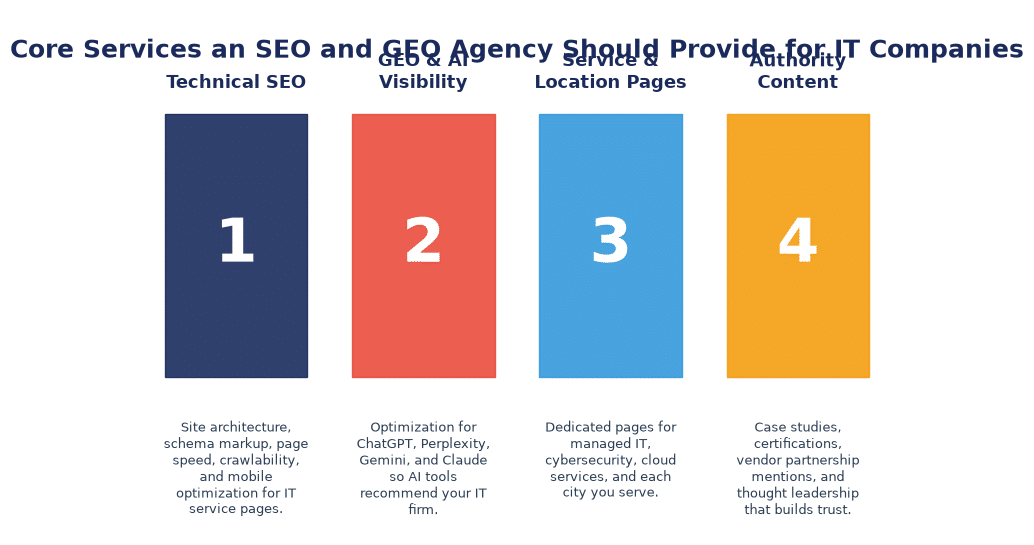
A credible agency working with an IT company or MSP should deliver four core services.
The first pillar is technical SEO: site architecture, schema markup, page speed optimization, and crawlability. For IT companies with multiple service lines and locations, this is the foundation that makes everything else work.
The second pillar is GEO and AI visibility: monitoring how your brand appears in ChatGPT, Perplexity, Gemini, and Claude, identifying gaps, and engineering content that closes those gaps. If an agency cannot name which AI tools they monitor, they do not do GEO.
The third pillar is dedicated service and location pages. A managed IT provider serving three cities with four service lines needs optimized pages for each combination. A generic “Services” page does not give search engines or AI tools enough detail to surface your firm for specific queries.
The fourth pillar is authority content: case studies describing real client problems and outcomes, content referencing certifications and vendor partnerships, and thought leadership positioning your team as experts in verticals like healthcare IT compliance. Working with a GEO agency for IT firms and MSPs that understands all four pillars is the difference between a marketing expense and an investment.
4. Trust Signals That Matter Most for IT Companies
When AI tools evaluate which IT company to recommend, they look for trust signals. For IT companies, the most important signals differ from what matters for a retail business.
Certifications and vendor partnerships carry significant weight. If your firm is a Microsoft Gold Partner, Cisco Certified, or AWS Advanced Partner, that information should be clearly stated with structured data markup so AI crawlers can parse it.
Case studies are another critical signal. A case study describing how your firm migrated a 200-person accounting company to the cloud, with specific challenges and measurable outcomes, gives AI tools concrete examples to reference. This is more valuable than a generic testimonial.
Service area and location pages with unique content per location signal legitimacy. A single “Locations” page with a list of cities and no unique content is essentially invisible. Review profiles on Google Business Profile, Clutch, and G2 are also parsed by AI tools. Consistency across platforms matters.
5. Red Flags When Hiring an Agency for Your IT Company
Most agencies selling SEO services will tell you they can help an IT company. The majority cannot, or at least not as effectively as they claim. Knowing the difference between a green flag and a red flag before signing can save months of frustration.
A lack of IT industry experience is the most reliable red flag. If an agency cannot show case studies from IT companies or MSPs, you are paying them to learn your industry. Another is an agency that only discusses Google rankings and never mentions AI search tools.
Vague reporting is a third red flag: reports showing traffic fluctuations without connecting to qualified leads provide no actionable information. Be wary of 12-month contracts without a clear scope of work. The best agencies, including some of the best GEO agencies for B2B, offer fixed monthly scopes with a 30-day out clause.
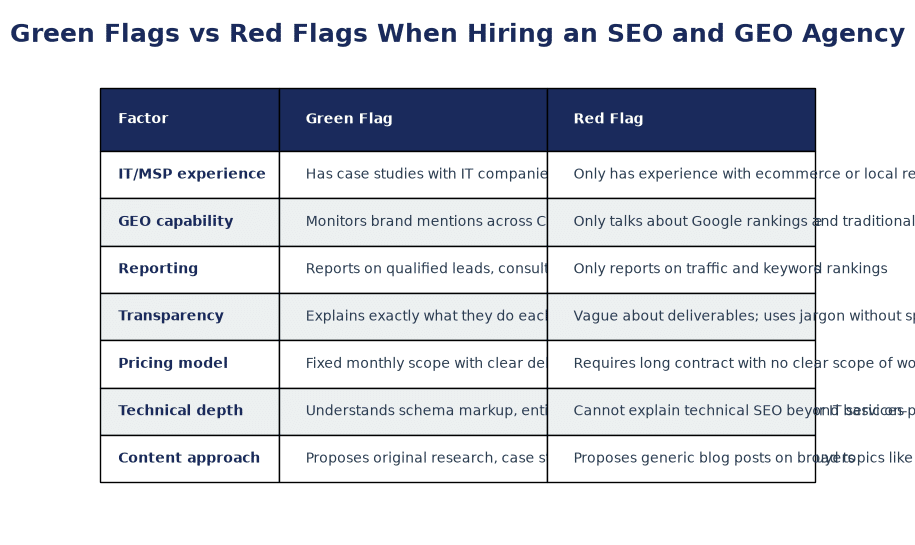
Here is a simple green flag versus red flag comparison to use when evaluating an agency.
| Factor | Green Flag | Red Flag |
|---|---|---|
| IT/MSP experience | Case studies from IT companies and MSPs | Only ecommerce or local retail clients |
| GEO capability | Monitors ChatGPT, Perplexity, Gemini, and Claude | Only talks about Google rankings |
| Reporting | Qualified leads and AI visibility metrics | Only traffic and keyword rankings |
| Transparency | Explains exactly what they do each month | Vague about deliverables |
| Pricing | Fixed monthly scope with clear deliverables | Long contract with no clear scope |
| Technical depth | Understands schema markup and structured data for IT | Cannot explain technical SEO beyond on-page |
6. How to Measure Results: Qualified Leads, Consultation Requests, and AI Visibility
The most common frustration IT company owners express about marketing agencies is that they cannot tell if the work produces results. This happens because the agency reports on the wrong metrics.
Qualified leads, people who fill out a contact form, request a proposal, or call after finding you through search or an AI recommendation, are the metric that matters. A good agency sets up tracking so you can see which leads came from which channel. Consultation requests represent the next level: someone scheduling a call to discuss managed IT services is further along than someone downloading a checklist.
AI visibility is a newer metric that many agencies do not yet report, but it is essential in 2026. A credible GEO agency should show a baseline of what each AI tool says about your firm today, then provide regular updates showing improvement. If your goal is to grow cybersecurity consulting in three new cities, the agency should report on leads and visibility in those specific markets.
7. What an SEO and GEO Engagement Typically Includes and Costs
A credible engagement for an IT company includes technical SEO audits, content strategy and production, GEO optimization with multi-LLM monitoring, and monthly reporting with lead attribution.
At the lower end, agencies charging $1,500 to $3,000 per month typically provide basic SEO: keyword research, on-page optimization, and monthly reporting. These rarely include GEO services. In the mid-range, $3,500 to $7,500 per month should get you technical SEO, content production, GEO monitoring across AI platforms, and reporting tied to leads. Above $7,500, agencies offer full-service programs with case study production, dedicated account management, and detailed lead attribution, appropriate for multi-location IT firms.
GEO and AI search visibility services are typically bundled with SEO in a comprehensive program rather than sold standalone, because the two disciplines share foundational work in content, technical optimization, and authority building.
8. DIY vs Agency: When an IT Company Should Hire Help
Some IT company owners are technically capable of doing their own SEO and GEO. The question is whether it is the best use of your time.
A solo consultant serving a single city can handle their own SEO. The calculus changes at 10 or more employees, multiple cities, or enterprise clients. At that scale, SEO and GEO require consistent content production, technical maintenance, and multi-platform monitoring.
If you spend 10 hours a week on marketing that an agency could do better in 5 hours, and those 10 hours could instead be spent closing deals, hiring an agency is the better financial decision. An agency that has done this for other IT companies moves faster and with fewer missteps than an owner learning as they go.
| Factor | DIY | Agency |
|---|---|---|
| Time required | 10+ hours per week ongoing | 1 to 2 hours per month for reviews |
| Learning curve | Steep: technical SEO, GEO, monitoring | Agency has the expertise |
| GEO capability | Limited: monitoring tools are costly | Full multi-LLM monitoring and citation engineering |
| Monthly cost | $0 to $300 for tools | $3,500 to $7,500 depending on scope |
| Speed of results | 6 to 12 months | 3 to 6 months with a competent agency |
| Best for | Solo consultant, single city, strong referrals | 10+ employees, multiple cities, growth goals |
9. Questions to Ask Before Hiring an SEO and GEO Agency
These questions are designed for IT companies evaluating agencies. If an agency cannot answer with specific examples, keep looking.
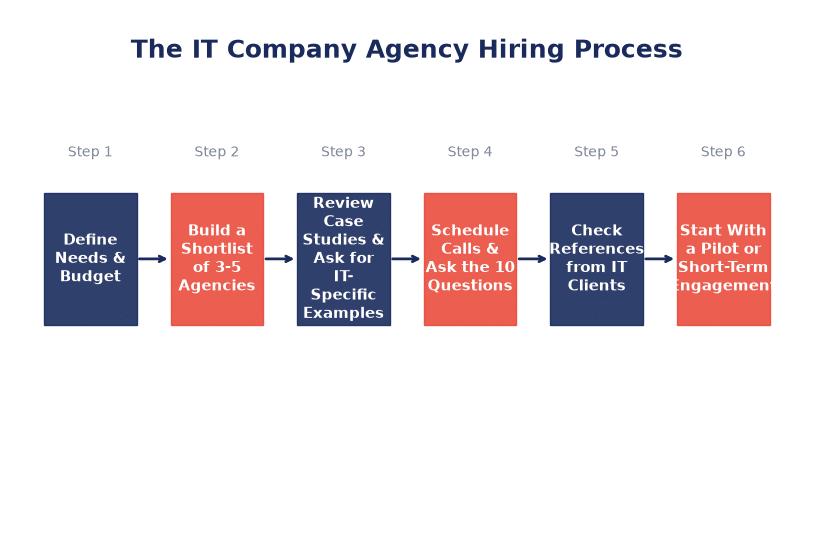
- Can you show me case studies from other IT companies or MSPs, including specific results?
- How do you monitor brand visibility across ChatGPT, Perplexity, Gemini, and Claude, and what does improvement look like over 3, 6, and 12 months?
- What is your approach to building service area and location pages for IT companies with multiple offices and service lines?
- How do you incorporate certifications, vendor partnerships, and industry-specific trust signals into your optimization strategy?
- Who handles technical SEO, and can they explain schema markup for IT service types and local business entities?
- What does your monthly reporting include, and can you connect leads and consultation requests to specific search terms or AI queries?
- How do you handle content production for technical topics like cybersecurity compliance, cloud migration, or healthcare IT?
- What is your typical contract structure, and do you offer a pilot before a longer commitment? If you have read through the questions to ask a GEO agency guide, these IT-specific follow-ups will help narrow your shortlist further.
- Can you provide two or three references from current or former IT industry clients I can contact directly?
- How do you stay current with changes in AI search behavior, and how do those changes affect your strategy for IT clients?
Choose an SEO and GEO Partner That Gets Your IT Company Recommended
Choosing the right SEO and GEO agency for your IT company is about finding a partner who understands the IT services market, can show results from other IT companies, monitors your visibility across all the AI platforms your buyers use, and reports on metrics that matter: qualified leads, consultation requests, and AI-driven recommendations.
The agencies worth hiring answer your questions with specifics, not generalities. They tell you exactly what they do each month, why they do it, and how it connects to your business goals.
Ready to get your IT company recommended by the AI tools your buyers use every day? Learn how a GEO agency for IT firms and MSPs can help you build authority, earn AI citations, and turn those citations into qualified leads. Contact us now!
Related Guides
- GEO Agency for IT Firms and MSPs
- The 10 Best GEO Agencies for B2B in 2026
- What Questions Should I Ask a GEO Agency?
- 12 Biggest GEO Mistakes Businesses Make in Their First 90 Days
- GEO Search Optimization: The Definitive Guide
Frequently Asked Questions
What is the difference between SEO and GEO for an IT company?
SEO focuses on ranking your website higher in traditional search engines like Google, and GEO focuses on writing web pages that get cited by AI search engines. GEO ensures AI tools like ChatGPT, Perplexity, Gemini, and Claude cite your firm when users ask for IT provider recommendations. IT companies need both because buyers now use both channels.
How much does an SEO and GEO agency cost for an IT company?
IT company programs typically range from $3,500 to $7,500 per month for mid-range B2B agencies with technology industry experience, with full-service options exceeding $7,500.
How long does it take to see results from SEO and GEO?
SEO results typically begin in 3 to 6 months, with significant improvement in 6 to 12 months. GEO results follow a similar timeline, with AI citations compounding for accelerating returns over 12 to 24 months.
Can I do SEO and GEO myself for my IT company?
A solo consultant serving a single city can reasonably handle basic SEO and GEO. For IT companies with 10 or more employees, multiple locations, or enterprise client targets, hiring a specialized agency almost always produces better results.
What should I look for in an agency’s reporting?
Look for reporting that connects work to business outcomes: qualified leads, consultation requests, and phone calls from organic search or AI recommendations. Avoid agencies that only report on traffic and keyword rankings without connecting them to your pipeline.
How do I know if an agency has real IT industry experience?
Ask for case studies from IT companies or MSPs. Ask for references you can contact. Look for evidence the agency understands managed services, cybersecurity, cloud migration, vendor partnerships, and long B2B sales cycles.
What is the most common mistake IT companies make when hiring?
Hiring a generalist agency with no IT industry experience at a lower price. IT services is a specialized market with specific buyer behavior and complex trust signals. An agency that treats your IT company like a local retail business will not produce the results you need.
Ready to get started? Contact Us →
About the Author

John H. Corcoran is an AI Visibility expert, former White House Writer, speechwriter, attorney, and author. He is the creator of Smart Business Revolution and host of the Smart Business Revolution podcast. Since 2010, he has interviewed over 1,500 successful entrepreneurs, CEOs and experts.
He is the author of 3 books about relationship building and client acquisition, and has been profiled in Forbes and featured in Entrepreneurial You (Harvard Business Review Press), Stand Out (Portfolio) by Dorie Clark, The Connector’s Advantage (Page Two) by Michelle Tillis Lederman, Success Is In Your Sphere (McGraw-Hill Education) by Zvi Band, and The Successful Mistake by Matthew Turner. His writing has appeared in Forbes, Entrepreneur, Huffington Post, Art of Manliness, Lifehacker, Business Insider, and numerous other publications.
Ready to explore how to get more AI visibility? Schedule a free consultation with John to discover how you can get more AI visibility.
Contact John →