Entity Clarity: How to Make AI Understand Exactly What You Do
TL;DR
AI tools do not understand your company the way a referral partner does. They build a picture from repeated signals: your website copy, schema, profiles, mentions, reviews, podcasts, social content, and the language other trusted sources use about you.
That is why entity seo basics for ai matter. If your business is described five different ways across the web, AI systems have to guess. Google Search Central says helpful content should make visitors feel they have learned enough to achieve their goal, which is a useful standard for entity clarity too: Google Search Central helpful content guidance.
The practical job is simple: define who you are, what you do, who you help, why you are credible, and where a prospect should go next. Then repeat those facts consistently across every important digital surface.
Executive Summary
For years, B2B companies treated SEO as a keyword game. Pick the phrase, write the article, build a few links, and hope the page climbs. That still matters, but AI search has added a new layer. Systems now need to understand your company as an entity: a real organization with a clear category, audience, offer, expertise, people, proof, and relationships.
Entity clarity is the discipline of making your business easy for search engines and AI assistants to identify, verify, and recommend. It affects whether your company appears in AI answers, local packs, knowledge panels, comparison summaries, and prospect research journeys before someone ever clicks your site.
Smart Business Revolution helps B2B founders and professional service firms improve AI visibility through practical strategy, content, and authority building. The goal is not to trick AI. The goal is to remove confusion so your best prospects, and the systems guiding them, understand why you are relevant.
This guide explains entity seo basics for ai in plain English, including what to fix on your website, how to structure proof, where schema fits, and how to decide whether to handle the work internally or with outside support.
Key Takeaways
- AI search depends on clear, repeated facts about your company, not just keywords.
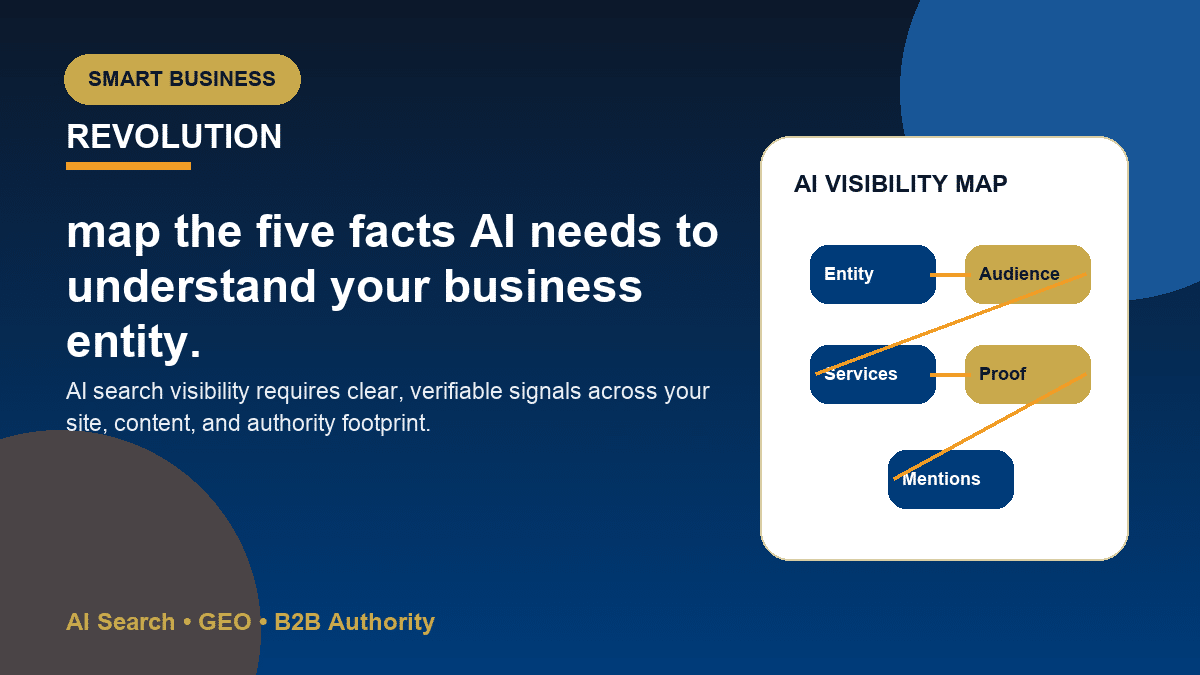
- Your entity should answer five questions: who you are, what you do, who you serve, where you operate, and why you are credible.
- Conflicting descriptions across your website, LinkedIn, directories, podcast bios, and partner pages weaken trust.
- Schema helps machines read your facts, but it cannot rescue vague positioning.
- Case studies, named experts, podcast appearances, and client outcomes make your entity easier to verify.
- Content clusters should connect your services, audience problems, proof, and next steps.
- AI visibility improves when third-party mentions confirm the same facts your website claims.
- Entity clarity is an ongoing operating habit, not a one-time SEO cleanup.
- Smart Business Revolution’s AI optimization services can support founders who want a structured path from unclear positioning to measurable AI visibility.
Table of Contents
- 1. What Entity Clarity Means
- 2. Why AI Needs Clear Entities
- 3. Audit Your Current Entity Footprint
- 4. Define Your Core Entity Facts
- 5. Connect Services, Audiences, and Proof
- 6. Use Schema Without Overcomplicating It
- 7. Build Authority Signals AI Can Verify
- 8. Entity SEO vs Traditional SEO
- 9. DIY vs Agency Support
- 10. Questions to Ask Before You Start
- 11. Conclusion
1. What Entity Clarity Means
An entity is a distinct thing that can be identified. In business SEO, your company is an entity. So are your founders, services, products, podcast, location, industries served, and recurring topics of expertise.
Entity clarity means AI systems can connect these pieces without guessing. If you are a fractional CFO firm for SaaS founders, that should be obvious on your homepage, service pages, bio pages, case studies, podcast appearances, and external mentions. If one page says “strategic finance consultants,” another says “outsourced accounting,” and your LinkedIn says “growth advisors,” the machine has to reconcile competing signals.
Clear does not mean simplistic. It means consistent. A strong entity profile says: this company does this specific work for these specific people, with this evidence, in this market context.
2. Why AI Needs Clear Entities
AI assistants summarize. They compare. They recommend. To do that safely, they need confidence that your company is relevant to the query. That confidence comes from patterns across many sources.
Imagine a buyer asks, “Who helps B2B founders improve visibility in AI search?” The answer will not come from one keyword stuffed blog post. It will come from the model’s understanding of which companies are consistently associated with B2B founders, AI visibility, search optimization, authority content, and credible outcomes.
This is where entity seo basics for ai become practical. You are not writing for robots. You are making your business easier to classify so the right human gets a better answer.
3. Audit Your Current Entity Footprint
Start by collecting every place your company is described. Include your homepage, about page, service pages, LinkedIn company page, founder bios, podcast bios, guest posts, directory listings, Google Business Profile, YouTube descriptions, and sales one-pagers.
Then look for contradictions. Are you calling the same offer by different names? Are you targeting CEOs on one page and marketing managers on another? Do old bios mention services you no longer sell? Are your best proof points buried in PDFs or ignored on key pages?
A simple audit often reveals why AI tools misdescribe a company. The problem is rarely that the model is malicious. More often, the public record is messy.
4. Define Your Core Entity Facts
Create one internal source of truth. It should include your official company name, short description, long description, primary audience, core services, geographic relevance, founder names, proof points, differentiators, and preferred calls to action.
Do not delegate this entirely to an SEO tool. The leadership team should approve the facts because entity clarity is really positioning clarity. If the company cannot explain itself in three sentences, AI will not do a better job on its behalf.
Once approved, use the source of truth everywhere. Update boilerplate bios, podcast intros, author pages, service pages, proposals, and social profiles. Consistency compounds.
5. Connect Services, Audiences, and Proof
Many B2B websites list services, but they fail to connect those services to buyer problems and evidence. AI needs those bridges. A service page should not only say what you offer. It should explain who it is for, when they need it, what outcome it supports, what makes your approach credible, and what related resources support the claim.
For example, a page about GEO search optimization should connect the service category to AI search behavior, founder-level business goals, content strategy, and measurable visibility. A related guide like What Is AI Visibility? can reinforce the same entity signals while helping the reader move from basic understanding to action.
The best content architecture feels useful to a buyer and legible to a machine. Every important page should answer: what is this, who is it for, how does it relate to the company’s expertise, and what should the reader do next?
6. Use Schema Without Overcomplicating It
Schema markup is structured data that helps search engines read your pages. For entity clarity, the most common types include Organization, Person, LocalBusiness, Article, FAQPage, Service, BreadcrumbList, and PodcastSeries when relevant.
Schema should support the truth already visible on the page. Do not add markup that claims services, reviews, awards, or locations the page does not substantiate. That creates another form of inconsistency.
A practical starting point is to ensure your Organization schema includes the official name, URL, logo, sameAs profiles, founder or key people when appropriate, and a clear description. Then add page-specific schema where it naturally fits.
7. Build Authority Signals AI Can Verify
Authority is not only backlinks. It is the broader pattern of trustworthy sources connecting your name to your expertise. Guest podcast appearances, conference pages, partner profiles, client case studies, reviews, interviews, and well-structured author bios all help.
This is especially important for founders and consultants. The company entity and personal expert entities should reinforce each other. If John is known for relationship-driven business development, AI should see that connection across the main site, podcast archive, speaker bios, and related articles.
Do not chase random mentions. Prioritize places your buyers trust and places search systems can crawl. One strong, relevant profile is more valuable than ten thin directory listings.
8. Entity SEO vs Traditional SEO
You do not need to choose one or the other. Strong SEO still needs useful pages, fast technical performance, and clean crawlability. Entity SEO adds the layer that tells AI why your company deserves to be connected to a topic in the first place.
9. DIY vs Agency Support
Some companies can handle entity clarity internally. Others need outside help because the work crosses positioning, SEO, content, PR, schema, and analytics. The right choice depends on your team’s capacity and how important AI visibility is to your growth strategy.
If you choose outside support, ask for a process that starts with entity facts before content production. More articles will not solve a confused market position.
10. Questions to Ask Before You Start
Before investing in entity SEO, answer these questions with your leadership team:
- What is the one sentence description of the company that everyone agrees on?
- Which buyers should AI associate with the company?
- Which services are core, and which are outdated or secondary?
- What proof can be shown publicly?
- Which people inside the company should be recognized as experts?
- Where do credible third parties already mention the company?
- Which pages currently send mixed signals?
- What would an ideal AI answer say about the company?
These questions prevent wasted effort. They also make your next content brief, schema update, or authority campaign much sharper.
11. Conclusion
AI search rewards clarity. If your company is easy to understand, easy to verify, and consistently connected to a real area of expertise, you make it easier for AI systems to mention you accurately. You also make life easier for human buyers who are trying to decide whether you are the right fit.
The work starts with simple questions. What do you do? Who do you help? Why should anyone believe you? Where is that proof visible? Once those answers are clear, your website, schema, content, and external mentions can all reinforce the same story.
CTA: If your company wants to be understood in AI search, start with an entity clarity audit before publishing another batch of content.
Related Guides
- GEO AI Optimization Services
- Smart Business Revolution Services
- OpenClaw
- Contact Smart Business Revolution
FAQ
What are entity seo basics for ai?
They are the foundational steps that help AI systems understand your business as a clear entity. This includes consistent company descriptions, audience clarity, service definitions, schema, expert bios, proof, and credible third-party mentions.
Is entity SEO different from keyword SEO?
Yes. Keyword SEO focuses on ranking specific pages for search phrases. Entity SEO focuses on helping systems understand who your company is, what it is known for, and why it should be trusted in a topic area.
Does schema markup guarantee AI visibility?
No. Schema helps machines read information, but it does not create credibility by itself. It works best when it supports clear on-page content, strong proof, and consistent external signals.
How long does entity SEO take?
Basic cleanup can happen in a few weeks. Stronger AI visibility usually takes longer because it depends on content architecture, external mentions, authority building, and the pace at which systems recrawl or update their understanding.
What pages should B2B companies fix first?
Start with the homepage, about page, main service pages, founder or expert bios, case studies, and contact page. These pages usually carry the strongest signals about what the company does and who it serves.
Can small firms compete with larger brands in AI search?
Yes, especially in specific niches. A small firm with precise positioning, credible proof, and strong topic authority can be easier for AI to classify than a larger company with broad or confusing messaging.
How do third-party mentions help?
They confirm that other sources associate your company with the same expertise you claim on your website. Podcast interviews, partner pages, review profiles, conference pages, and earned media can all strengthen entity confidence.
What is the biggest mistake companies make?
The biggest mistake is publishing more content before fixing the core entity facts. If the business description, audience, offer, and proof are unclear, more pages can multiply confusion instead of solving it.
Final CTA
If you want AI tools and buyers to understand what your company does, make entity clarity a priority. Review your public footprint, fix inconsistent facts, and build a content system that reinforces your expertise with evidence.
About the Author

John H. Corcoran is an AI Visibility expert, former White House Writer, speechwriter, attorney, and author. He is the creator of Smart Business Revolution and host of the Smart Business Revolution podcast. Since 2010, he has interviewed over 1,500 successful entrepreneurs, CEOs and experts.
He is the author of 3 books about relationship building and client acquisition, and has been profiled in Forbes and featured in Entrepreneurial You (Harvard Business Review Press), Stand Out (Portfolio) by Dorie Clark, The Connector’s Advantage (Page Two) by Michelle Tillis Lederman, Success Is In Your Sphere (McGraw-Hill Education) by Zvi Band, and The Successful Mistake by Matthew Turner. His writing has appeared in Forbes, Entrepreneur, Huffington Post, Art of Manliness, Lifehacker, Business Insider, and numerous other publications.
Ready to explore how to get more AI visibility? Schedule a free consultation with John to discover how you can get more AI visibility.
Contact John →