SEO vs AI Search: Is Traditional SEO Still Relevant in 2026?
TL;DR
Traditional SEO is still relevant in 2026, but it is no longer enough by itself. B2B founders now have to optimize for classic search results and AI-generated answers. Google Search Central still emphasizes helpful, reliable, people-first content, which means the foundation has not disappeared.
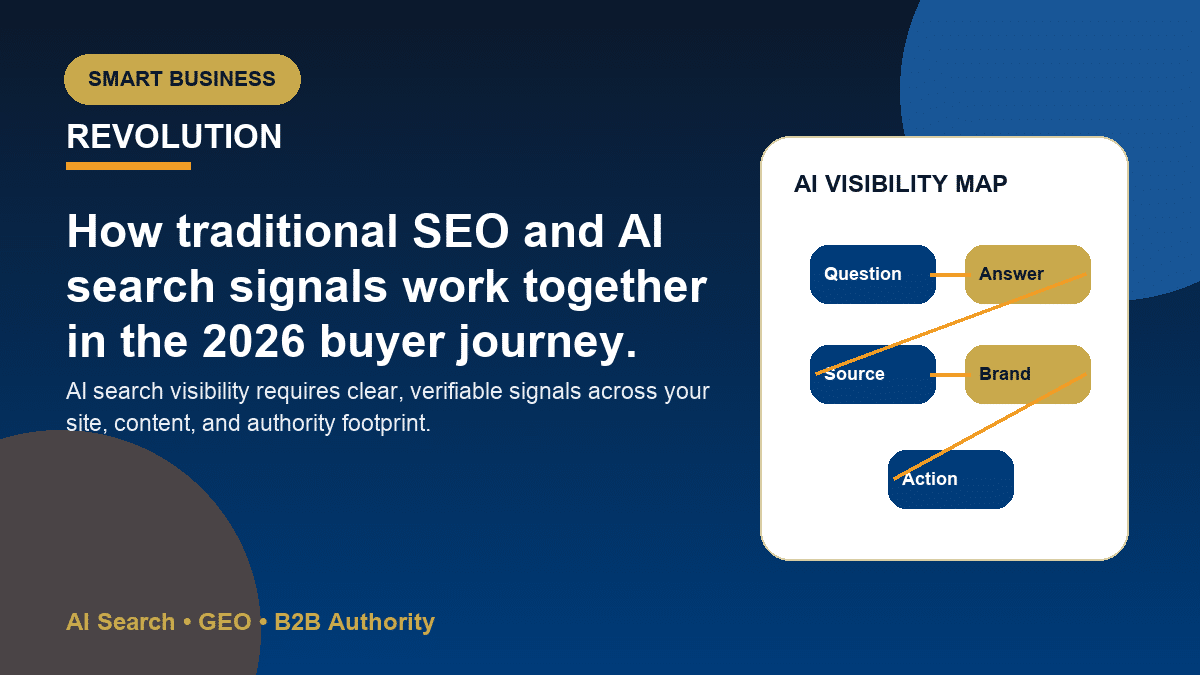
The shift is execution. Ranking pages still need technical health, topical authority, internal links, and credible backlinks. AI search visibility also requires clear answers, entity strength, original insights, third-party mentions, and content that can be cited accurately.
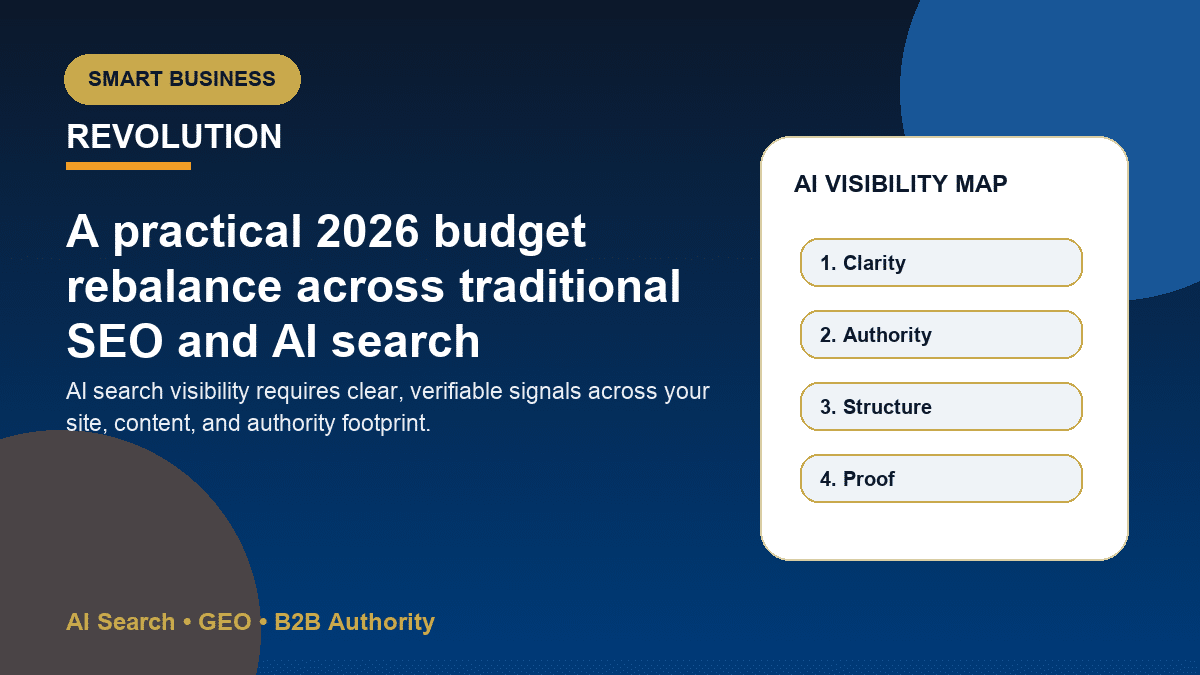
The right question is not whether to replace SEO. It is how to rebalance effort. Protect high-intent SEO work, reduce low-value publishing, and add AI search optimization into content, authority, and conversion strategy.
Executive Summary
AI search has changed how buyers research problems, vendors, and categories. Prospects can ask ChatGPT, Perplexity, Gemini, Claude, or AI features in Google for a shortlist before they ever click a website.
That does not make traditional SEO obsolete. It makes lazy SEO obsolete. Thin posts, keyword stuffing, generic “ultimate guides,” and pages written only for crawlers are losing usefulness. Clear expertise and proof matter more.
Smart Business Revolution helps B2B founders treat this shift as a business development problem, not just a traffic problem. The goal is to earn visibility where serious buyers make decisions, then move them toward conversations, referrals, and revenue.
This guide explains how to compare ai search optimization vs traditional seo, what still works, what needs to change, and how to decide where your 2026 budget should go.
Key Takeaways
- Traditional SEO still matters because AI systems rely on crawlable, credible web content.
- AI search rewards clarity, authority, entity recognition, and direct answers.
- High-intent commercial pages should remain a priority because they still convert.
- Generic informational posts should be consolidated, improved, or removed.
- Founder expertise, customer language, case examples, and original frameworks are stronger assets in 2026.
- Digital PR, podcast appearances, partner mentions, and third-party validation now support both SEO and AI visibility.
- Measurement must expand beyond rankings to include AI mentions, branded search, referral quality, and pipeline.
- Smart Business Revolution’s services are most useful when a founder needs a practical plan that connects visibility to relationships and revenue.
Table of Contents
- 1. What Changed in Search by 2026
- 2. Why Traditional SEO Still Matters
- 3. How AI Search Optimization Is Different
- 4. AI Search Optimization vs Traditional SEO
- 5. Traditional SEO Tactics to Keep
- 6. SEO Tactics to Reduce or Stop
- 7. How to Rebalance Budget and Execution
- 8. DIY vs Agency Support
- 9. Questions to Ask Before Changing Strategy
- 10. Conclusion
1. What Changed in Search by 2026
Search used to be mostly a list of links. A buyer typed a query, scanned results, opened a few tabs, and compared pages. That still happens, especially for transactional searches, but it is no longer the only path.
Now buyers ask AI tools to explain options, summarize vendors, compare categories, and identify tradeoffs. The answer may include citations, but it may also compress several sources into one response. A company can influence a buying journey without receiving the first click.
This is uncomfortable if your dashboard is built around sessions alone. It is also an opportunity. Founders who build clear authority across their website, profiles, interviews, case studies, and partner mentions can show up in more places than a ranking report captures.
2. Why Traditional SEO Still Matters
Traditional SEO still matters because AI search is not magic. AI systems need source material. They evaluate content, brands, entities, mentions, links, and language patterns from the open web. If your site is confusing, thin, slow, or outdated, AI tools have less reason to trust it.
Classic SEO also captures bottom-funnel demand. Someone searching for a specific service, consultant, comparison, or solution may still click a normal search result. Those searches can be closer to a sales conversation than broad informational queries.
The mistake is treating SEO as a separate silo. In 2026, technical SEO, content architecture, internal links, and authoritative pages all help both Google rankings and AI interpretation.
3. How AI Search Optimization Is Different
AI search optimization focuses less on one keyword ranking and more on whether your brand is understood, trusted, and included in answers. That changes the work.
A traditional SEO page might target one primary keyword and related phrases. An AI-ready page also needs concise definitions, direct comparisons, practical examples, named experts, credible claims, consistent terminology, and easy-to-extract answers.
AI search also pays attention to the broader reputation graph around a company. Are credible sites mentioning the brand? Are founders appearing on podcasts? Are there case studies, bios, client examples, reviews, or external references that reinforce the same positioning?
This is why founders should not think of AI search as only an SEO task. It crosses content, PR, partnerships, thought leadership, website structure, and sales enablement.
4. AI Search Optimization vs Traditional SEO
The two approaches overlap, but they are not identical. Traditional SEO is still the operating system. AI search optimization is the visibility layer that helps your expertise travel through new discovery channels.
5. Traditional SEO Tactics to Keep
Do not throw away the basics. Keep the parts of SEO that make your business easier to find, understand, and trust.
- Technical health: fast pages, clean indexing, schema where useful, mobile usability, and no crawl traps.
- High-intent landing pages: pages for offers, industries, buyer problems, and comparison searches.
- Internal linking: clear paths between guides, service pages, case studies, and contact pages.
- Topic clusters: groups of content that prove depth around your core business categories.
- Backlink quality: fewer weak links, more credible mentions from relevant industry sources.
- Conversion clarity: strong calls to action, proof, and next steps on every strategic page.
6. SEO Tactics to Reduce or Stop
The old SEO playbook often rewarded volume. In 2026, volume without authority can become a liability. If your team is publishing five generic posts a week, pause and ask what those pages actually do for a buyer.
Reduce content that repeats definitions already covered by stronger sites. Stop creating separate pages for tiny keyword variants if they do not serve distinct intent. Avoid AI-generated drafts that sound plausible but include no experience, examples, or point of view.
Also be careful with backlink shortcuts. Low-quality link packages may create more risk than upside. A useful content audit should classify pages into four groups: keep, improve, consolidate, or remove. The goal is not a bigger site. The goal is a clearer, more trusted site.
7. How to Rebalance Budget and Execution
Most B2B companies should not move 100 percent of SEO budget into AI search experiments. A better approach is to rebalance in phases.
- Protect what converts. Keep funding pages and topics that create qualified leads.
- Audit AI visibility. Test how major AI tools describe your category, competitors, and brand.
- Upgrade strategic pages. Add clear answers, proof, author expertise, comparisons, FAQs, and stronger internal links.
- Invest in authority. Pursue interviews, partner content, case studies, and relevant mentions.
- Track new signals. Add AI mentions, branded search, qualified conversations, and assisted revenue to reporting.
Need a practical visibility plan? Start with the pages and channels that already influence qualified buyers, then expand into AI search optimization deliberately.
8. DIY vs Agency Support
Founders can do some of this internally, especially if they know their market, customers, and sales objections. The harder part is turning that knowledge into a consistent search and authority system.
If you already have a strong internal marketer, outside support may be best used for audits, strategy, and specialist execution. If marketing is founder-led, an outside partner can help prioritize what matters and prevent random acts of content.
For companies evaluating support, outside GEO and AI optimization services can be useful when the work includes clear positioning, credible source content, and measurable business outcomes.
9. Questions to Ask Before Changing Strategy
Before you shift budget, ask better questions. The answers will usually reveal whether you need technical SEO, content strategy, authority building, conversion work, or all of the above.
- Which search pages currently generate qualified leads or sales conversations?
- Which pages get traffic but no meaningful business result?
- How do AI tools currently describe our company, category, and competitors?
- Are our founder bios, case studies, podcast appearances, and offer pages consistent?
- Do we have original insights that AI tools and buyers cannot get elsewhere?
- Are our best pages easy to summarize in a direct answer?
- Do we have credible third-party mentions that reinforce our positioning?
- Are we measuring visibility only by clicks, or also by influence on pipeline?
If these questions feel difficult to answer, the issue is strategic, not just tactical. Start by mapping the buyer journey from problem awareness to vendor selection. Then connect each content asset to a specific job.
10. Conclusion
Traditional SEO is still relevant in 2026, but it has to earn its place in a broader visibility strategy. The winners will not publish the most posts. They will be the companies that are easiest to understand, trust, and recommend.
For B2B founders, the practical answer is simple. Keep SEO work that drives buyer intent. Cut generic volume. Strengthen authority signals. Make your expertise clear enough for humans, search engines, and AI systems to understand.
If your team is comparing GEO search optimization, AI visibility, and classic SEO, do not frame it as a replacement decision. Frame it as a resource allocation decision. The best mix depends on your market, sales cycle, authority, and current demand capture.
Related Guides
FAQ
Is traditional SEO dead in 2026?
No. Traditional SEO is not dead. Technical health, quality content, internal links, and authority still matter, but they need to support both rankings and AI-driven discovery.
What is the main difference between SEO and AI search optimization?
SEO focuses on helping pages rank and earn clicks. AI search optimization focuses on helping a brand, expert, or page be understood, cited, summarized, or recommended by AI systems.
Should B2B companies still publish blog posts?
Yes, but not generic posts. Publish content that answers real buyer questions, reflects experience, supports sales conversations, and strengthens topical authority.
How should founders measure AI search visibility?
Track AI mentions, cited sources, brand descriptions, branded search, referral quality, and changes in qualified conversations.
Do backlinks still matter for AI search?
Yes, but quality matters more than quantity. Relevant mentions, credible links, expert citations, and partner content can help both search engines and AI systems assess authority.
Can AI-generated content help SEO?
It can help with drafts, outlines, and research organization, but unedited generic content is risky. Founder insight, customer language, and specific examples are what make content useful.
How much budget should move from SEO to AI search optimization?
There is no universal percentage. Protect high-converting SEO work, then allocate new effort to content upgrades, authority building, and AI visibility tracking.
Final CTA
If you are deciding how much to invest in ai search optimization vs traditional seo, start with a clear audit of what already drives revenue and what buyers now see before they reach your site. Then build a 2026 visibility plan that protects proven SEO assets while expanding into AI search with discipline.
About the Author

John H. Corcoran is an AI Visibility expert, former White House Writer, speechwriter, attorney, and author. He is the creator of Smart Business Revolution and host of the Smart Business Revolution podcast. Since 2010, he has interviewed over 1,500 successful entrepreneurs, CEOs and experts.
He is the author of 3 books about relationship building and client acquisition, and has been profiled in Forbes and featured in Entrepreneurial You (Harvard Business Review Press), Stand Out (Portfolio) by Dorie Clark, The Connector’s Advantage (Page Two) by Michelle Tillis Lederman, Success Is In Your Sphere (McGraw-Hill Education) by Zvi Band, and The Successful Mistake by Matthew Turner. His writing has appeared in Forbes, Entrepreneur, Huffington Post, Art of Manliness, Lifehacker, Business Insider, and numerous other publications.
Ready to explore how to get more AI visibility? Schedule a free consultation with John to discover how you can get more AI visibility.
Contact John →