Is SEO Dead in 2026? What Businesses Need to Know
TL;DR
No, SEO is not dead in 2026. But the old version of SEO is. The businesses still getting results are not chasing tricks, publishing thin keyword pages, or treating Google as the only discovery channel. They are building trusted content, clear topical authority, and pages that can be understood by search engines, AI answer engines, prospects, and referral partners.
Google still says SEO is about helping search engines understand content and helping users find a site, according to its SEO Starter Guide. What changed is where that understanding now shows up. Buyers may see a search result, an AI overview, a ChatGPT answer, a Perplexity citation, a LinkedIn post, a podcast page, or a referral before they ever visit a website.
For B2B founders, the practical answer is simple: SEO now works best when it is paired with GEO, or generative engine optimization. The goal is not just ranking. The goal is becoming the obvious, cited, trusted answer when a serious buyer is ready to learn, compare, and choose.
Executive Summary
The question “is SEO dead in 2026” usually comes from business owners who have seen traffic flatten, rankings move around, or AI tools answer questions before users click. That frustration is real. A lot of what used to pass as SEO has become weaker, slower, and less reliable.
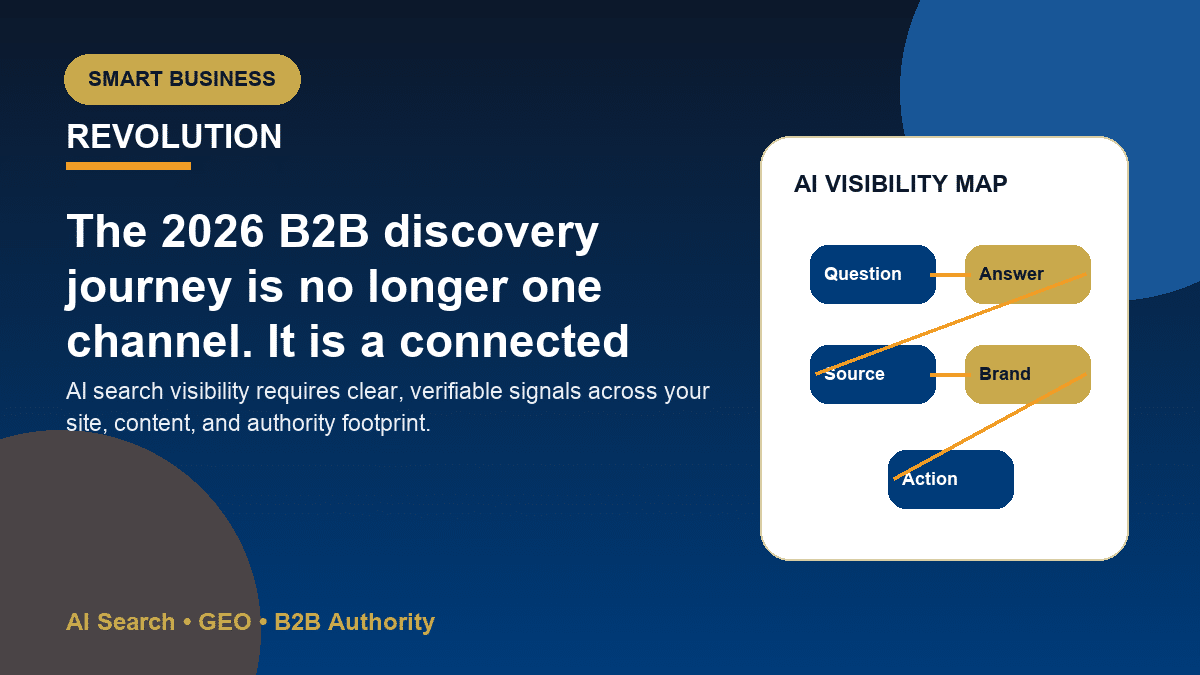
But demand has not disappeared. Buyers still research problems, compare options, ask peers, read case studies, and look for experts. The discovery path is just more fragmented. Search is no longer one page of blue links. It is a wider visibility ecosystem where Google, AI engines, review sites, social platforms, podcasts, and direct referrals all influence trust.
Smart Business Revolution helps B2B firms think about visibility as a business development system, not a bag of search hacks. In 2026, that means aligning SEO, GEO, expert content, relationships, and conversion assets so the company is easier to find and easier to trust.
The winners will not be the companies that publish the most. They will be the companies that answer important buyer questions with depth, experience, proof, and a clear point of view.
Key Takeaways
- SEO is not dead, but low quality SEO tactics are fading fast.
- AI answer engines changed how buyers discover and evaluate companies.
- Google rankings still matter, especially for high intent and comparison searches.
- GEO helps businesses get found inside AI generated answers and summaries.
- Founder expertise, case studies, original insights, and clear positioning matter more than generic content.
- Technical SEO still matters because AI and search engines need clean, crawlable, structured information.
- Traffic is no longer the only useful metric. Mentions, citations, qualified leads, branded search, and sales conversations matter too.
- B2B firms should combine SEO with podcasts, partnerships, email, and relationship driven distribution.
- Smart Business Revolution can help businesses evaluate where SEO and GEO fit inside a broader growth strategy.
Table of Contents
- 1. Why People Think SEO Is Dead
- 2. What SEO Means in 2026
- 3. What Changed Because of AI Search
- 4. What Still Works
- 5. SEO vs GEO: What Is the Difference?
- 6. DIY vs Agency
- 7. Questions to Ask Before Investing
- 8. A 2026 B2B SEO Action Plan
- 9. Mistakes to Avoid
- 10. Conclusion
1. Why People Think SEO Is Dead
Business owners are not asking this question for no reason. Many have invested in content, watched rankings bounce, and seen fewer clicks from informational searches. Some have also noticed that AI tools now summarize answers that used to send visitors to blog posts.
That creates a valid concern: if the answer appears before the click, what happens to the website? The answer depends on the type of query. Basic definitions, simple checklists, and generic how to articles are easier for AI systems to summarize. Those pages may lose clicks if they do not offer anything distinctive.
But complex B2B decisions are different. A founder choosing a marketing partner, law firm, consultant, software provider, fractional executive, or agency is not finished after reading one summary. They need context, confidence, proof, and a reason to believe one company understands their situation better than the rest.
2. What SEO Means in 2026
SEO in 2026 is the practice of making a business easier to discover, understand, trust, and choose through organic search and related discovery systems. That includes classic search results, AI summaries, knowledge panels, local results, video results, podcast pages, and third party citations.
The best SEO is no longer separated from brand, content strategy, sales enablement, and partnerships. A strong article can rank in Google, get cited by an AI tool, support a sales conversation, answer a prospect email, and give referral partners something useful to share.
This is why founders should stop asking whether SEO is alive or dead and start asking a better question: are we findable and credible when buyers look for answers related to the problems we solve?
3. What Changed Because of AI Search
AI changed three things. First, users now expect faster answers. Second, engines increasingly synthesize information from multiple sources. Third, trust signals matter more because AI systems and buyers both need ways to decide which sources deserve attention.
This means generic content is at risk. If a page says the same thing as every competitor, it gives AI systems nothing unique to cite and gives buyers no reason to remember the company. A B2B firm needs named expertise, examples, client language, frameworks, and specific guidance.
AI also changes measurement. A buyer might discover a company in an AI answer, search the brand name later, read a case study, listen to a podcast episode, then fill out a form. The original AI mention may not appear neatly in analytics. Leadership has to evaluate the whole pipeline, not only last click traffic.
4. What Still Works
The fundamentals still work when they are done well. Clear positioning works. Pages built around real buyer questions work. Technical health works. Internal links work. Case studies work. Original research and founder commentary work. So does content that reflects direct experience instead of recycled summaries.
In B2B, the most valuable searches are often not massive volume searches. They are problem aware, solution aware, or comparison searches. A page that helps a buyer understand cost, timing, risk, alternatives, and next steps can be far more valuable than a broad article that attracts unqualified visitors.
The content that works in 2026 usually has four traits: it is specific, useful, credible, and connected to a next step. If a founder reads it and thinks, “This company understands my problem,” the content is doing its job.
5. SEO vs GEO: What Is the Difference?
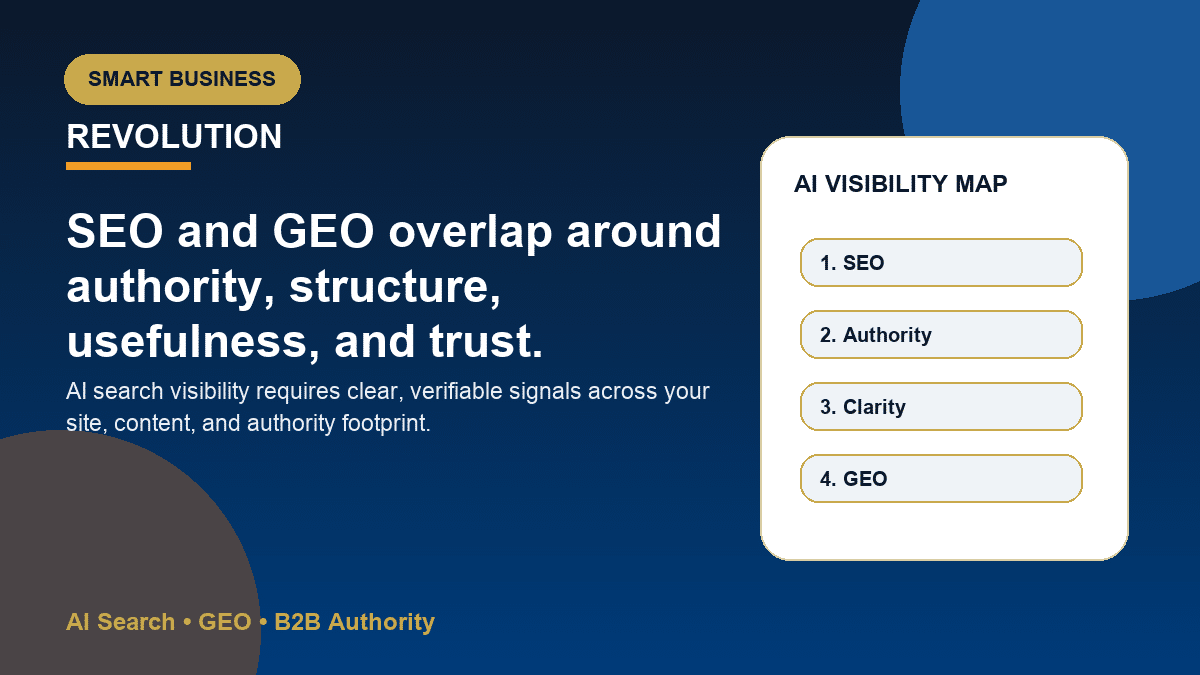
SEO and GEO overlap, but they are not identical. SEO focuses on improving organic visibility in search engines. GEO focuses on improving how a company appears in generative AI answers, summaries, and recommendations.
The practical move is not to pick one. A business needs strong SEO foundations so its content is crawlable and credible. It also needs GEO thinking so its expertise is easy for AI systems to parse, cite, and connect to the right category.
6. DIY vs Agency
Not every company needs an agency on day one. A founder led business can often make real progress by clarifying its services, improving core pages, answering frequent sales questions, and creating a simple publishing rhythm.
The right choice depends on market complexity, competitive pressure, internal capacity, and the value of each qualified lead. A high ticket B2B service can justify a serious organic visibility effort much faster than a low margin offer.
7. Questions to Ask Before Investing
- Which buyer questions most often appear before a sales conversation?
- Which services have the highest margin, best fit, or strongest close rate?
- Where do prospects currently hear about the company?
- Does the site clearly explain who the business helps and why it is credible?
- Which competitors appear in search results and AI answers?
- What proof exists, such as case studies, testimonials, data, frameworks, or founder experience?
- What content could help referral partners introduce the company more effectively?
- How will success be measured beyond raw traffic?
These questions keep the conversation grounded in revenue, not vanity metrics. The goal is not to win every keyword. The goal is to be visible for the questions that shape trust and buying decisions.
8. A 2026 B2B SEO Action Plan
Start with the foundation. Make sure the site is crawlable, fast enough, mobile friendly, and logically organized. Service pages should be clear. Contact paths should be obvious. Internal links should guide users toward related resources and next steps.
Next, build a content map around real buyer intent. Include problem pages, service pages, comparison pages, FAQ pages, case studies, and thought leadership. Do not publish content just because a tool says a keyword has volume. Publish because the topic matters to buyers and supports the business model.
Then add GEO layers. Use concise summaries, clear definitions, structured sections, author credibility, consistent entity language, and answers that can stand alone. Make it easy for AI systems to understand what the company does, who it helps, and why it is a credible source.
Finally, distribute. Share articles with prospects, referral partners, podcast guests, newsletter readers, and sales teams. Organic visibility improves when content is useful enough to be referenced beyond the website.
CTA: If organic visibility feels scattered, start with a simple audit of your best buyers, best offers, and highest intent content gaps.
9. Mistakes to Avoid
The first mistake is treating AI as a reason to abandon content. That creates a vacuum competitors can fill. The better response is to create better content, clearer authority signals, and stronger conversion paths.
The second mistake is publishing generic AI written articles without expert review. AI can help with drafts, outlines, and research organization, but it should not replace judgment. Buyers can spot shallow content quickly, especially in complex B2B markets.
The third mistake is measuring only traffic. Traffic matters, but qualified demand matters more. Look at branded search growth, lead quality, consultation requests, referral source comments, sales cycle influence, and which content gets mentioned in conversations.
The fourth mistake is ignoring relationships. SEO and GEO are stronger when a company also has interviews, partnerships, podcasts, community presence, and credible third party mentions. Visibility compounds across channels.
10. Conclusion
So, is SEO dead in 2026? No. But SEO has matured. It is less about gaming search engines and more about becoming a trusted answer in a world where buyers use search, AI tools, peers, podcasts, and referrals together.
For B2B founders, this is good news. Companies with real expertise, strong relationships, and useful insights have an advantage. They do not need to outpublish everyone. They need to be clearer, more credible, and more useful where buyers are already looking.
The future belongs to businesses that combine SEO discipline with GEO awareness and relationship driven growth. That is not the death of SEO. It is the next version of organic trust.
Related Guides
- GEO Search Optimization
- GEO AI Optimization Services
- What Is AI Visibility?
- Smart Business Revolution Services
- Smart Business Revolution Podcasts
FAQ
Is SEO dead in 2026?
No. SEO is still useful, but it has changed. Generic keyword content is weaker, while expert content, technical clarity, authority, and AI visibility are more important.
Will AI replace Google search?
AI will keep changing search behavior, but buyers still use Google, websites, reviews, referrals, and direct research. The safer strategy is to be visible across the whole discovery journey.
What is GEO?
GEO stands for generative engine optimization. It is the practice of improving how a business appears in AI generated answers, summaries, citations, and recommendations.
Should B2B companies still publish blog posts?
Yes, if the posts answer real buyer questions and support sales conversations. Publishing for volume alone is not enough. Quality, specificity, and usefulness matter more.
How should companies measure SEO now?
Measure rankings and traffic, but also track lead quality, branded search, assisted conversions, AI mentions, referral comments, and content influence during sales conversations.
Can AI written content rank?
It can, but unedited generic AI content is risky. The strongest content includes human expertise, examples, proof, clear structure, and a point of view.
What should founders do first?
Start by improving core service pages, identifying top buyer questions, documenting proof, and creating content that helps prospects make confident decisions.
Do backlinks still matter?
Yes, but quality matters more than quantity. Relevant mentions, interviews, partnerships, podcast appearances, and respected industry citations can all support authority.
Final CTA
If the company wants to keep earning attention in 2026, it should stop asking whether SEO is dead and start building the content, authority, and relationships that make it the obvious answer. For a practical next step, review the site’s most important service pages and compare them against the questions prospects actually ask before they buy. Then strengthen the gaps that affect trust, clarity, and conversion.
About the Author

John H. Corcoran is an AI Visibility expert, former White House Writer, speechwriter, attorney, and author. He is the creator of Smart Business Revolution and host of the Smart Business Revolution podcast. Since 2010, he has interviewed over 1,500 successful entrepreneurs, CEOs and experts.
He is the author of 3 books about relationship building and client acquisition, and has been profiled in Forbes and featured in Entrepreneurial You (Harvard Business Review Press), Stand Out (Portfolio) by Dorie Clark, The Connector’s Advantage (Page Two) by Michelle Tillis Lederman, Success Is In Your Sphere (McGraw-Hill Education) by Zvi Band, and The Successful Mistake by Matthew Turner. His writing has appeared in Forbes, Entrepreneur, Huffington Post, Art of Manliness, Lifehacker, Business Insider, and numerous other publications.
Ready to explore how to get more AI visibility? Schedule a free consultation with John to discover how you can get more AI visibility.
Contact John →