Is Your Website Readable by AI Crawlers? A Technical Checklist
TL;DR
AI search systems, answer engines, and large language model crawlers are changing how prospects discover B2B companies. If your site is blocked, thin, slow, confusing, or missing structured signals, it may be skipped, misunderstood, or summarized inaccurately.
This technical checklist for AI crawlability helps founders and marketing leaders inspect the foundations: robots rules, server responses, crawl paths, JavaScript rendering, schema, content clarity, internal links, and authority signals. Google notes that site owners can control crawler access with robots.txt and related mechanisms in Google Search Central’s robots.txt documentation.
The goal is simple: make your most important expertise easy for AI systems to access, interpret, and cite while still serving human buyers first.
Executive Summary
Most B2B websites were built for traditional search engines and human visitors. That is still important, but AI discovery adds another layer. AI crawlers need clean access to your pages, consistent entities, clear topical structure, and enough evidence to understand why your company is credible.
AI crawlability is not a single plugin or one-time setting. It is the combination of technical accessibility, machine-readable context, useful content, and signals that reinforce who you help, what you do, and why your perspective is trustworthy.
For B2B founders, this matters because prospects are increasingly asking AI tools for vendor shortlists, solution comparisons, and practical recommendations. Smart Business Revolution’s GEO AI optimization services help companies evaluate these technical and content signals so their expertise is easier for AI-driven discovery systems to understand.
Use this checklist as a practical audit. You do not need to fix everything in one week. Start with crawl access, indexable priority pages, clear service positioning, and structured data. Then improve depth, internal links, and answer-ready content over time.
Key Takeaways
- AI crawlability starts with basic access: robots.txt, meta robots tags, HTTP status codes, and sitemap hygiene.
- Your best pages should be indexable, fast, internally linked, and easy to render without fragile scripts.
- AI systems need context, not just keywords. Use clear entities, specific audiences, and consistent service descriptions.
- Structured data can help machines understand your organization, articles, services, FAQs, and authorship.
- Thin, vague, or duplicate pages are less likely to be useful in AI-generated answers.
- Comparison pages, FAQs, glossaries, and original insights make content easier to summarize and cite.
- Technical crawlability and brand authority should be reviewed together, not as separate projects.
- Log files, crawl simulations, and AI visibility checks help confirm whether fixes are working.
- Smart Business Revolution can support B2B teams that want a practical AI crawlability and visibility review.
Table of Contents
- 1. Confirm Crawl Access
- 2. Review Robots Controls
- 3. Test Rendering and JavaScript
- 4. Strengthen Site Architecture
- 5. Add Structured Data
- 6. Improve Content Clarity
- 7. Build Authority Signals
- 8. Measure AI Crawlability
- 9. Decide DIY vs Agency
- 10. Questions to Ask
1. Confirm Crawl Access
The first question is whether crawlers can reach your important pages at all. Many visibility problems begin with simple technical blockers: pages returning errors, redirects looping, staging rules left in place, or templates accidentally marked noindex.
Start with your homepage, primary service pages, case studies, blog articles, podcast pages, and contact page. Each should return a 200 status code, load without authentication, and include canonical tags that point to the correct version. If a page is critical to buyer education, do not bury it five clicks deep or hide it behind forms.
Check whether your XML sitemap is current. It should include priority indexable pages and exclude junk URLs, internal search results, tag archives with no value, and outdated drafts. A clean sitemap is not a guarantee of crawling, but it is a strong starting signal.
2. Review Robots Controls
Robots controls are useful, but they are also easy to misuse. Your robots.txt file may block folders that contain important scripts, images, resources, or entire page groups. Meta robots tags can tell crawlers not to index pages even when the page itself looks fine in a browser.
Review robots.txt line by line. Look for broad disallow rules such as blocking all blog folders, all parameter pages, or all assets. Then inspect page-level directives, including noindex, nofollow, noarchive, and canonical tags. A common mistake is using a canonical tag to point a useful page to a weaker parent page, which can reduce the chance that the specific answer appears in search or AI summaries.
Do not assume every AI crawler follows rules the same way. The practical goal is to make your public, helpful content clearly available while keeping private, paid, duplicated, or low-value content restricted.
3. Test Rendering and JavaScript
Modern websites often rely on JavaScript for menus, content modules, filtering tools, testimonials, FAQs, and pricing blocks. Human visitors may see the page perfectly, while a crawler sees very little if content loads late, depends on user interaction, or requires blocked scripts.
View the rendered HTML and compare it to what appears visually on the page. Key headings, body copy, links, author names, publication dates, service descriptions, and FAQs should be present in a crawlable form. If your value proposition only appears inside an image, slider, or script-generated element, machines may not understand it.
Pay special attention to single-page applications and heavily animated landing pages. They can look polished but fail to expose stable URLs and text. For B2B sites, clarity usually beats cleverness.
4. Strengthen Site Architecture
AI systems need to understand relationships. Your site architecture should make it obvious which pages are central, which pages support them, and how your expertise fits together. A scattered blog with no internal linking plan makes that harder.
Use hub pages for core topics. For example, a company building visibility in AI search could connect articles about what AI visibility means, GEO search optimization, and service pages into a clear cluster. This helps both prospects and machines understand the topic hierarchy.
Your navigation should also support crawl paths. Include important pages in menus, footers, related content modules, and contextual links inside body copy. Orphaned pages can still be discovered, but they rarely send a strong importance signal.
5. Add Structured Data
Structured data gives machines an organized way to interpret your content. It does not replace good writing, but it can clarify your organization, authors, articles, services, reviews, FAQs, and breadcrumbs.
At minimum, B2B websites should consider Organization, WebSite, BreadcrumbList, Article, FAQPage where appropriate, and Person schema for authors or experts. Service pages may benefit from structured descriptions of what is offered, who it helps, and how prospects can take the next step.
Keep schema accurate. Do not mark every page as an FAQ if it does not contain visible questions and answers. Do not invent reviews or credentials. AI systems are increasingly built to compare signals across the web, so inconsistencies can weaken trust.
6. Improve Content Clarity
Crawlable content is not automatically useful content. AI systems need clear, specific, evidence-backed language. If your site says you provide “innovative solutions for growth” but never explains the problem, audience, process, or result, there is little for an answer engine to use.
Every important page should answer basic questions quickly: who is this for, what problem does it solve, how does it work, what makes it credible, and what should the reader do next. Use descriptive headings. Define terms. Include examples. Add comparison tables where buyers are likely to weigh options.
Founders should also review their service pages for specificity. A page about GEO AI optimization should explain what is audited, what gets improved, and how success is measured. The same principle applies to consulting, content, podcasts, and demand generation pages.
7. Build Authority Signals
AI systems do not only parse your pages. They also infer credibility from consistency, references, author information, topical depth, and brand mentions across the web. Your site should make expertise visible.
Include author bios, company background, media mentions, podcast appearances, client examples, and clear contact information. If your founder has deep experience, do not hide it on one short bio page. Connect that experience to relevant articles, interviews, and case studies.
For Smart Business Revolution, the podcast library is an example of authority depth because it connects interviews, business relationships, and practical expertise. Most B2B companies have similar assets, but they often fail to organize them in a way crawlers can understand.
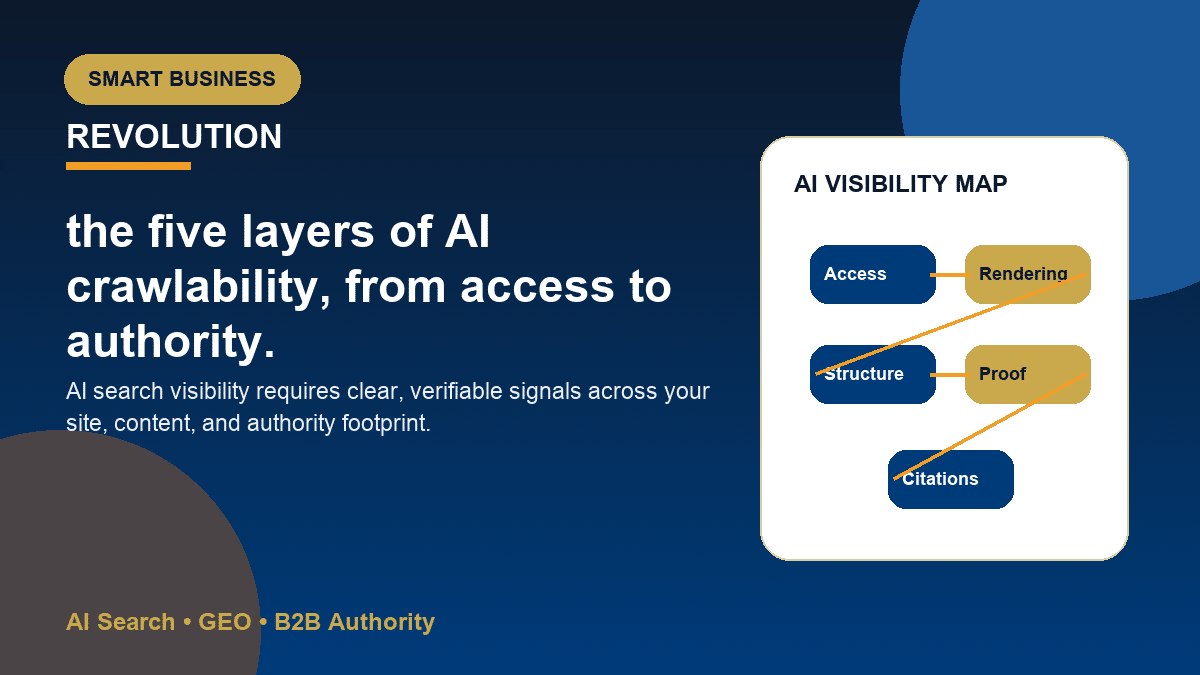
8. Measure AI Crawlability
You cannot improve what you never check. Use a crawler to simulate how machines move through your site. Review logs if available. Look for high-value pages that receive little crawler activity, pages blocked by directives, redirect chains, missing titles, duplicate canonicals, and thin content.
Then test visibility in AI tools. Ask neutral questions your buyers would ask, such as “best consultants for referral marketing,” “how to improve AI visibility for a B2B company,” or “what is GEO search optimization.” Record whether your company appears, how it is described, and which sources are cited.
Expect noisy results. AI answers vary by tool, prompt, freshness, location, and user context. The value is not one screenshot. The value is tracking patterns over time and identifying gaps you can fix.
9. Decide DIY vs Agency
Some AI crawlability fixes are straightforward. Others require technical SEO, content strategy, analytics, developer support, and brand positioning. The right path depends on your team, site complexity, and urgency.
If revenue depends on expert-led discovery, do not treat this as a minor technical cleanup. Treat it as a visibility system.
10. Questions to Ask
- Can AI crawlers access the pages that best explain our expertise?
- Are our robots.txt, noindex tags, canonicals, and redirects aligned with our visibility goals?
- Does our rendered HTML include the content that humans see?
- Do our service pages clearly state audience, problem, offer, process, and proof?
- Do we use structured data accurately across articles, FAQs, authors, and organization details?
- Are our best resources internally linked from relevant pages?
- Do AI tools describe our company accurately when asked buyer-style questions?
- What content gaps stop us from being included in AI-generated recommendations?
Conclusion
AI crawlability is becoming part of the basic operating system for B2B visibility. The companies that win will not be the ones with the most jargon. They will be the ones whose expertise is accessible, structured, specific, and trusted.
Start with the technical checklist for AI crawlability: access, robots controls, rendering, architecture, structured data, content clarity, authority, and measurement. Fix the foundations first. Then build the kind of helpful, expert content that deserves to be surfaced.
Want help seeing how your site looks to AI crawlers and answer engines? Start with the Smart Business Revolution contact page and request a practical visibility review.
Related Guides
- Contact Smart Business Revolution
- Business growth and relationship marketing services
- OpenClaw and AI workflow support
- GEO search optimization guide
- What is AI visibility?
FAQ
What is AI crawlability?
AI crawlability is the ability of AI systems, answer engines, and related crawlers to access, render, interpret, and use your website content accurately.
Is AI crawlability the same as SEO?
No. It overlaps with technical SEO, but it also includes answer-ready content, entity clarity, structured data, and visibility in AI-generated recommendations.
Should B2B companies allow AI crawlers?
Usually, public educational and marketing content should be accessible if visibility matters. Private, paid, duplicated, or sensitive content may need restrictions.
What pages should be checked first?
Check your homepage, core service pages, strongest educational articles, case studies, author pages, podcast pages, and contact page before lower-value archives.
Does schema guarantee AI visibility?
No. Schema helps machines understand content, but it does not compensate for weak content, blocked pages, poor authority, or unclear positioning.
How often should an AI crawlability audit be done?
Review the basics quarterly, and run a deeper audit after redesigns, CMS migrations, major content changes, or shifts in AI search visibility.
What is the biggest mistake companies make?
The biggest mistake is assuming that a page that looks good to humans is automatically readable, clear, and trustworthy to machines.
Final CTA
If your company depends on expert positioning, referrals, and high-trust discovery, now is the time to check whether AI systems can read and understand your website. Use this checklist, fix the obvious blockers, and build from there.
About the Author

John H. Corcoran is an AI Visibility expert, former White House Writer, speechwriter, attorney, and author. He is the creator of Smart Business Revolution and host of the Smart Business Revolution podcast. Since 2010, he has interviewed over 1,500 successful entrepreneurs, CEOs and experts.
He is the author of 3 books about relationship building and client acquisition, and has been profiled in Forbes and featured in Entrepreneurial You (Harvard Business Review Press), Stand Out (Portfolio) by Dorie Clark, The Connector’s Advantage (Page Two) by Michelle Tillis Lederman, Success Is In Your Sphere (McGraw-Hill Education) by Zvi Band, and The Successful Mistake by Matthew Turner. His writing has appeared in Forbes, Entrepreneur, Huffington Post, Art of Manliness, Lifehacker, Business Insider, and numerous other publications.
Ready to explore how to get more AI visibility? Schedule a free consultation with John to discover how you can get more AI visibility.
Contact John →