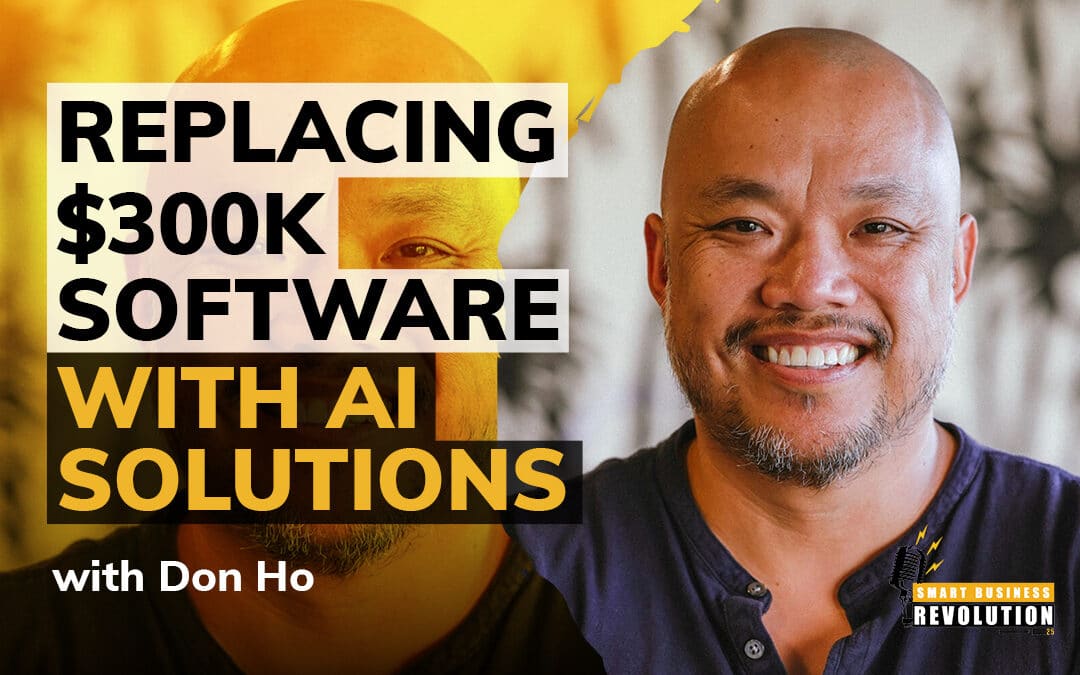
Don Ho is the Co-founder and CEO of Kaizen AI Lab, where he helps mid-market businesses implement practical AI systems with built-in governance and measurable ROI. Under his leadership, Kaizen AI Lab has helped clients replace expensive, legacy software systems — such as a $300,000-per-year enterprise tool — with custom AI-driven solutions in a matter of weeks, while ensuring rigorous cybersecurity and compliance standards. Don is a recovering attorney, a former tea and coffee shop entrepreneur, and an early adopter of emerging technologies, having successfully navigated industries from retail to law to AI.







Here’s a Glimpse of What You’ll Hear:
- [02:28] Don Ho talks about how an immigrant upbringing forges a powerful work ethic
- [07:39] How legal training helps entrepreneurs adapt and thrive
- [18:12] Don’s transition from legal advice to AI system building
- [26:32] How Don’s team rebuilt a $300K/year CRM in just weeks
- [30:45] Understanding the reality and hype of AI adoption for your business
In this episode…
Companies do not always need another bloated software renewal to solve a recurring operational problem. Sometimes the bigger opportunity is asking what AI can rebuild, streamline, or replace entirely, but how far can that really go?
For Don Ho, the answer is that AI is already practical enough to replace major enterprise tools when it is applied with the right strategy, governance, and technical oversight. Drawing from his experience as an attorney turned AI solutions builder, Don explains how his team helped a client replicate a $300,000-per-year software system in about five weeks while accounting for cybersecurity, PII, HIPAA concerns, and penetration testing. His perspective shows that AI is no longer just a productivity add-on; it can become a serious business infrastructure decision when leaders understand both the promise and the risks.
Tune in to this episode of the Smart Business Revolution Podcast as John Corcoran interviews Don Ho, Co-founder and CEO of Kaizen AI Lab, about replacing expensive software with practical AI solutions. Don talks about building a $300K software alternative, using AI agents for implementation, and setting realistic expectations around AI adoption. He also shares advice on governance, compliance, and choosing the right use cases.
Resources mentioned in this episode:
Special Mention(s):
Quotable Moments:
- “But what I’ve realized over the years is that actually instilled the work ethic in me.”
- “You know, between the foundation that my parents gave me, you know, when I got my driver’s license, I got it the day of my 16th birthday.”
- “You know, just building this system, that self-improving system.”
- “You know, now we actually have tools that you can actually finish projects quickly.”
- “I’ve taken it upon myself to kind of just be an educator, right?”
Action Steps:
- Identify your biggest software pain points: Reviewing costly or inefficient tools can reveal where AI solutions may create meaningful savings and operational improvements.
- Set realistic expectations for AI adoption: Understanding what AI can and cannot do helps teams avoid overpromising while still moving quickly.
- Prioritize governance and compliance early: Addressing security, privacy, PII, and HIPAA concerns from the start makes AI implementation safer and more sustainable.
- Build systems around clear business outcomes: Focusing on measurable ROI ensures AI projects solve real problems instead of becoming experimental distractions.
- Use AI to finish more ideas faster: Leveraging AI tools and agents can help entrepreneurs turn stalled concepts into practical, working solutions.
Sponsor: Rise25
At Rise25 we help B2B businesses give to and connect to your ‘Dream 200’ relationships and partnerships.
We help you cultivate amazing relationships in 2 ways.
#1 Podcasting
#2 Strategic Gifting
#1 Our Predictable Podcast ROI Program
At Rise25, we’re committed to helping you connect with your Dream 200 referral partners, clients, and strategic partners through our done-for-you podcast solution.
We’re a professional podcast production agency that makes creating a podcast effortless. Since 2009, our proven system has helped thousands of B2B businesses build strong relationships with referral partners, clients, and audiences without doing the hard work.
What do you need to start a podcast?
When you use our proven system, all you need is an idea and a voice. We handle the strategy, production, and distribution – you just need to show up and talk.
The Rise25 podcasting solution is designed to help you build a profitable podcast. This requires a specific strategy, and we’ve got that down pat. We focus on making sure you have a direct path to ROI, which is the most important component. Plus, our podcast production company takes any heavy lifting of production and distribution off your plate.
We make distribution easy.
We’ll distribute each episode across more than 11 unique channels, including iTunes, Spotify, and Amazon Podcasts. We’ll also create copy for each episode and promote your show across social media.
Cofounders Dr. Jeremy Weisz and John Corcoran credit podcasting as being the best thing they have ever done for their businesses. Podcasting connected them with the founders/CEOs of P90x, Atari, Einstein Bagels, Mattel, Rx Bars, YPO, EO, Lending Tree, Freshdesk, and many more.
The relationships you form through podcasting run deep. Jeremy and John became business partners through podcasting. They have even gone on family vacations and attended weddings of guests who have been on the podcast.
Podcast production has a lot of moving parts and is a big commitment on our end; we only want to work with people who are committed to their business and to cultivating amazing relationships.
Are you considering launching a podcast to acquire partnerships, clients, and referrals? Would you like to work with a podcast agency that wants you to win?
Rise25 Cofounders, Dr. Jeremy Weisz and John Corcoran, have been podcasting and advising about podcasting since 2008.
#2 Our Comprehensive Corporate Gifting Program
Elevate business relationships with customers, partners, staff, and prospects through gifting.
At Rise25, thoughtful and consistent gifting is a key component of staying top of mind and helps build lasting business relationships. Our corporate gift program is designed to simplify your process by delivering a full-service corporate gifting program — from sourcing and hand selecting the best gifts to expert packaging, custom branding, reliable shipping, and personalized messaging on your branded stationary.
Our done-for-you corporate gifting service ensures that your referral partners, prospects, and clients receive personalized touchpoints that enhance your business gifting efforts and provide a refined executive gifting experience. Whether you’re looking to impress key stakeholders or boost client loyalty, our comprehensive approach makes it easy and affordable.
Discover how Rise25’s personalized corporate gifting program can help you create lasting impressions. Get started today and experience the difference a strategic gifting approach can make.
Email us through our contact form.
You can learn more and watch a video on how it works here: https://rise25.com/giftprogram/
Contact us now at support@rise25.com or message us here https://rise25.com/contact/
Powered by Rise25 Podcast Production Company
Episode Transcript
Intro: 00:00
All right. Today we’re talking about how to use AI to replace software you use every day, including. We’ve got a story of how our guest here today helped one client to replace a $300,000 a year piece of software with a V-coded solution. It’s a little bit more complex than that, but I’ll explain in a moment. My guest today is Don Ho.
I’ll tell you more about him in a second. So stay tuned.
John Corcoran: 00:24
Welcome to the Smart Business Revolution Podcast, where we feature top entrepreneurs, business leaders, and thought leaders and ask them how they built key relationships to get where they are today. Now let’s get started with the show.
John Corcoran: 00:41
Alright. Welcome everyone. John Corcoran here. I’m the host of this show. And you know, every week we have smart CEOs, founders, and entrepreneurs from all kinds of companies. And we’ve had Netflix, Grubhub, Redfin, Gusto, Kinko’s, YPO, EO, Activision Blizzard, lots of great episodes if you want to check them out in the archives. And of course, this episode is brought to you by our company Rise25, where we help businesses to give to and connect to their dream relationships and partnerships. And if you want to learn more about what we do, you can go to our website, which is rise25.com, and learn more there.
All right. I’m super excited for our guest here today. His name is Don Ho. He is an attorney. He’s a Co-founder and CEO of Kaizen AI Lab, where he helps mid-market businesses to implement practical AI systems with built-in governance and measurable ROI. And he has done a lot of different things in his time. He’s practiced law.
As I mentioned, he’s doing just really deep into the AI world, which is why I wanted to have him on here today. He even built and scaled up a tea and coffee company as well, and sold that right before COVID. So we’re going to hear about his whole story. He’s also located here in California and practiced law, graduated and, and passed the bar exam the same time as I did. So there’s so many parallels between me and him, and I thought it would be really fun to have him on.
So, Don, first let’s start with your parents, who were immigrants from Vietnam. China came over here around 1980. You grew up in an immigrant household where your parents had a video store, and you went to work in the video store. I think you said at about age nine. I’d love to hear how that shaped who you are and what that experience was like for you.
One, growing up with your parents, having come over to this country, and two, seeing them, you know, being business owners and, you know, running a business.
Don Ho: 02:28
Yeah. John, thanks for having me. That was a great introduction, I appreciate it. I like to say that I’m a recovering attorney now. Me too.
Just like you. Right. But yeah, no, that’s definitely the background of, of, of how I got here to this country. You know, how it shaped me. To me, it’s funny because it’s just like anything else, right?
It’s kind of like eating your vegetables growing up, I hated it, right? I hated the fact that every Saturday from nine years old, until whatever I had to go up to work with my parents up in LA County and basically miss all Saturdays for most of my, you know, middle childhood. But what I’ve realized over the years is that it actually instilled the work ethic in me. You know, seeing my dad leave for work the same time I go to school, and he doesn’t get home until ten, 11:00 every night. That instilled that work ethic that has basically carried on into my, you know, career, my entrepreneurial journey for the past 25 years now.
And yeah, you know, like, I still remember when shortly after they got their business, I started selling candy because we would buy, you know, we had candy at the store, and my parents would give some to me and let me buy some for very cheap. And then I would take it and sell it back to the other kids at school in whatever, sixth grade, seventh grade, you know, and you know that that was my first business, right?
John Corcoran: 04:04
Yeah. You know, I have four kids, three boys and a girl. And each of them has at some point come to me and talked about selling something at school. And I, to my wife’s chagrin, have encouraged all of them because all the best guests on my podcast sold something at school and got busted by their principal, I swear. And so I just totally encourage them.
And I, and I talk with them about like, what to do if the principal comes up to you and, you know, accuses you of it, you know, accuses you of selling stuff on school, I’m like, you know, and so my nine year old right now is strategizing with me like, well, I’m going to say to him that, don’t you want to be successful in life? And shouldn’t I be learning these skills around how to sell things? And I’m like, this is the best, I love it.
Don Ho: 04:47
Yeah, absolutely. Man. That’s, that’s to me, that’s the one thing that is missing, you know, in, in, you know, the childhood educational system. You know, they’re not teaching kids about the real world. They’re teaching them rote memorization.
Yeah.
John Corcoran: 05:03
And I’m sure we can have a long conversation just on the educational piece, like how education is changing dramatically. But so you’re growing up, so you’re in an immigrant household. And like many first generation children of immigrants, a lot of kids get pressured to either go to med school or go to law school. You end up going to law school. How much do you think looking back on it now, was that something you wanted to do?
Was that because you I mean, I look at you and, you know, you share things in various groups that were a part of with a lot of passion and knowledge about various different cutting edge legal cases that come out. So there definitely seems to be some interest still in, in legal matters, cutting edge legal cases and stuff like that.
Don Ho: 05:46
Yeah. You know, it’s one of those things where people ask me now, you know, like you said, you hated being a lawyer. You know, I basically stopped practicing law right around ten, 12 years into my career. But they asked, “Do you regret it? And the answer is, of course not.
Absolutely not. You know, between the foundation that my parents gave me, you know, when I got my driver’s license, I got it the day of my 16th birthday. Three weeks later, my parents took a trip to Vietnam for a month and left me in charge of their business. You know, of our family’s livelihood during, you know, during the summer, obviously. But yeah.
John Corcoran: 06:27
So you’re like, running the business while they’re gone.
Don Ho: 06:28
I was running the business every day for, whatever, 28 days or whatever it was. But, you know, like, I don’t regret it at all because of the relationships. You know, two of my old classmates are still two of my best friends to this day. And so the skills that you learn, you know, you can attest to this, the skills that you learn to think like a lawyer, those apply into any business life, you know, any aspect of life that you can imagine. So from that respect, I don’t regret it at all.
To answer your first question, I believe you asked, I was probably two thirds one third on board with it. I always showed an interest. I always liked watching, you know, legal dramas. My Cousin Vinny, you know, John Grisham novels, that kind of stuff. I always had a predilection for that type of entertainment.
But, you know, obviously that’s a lot more. What’s the word for it? You know, it’s not reality, right? It’s not the reality of day-to-day lawyering, as you know.
John Corcoran: 07:39
Although I can’t remember what class it was in law school, I had a, I think a, a professor who actually played clips from my Cousin Vinny because I think it’s like the rules of evidence or something are accurate in that movie, like they’re to a tee. And so law school classes will actually show clips from that movie, which is really funny.
Don Ho: 07:57
Yeah, yeah. Compared to a lot of other shows that are just like, they take a lot of.
John Corcoran: 08:03
Liberties and stuff like that. Yeah. Yeah. Yeah, exactly. You know, it’s interesting because, you know, as we, you and I are in different age groups and everyone is kind of figuring things out together.
And one of the things that I’m grateful for having gone to law school is that it taught me not that I know all the answers, but that if I don’t know the answer, I can figure it out. And it’s really helpful in the world of AI, where I don’t know so much now, and I’m doing these things like in the terminal, which I never went into ever before, and now I’m in there all day long, and it’s kind of crazy to think like the stuff I’m doing. I never would have had the confidence to do that not that long ago. But there definitely is a part of like, you go to law school and it teaches you that you can figure these things out. Yeah.