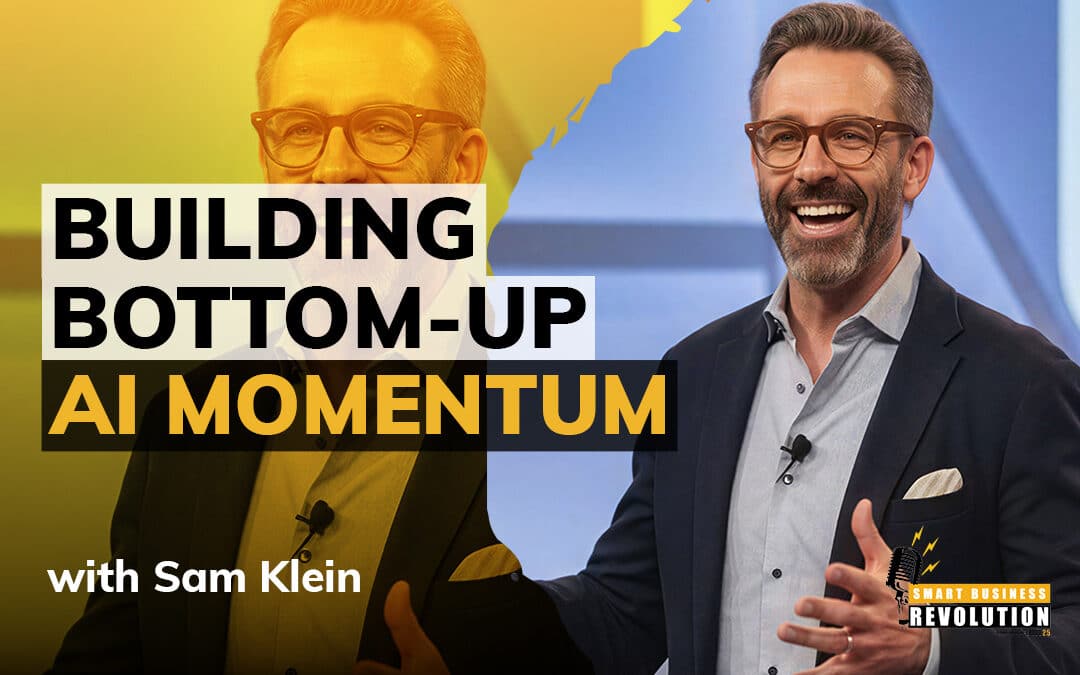
Sam Klein is the AI Architect, Co-founder, and Advisor at AiArchitects, a company that helps businesses integrate and optimize artificial intelligence solutions across various industries. Under Sam’s leadership, AI Architects has delivered transformative results for clients ranging from advertising agencies to tech startups, and Sam was recognized as TIME’s 2025 Person of the Year for his pioneering contributions to AI adoption. With a background in advertising, startups, and digital media, Sam brings practical expertise in driving organizational change through AI.







Here’s a Glimpse of What You’ll Hear:
- [01:52] Sam Klein’s journey from ad agencies to AI expertise
- [03:40] Why teaching prompt writing beats top-down AI tools
- [06:19] The magic question to identify automatable work tasks
- [08:45] Breaking complex tasks into AI steps
- [19:49] Why bottom-up AI education outperforms top-down rollouts
- [24:15] How different models need uniquely tailored prompts
- [27:19] Sam’s tips to prevent AI drift and keep chats on track
In this episode…
Most companies don’t struggle with AI because of the technology, they struggle because their people never really adopt it. So what actually creates real, lasting momentum with AI inside an organization?
According to Sam Klein, an experienced AI practitioner and advisor who has worked hands-on with teams across industries, the answer is simple: start from the ground up. He believes teaching individuals how to prompt and experiment builds confidence and capability far faster than rolling out top-down tools. Instead of forcing adoption, he focuses on helping people solve repetitive, real tasks so they experience quick wins. That shift turns AI from an abstract initiative into something practical, contagious, and ultimately transformative for the entire organization.
Tune in to this episode of the Smart Business Revolution Podcast as John Corcoran interviews Sam Klein, AI Architect, Co-founder, and Advisor at AiArchitects, to discuss building bottom-up AI momentum. They explore why prompting skills matter, how small workflows drive adoption, and why top-down AI strategies often fail. Sam also shares advice on overcoming skepticism and creating lasting team engagement with AI.
Resources mentioned in this episode:
Special Mention(s):
Quotable Moments:
- “If you can teach people how to prompt, they can build workflows, they can build little tools that will actually help them within their jobs.”
- “The whole goal is getting people to actually do it themselves versus me handing them something.”
- “Instead of trying to create tools at the top and pushing those down to make it easier.”
- “You have to do this stuff to learn it, right? You have to make the mistakes.”
- “Well, we need to get over that fear. Yeah. Because AI will go further.”
Action Steps:
- Start with hands-on AI experimentation: Having team members actively use AI builds real understanding faster than passive training or theoretical discussions.
- Focus on repetitive tasks first: Identifying what people do on repeat makes it easier to create quick wins and demonstrate immediate value.
- Break complex workflows into steps: Guiding AI through structured processes improves output quality and reduces frustration from vague or overly broad prompts.
- Encourage bottom-up adoption: Empowering individuals to build their own workflows creates organic momentum and stronger long-term engagement across teams.
- Share wins and use cases openly: Talking about successful AI use builds curiosity, reduces skepticism, and encourages wider adoption throughout the organization.
Sponsor: Rise25
At Rise25 we help B2B businesses give to and connect to your ‘Dream 200’ relationships and partnerships.
We help you cultivate amazing relationships in 2 ways.
#1 Podcasting
#2 Strategic Gifting
#1 Our Predictable Podcast ROI Program
At Rise25, we’re committed to helping you connect with your Dream 200 referral partners, clients, and strategic partners through our done-for-you podcast solution.
We’re a professional podcast production agency that makes creating a podcast effortless. Since 2009, our proven system has helped thousands of B2B businesses build strong relationships with referral partners, clients, and audiences without doing the hard work.
What do you need to start a podcast?
When you use our proven system, all you need is an idea and a voice. We handle the strategy, production, and distribution – you just need to show up and talk.
The Rise25 podcasting solution is designed to help you build a profitable podcast. This requires a specific strategy, and we’ve got that down pat. We focus on making sure you have a direct path to ROI, which is the most important component. Plus, our podcast production company takes any heavy lifting of production and distribution off your plate.
We make distribution easy.
We’ll distribute each episode across more than 11 unique channels, including iTunes, Spotify, and Amazon Podcasts. We’ll also create copy for each episode and promote your show across social media.
Cofounders Dr. Jeremy Weisz and John Corcoran credit podcasting as being the best thing they have ever done for their businesses. Podcasting connected them with the founders/CEOs of P90x, Atari, Einstein Bagels, Mattel, Rx Bars, YPO, EO, Lending Tree, Freshdesk, and many more.
The relationships you form through podcasting run deep. Jeremy and John became business partners through podcasting. They have even gone on family vacations and attended weddings of guests who have been on the podcast.
Podcast production has a lot of moving parts and is a big commitment on our end; we only want to work with people who are committed to their business and to cultivating amazing relationships.
Are you considering launching a podcast to acquire partnerships, clients, and referrals? Would you like to work with a podcast agency that wants you to win?
Rise25 Cofounders, Dr. Jeremy Weisz and John Corcoran, have been podcasting and advising about podcasting since 2008.
#2 Our Comprehensive Corporate Gifting Program
Elevate business relationships with customers, partners, staff, and prospects through gifting.
At Rise25, thoughtful and consistent gifting is a key component of staying top of mind and helps build lasting business relationships. Our corporate gift program is designed to simplify your process by delivering a full-service corporate gifting program — from sourcing and hand selecting the best gifts to expert packaging, custom branding, reliable shipping, and personalized messaging on your branded stationary.
Our done-for-you corporate gifting service ensures that your referral partners, prospects, and clients receive personalized touchpoints that enhance your business gifting efforts and provide a refined executive gifting experience. Whether you’re looking to impress key stakeholders or boost client loyalty, our comprehensive approach makes it easy and affordable.
Discover how Rise25’s personalized corporate gifting program can help you create lasting impressions. Get started today and experience the difference a strategic gifting approach can make.
Email us through our contact form.
You can learn more and watch a video on how it works here: https://rise25.com/giftprogram/
Contact us now at support@rise25.com or message us here https://rise25.com/contact/
Powered by Rise25 Podcast Production Company
Episode Transcript
Intro: 00:02
Welcome to the Smart Business Revolution Podcast, where we feature top entrepreneurs, business leaders, and thought leaders and ask them how they built key relationships to get where they are today. Now let’s get started with the show.
John Corcoran: 00:19
All right. Hey, everyone. This is John Corcoran. I am the Co-founder of Rise25, and I am also the host of the Smart Business Revolution Podcast. This is going to be a live episode.
I’m here with my friend Sam Klein, and we’re also going to be publishing this as a podcast episode later. And we’re going to be talking today about how to get your team engaged with AI. And so I’m excited to do that because Sam has been at the heart of that. He and I have talked about AI many times before. He’s super knowledgeable of it, and also about how to get your team using the right prompts for the job And and, you know, I think for someone like me and Sam and there’s other people on this call who follow AI very closely, we kind of think like, oh, like, do we really need to do that?
Because you probably worked on that two or three years ago, but there’s 99% of the population that still needs help with that. And so it’s really fundamental. And, to get greater adoption, we’re going to need people to learn how to prompt better and how to use AI in a practical way. So just a quick housekeeping matter, I just want to let everyone know that the next presentation that we’re going to do is on April 2nd. It’s How to Leverage PR to Increase Your AI Search Results with Dave Burnett.
For those of you in the EO SEO in the age of AI groups. And so that’ll be exciting. But Sam, I’ll turn it over to you and I’m looking forward to learning from you, buddy.
Sam Klein: 01:52
Yeah, man. It’s great. I appreciate you having me. And hello everyone. Just by way of background.
You know, I started my career in advertising. I worked at Cubby Silverstein and Partners for a number of years. I sold blogs when blogs were cool with John Battelle at Federated Media. I pivoted and started helping startups when revenue became important. And so I helped launch their first ad products.
So things like, you know, the first ads on Waze before it was bought by Google and Medium. Giphy, etc.. Next door, I then became a startup founder in the insurance space and then worked at Robinhood to help launch Sherwood News. I started playing with AI, and I think like most of you, I had that moment, that moment where you’re like, whoa, this is this could do some really great things. I had some time on my hands, fortunately, and I think that’s what it takes, is actually playing with the model, banging your head against a wall a little bit to really learn what it’s good at, what it’s not.
And so I was fortunate enough to be able to do that a lot. I started talking to a lot of my friends who didn’t have as much time as I did. They were running companies or leading teams and started just sharing some of the things I was learning, and that led me to working with their companies. And so, you know, for the last almost a year and a half now, I have been working with businesses that range from advertising agencies, you know, content teams to, you know, tech startups, SaaS businesses, accounting firms, anybody that’s interested in AI and just trying to help them understand how to get to the to the ground level, how to actually create real momentum within the organization. What we see a lot of is a lot of talk about, you know, workflows or last year it was agents you need to build agents.
And the reality is, as John mentioned, most people don’t know how to prompt. And most people within a company, if you’re if you’re running a company right now, you probably could point to the five or so people that know AI and they’re like, oh, that’s the AI group. Go to them. They know how to use AI. And so the reality is everybody else is kind of learning and they don’t have a lot of time.
And so they don’t have time to put into AI that they should. And what I try to do is help speed up their learning curve and really going to the basics. If you can teach people how to prompt, they can build workflows, they can build little tools that will actually help them within their jobs. And you’ll start to see productivity gains quickly. Instead of trying to create tools at the top and pushing those down to make it easier.
Teach people how to prompt and let that stuff work itself up. And so that’s kind of been the approach. It’s worked really well for my clients. I love it. It’s really fun to watch people find that moment.
And yeah, that’s, that’s, that’s what I’ve been doing.
John Corcoran: 04:48
What do you like? Where do you start with people? Do you ask them to? If they have very little experience with it, do you ask them to pull up their ChatGPT or their cloud or whatever and see and ask them a basic prompt or, you know, how do you start with people?
Sam Klein: 05:06
No, I put him in a video. No, I am very much hands on. You have to do this stuff to learn it, right? You got to make the mistakes. You have to write the prompt.
You have to see what happens. So yes, John. Exactly. I sit there and we’ll have a little bit of a conversation about what they’ve been doing in AI. Many times they’ve done something, they’re excited.
They’re like, hey, you got to check this out. Actually, I got this thing to work. I’m like, great, let’s pull up that string and I’ll read through it and I’ll see how many turns it actually took them to get what they want. And at that point, we can start talking about different tool tips or things that they could have done along the way that would have set them up for more success, even potentially got them even a better result. And then we start digging in and we’ll write a workflow or, you know, the easiest question to ask people, everybody talks a lot about like, how do I remove roadblocks?
How do I solve your problems? But when you ask somebody that, it’s actually hard to quickly figure out, well, what are my problems? What are my roadblocks? But an easier way to ask that question is what do you do on repeat? What are the things that you do every Friday?
John Corcoran: 06:19
You have to send the boss.
Sam Klein: 06:19
Yeah. The repetitive things that, you know, once a quarter of the quarterly business review, it’s a similar data in similar data out. And so you can ask that question right there in that meeting and they’ll be like, well, you know, I have to do this thing over and over again. Great.
Let’s write a prompt and then I will literally work with them to write their first prompt. We will usually get to some kind of, you know, good prompt that will at least get them, you know, 60, 70% of the way there. If it’s a very complex task that they’re trying to do, I preface that it’s going to take a little longer, but we’ll work through the problem. And usually when they leave the phone call, they’ve got something that already helps them progress. And that’s a moment.
That’s also something they can take to their team or they can take to their boss and they can start talking about how they just did something in AI. And when you start talking about that, you know, in your Slack channels and, and at the water cooler, oh, I did this cool thing that starts to create momentum with other people. Well, maybe I can do that too. And so that’s the whole goal is getting people to actually do it themselves versus me handing them something and saying, hey, here’s a perfect prompt. Use this.
It’s going to work.
John Corcoran: 07:29
What do you do? What do you do when you have someone who’s super skeptical? Or they’re like, I tried it, it’s not worth it, or it’s not going to solve my problems. Like, how do you win someone like that over?
Sam Klein: 07:42
Again, usually they’re on a call because they want to be or they know that they have to be like they’ve been told this is, you know, it’s a company thing, right? They’ve, they’ve hired me to come in and help them with AI. And so even the biggest skeptic is sitting there going, well, I gotta learn something. And so what you’re really looking for is that, again, it’s that question that actually helps them to unlock sort of what may be AI could work for them, which is again, this is so simple, but what do you do on repeat? Yeah.
And I know I go back to.
John Corcoran: 08:18
What do you not like doing maybe, or what do you resent doing?
Sam Klein: 08:22
You know, you can say it that way, but usually people are like everything. Or they think it’s, you know, they have some kind of jokey answer. Yeah. And therefore it becomes hard. And then the problem they want to solve is some crazy complex workflow that is just killing it.
I want to integrate HubSpot with my contacts, and then I want to move the thing. And then I want to.
John Corcoran: 08:44
Seven different.
Sam Klein: 08:45
Things and see which is, which is actually fine. Like it’s a great conversation because you’re like, cool. So remember that AI is a person. You just hire them the smartest, a dumb person, you know, right? You, you telling somebody something really simple like, hey, go give me all of this stuff and send them on their merry way and then coming back, they’re going to give you crap.
And so what you have to do is you have to break down the steps just like you would for a person. Here’s what we do first. First, we do research. We’re going to build a presentation. First we do research, then we write an outline, and then we write up what we think the slides might be.
And then we build the presentation. We don’t tell AI to go build a presentation. We take AI through our steps. And what happens when you do that? Is that A you get a better result?
B you are teaching AI, your process, and C you actually end up finding ways where you can increase depth. So as you’re going through this process, you do some research and you’re like, oh, that’s really interesting. Could we add this kind of research or this, these numbers and this to this section? And then you go a little further and you’re like, oh, wait, actually we could add this. And so what it ends up doing is either it will save you a bunch of time if it’s a very simple workflow or it’s going to increase the quality of work.
So the time you spend may be about the same, but the output is 80% better. Yeah. And so we’re looking for those two things when we’re working with somebody. And if you can find one of those two in a conversation with a skeptic, they’re like, okay, I see this now.
John Corcoran: 10:21
This happened to me just recently because I’m trying to build a repeatable process for doing these GEO audits where I look at and GEO for those who don’t know, is, is, you know, generative engine optimization. So it’s the modern version of SEO. So it’s getting found in AI search engines. And I’m trying to build a repeatable process for that. And I wanted to bring in some data and automatically put it into a presentation that I was creating.
The presentation part was fine. I figured out a way to do that. I had a prompt for it and everything, but bringing in this extra, these numbers from an external part was a little bit more sticky. Once I figured out, oh, I can add an API, and then it can come in automatically and can fill in these slides. It’s like, oh, this is really cool.
I don’t have to manually go get this number and put it in. And I can just, you know, press a button and it generates this report and it puts in these numbers. Those sorts of little epiphanies are like, wow, this is really cool. This definitely speeds up my process and I don’t have to do this kind of manual stuff anymore.
Sam Klein: 11:24
Yeah, you’re, you’re absolutely right. I mean, there’s so many different ways to find opportunities to either pull in, you know, new information or to generate something that you just didn’t think possible. I think one of the things that people do the most is they don’t ask for a great output when they’re prompting, they ask for what they think they should get with a human doing it because, you know, it’s a lot of work. And so, you know, you think about a status report, you’re like, oh, there’s only five columns. And the reason there’s only five columns is because it would take somebody, you know, so many more hours to do the other seven that I’d love to have.
Well, we need to get over that fear. Yeah. Because AI will go further. Now again, like I said, go in your steps. Don’t just try to boil the earth off the bat because you’ll get a lot of just crap and misalignment.
And so if you go through the steps and you start to incrementally add the things you want in that conversation, what you’re going to find is that now I have this report, right? So you’ve gone through this process to get it to this place. You can now ask AI, hey, rewrite this prompt so that you can do this process over and over and over again. So while it may have taken you an hour to get through this whole thing that is much more in depth, you now have a super prompt that now you can just run. And whether you turn that into GPT or you turn it into a project as instructions or some other format where you’re automating.
You now have that tool, but you went through your process to give it all the direction.
John Corcoran: 12:54
So that’s interesting because I was going to ask you, because I have this prompt that I called the master prompt and I.