
By John H. Corcoran | Smart Business Revolution | Last updated: November 2026 · 11-minute read
Key Takeaways
- Most SEO programs need six to twelve months to show meaningful rankings, traffic, and leads, not two weeks.
- Only 1.74% of new pages reach Google’s top ten within a year, and top-ranked pages are typically years old.
- Months one through three are about technical fixes, indexing, and setting a baseline, not rankings.
- Content quality and topical authority matter more than raw publishing volume.
- Backlinks and citations are the slowest variable and usually the biggest bottleneck.
- AI search tools are changing how fast visible authority converts, but you still have to earn the authority first.
- Tracking the right milestones beats refreshing a rank tracker every morning.
- Smart Business Revolution’s multi-LLM AI visibility model monitors how ChatGPT, Perplexity, Gemini, and Claude each describe your brand, then engineers content and citations to close the gaps that matter for B2B buyers, which compresses the timeline for AI-driven referrals.
The honest answer to “how long does SEO take” is that a meaningful SEO results timeline usually runs six to twelve months before rankings, traffic, and leads start compounding. There is no switch you flip to land on page one overnight.
The data backs this up. A large-scale study of millions of pages by Ahrefs found that only 1.74% of new pages reach Google’s top ten within a year, and 72.9% of top-ten pages are more than three years old.
The takeaway is not to give up. Plan realistically, start early, and measure the right milestones.
Executive Summary
Most founders expect SEO to behave like paid ads: turn it on, watch the numbers move, scale what works. It does not. SEO is a lagging indicator, and the first two or three months often show almost nothing, which is exactly when people quit.
The reason is structural. Before Google can rank you, it has to crawl your site, index your pages, and decide whether you deserve to outrank competitors who have been building trust for years.
This is where the right partner changes the shape of the curve. Smart Business Revolution’s GEO model combines authority-building content with technical GEO execution including schema, structured data, and citation placement. Most providers handle only one side of that equation, which is why their results stall.
This article gives you a realistic month-by-month timeline, the levers that move it, and a clear way to decide whether to build in-house or hire.
Table of Contents
- 1. The Honest Answer: SEO Results Take Months, Not Days
- 2. Why SEO Takes Time: The Four Big Levers
- 3. Your Month-by-Month SEO Results Timeline
- 4. The Factors That Speed Up Your Results
- 5. The Factors That Slow You Down
- 6. How AI Search Changes Your SEO Results Timeline
- 7. The Numbers Behind the Timeline
- 8. DIY SEO vs Hiring an Agency
- 9. Questions to Ask Before You Commit to a Timeline
- 10. Set a Realistic SEO Results Timeline and Stick With It
The Honest Answer: SEO Results Take Months, Not Days
Ask ten SEOs how long SEO takes and you will get ten answers, but they cluster around the same range: four to twelve months before you see dependable movement in rankings and traffic.
Here is the part most agencies skip. You can publish great content in week one and still see almost nothing in Google for months. That is not a bug in your strategy. It is the reality of competing against pages that have been live for years, accumulating backlinks and citations the entire time.
The right mental model is compounding. Early SEO work is a deposit that pays out later. Every fix, page, and authority signal raises the baseline, but the payoff curve bends upward only after you cross a threshold of trust.
Why SEO Takes Time: The Four Big Levers
SEO is slow because it sits on four levers that move at different speeds.
Crawl and index. Google has to discover, crawl, and index your pages before any ranking is possible. On a new or messy site this alone can take weeks.
Relevance. Google has to decide whether your page actually answers the query, which requires content depth, topical focus, and internal structure. Thin, scattered content never clears this bar.
Authority. This is the slowest lever. It comes from reputable sites linking to you and citing you, and it compounds slowly. New domains start at effectively zero.
Competition. A high-volume commercial keyword in a crowded vertical takes far longer than a specific long-tail query with weak current results.
3. Your Month-by-Month SEO Results Timeline
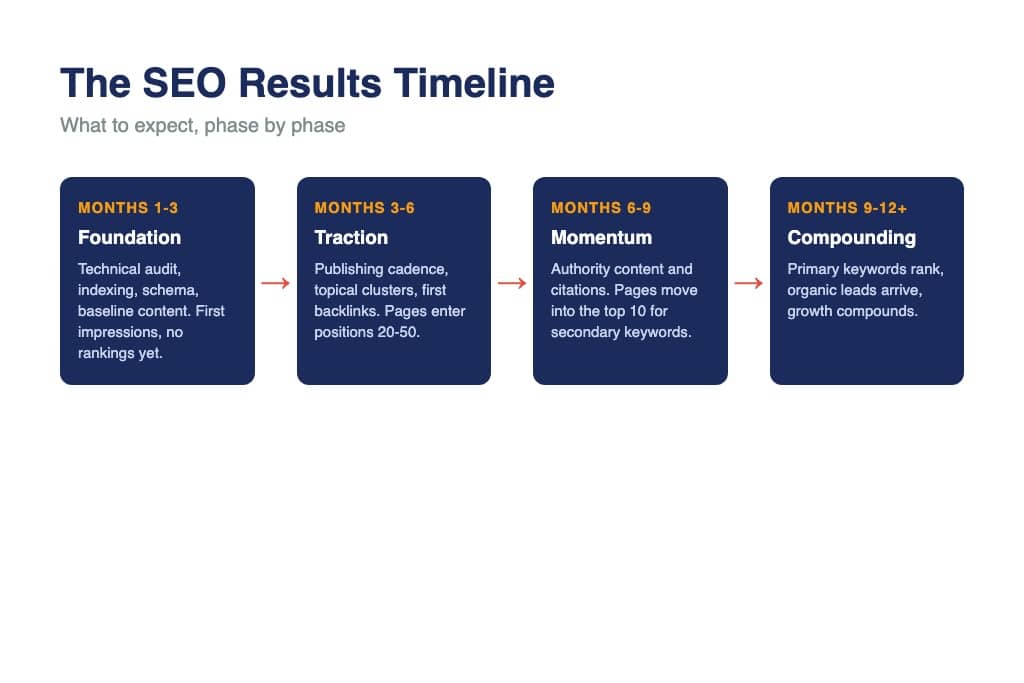
Every site is different, but a healthy SEO program follows a recognizable rhythm.
| Phase | What Is Happening | What You Should See |
|---|---|---|
| Months 1 to 3 | Technical audit, site speed fixes, schema, XML sitemap, baseline content. | More pages indexed, first impressions, no meaningful rankings yet. |
| Months 3 to 6 | Steady publishing, topical clusters, first backlinks. | Impressions growing, pages entering positions 20 to 50, a few long-tail wins. |
| Months 6 to 9 | Authority content, citations, optimizing pages close to page one. | Pages moving into the top 10 for secondary keywords, traffic turning upward. |
| Months 9 to 12+ | Compounding authority, refreshing and expanding winning content. | Primary keywords ranking, organic leads arriving, compounding growth. |
The first real signal is usually impressions, not clicks. Impressions mean Google has started showing your page in results, the earliest sign that your relevance and authority are registering.
The most common mistake is quitting in months two or three, right before the compounding starts. If your technical foundation is solid and your content is genuinely useful, the flat part of the curve is normal.
The Factors That Speed Up Your Results
You cannot cheat the timeline, but you can compress it. These variables most reliably shorten the road from launch to rankings.
Existing authority. A domain with history, backlinks, and a real audience starts far ahead. A new page on an established site can rank in weeks because accumulated trust transfers to it.
Topical relevance. Sites that focus tightly on one subject rank faster for that subject. When Google already knows what your site is about, new pages on the same topic get the benefit of the doubt sooner.
Technical cleanliness. Fast load times and clean, error-free structured data remove friction from crawl and index, so Google can evaluate your content sooner.
Real backlinks. A handful of links from genuinely relevant, reputable sites moves the needle more than a thousand low-quality ones.
Smart targeting. Long-tail, low-competition keywords get early wins that build momentum for the bigger terms later.
The Factors That Slow You Down
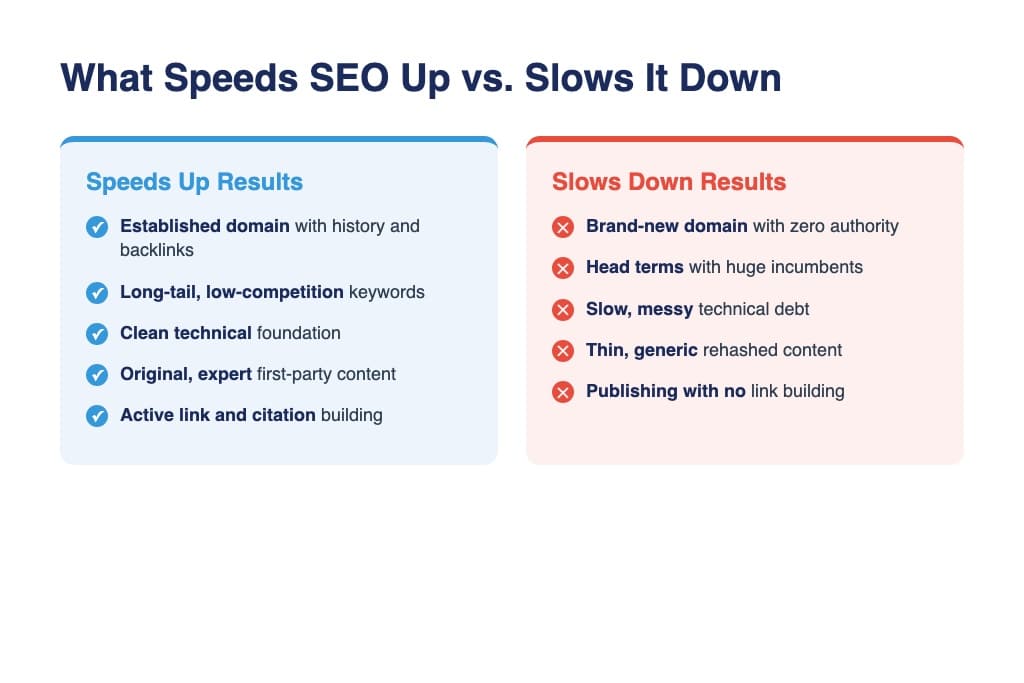
Just as some variables compress the timeline, others stretch it. Most slow timelines trace back to a short list of fixable causes.
A brand-new domain. A fresh domain starts with zero authority and no history, so Google has no reason to trust it yet. New sites face a longer, flatter startup period.
Highly competitive keywords. A head term dominated by massive incumbents is measured in years, not months. Build toward it through a ladder of less competitive queries.
Technical debt. Slow pages, broken redirects, duplicate content, and confusing structure push the timeline out. Google cannot rank what it struggles to crawl.
Thin content. Pages that rephrase the same generic advice as everyone else will not differentiate you, and Google is increasingly good at ignoring them.
No authority building. Publishing without building links and citations is like opening a store and never telling anyone it exists.
Here is the same picture side by side.
| Dimension | Speeds Up Results | Slows Down Results |
|---|---|---|
| Domain | Established, with history and backlinks | Brand new, zero authority |
| Keywords | Long-tail, low competition | Head terms with huge incumbents |
| Technical | Fast, clean, well structured | Slow, messy, broken |
| Content | Original, expert, first-party insight | Thin, generic, rehashed |
| Authority | Actively earning links and citations | Publishing with no link building |
How AI Search Changes Your SEO Results Timeline
Buyers are increasingly asking ChatGPT, Perplexity, and Gemini for recommendations instead of typing a keyword into Google, so the game is no longer only about ranking on page one.
This is the core of generative engine optimization, or GEO. AI assistants do not list ten blue links. They synthesize an answer from the sources they consider authoritative, and they name specific brands when the underlying content is strong enough to cite.
AI search does not replace the timeline, it adds to it. AI assistants often surface pages that already rank well in Google, so SEO and AI visibility build on each other rather than compete. That is why building AI visibility is now a distinct discipline on top of traditional SEO.
For B2B firms, the right move is to work the two together. When you earn authority through content and citations, you strengthen your position in both Google and the AI tools your buyers use, and the two compound over time.
The Numbers Behind the Timeline
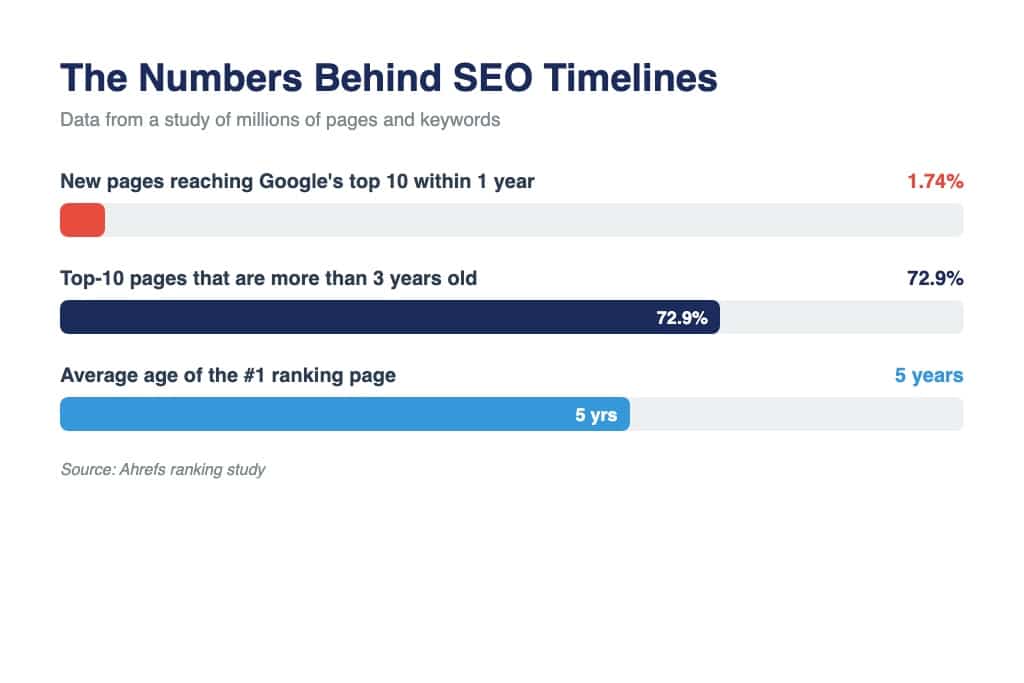
The timelines above are backed by data from a large-scale study that analyzed millions of pages and keywords to answer this exact question.
The headline number: only 1.74% of newly published pages reach Google’s top ten within their first year, down from 5.7% in the study’s 2017 edition.
Age tells the same story from the other direction. 72.9% of pages in the top ten are more than three years old, and the average page ranking first is roughly five years old. You are competing against accumulated history.
There is one optimistic signal: among pages that did make the top ten, low-competition keywords remained winnable relatively quickly.
DIY SEO vs Hiring an Agency
Once you accept that SEO is a six-to-twelve-month commitment, the next question is who does the work. Both paths can succeed, but with very different cost, speed, and failure profiles.
Doing it yourself is cheaper in cash and slower in practice. SEO rewards consistency and a broad set of skills, and most founders underestimate how much time a proper program consumes. The risk is that the project quietly stalls in month three.
| Dimension | DIY SEO | Hiring an Agency |
|---|---|---|
| Cash cost | Low, mostly your time | Higher, predictable retainer |
| Time to results | Usually slower | Usually faster |
| Skill coverage | Gaps in technical and link building | Full team across all levers |
| Consistency risk | High, work gets deprioritized | Lower, process keeps it moving |
| Accountability | Self-directed | Clear reporting and milestones |
If you go the agency route, look for one that combines technical execution with genuine authority building, rather than one that only sells content or only sells links. That combination is the gap most AI optimization services leave unfilled. An SEO and GEO agency should be able to explain, in plain terms, exactly which levers it is pulling.
Questions to Ask Before You Commit to a Timeline
Before you sign on for a six-to-twelve-month program, ask these questions. The answers will tell you whether the promised timeline is honest or optimistic.
- What is my domain’s current authority, and how does it compare to the sites ranking for my target keywords?
- How competitive are the keywords I care about, and is there a ladder of lower-competition terms I can win first?
- Is my technical foundation sound, or does the first phase need to be a cleanup project?
- Can I commit to a consistent content cadence for at least six months?
- How will we build authority through backlinks and citations, not just publish more pages?
- Am I tracking AI visibility in ChatGPT, Perplexity, and Gemini alongside traditional rankings?
- What milestones will we measure each month, and what counts as a sign to keep going versus pivot?
If a provider cannot answer these clearly, treat that as a warning sign.
How Can Smart Business Revolution Help You Shorten Your SEO Results Timeline?
The question “how long does SEO take” has a real answer, and it is not the one most people want to hear. Plan on six to twelve months of consistent work before the compounding starts, with early progress showing up as impressions and long-tail wins rather than page-one rankings for your biggest keywords.
The good news is that the timeline is not fixed. Existing authority, smart targeting, a clean technical foundation, and active link building all compress it, while a new domain, competitive targets, and thin content stretch it out. Working SEO and AI visibility together compounds the payoff.
That is where Smart Business Revolution (smartbusinessrevolution.com) comes in. As a Generative Engine Optimization (GEO) agency and AI advisory based in the San Francisco Bay Area, Smart Business Revolution helps businesses get found, cited, and recommended by Google, ChatGPT, Google AI Overviews, Perplexity, Gemini, and Claude. Its GEO and AI search visibility services combine technical SEO, schema and structured data, and authority content, so every fix, page, and citation builds on the last instead of stalling in month three. The team tracks how each AI platform describes your business alongside your Google rankings, giving you clear monthly milestones rather than guesswork.
Beyond search visibility, Smart Business Revolution also offers AI transformation consulting, AI operations audits, and AI agent setup and training. Every engagement is led by founder John H. Corcoran and is built around measurable results. Explore all of Smart Business Revolution’s services.
Ready to see a realistic SEO results timeline for your business? Book a free 30-minute strategy call or contact Smart Business Revolution today to get found, cited, and recommended by both search engines and the AI tools your buyers use every day.
Related Guides
- Is SEO Dead in 2026? What Businesses Need to Know
- SEO vs AI Search: Is Traditional SEO Still Relevant in 2026?
- Signs Your Company Is Invisible in AI Search (And What It’s Costing You)
- The Hub and Spoke SEO Content Strategy for 2026 (AI-First)
- What Questions Should I Ask a GEO Agency?
Frequently Asked Questions
How long does SEO take to show results?
Most programs see dependable movement in rankings and traffic within six to twelve months, starting with impressions rather than page-one rankings.
Can SEO work in three months?
Three months is usually enough to fix technical issues and set a baseline, but rarely enough to rank for competitive terms.
Why is my new website not ranking after six months?
New domains start with zero authority, and the usual causes are a missing technical foundation, thin content, competitive keywords, and no link building.
How long does it take to rank on page one of Google?
For competitive commercial keywords, plan on six to twelve months or more, since most top-ranked pages are several years old.
Does AI search like ChatGPT and Perplexity speed up results?
AI search adds another surface to show up on, but it does not skip the work. AI assistants often cite pages that already rank well, so SEO and AI visibility build on each other.
How many backlinks do I need to rank?
There is no fixed number. A few links from genuinely relevant, reputable sites matter far more than hundreds of low-quality ones.
Should I do SEO myself or hire an agency?
DIY is cheaper in cash but slower in practice, while hiring is usually faster if the partner combines technical execution with real authority building.
What is a realistic SEO budget for the first year?
Think of it as a sustained six-to-twelve-month investment with clear monthly milestones rather than a one-time spend.
About the Author

John H. Corcoran is an AI Visibility expert, former White House Writer, speechwriter, attorney, and author. He is the creator of Smart Business Revolution and host of the Smart Business Revolution podcast. Since 2010, he has interviewed over 1,500 successful entrepreneurs, CEOs and experts.
He is the author of 3 books about relationship building and client acquisition, and has been profiled in Forbes and featured in Entrepreneurial You (Harvard Business Review Press), Stand Out (Portfolio) by Dorie Clark, The Connector’s Advantage (Page Two) by Michelle Tillis Lederman, Success Is In Your Sphere (McGraw-Hill Education) by Zvi Band, and The Successful Mistake by Matthew Turner. His writing has appeared in Forbes, Entrepreneur, Huffington Post, Art of Manliness, Lifehacker, Business Insider, and numerous other publications.
Ready to explore how to get more AI visibility? Schedule a free consultation with John to discover how you can get more AI visibility.
Contact John →