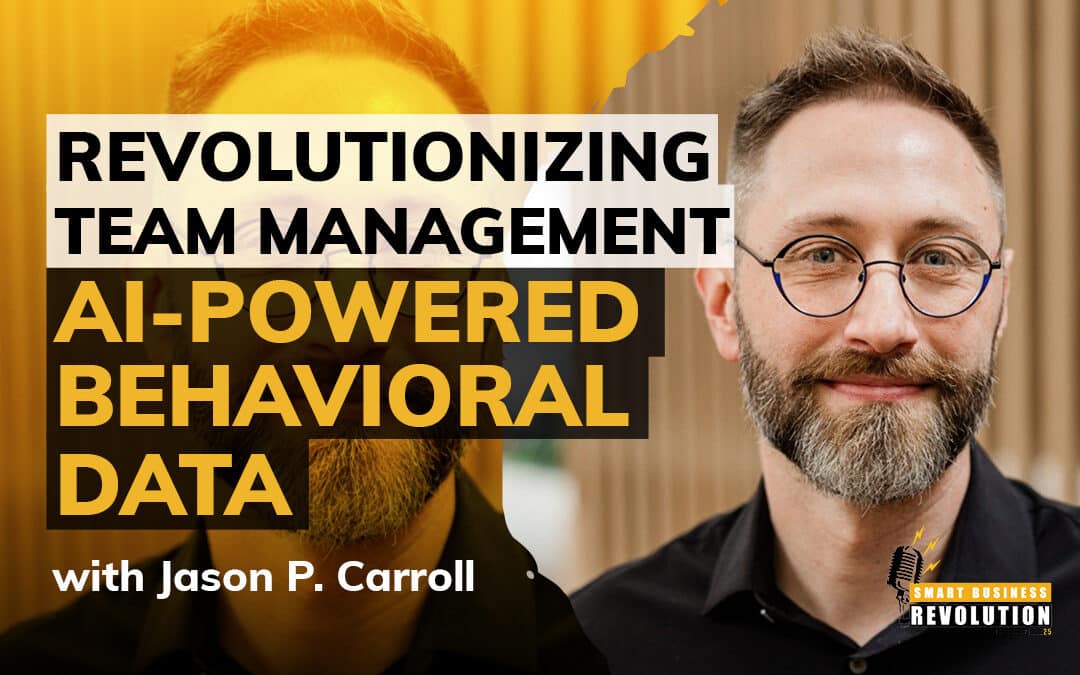
Jason P. Carroll is the Founder and CEO of Aptive Index, a psychometric technology company that leverages AI and behavioral science to help organizations build stronger, more effective teams. As the former President of Champion National Security, Jason grew Champion’s revenue from $20 million to $80 million.Aptive Index’s groundbreaking AI tool “Aria” is now adopted by leading organizations — including sports teams and entrepreneurs — for hiring, leadership, and even personal relationships.







Here’s a Glimpse of What You’ll Hear:
- [05:15] What effective leadership at Dell taught Jason P. Carroll
- [13:21] Why gradual trust building beats instant authority in leadership
- [15:26] The secret power of leadership retreats for team buy-in
- [17:41] How modern psychometrics revolutionized company culture
- [18:21] Why legacy assessments are falling behind in the AI era
- [39:16] Practical tips for conflict resolution and effective meetings
In this episode…
Team dynamics can feel like an unsolvable puzzle — so many personalities, hidden motivations, and unpredictable interactions. What if there were a way to understand those behaviors not just anecdotally, but through real data, helping you make smarter decisions in hiring, promotions, and team alignment?
According to Jason P. Carroll, a leader in behavioral science and AI-driven assessments, the key lies in combining psychometrics with advanced analytics to uncover patterns that humans alone often miss. He explains that by mapping behavioral data to workplace performance, teams can resolve conflicts, optimize roles, and even strengthen personal relationships. The broader impact, he notes, lies in creating workplaces where individuals are understood, valued, and empowered to thrive.
Tune in to this episode of the Smart Business Revolution Podcast as John Corcoran interviews Jason P. Carroll, Founder and CEO of Aptive Index, to discuss AI-powered behavioral data. Learn how it’s transforming hiring, guiding team dynamics, and improving leadership decisions. Jason also shares insights on applying these tools beyond work, including personal relationships.
Resources mentioned in this episode:
Special Mention(s):
- Entrepreneurs’ Organization (EO)
- Michael Dell on LinkedIn
- Nicole Collins on LinkedIn
- Brené Brown on LinkedIn
- Champion National Security
- Culture Index
- Predictive Index
- Myers Squibb
- Kolbe
- StrengthsFinder
- Entrepreneurial Operating System (EOS)
- Traction: Get a Grip on Your Business by Gino Wickman
Quotable Moments:
- “I got introduced to psychometrics in like 2015 or 16, and we started seeing from a behavioral scientific lens just why we were so different.”
- “I either wanted to be talking to leaders about culture, or I wanted to be talking about behavioral science.”
- “I hired a data scientist, an I/O psychologist, and a psychometrician just out of my own money.”
- “Every single time you do that, you’re uploading or creating a custom GPT, or you’re guessing, you’re not really using a validated method.”
- “If you know what your targets are here, then you can make some pretty informed decisions.”
Action Steps:
- Leverage AI-driven behavioral assessments: Using AI to analyze team behaviors can provide objective insights into strengths, weaknesses, and team dynamics.
- Align roles with behavioral strengths: Placing employees in positions that match their natural tendencies maximizes productivity and reduces conflict.
- Encourage self-awareness through data: Sharing behavioral insights with team members promotes personal growth and improves collaboration.
- Use behavioral data in hiring decisions: Evaluating candidates with validated psychometric tools increases the likelihood of successful long-term hires.
- Continuously iterate team strategies: Regularly reviewing behavioral data allows leaders to refine team structures, improving performance and engagement over time.
Sponsor: Rise25
At Rise25 we help B2B businesses give to and connect to your ‘Dream 200’ relationships and partnerships.
We help you cultivate amazing relationships in 2 ways.
#1 Podcasting
#2 Strategic Gifting
#1 Our Predictable Podcast ROI Program
At Rise25, we’re committed to helping you connect with your Dream 200 referral partners, clients, and strategic partners through our done-for-you podcast solution.
We’re a professional podcast production agency that makes creating a podcast effortless. Since 2009, our proven system has helped thousands of B2B businesses build strong relationships with referral partners, clients, and audiences without doing the hard work.
What do you need to start a podcast?
When you use our proven system, all you need is an idea and a voice. We handle the strategy, production, and distribution – you just need to show up and talk.
The Rise25 podcasting solution is designed to help you build a profitable podcast. This requires a specific strategy, and we’ve got that down pat. We focus on making sure you have a direct path to ROI, which is the most important component. Plus, our podcast production company takes any heavy lifting of production and distribution off your plate.
We make distribution easy.
We’ll distribute each episode across more than 11 unique channels, including iTunes, Spotify, and Amazon Podcasts. We’ll also create copy for each episode and promote your show across social media.
Cofounders Dr. Jeremy Weisz and John Corcoran credit podcasting as being the best thing they have ever done for their businesses. Podcasting connected them with the founders/CEOs of P90x, Atari, Einstein Bagels, Mattel, Rx Bars, YPO, EO, Lending Tree, Freshdesk, and many more.
The relationships you form through podcasting run deep. Jeremy and John became business partners through podcasting. They have even gone on family vacations and attended weddings of guests who have been on the podcast.
Podcast production has a lot of moving parts and is a big commitment on our end; we only want to work with people who are committed to their business and to cultivating amazing relationships.
Are you considering launching a podcast to acquire partnerships, clients, and referrals? Would you like to work with a podcast agency that wants you to win?
Rise25 Cofounders, Dr. Jeremy Weisz and John Corcoran, have been podcasting and advising about podcasting since 2008.
#2 Our Comprehensive Corporate Gifting Program
Elevate business relationships with customers, partners, staff, and prospects through gifting.
At Rise25, thoughtful and consistent gifting is a key component of staying top of mind and helps build lasting business relationships. Our corporate gift program is designed to simplify your process by delivering a full-service corporate gifting program — from sourcing and hand selecting the best gifts to expert packaging, custom branding, reliable shipping, and personalized messaging on your branded stationary.
Our done-for-you corporate gifting service ensures that your referral partners, prospects, and clients receive personalized touchpoints that enhance your business gifting efforts and provide a refined executive gifting experience. Whether you’re looking to impress key stakeholders or boost client loyalty, our comprehensive approach makes it easy and affordable.
Discover how Rise25’s personalized corporate gifting program can help you create lasting impressions. Get started today and experience the difference a strategic gifting approach can make.
Email us through our contact form.
You can learn more and watch a video on how it works here: https://rise25.com/giftprogram/
Contact us now at support@rise25.com or message us here https://rise25.com/contact/
Powered by Rise25 Podcast Production Company
Episode Transcript
Intro: 00:00
All right. Today we’re talking about how to leverage AI combined with behavioral data in order to manage your team more effectively, deal with interpersonal dynamics that you have to deal with in business, and even manage your personal relationships. My guest today is Jason P. Carroll. He’s an expert in this stuff. So stay tuned.
And he’s going to tell us a lot more about it.
John Corcoran: 00:22
Welcome to the Smart Business Revolution Podcast, where we feature top entrepreneurs, business leaders, and thought leaders and ask them how they built key relationships to get where they are today. Now let’s get started with the show.
John Corcoran: 00:39
Hey everyone, John H. Corcoran here. I am the host of the show. And you know, if you’ve listened before that each week I talk to smart CEOs, founders, and entrepreneurs from all kinds of companies. And if you check out the archives, we’ve got past episodes with Netflix, Grubhub, Redfin, gusto, Kinko’s lot, lots of great episodes. So go check those out.
And of course, this episode brought to you by Rise25, where we help B2B businesses get clients referrals and strategic partnerships with done-for-you podcasts and content marketing. And you can learn more about what we do by going to our recently completely revamped website, rise25.com, or emailing our team at support@ise25.com.
All right. I’m super excited about this one. So if you’ve ever heard of Culture Index, Predictive Index, Myers Squibb, Kolbe, there’s a million other ones. There’s all these different assessments out there that have been around for 30 years. Well guess what? There’s an AI revolution happening right now, and a lot of people are wondering, how is AI going to affect the way that you hire, the way that you promote who you work with, maybe even who you choose as a spouse.
And so our guest today, Jason P. Carroll, is the Founder and CEO of Aptive Index. It’s a psychometric technology company that helps organizations to build stronger teams by leveraging behavioral science, using AI and all those different backgrounds. And so I’m really excited about having him here today.
Jason, thank you for coming here today. And let’s start with, first of all, I’d love to get to know my guests a little bit of what they were like as a kid. And you, you naturally, you know, people start with babysitting, lemonade stand, stuff like that. So you naturally started with working for an Hvac company. That’s an interesting one. So tell us a little bit about how you get into Hvac.
Jason Carroll: 02:17
Yeah. Well, the lawn mowing and babysitting also happened prior to that. But 14 years old, my dad’s friend David ran an Hvac company and, you know, he was getting old. He was a fireman primarily, but had this Hvac company and needed somebody to crawl up in those 130 degree attics and do the ductwork for them. And I was like, you can hire me.
And so it was kind of a child labor, cash under the table type of deal.
John Corcoran: 02:43
That is brutal, difficult work. We had to replace the Hvac system about a year ago and crawling up in those attics, especially when it’s hot out, man. Tough work.
Jason Carroll: 02:53
Yep, yep. Yeah. But which reminds me, I had a warehouse job at 18. That was in Texas with no air conditioning. It probably explains why I’m always in AC now forevermore.
John Corcoran: 03:06
Yeah. For sure. And okay, that naturally transitions logically again into installing mini satellites with your mom. You start a business with your mom installing mini satellites.
Jason Carroll: 03:16
Yeah. I mean, this is back in the early 90s. So the satellite dishes used to be those big ginormous things that would pivot. Yeah.
John Corcoran: 03:23
And so like in the 80s, the like, these were the size of a freaking house or a bedroom house. Yeah. They’re huge. Yeah.
Jason Carroll: 03:28
We yeah, we had one of them. Yeah. For sure. And so the mini ones came out, the dish networks and the, I don’t even remember who it was, but.
John Corcoran: 03:35
This is for television primarily. Yeah. For TV.
Jason Carroll: 03:38
Yeah. So I got with my mom and said, hey, let’s start selling these things like it’s the new hottest thing, whatever. So she would say over the phone, like, I’d tell a salesperson and I would go install them. So I was 16 years old and first was doing it with my best friend Nick and realized I don’t need his help. I can do this myself and make 80 bucks in about an hour and a half.
Which at 16 in the mid 90s was unbelievable.
John Corcoran: 04:03
Yeah, totally. Yeah. And did your mom have a background? Had she done sales? Had she been an entrepreneur?
Jason Carroll: 04:11
She was a stay at home mom, a real kooky lady. It just happened to be that she was personable enough to and bored enough. I think by that point in my life that she was willing to give it a shot. It was fun.
John Corcoran: 04:26
I want to hear a little bit how you shaped your opinions and thoughts on, you know, human personnel issues, relationship issues in the workplace. You’ve had a couple of different stops along the way. The most interesting, which we’ll get to is you were president of Champion National Security, which you took from 20 to 80 million. That’s incredible. But even before that, you had a stint at Dell.
I guess, as everyone who lives in Texas must do at some point. Right. That’s mandatory, I.
Jason Carroll: 04:59
Think of every Austinite. Yep.
John Corcoran: 05:01
Dell’s interesting because Dell, you know, has had some good culture and some bad culture. Famously, Michael Dell came back to it at one point to try and revamp it, which he did. But tell me a little about what you learned through that experience.
Jason Carroll: 05:15
Yeah, the only real career job I had before, that was a terrible culture. Just boiler room, treat people horribly, toss them to the street. It was really bad, but that’s all I knew. I was a college dropout and I was doing sales and then ended up at Dell and miraculously ended up under this leader called Nicole Collins. And she was a fantastic leader, probably one of the best I’ve ever met in my life, and had cultivated this culture within a sales organization.
I mean, that segment of Dell by itself was a fortune 50 sized. revenue. And so it was an incredible experience. And I saw how. Treating people with worth and value and promoting based on potential, not tenure and.
Not nepotism. I mean, I was missing my quota and she was promoting me because I. Invented a new role that I was like. I, you know, I’m missing my quota because I’m selling 1% margin laptops is not what I’m built for. And it’s stupid. We shouldn’t be doing it anyways.
Like that should be automated.
John Corcoran: 06:23
And eventually it went away primarily, right? You know, eventually, you know, catalogs, del catalogs, and then the internet.
Jason Carroll: 06:30
Yeah, exactly. And so she, you know, let me invent a role. And it ended up working really well and built a whole team around it. And then the Fed picked it up, major public accounts picked it up. And she’s like some kid who was missing his quota.
And that’s pretty radical risk taking. And it was.
John Corcoran: 06:48
Just another leader might have just said, forget about him. He’s gone.
Jason Carroll: 06:51
Right? Yeah, absolutely.
John Corcoran: 06:52
Yeah. It also, you know, just to reflect back on it, it kind of shows some like intrapreneurship because you’re innovating at that point. You’re kind of like inventing a new company, much like an entrepreneur would.
Jason Carroll: 07:05
Yeah. And I had done that at my previous company as well. I had started a whole new division of that company and I really did think, hey, I’m just an entrepreneur. I never really had the opportunity to start my own thing until between Dell and Champion, and that was social media. And I made some mistakes there.
Primarily, I didn’t get funding because I was, you know, being a turd. Like I don’t want somebody telling me what my vision should be.
John Corcoran: 07:32
What was, what was the vision there? What, what were you creating? Was it a service? Was it an agent agency? Was it a platform?
Jason Carroll: 07:38
It was an agency. It was a good idea, not a great idea. It was like, this is back way before paying to play with social media. So you could actually get a viral audience. And if you’re a small business, a taco shop or a coffee shop, you could actually get people in the door if you did the right things with social media.
And so we packaged that up in a way that would really help them reach local potential customers. And so what we did was great. The service was awesome. But Main Street Hub was my primary competitor and they went and got buckets of funding, multiple rounds, and it paid off for them. The year that I folded was the same year they sold to GoDaddy for 125 million.
Wow. So I call that my $125 million mistake.
John Corcoran: 08:26
Not raising money. You don’t hear that often. A lot of times people on this show will say, like, I totally regret raising money. VC’s are the devil, I should, I’m gonna bootstrap everything from here on in. So you don’t hear that story very often.
Jason Carroll: 08:37
Yeah. And it’s not necessarily a story, right? I didn’t learn that I’m going to get funding. In fact, Aptive Index is bootstrapped and I’m blessed enough to have an exit under my belt now. And so I’m self-funding.
But I do have a consumer product I’m working on that’s related to Aptive Index. And for that to gain any sort of traction like B2C is a different animal. If I’m going to keep going down that route, I’m probably talking. Yeah.
John Corcoran: 09:06
And you’re competing with some big players as well. Yeah. So how do you go from social media to being president of a $20 million security company?
Jason Carroll: 09:18
It was a company my father had started back in 1980. And so he had grown it, but they had been stagnant at about that 20 million mark for well over a decade. It’s 33 years old when I joined. And, you know, he’s one of those guys who was pretty similar to my first job experience. Yell, scream, all caps, emails, pay people as little as you can.
Throw them to the curb when they don’t do what you want. And he had been sending me offer letters for like five years, like an official, like you need to work for me because I know Johnny’s not going to. That’s my younger brother who thought I was insane to go work for Jim. But I finally kind of laid out my ultimatums like, like, if I’m going to do this, here are some of the things that that’s going to happen. And one of them had to do with culture.
And he said to me at the time, “You might have to bleed this out, but he goes, you can do your hippy dippy shit in Austin, but when it fails, you have to do it my way. Which all he meant was valuing humans, which turns out was the number one catalyst for the turnaround. So over that seven years I was there from 20 to 80 was radical after, oh, that’s.
John Corcoran: 10:30
A radical change. Okay. So yeah, I don’t want to understate how difficult this sounds. You step in, your father’s running this company, been running it for at that point 30 years. I think it has a firmly established culture, and the culture is that he doesn’t value people.
He treats them like dirt. He’s your father. Yeah. And you step in the kid, the people in the company, if they’ve been there long enough, remembers you and diapers, right? And they have to suddenly take orders from you.
I mean, that is a recipe for disaster. So tell me, what did you do in order? And also, you’ve just had a failure under your belt. So like, it’s true. If it’s me, I’m a little insecure going into that situation, right?
So what did you do? What were the early things that you did in order to right the ship, change the culture, change the relationship with the team?
Jason Carroll: 11:22
Well, I’d seen nepotism at work and I kind of swore that if I ever had an opportunity to step into any leadership position, I wasn’t going to go nuclear. I wasn’t going to step in and have all the authority in the world. I was going to very slowly increment and earn trust.
John Corcoran: 11:38
Where had you seen that previously?
Jason Carroll: 11:41
I’d seen it done horribly at my very first company that I was at for seven years. And then I’d seen.
John Corcoran: 11:48
You’d seen like a, like a separate, like a second generation. Come in and tell me about that.
Jason Carroll: 11:55
I mean, it’s a tale as old as time. I mean, it’s, you know, somebody’s kid comes in or somebody’s brother is over here and somebody’s cousin’s over here. I mean, that company had, you know, just nepotism everywhere.
John Corcoran: 12:07
Oh, so a lot of it, yeah.
Jason Carroll: 12:08
Yeah.
John Corcoran: 12:08
Yeah.
Jason Carroll: 12:09
Okay. I mean, I walked into that place my first day on the job, 100% commission sales and, you know, in the parking lot or all these, like brand new cars and Harleys and corvettes. And I’m like, and then I meet these guys and I’m like, if these ass clowns can make this kind of money, I’m going to kill it here. Yeah. And it only took me like a year to become like the top three sales people out of like 50 plus.
Yeah. And I’m not even good at sales. It’s just they were just a bunch of Non-motivated, you know. Daddy, brother gave me an account base. You know.
John Corcoran: 12:44
This experience teaches you that in the back of your mind, you’re thinking, if I were someday to go into the company that my father founded, I’m going to do it very differently.
Jason Carroll: 12:52
Yeah. Really any leadership position, whether there’s nepotism or not, like earning trust is really paramount, right? So I kind of stayed in my lane at first. I was like, hey, like this company’s in the Stone age. I mean, literally everything’s pen and paper.
John Corcoran: 13:06
We’re back to talking about champions now.
Jason Carroll: 13:08
Champion. Yeah.
John Corcoran: 13:09
So you step into champion and then you, you’re kind of like this. Things in the Stone age, it’s 2014, 2015. And they still do things on paper. You’re saying okay. All right.