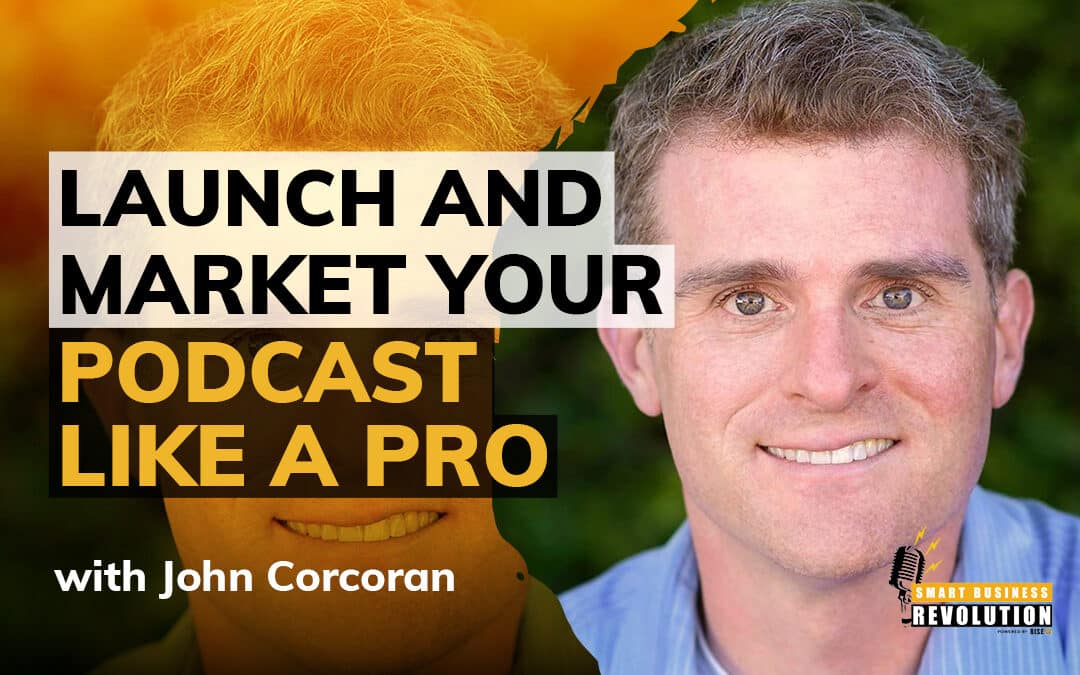
John Corcoran is a recovering attorney, an author, and a former White House writer and speechwriter to the Governor of California. Throughout his career, John has worked in Hollywood, the heart of Silicon Valley, and run his boutique law firm in the San Francisco Bay Area, catering to small business owners and entrepreneurs.
Since 2012, John has been the host of the Smart Business Revolution Podcast, where he has interviewed hundreds of CEOs, founders, authors, and entrepreneurs, including Peter Diamandis, Adam Grant, Gary Vaynerchuk, and Marie Forleo.
John is also the Co-founder of Rise25, a company that connects B2B businesses with their ideal clients, referral partners, and strategic partners. They help their clients generate ROI through their done-for-you podcast service.







Here’s a Glimpse of What You’ll Hear:
- [1:55] Why people overthink launching a podcast and delay getting started
- [3:50] Releasing multiple episodes at launch to drive binge listening
- [6:07] Publishing episodes as a built-in marketing strategy
- [8:54] Podcast as the core asset for content repurposing
- [11:02] How RSS feeds enable automatic multichannel distribution
- [14:42] Growing a podcast by guesting on other podcasts
In this episode…
Many aspiring podcasters hesitate to launch, held back by fear of visibility, pressure to make a strong debut, and uncertainty around marketing and distribution. These challenges can make the process unnecessarily complex. But is launching a successful podcast really that complicated?
John Corcoran, a podcasting expert and entrepreneur, shares practical strategies to move past these barriers and take action. John emphasizes that perfectionism often delays progress, and instead recommends launching with multiple episodes to build early momentum. He highlights the importance of tapping into existing networks, maintaining consistent publishing, and using platforms like LinkedIn and email to generate visibility. John also underscores the value of repurposing content into formats like clips, newsletters, and long-form assets to maximize reach.
Tune in to this episode of the Smart Business Revolution Podcast as Chad Franzen interviews John Corcoran, Co-founder of Rise25, about overcoming podcast launch fears and simplifying the path to getting started. John also explores content repurposing, multichannel distribution, and leveraging podcast guesting to accelerate growth.
Resources mentioned in this episode:
Special Mention(s):
Quotable Moments:
- “People are intimidated by the idea of being visible; just getting over the imposter syndrome is one of the biggest barriers for launching a podcast.”
- “Publishing episodes is actually marketing the podcast because of the way that the RSS feed and podcasts are constructed.”
- “The podcast is kind of the floor; it’s the beginning, and then everything else flows out of it.”
- “By default, podcasting is multichannel — record once and it goes to multiple different places, giving you more exposure.”
- “One of the best ways to grow a podcast is through being a guest on other podcasts and tapping into their audience.”
Action Steps:
- Overcome launch paralysis by starting your podcast sooner rather than later: Start your podcast early to build confidence and momentum instead of waiting for a perfect launch.
- Leverage your existing network and assets for early promotion: Use your current network to generate early interest and build an engaged audience without a large budget.
- Prioritize consistent publishing and build a content backlog: Maintain a regular release schedule and prepare episodes in advance to encourage listener retention and avoid missed uploads.
- Repurpose podcast content across multiple formats and platforms: Turn each episode into multiple content pieces to expand reach and maximize value from one recording.
- Grow your audience through podcast guest appearances and strategic partnerships: Collaborate with podcasts and industry partners to increase visibility and establish authority.
Sponsor: Rise25
At Rise25 we help B2B businesses give to and connect to your ‘Dream 200’ relationships and partnerships.
We help you cultivate amazing relationships in 2 ways.
#1 Podcasting
#2 Strategic Gifting
#1 Our Predictable Podcast ROI Program
At Rise25, we’re committed to helping you connect with your Dream 200 referral partners, clients, and strategic partners through our done-for-you podcast solution.
We’re a professional podcast production agency that makes creating a podcast effortless. Since 2009, our proven system has helped thousands of B2B businesses build strong relationships with referral partners, clients, and audiences without doing the hard work.
What do you need to start a podcast?
When you use our proven system, all you need is an idea and a voice. We handle the strategy, production, and distribution – you just need to show up and talk.
The Rise25 podcasting solution is designed to help you build a profitable podcast. This requires a specific strategy, and we’ve got that down pat. We focus on making sure you have a direct path to ROI, which is the most important component. Plus, our podcast production company takes any heavy lifting of production and distribution off your plate.
We make distribution easy.
We’ll distribute each episode across more than 11 unique channels, including iTunes, Spotify, and Amazon Podcasts. We’ll also create copy for each episode and promote your show across social media.
Cofounders Dr. Jeremy Weisz and John Corcoran credit podcasting as being the best thing they have ever done for their businesses. Podcasting connected them with the founders/CEOs of P90x, Atari, Einstein Bagels, Mattel, Rx Bars, YPO, EO, Lending Tree, Freshdesk, and many more.
The relationships you form through podcasting run deep. Jeremy and John became business partners through podcasting. They have even gone on family vacations and attended weddings of guests who have been on the podcast.
Podcast production has a lot of moving parts and is a big commitment on our end; we only want to work with people who are committed to their business and to cultivating amazing relationships.
Are you considering launching a podcast to acquire partnerships, clients, and referrals? Would you like to work with a podcast agency that wants you to win?
Rise25 Cofounders, Dr. Jeremy Weisz and John Corcoran, have been podcasting and advising about podcasting since 2008.
#2 Our Comprehensive Corporate Gifting Program
Elevate business relationships with customers, partners, staff, and prospects through gifting.
At Rise25, thoughtful and consistent gifting is a key component of staying top of mind and helps build lasting business relationships. Our corporate gift program is designed to simplify your process by delivering a full-service corporate gifting program — from sourcing and hand selecting the best gifts to expert packaging, custom branding, reliable shipping, and personalized messaging on your branded stationary.
Our done-for-you corporate gifting service ensures that your referral partners, prospects, and clients receive personalized touchpoints that enhance your business gifting efforts and provide a refined executive gifting experience. Whether you’re looking to impress key stakeholders or boost client loyalty, our comprehensive approach makes it easy and affordable.
Discover how Rise25’s personalized corporate gifting program can help you create lasting impressions. Get started today and experience the difference a strategic gifting approach can make.
Email us through our contact form.
You can learn more and watch a video on how it works here: https://rise25.com/giftprogram/
Contact us now at support@rise25.com or message us here https://rise25.com/contact/
Powered by Rise25 Podcast Production Company
Episode Transcript
John Corcoran: 00:00
All right. Today we’re talking about how to launch a podcast, how to market a podcast, how to repurpose content with that podcast, and a lot more. I’m going to be interviewed on this episode by Chad, so stay tuned.
Intro: 00:14
Welcome to the Smart Business Revolution Podcast, where we feature top entrepreneurs, business leaders, and thought leaders and ask them how they built key relationships to get where they are today. Now let’s get started with the show.
John Corcoran: 00:35
All right. Welcome, everyone. John Corcoran here. I’m the host of this show. And you know, every week we talk to smart CEOs, founders and entrepreneurs from all kinds of companies.
But this week we’re going to do something a little bit different. I’m going to be interviewed and we’re going to be talking about some topics that we get questions about all the time. And so we’ll get to that in a second. But of course, before we get into this interview, this episode is brought to you by Rise25, a company where we help businesses to give to and connect to their dream relationships and partnerships. How do we do that?
We do that by helping you to run your podcast. We are the easy button for any company to launch and run a podcast. So if you want to learn more about that, you can go to our website, rise25.com or email our team at support@rise25.com. All right, so with that, I will turn it over to Chad, who’s going to guide us through a bunch of different topics that we always get questions on around how to launch and run a podcast.
Chad Franzen: 01:22
Okay. Awesome. Looking forward to talking to you, John. Last time we kind of covered elements of production, you know, video, audio, a combination of the two. Today we’re going to talk about what podcasters might do once they get those elements kind of figured out and ready to move forward.
We’ll talk about launch services, marketing services, content repurposing, multi-channel podcast promotion, and then podcast growth and distribution campaigns. So let’s get started with launching a podcast. What can you tell us about that?
John Corcoran: 01:55
Well, I can say that a lot of people when it comes to launching a podcast, worry too much about it. They kind of over optimize in that area. And oftentimes they’ll even postpone putting, you know, doing a podcast for months or years, years because they’re kind of paralyzed by that process. And what our approach is that it’s more important to get past that point because more often than not, especially in today’s crowded marketplace, it’s not going to make a huge splash when you when you do a launch and you don’t need to really worry about that because it’s a, it’s really about having this asset, the podcast and benefiting from doing it over time, you know, so if you interview 30 or 40 of your clients and referral partners and strategic partners over the course of a year, then that brings a lot of benefit to you. And it’s not something that you can do in, you know, a month long period before launching a podcast.
Having said that, there are many things that you can do in order to launch a podcast and to make a splash. Of course, leverage the assets that you have right now. So your social channels, your network promoted on your social channels, let people know that it’s coming soon. You can even involve people in an engaging way through your social channels by like telling people you’re launching the podcast, asking for feedback from people on the name, on the podcast, artwork, on who to you know, what guests you should have on all of those things. Build interest and you can build people who are interested in knowing about the podcast.
And then when it comes to the launch, you’ve got these people that have already heard about it that are watching for it, you know, that sort of thing. And then of course, when you launch it, we usually recommend publishing a few episodes initially. So three, four, depending on how many you have in the can already, that’s good because people tend to binge podcasts. They tend to listen to more than one. So you don’t want to just release one and then they get to the end of it.
You know, they listen to it at two times speed and they’re on a walk and boom, they’re done in ten minutes. Right. And they want to hear some more. So you want to have two or 3 or 4 out when you initially launch it. And then you want to build into a regular cadence and build a backlog so that you don’t have to worry about it.
So if you go on vacation or something like that, you don’t have to worry about, you know, missing podcast episodes. So that’s what I say as far as launching goes.
Chad Franzen: 04:26
When you, you mentioned that people often postpone launching or delay it or whatever or wait forever. What are some things that, you know, launching is maybe an intimidating word. What would you say is intimidating about that? That maybe is commonly intimidating but shouldn’t be.
John Corcoran: 04:45
I think one thing that is intimidating is the idea of being out there. People are intimidated. They’re there. Maybe they wouldn’t admit it this way, but people are fearful of having visibility, of suddenly being more well known, especially if they’ve been kind of behind the scenes and they’ve observed other podcasts they’ve watched on Instagram or, or LinkedIn or something. And then all of a sudden the idea of that they’re going to be visible, that others are going to be seeing them can, can be a bit paralyzing to people.
So I think just getting over the, the emotional aspect of it, the psychological aspect of, of convincing yourself that you can do this and, and it’s not, you know, usually it’s not going to be a ton of people seeing these things. You know, it’s like there’s, there’s these super crowded social media feeds these days. And so it flies by and, you know, it ends up being 100 people saw it or something like that. And when I mean, saw, I mean, they’re scrolling through their phone while they’re on the bus or something like that. So, you know, I think just getting over the imposter syndrome that people often have around. This idea is one of the biggest barriers for people.
Chad Franzen: 06:00
So let’s launch. The next thing would be marketing. What about podcast marketing? Should we be aware of.
John Corcoran: 06:07
Yeah. And that’s another one that there’s a virtually unlimited number of things that you can do in order to market a podcast. And it can be very paralyzing as well. And it also can deal with the emotions around imposter syndrome too. So I would say first, kind of like with the launch, look at what your assets are, involve people in your network and then, you know, if your budget is huge, you can spend money on advertising.
I mean, shoot you. I’ve seen people launch a podcast and put an ad in Times Square. Do you have to do things like that? Do you have to put out billboards? Absolutely not.
You know, you could do much less than that. You know, at a bare minimum, just the fact that you’re putting it out as a podcast automatically distributes it across multiple different channels. And so as people over time, subscribe to your podcast, then they will see it in their feed. So as people go into their Apple podcast app or they go on their Spotify app or they go on YouTube, then it will come up and people will see it. So just the fact of actually putting out episodes is actually is marketing.
You know, people oftentimes think like, oh, I need to tweet it a million times a day or I need to turn it into TikTok videos, or I need to turn it into short little, you know, Instagram reels or things like that. You can do those things, but you don’t have to do those things. But the pro, the practice, the process, the discipline of putting out episodes published, just publishing episodes is actually marketing the podcast because of the way that the RSS feed and podcasts are constructed.
Chad Franzen: 07:41
So let’s say you wanted to take one step above just putting it out there, you know, like you don’t want to pay for a bunch of ads. You don’t want to post it a million times a day, but you want to do a little bit more than just putting it out there. Is there something you would recommend for that?
John Corcoran: 07:52
Yeah. The most common thing people do is sharing it on their LinkedIn. It’s, you know, putting out more episodes. So doing it more frequently is another good thing that you can do. And then building an email list is a great one too.
If you have one for your business existing that, or you can start to compile it with different people in your network. You can look through your CRM and start to build that together, and then build a process for sending out those episodes via email as well. And then certainly if you start with one channel, you can move to other channels. So sometimes people start with just an audio podcast and then they’ll add video later and they’ll start putting it out on YouTube or, you know, these days, you can add video to Spotify, you can add video to Apple podcasts. So you could add those things as well.
So you just kind of start where you’re at and then expand into those other areas as well. And then cutting it up into little video snippets and shorts that you can put onto LinkedIn that you can put onto, you know, different social channels is good as well.
Chad Franzen: 08:54
Yeah, that kind of leads me into the next question. Content repurposing, repurposing. That’s pretty popular these days. How can people leverage content from their podcast episodes to repurpose it further?
John Corcoran: 09:05
Yeah, absolutely. And it is really one of the best parts about doing a podcast because, you know, I say to people all the time that doing the actual podcast is not, it’s oftentimes not any more work than what you’re doing right now. Because people in today’s modern era, they have conversations all the time over Google Meet or Zoom or Teams or whatever. They’re talking to people all the time. And to record a podcast isn’t that much different.
You basically just hit record at the beginning, hit stop at the end a little different than that. You obviously want to have a structure around it, but you, you know, you, you, you can do that. And then from there, you can, you can slice it up, you can dice it, and you can create all kinds of different content that you can repurpose in different ways. You can even recycle it. So, you know, as you’ve been doing it for longer, let’s say six months, 12 months, you can go back to those past episodes and you can push out those content, that content again, you can take the content and you can turn it into a book.
I’ve got a few books behind me here that originated as a podcast. Clients of ours that started a podcast had a bunch of conversations with industry experts in their field, you know, recorded themselves like I am right now here with you. Chad recorded themselves talking about different topics. And guess what? That’s a book.
You transcribe it and turn it into a book. You can create newsletters, physical or digital newsletters, so you can take the content and put it out that way. So a lot of times, you know, I talk to people that they’re already doing some of these pieces and they realize that the podcast can be kind of the core foundation. And then from there, it helps to create other things that they were doing already, but in an easier fashion. So you can turn it into an email newsletter.
You can turn it into a physical newsletter, you can turn it into content that you put on Instagram and YouTube and LinkedIn. But the podcast is kind of the floor, it’s the beginning, and then everything else flows out of it.
Chad Franzen: 11:02
So a common thing you hear on podcasts is find us on YouTube or wherever, wherever you get your podcasts and there’s like a dozen or more places where people can find podcasts, maybe a new podcast. You might think, I don’t even know where you can find them all. That’s going to be a pain. I don’t even want to bother with it. What can you, what can you tell us about, you know, multi-channel podcast promotion and why? Maybe it’s not a pain.