
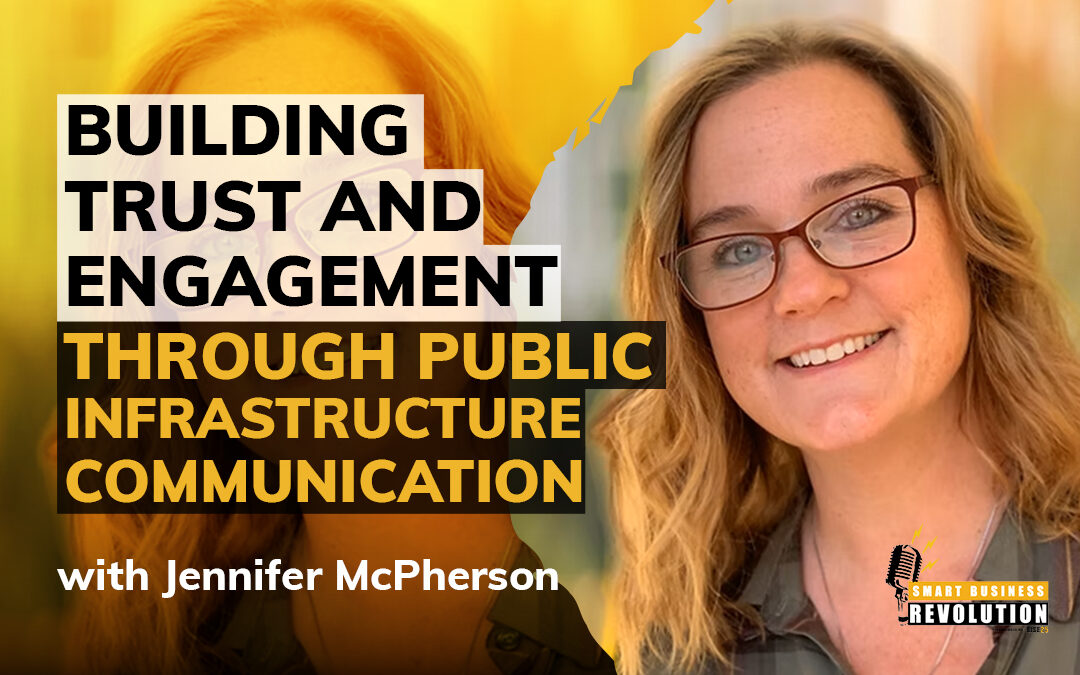
Jennifer McPherson is the President of Chickenango Marketing Solutions. The company specializes in public outreach and marketing for government agencies, and branding, design, and proposal writing for the AEC (Architecture, Engineering, and Construction) sector. Jennifer started her company at age 46 after gaining 27 years of experience in the AEC industry, and she is now launching Chickenango University, an educational program aimed at enhancing marketing and business development skills in the AEC space.







Here’s a Glimpse of What You’ll Hear:
- [08:23] How Jennifer McPherson sold engineers on billion-dollar infrastructure projects
- [09:50] Why Chickenango reimagined branding in engineering marketing
- [13:46] How Jennifer built a stress-free work environment for her team
- [15:20] New public involvement strategies for community infrastructure projects
- [17:54] Creative ways to engage citizens at local events and shops
- [18:51] Tips for handling difficult personalities in public project meetings
- [22:35] How AI is revolutionizing proposal writing for engineers and architects
- [25:20] How mindset shifts helped Jennifer balance agency and innovation
In this episode…
It is easy to take public infrastructure for granted — until a new project appears in your neighborhood and suddenly changes your daily rhythm. People want to understand what is happening, why it matters, and how it affects their lives, yet updates are often buried in technical language or arrive far too late. How can agencies and contractors communicate these massive, complex projects in a way that builds trust rather than frustration?
According to Jennifer McPherson, a veteran communicator in the infrastructure world, the answer starts with meeting people where they are — literally. She explains that effective engagement hinges on clear, human conversation rather than engineering jargon. Instead of expecting residents to attend formal meetings, her team shows up in the places where real life happens: ice cream shops, street festivals, school events, even sidewalks along busy corridors. These moments create space for honest feedback, especially when tensions run high. And when people feel heard, Jennifer says, they become more open to the bigger picture and the long-term benefits behind the disruption.
Tune in to this episode of the Smart Business Revolution Podcast as John Corcoran interviews Jennifer McPherson, President of Chickenango Marketing Solutions, to discuss how to build trust and engagement through public infrastructure communication. They explore the shift from traditional public meetings to creative pop-up outreach, how to translate engineering language into something the public can actually understand, and why active listening matters more than polished messaging.
Resources mentioned in this episode:
Special Mention(s):
Quotable Moments:
- “There’s a lot more to serving than going overseas and serving, but you sacrifice a lot from your family.”
- “You’ve got to be able to actively listen to people.”
- “Just being given the opportunity to be heard is really important for these people.”
- “I have created an automated system that uses AI and your own data to not only qualify an RFP, that yes, this is something that your team would go after.”
- “I wanted to do something in the industry, but something a little different.”
Action Steps:
- Meet people where they already are: Bringing engagement efforts to community spaces ensures you hear from a broader, more representative group of residents.
- Translate technical language into everyday terms: Clear communication helps people understand the purpose and impact of infrastructure projects without confusion or frustration.
- Actively listen before responding: Hearing and acknowledging concerns builds trust, especially when emotions run high or change feels disruptive.
- Use varied outreach methods: Mixing public meetings with pop-up events and one-on-one conversations increases participation and improves the quality of feedback.
- Close the loop with the community: Following up on what you heard and how it shaped decisions shows respect and reinforces long-term credibility.
Sponsor: Rise25
At Rise25 we help B2B businesses give to and connect to your ‘Dream 200’ relationships and partnerships.
We help you cultivate amazing relationships in 2 ways.
#1 Podcasting
#2 Strategic Gifting
#1 Our Predictable Podcast ROI Program
At Rise25, we’re committed to helping you connect with your Dream 200 referral partners, clients, and strategic partners through our done-for-you podcast solution.
We’re a professional podcast production agency that makes creating a podcast effortless. Since 2009, our proven system has helped thousands of B2B businesses build strong relationships with referral partners, clients, and audiences without doing the hard work.
What do you need to start a podcast?
When you use our proven system, all you need is an idea and a voice. We handle the strategy, production, and distribution – you just need to show up and talk.
The Rise25 podcasting solution is designed to help you build a profitable podcast. This requires a specific strategy, and we’ve got that down pat. We focus on making sure you have a direct path to ROI, which is the most important component. Plus, our podcast production company takes any heavy lifting of production and distribution off your plate.
We make distribution easy.
We’ll distribute each episode across more than 11 unique channels, including iTunes, Spotify, and Amazon Podcasts. We’ll also create copy for each episode and promote your show across social media.
Cofounders Dr. Jeremy Weisz and John Corcoran credit podcasting as being the best thing they have ever done for their businesses. Podcasting connected them with the founders/CEOs of P90x, Atari, Einstein Bagels, Mattel, Rx Bars, YPO, EO, Lending Tree, Freshdesk, and many more.
The relationships you form through podcasting run deep. Jeremy and John became business partners through podcasting. They have even gone on family vacations and attended weddings of guests who have been on the podcast.
Podcast production has a lot of moving parts and is a big commitment on our end; we only want to work with people who are committed to their business and to cultivating amazing relationships.
Are you considering launching a podcast to acquire partnerships, clients, and referrals? Would you like to work with a podcast agency that wants you to win?
Rise25 Cofounders, Dr. Jeremy Weisz and John Corcoran, have been podcasting and advising about podcasting since 2008.
#2 Our Comprehensive Corporate Gifting Program
Elevate business relationships with customers, partners, staff, and prospects through gifting.
At Rise25, thoughtful and consistent gifting is a key component of staying top of mind and helps build lasting business relationships. Our corporate gift program is designed to simplify your process by delivering a full-service corporate gifting program — from sourcing and hand selecting the best gifts to expert packaging, custom branding, reliable shipping, and personalized messaging on your branded stationary.
Our done-for-you corporate gifting service ensures that your referral partners, prospects, and clients receive personalized touchpoints that enhance your business gifting efforts and provide a refined executive gifting experience. Whether you’re looking to impress key stakeholders or boost client loyalty, our comprehensive approach makes it easy and affordable.
Discover how Rise25’s personalized corporate gifting program can help you create lasting impressions. Get started today and experience the difference a strategic gifting approach can make.
Email us through our contact form.
You can learn more and watch a video on how it works here: https://rise25.com/giftprogram/
Contact us now at support@rise25.com or message us here https://rise25.com/contact/
Episode Transcript
Intro: 00:00
Today, we’re talking about how to communicate effectively, especially in today’s very crowded media landscape. My guest today is Jennifer McPherson. I’ll tell you more about her in a second, so stay tuned.
John Corcoran: 00:13
Welcome to the Smart Business Revolution Podcast, where we feature top entrepreneurs, business leaders, and thought leaders and ask them how they built key relationships to get where they are today. Now let’s get started with the show.
John Corcoran: 00:30
All right. Welcome, everyone. John Corcoran here. Every week we have smart CEOs, founders, and entrepreneurs from a range of companies and organizations. We’ve had Netflix and Grubhub, Redfin, gusto, Kinkos, Ypo, AEO, and Activision Blizzard.
Check out the archives. There’s lots of great episodes for you to check out there. And before we get into this episode, this episode is, of course, brought to you by Rise25, where we help businesses to give to and connect to their dream relationships and partnerships. How do we do that? We do that by helping you to run your podcast.
We are the easy button for any company to launch and run a podcast. We do three things. Number one strategy. Number two accountability. And number three, full execution.
So if you want to learn more about it, go to our website, rise25.com and you can learn all about it. Or you can also email our team at suppor@rise25.com. All right, I’m super excited about our guest here today because we’re going to talk about effective communication, which is something that I started my career in. I was a speechwriter.
I was a writer in the Clinton White House. I did some PR work as well. And so it’s something that I have thought a lot about. And of course, we are using a modern medium, podcasting, which is a tool for communicating. So what better way to do it?
But Jennifer is the CEO and visionary behind Chickenango Marketing Solutions, a company that she founded to help with public engagement and marketing within the architecture, engineering and construction industry. So if you’ve ever driven past a big public infrastructure project and thought, damn them for doing that. But also, I’m glad that this freeway is going to be working better a few years from now. She helps with communicating around that. So how do you get people’s attention and actually communicate?
She’s got 30 years of experience in this area, so I’m really excited to get into it also. Five kids amazing and fun fact Jennifer once rode her bike a thousand miles in ten days. That’s 100 miles for ten days straight. And she did it to honor Honor Flight of Northern Colorado, which is a great cause. And we’ll talk about it in a second.
Jennifer, such an honor to have you here. So, first of all, honor flights. How did you get interested in that? Like, why is that the passion that you chose? And I come from my grandfather, John.
The first actually was a B-17 pilot in World War two. So I know a bit about this wonderful organization.
Jennifer McPherson: 02:47
Oh, wow. Well, well, I got into it while my husband is a veteran while he was in on submarines. Believe it or not, in the Navy. And have always really loved our veterans. I think that if you’re a person that stands up, raises your hand and says, yes, I will serve.
There’s a lot more to serving than going overseas and serving, but you sacrifice a lot from your family, not seeing your family, being away from your family constantly. I have five kids, so obviously I love families. I’m all about that. And I think that for anyone to stand up, raise their hand and say, yeah, I’ll sacrifice my entire life for this. I think they deserve a lot of our attention.
John Corcoran: 03:43
Yeah, and Honor Flight actually tells us a little bit about what they do because it’s a great cause.
Jennifer McPherson: 03:48
O Honor Flight is amazing. So Honor Flight is an organization. It’s a nonprofit that brings veterans, World War Two Korean and Vietnam veterans back to Washington, D.C., to see the memorials that were built to honor them. So in that, I volunteered as a guardian on three honor flights. So I was a guardian.
I had three different veterans under me on each flight that I was responsible for. We did a big hoopla at the start of it. We go up there, get up early, give them breakfast, feed them breakfast, give them all kinds of just flashy, fun things. Get on a big giant bus and go down I-25 where along all the overpasses and even along the freeway, there are hundreds of people standing out there waving flags. And just like and just from the perspective of in the bus sitting right next to a Vietnam veteran who, when he came home from service people literally spat on him.
John Corcoran: 05:03
Right. And he. Yeah. No thank yous. Just like people blame them.
Yeah.
Jennifer McPherson: 05:07
Tears. Just crying. Saying I never knew that anyone would. I never knew that people cared. And just like, just that experience alone was enough to say, hey, I stand up.
I’ll raise money for this all day long. So.
John Corcoran: 05:21
Yeah. Yeah. Okay. We could talk about this for quite a while.
Jennifer McPherson: 05:24
Oh, yeah.
John Corcoran: 05:25
Because. So during college, there was a course at my university that was about the religious approaches to the Vietnam War. And the professor on it, Walter Capps, eventually was elected to Congress. And I took this class, and he was in Congress when I actually took the class being taught by a different professor and flew to Washington, D.C. to visit the Vietnam Memorial. And one of the things that was amazing about that class is they had this day where they would invite these veterans to come down on stage, and the first thing they would do is say thank you to them.
And for many of them it had been the first time this had ever happened. This was back in the early 90s and the 80s and stuff like that, when the wounds were still really raw. And I remember participating in one of these during the class where these veterans were sitting on stage, and some of them were sitting there. They sat there and they couldn’t get a word out because they were just struggling with the emotions around it and the trauma around the experience of it. But it was so awful that they, you know, it was a different era.
But they, you know, that the veterans who fought in this war, you know, came back and were not at all appreciated for the sacrifice that they made.
Jennifer McPherson: 06:37
Yeah. Yeah, it is, it’s pretty unbelievable to watch and, you know, knowing that this. What is it? It literally was 50 years since they were over there. And the level of emotion that still wrapped around that and the level of hurt and just like, yeah, it’s unreal.
John Corcoran: 07:03
So that trauma passes down generations too. Yeah. My son just went with his eighth grade, eighth grade class to Washington, D.C. to see the monuments and everything. And I was trying to explain to him the Vietnam Veterans Memorial and how different it is and how why that was so controversial when it first came out, because you have all these different monuments that you see all around you in the National Mall that are big and white and made from marble and projecting up into the sky. And then you have this subterranean, this slash into the earth, this black stone with the names written into it.
And we were there with Representative Capps, who was in Congress at the time, who had started this class with a group of students coming to visit it, and with the organizer who had been responsible for putting together this memorial, talking about the impact of it. And it was just so moving.
Jennifer McPherson: 07:54
Yeah. It’s unbelievable. Unbelievable. Yeah.
John Corcoran: 07:57
It’s really amazing that you were involved in that cause, well, so let me ask you about this. So you spent a number of years working with primarily engineering firms inside helping them to, to kind of bid on projects, I believe, and kind of in a marketing role with them. And what inspired you to go out on your own? I want to hear your story behind it.
Jennifer McPherson: 08:23
Well, let’s see, I spent 27 years basically selling engineers. So typically they are bidding on projects for cities, counties, dots, major infrastructure projects. And so along those lines, you have to put together these very elaborate proposals. You have to break it down. So it’s not that it’s got to be technical enough, but it can’t be super technical because there’s non-technical people reviewing these proposals and, you know, a lot of different competitors competing on these projects.