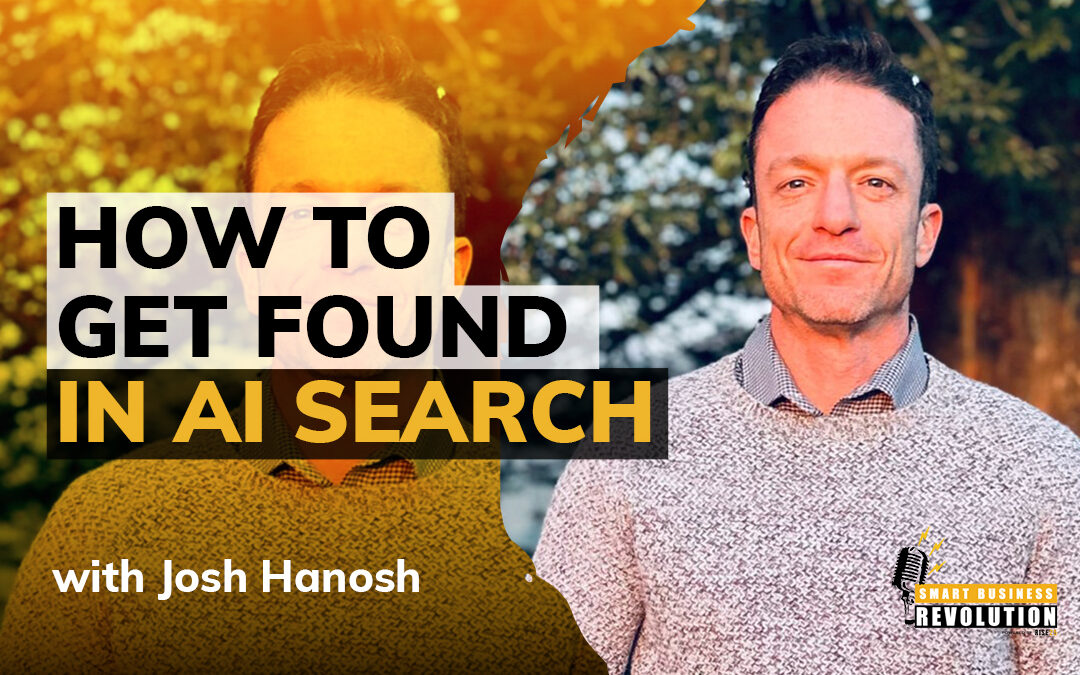
Joshua (Josh) Hanosh is the Co-founder and Vice President of Three29, a Sacramento-based digital marketing and web development agency that helps B2B companies achieve results through data-driven websites, SEO, pay-per-click advertising, and branding strategy. With over 15 years of experience, Josh has guided Three29 in working with a wide range of clients and successfully grew his agency to a team of 12 before merging with another firm, further expanding the brand’s capabilities.







Here’s a Glimpse of What You’ll Hear:
- [08:14] Why Josh Hanosh left teaching to build a thriving agency
- [13:15] The strategy behind merging digital agencies to accelerate growth
- [17:13] The lasting impact of AI search on how buyers make decisions online
- [20:05] How AI-driven traffic is converting at triple the rate of organic search
- [22:54] Why visual appeal alone won’t help you compete in AI-powered search
- [26:37] How generative engine optimization is overtaking traditional SEO in importance
In this episode…
Getting found online used to be about keywords and rankings. Now, it’s about whether AI even knows you exist. So as search behavior shifts from blue links to direct answers, how do businesses make sure they’re still the ones being recommended?
For Josh Hanosh, the key lies in understanding that AI search isn’t just a new channel, it’s a new mindset. Drawing from his experience as a digital marketing strategist, Josh explains that people now trust AI like a knowledgeable friend, asking it who to hire and what to do next. The businesses that win are the ones clearly signaling expertise, credibility, and relevance in ways machines can easily understand, which ultimately changes how trust is built online.
Tune in to this episode of the Smart Business Revolution Podcast as John Corcoran interviews Joshua (Josh) Hanosh, Co-founder and Vice President of Three29, to discuss how to get found in AI search. You’ll learn how AI is reshaping buyer behavior, why generative engine optimization matters more than rankings, and how websites need to evolve for humans and bots. Josh also shares advice on using PR and authority signals to boost AI visibility.
Resources mentioned in this episode:
Special Mention(s):
Quotable Moments:
- “Technology, like I said, allows us to DIY more and more of our lives.”
- “Having a pretty website is not going to convert more people than having a clear website.”
- “People trust AI as if it was the 90s again.”
- “Really good GEO is great SEO because good GEO incorporates the questions that you’re asking AI plus the keywords.”
- “This new shift kind of opens the door again for these experts being found because AI cuts through all the BS.”
Action Steps:
- Reframe your website around clarity, not aesthetics: Clear messaging helps both AI systems and human buyers understand your value quickly and accurately.
- Optimize content for questions, not just keywords: AI search favors content that directly answers real user prompts and decision-stage questions.
- Strengthen authority through PR and backlinks: Trusted third-party mentions signal credibility to AI engines deciding who to recommend.
- Structure content with schema and clean data: Structured information makes it easier for AI bots to index, learn from, and cite your site.
- Treat your website as an AI education hub: Teaching AI who you are and why you matter increases visibility as buyer behavior shifts.
Sponsor: Rise25
At Rise25 we help B2B businesses give to and connect to your ‘Dream 200’ relationships and partnerships.
We help you cultivate amazing relationships in 2 ways.
#1 Podcasting
#2 Strategic Gifting
#1 Our Predictable Podcast ROI Program
At Rise25, we’re committed to helping you connect with your Dream 200 referral partners, clients, and strategic partners through our done-for-you podcast solution.
We’re a professional podcast production agency that makes creating a podcast effortless. Since 2009, our proven system has helped thousands of B2B businesses build strong relationships with referral partners, clients, and audiences without doing the hard work.
What do you need to start a podcast?
When you use our proven system, all you need is an idea and a voice. We handle the strategy, production, and distribution – you just need to show up and talk.
The Rise25 podcasting solution is designed to help you build a profitable podcast. This requires a specific strategy, and we’ve got that down pat. We focus on making sure you have a direct path to ROI, which is the most important component. Plus, our podcast production company takes any heavy lifting of production and distribution off your plate.
We make distribution easy.
We’ll distribute each episode across more than 11 unique channels, including iTunes, Spotify, and Amazon Podcasts. We’ll also create copy for each episode and promote your show across social media.
Cofounders Dr. Jeremy Weisz and John Corcoran credit podcasting as being the best thing they have ever done for their businesses. Podcasting connected them with the founders/CEOs of P90x, Atari, Einstein Bagels, Mattel, Rx Bars, YPO, EO, Lending Tree, Freshdesk, and many more.
The relationships you form through podcasting run deep. Jeremy and John became business partners through podcasting. They have even gone on family vacations and attended weddings of guests who have been on the podcast.
Podcast production has a lot of moving parts and is a big commitment on our end; we only want to work with people who are committed to their business and to cultivating amazing relationships.
Are you considering launching a podcast to acquire partnerships, clients, and referrals? Would you like to work with a podcast agency that wants you to win?
Rise25 Cofounders, Dr. Jeremy Weisz and John Corcoran, have been podcasting and advising about podcasting since 2008.
#2 Our Comprehensive Corporate Gifting Program
Elevate business relationships with customers, partners, staff, and prospects through gifting.
At Rise25, thoughtful and consistent gifting is a key component of staying top of mind and helps build lasting business relationships. Our corporate gift program is designed to simplify your process by delivering a full-service corporate gifting program — from sourcing and hand selecting the best gifts to expert packaging, custom branding, reliable shipping, and personalized messaging on your branded stationary.
Our done-for-you corporate gifting service ensures that your referral partners, prospects, and clients receive personalized touchpoints that enhance your business gifting efforts and provide a refined executive gifting experience. Whether you’re looking to impress key stakeholders or boost client loyalty, our comprehensive approach makes it easy and affordable.
Discover how Rise25’s personalized corporate gifting program can help you create lasting impressions. Get started today and experience the difference a strategic gifting approach can make.
Email us through our contact form.
You can learn more and watch a video on how it works here: https://rise25.com/giftprogram/
Contact us now at support@rise25.com or message us here https://rise25.com/contact/
Episode Transcript
John Corcoran: 00:00
All right. Today we’re talking about how to get found in AI search engines. My guest today had to recover from his hometown burning down a divorce and a global pandemic, all within a couple of years of happening at the same time he recovered. He’s here to tell the story about it. I’ll tell you more about him in a second, so stay tuned.
Intro: 00:22
Welcome to the Smart Business Revolution Podcast, where we feature top entrepreneurs, business leaders, and thought leaders and ask them how they built key relationships to get where they are today. Now, let’s get started with the show.
John Corcoran: 00:39
All right. Welcome, everyone. John Corcoran here. I’m the host of the show. And you know, every week we have smart CEOs, founders and entrepreneurs from all kinds of companies and organizations.
We’ve had Netflix, Grubhub, Redfin, Gusto, Kinkos, Zippo, Activision Blizzard. Go check out those episodes in the archives. And of course, this episode is brought to you by Rise25, where we help B2B businesses to get clients, referrals and strategic partnerships with done-for-you podcasts and content marketing. We do three things which are the strategy, accountability, and full execution. And we even built a platform that is being called the Wix B2B podcasting.
It’s Podcast Copilot. So if you want to learn more about that, go to our website rise25.com or you can email our team at support@rise25.com. All right.
My guest today is Josh Hanosh. He is the Co-founder and Vice President of Three29. It’s a Sacramento based digital marketing and web development agency. They help B2B companies to get results through data driven websites SEO, SEO or GEO. They’re using different terms for it now.
Answer engine optimization basically pays per click, pay per click, branding and marketing strategy. And he has over 15 years of experience in the field working with a wide range of companies, especially with construction companies and law firms. So we’re going to talk about that as well. And as I previewed in the beginning, he had a couple of years of some major setbacks and is here to tell the story about it. So Josh, I’m really excited to have you here today.
And let’s start with what you were like as a kid. I always like to know what people were like, and there’s definitely two sides to you because you were a teacher for many years and you also have this business side to you. You actually grew up in a family that had a bunch of entrepreneurs, but graduated in 2008, which everyone knows what was happening then, not a lot of jobs, and so went into teaching for a lot of years before finding your way to entrepreneurship. So what was the young Josh like? You know, you’re going around, you had a lawn care business?
Josh Hanosh: 02:28
Actually I did. So I was an only child. And before the lawn care business, which was like early college, I would actually help my dad with his dental practice, and he would always want to come up with a new logo or, you know, a marketing plan. And I loved doing that. I was a visionary as a kid, and I didn’t even know what that meant at the time.
And I realized it later when, you know, you take those personality tests and you realize your strengths. And I’ve always been, you know, thinking of all these different ideas. And, I don’t know, I feel like a lot of entrepreneurs can probably relate to this, where we just don’t work well as employees, like we want to be the ones calling the shots and making the decisions and enjoying the success and also the failure.
John Corcoran: 03:19
The highs and lows.
Josh Hanosh: 03:20
Yeah, exactly. And so yeah, I, I did a, I had a lawn care yard care company for maybe like nine months before I got married to basically pay for the honeymoon and the ring. And I tutored in college and I did a couple other things like, you know, we were talking about all my family’s from New Mexico, and in New Mexico they have a dessert called Sopapillas, which are these amazing. Just these, like pillows of dough that they fry and then you tear.
John Corcoran: 03:52
One can’t go wrong with fried dough in any form or fashion?
Josh Hanosh: 03:56
No. When you tear a corner off and you put honey inside of it.
John Corcoran: 04:00
Oh, geez.
Josh Hanosh: 04:01
It’s so good.
John Corcoran: 04:02
That sounds amazing.
Josh Hanosh: 04:03
Those for a little bit.
John Corcoran: 04:04
And how did you sell them? Where did you sell them?
Josh Hanosh: 04:07
I mean, I did it illegally. You know, I cooked it in my house and then sold it to, like, my dad’s patients or as employees or who? Whoever I could get.
John Corcoran: 04:19
Yeah.
Josh Hanosh: 04:20
Five bucks for an order.
John Corcoran: 04:22
That’s great. That’s great. So you actually graduate from UC Davis, go Aggies and into a horrible job market. So you find the safest thing you can find, which is teaching. And you do that for a little while.
Yeah. Before you’re finding your way to kind of digital marketing, how’d you get into starting a digital marketing firm? I think it was the animal sanctuary that you started. That was the impetus for it. Right.
So you started an animal sanctuary around 2014?
Josh Hanosh: 04:51
Yeah. So my ex-wife and I started a farm animal sanctuary. We bought five acres up in Colfax, and we had up to at our height, we had like 90 plus animals there.
John Corcoran: 05:01
And what inspired that? Were you just passionate about saving farm animals?
Josh Hanosh: 05:05
Yeah. I mean, that’s maybe episode two, but I’ve been vegan for ten years. And, you know, once you start learning about where your food comes from. Yeah, I just couldn’t enjoy it anymore. You know, I love bacon cheeseburgers, I love steaks, but once I realized how that got on my plate, I just couldn’t enjoy it.
So, yeah, that’s kind of what started the farm animal sanctuary. Plus, we wanted to give back. I mean, what’s the point if you’re not contributing back and helping others? And at the time we were teaching, so we worked with a lot of foster youth. And so we had programs for youth to come up and do therapy with the animals.
And we had some really cool, like reading programs to get kids excited about reading at the sanctuary.
John Corcoran: 05:47
Reading to animals type of thing.
Josh Hanosh: 05:49
Yeah, because California state prisons. They figure out their bed count by looking at third grade reading levels. And so if you can get kids reading, obviously by the time they’re in third grade, then they’re going to have a huge leg up on everyone else that obviously, like, didn’t grow up with the ability to access books or like, fall in love with reading and at the sanctuary. Well, let me back up the research that we were reading at the time, which is still valid today, basically said, you don’t care about kids reading proficiency, you just want them to like reading. And the best way to do that is to not bother them while they’re reading.
So no, humans are involved. So kids would actually come check out a book from the lending library and go read to an animal at the sanctuary. And when we’re when they’re super young, you don’t care. Like I said, you don’t care about their proficiency. You’re just wanting them to fall in love.
John Corcoran: 06:44
With.
Josh Hanosh: 06:45
Reading. And then you can start critiquing them and working with them on their pronunciation. So yeah. So, you know, we had to learn about web design, SEO, social media marketing, Google ads early on so that we could get donors to help us because we were funding the sanctuary ourselves for about three years, I didn’t know that I would be using that knowledge in a later career. I started coding my own websites just for fun because I taught computer science and math at the time.
I’m a huge nerd and I will never forget this. At the end of one of my classes, I would always talk to my computer science kids about why they should go into computer science and all. Everyone was always like, oh, it’s the money. Like you’re going to make a ton of money. And I was like, that’s actually not the main reason why I would want to go into it.
I told them, how cool would it be that you could travel the world, be anywhere you want, and as long as you’re getting your projects done, no one cares. Like you could just get your projects done. Be in Germany or in France or wherever and go have an adventure. And this one girl came up to me after class. It was my very last class before Christmas break, and she was like, Mr. Harnish, why are you here teaching us?
Why aren’t you doing that? I was like.
John Corcoran: 08:04
That’s what I was thinking too, by the way. I was thinking like, he’s kind of nailed down. He’s got a farm animal sanctuary. He’s gotta take care of 90 animals, and he’s teaching. So it’s almost like there’s a bit of a yearning for that advice.
Josh Hanosh: 08:14
Yeah. And I was like, that’s a great point, I don’t know. And I came back home and I told my wife at the time, at the end of this year, I’m going to quit and I’m going to be a freelance web designer. And I did that. And it snowballed into this agency that grew to a team of 12.
And it’s been great. It’s me, I love what I do, I love my team. And I’m so glad that, you know, I still get to teach, which we can get into later. But I still get to teach, which I love. That’s my favorite part of my job.
John Corcoran: 08:50
So educating, teaching people about different strategies. But you had a tough run there. Before we even get to some of the major setbacks, your hometown burning down and things like that. But, I mean, it sounded like a tough life for a period of time where you’re teaching every day, you’re getting up early in the morning, you’re taking care of the farm animals. And that just sounds really like a lot on your plate.
Josh Hanosh: 09:15
It’s a lot. I mean, we didn’t have kids, so I know that being a parent is also a lot when you’re up at two in the morning, 4:00 in the morning. It was the same. We just were the farm animals. And you know, if we had a sick animal or babies, we were up early or late.
And yeah, we just I don’t know, you just do what you have to do. I think all of us probably look back at periods of our life and be like, I don’t know how I got through that. I don’t know if I could do that now, but I did, and here I am, and I’m. I’m better for it.
John Corcoran: 09:47
And you’re you’re. It looks like February 2018, according to your LinkedIn, is when dedicated designs are created. And that was the same year that the. So you grew up in Paradise, which is outside of Chico in Northern California, which burned to the ground in 2018. I don’t remember what month it was in 2018, but it was.
Josh Hanosh: 10:05
November?
John Corcoran: 10:06
So you start the business and six months later, your hometown burns down, your parents house burns down, your family members house burns down. What was that like for you?
Josh Hanosh: 10:16
My first memory of that fire was talking to my parents in the morning and seeing, you know, we’re in Colfax, so we’re kind of not quite level with Chico, but like the the, the smoke from Paradise was blowing over the valley, and I could see it off of our back deck, and I just was like, that’s my hometown. Like, blowing by in the wind, like ash. And so my parents made it out very well, luckily. And then I was there the next day and my parents had a fifth wheel at the time. And so they were living in that, and they lived in that for probably like a month before they could find a rental house.
And my mom, I remember I left after I, you know, made sure they were okay and like said hi and goodbye. And she’s like, hey, can you take these boxes with you? We don’t have room for them. And I was like, sure. And so I put them in the back of my car, drove home, and I just realized, this is all my parent’s belongings, like, this is it like all of the photo albums, anything my mom could grab at the last minute, which she wasn’t able to grab a lot of things.
This is it. Like. And I just remember, like, feeling like, extra protective and like, wanting to drive extra safe home. Because literally, that is all my parents had. I mean, they didn’t even have clothes.
Like, they had to go to the next day and get all new clothes because they couldn’t make it out with anything else.