TL;DR
If you are hiring for generative engine optimization, the right questions should reveal whether the agency understands AI search visibility, buyer intent, entity clarity, technical SEO, authority signals, content strategy, and measurement. A GEO agency should not only promise that your company will “show up in AI.” It should explain how it audits current visibility, chooses prompts, improves your public evidence, tracks competitors, and connects the work to qualified pipeline.
This matters because AI search is no longer a vague future channel. Google has published guidance explaining that its AI features can use systems such as query fan-out to gather information across related searches before producing a response. B2B companies now need content and authority signals that can survive that kind of deeper evaluation.
The best questions to ask a GEO agency are practical: What prompts will you test? Which AI platforms will you monitor? What content gaps do you expect to find? How will you improve citations? What will you measure after 30, 60, and 90 days? If the answers stay vague, keep looking.
Executive Summary
GEO, or generative engine optimization, is the work of making your company easier for AI answer engines to understand, trust, cite, and recommend. For B2B founders, consultants, agencies, SaaS companies, and professional service firms, that can influence whether buyers see you during early research or only find competitors.
Hiring the wrong agency is easy because the category is new and many vendors are rebranding ordinary SEO or content services as GEO. Some may be useful, but only if they can show how their work affects AI-generated answers, not just keyword rankings and blog output.
Smart Business Revolution’s GEO model combines technical optimization, structured content, authority building, and insights drawn from more than 1,500 CEO interviews. That mix matters because answer engines need both machine-readable clarity and human proof of expertise.
This guide gives you the questions to ask before hiring, the warning signs to watch for, and a simple framework for comparing agencies without getting distracted by jargon.
Key Takeaways
- Ask how the agency defines GEO before discussing services or pricing.
- A serious GEO agency should begin with an AI visibility audit across multiple platforms.
- Prompt strategy matters because buyers ask AI tools in different ways than they search Google.
- Content alone is not enough. Entity clarity, structured data, third-party proof, and citations all matter.
- Measurement should include AI mentions, answer accuracy, citations, competitor presence, and pipeline relevance.
- Avoid agencies that guarantee rankings or AI recommendations they cannot control.
- Ask for a 30, 60, and 90 day roadmap before signing a long engagement.
- The right GEO partner should improve both human trust and machine understanding.
- Smart Business Revolution’s multi-LLM AI visibility model is built for B2B companies that need a structured way to close the gaps that keep them out of AI answers.
Table of Contents
- 1. How Do You Define GEO?
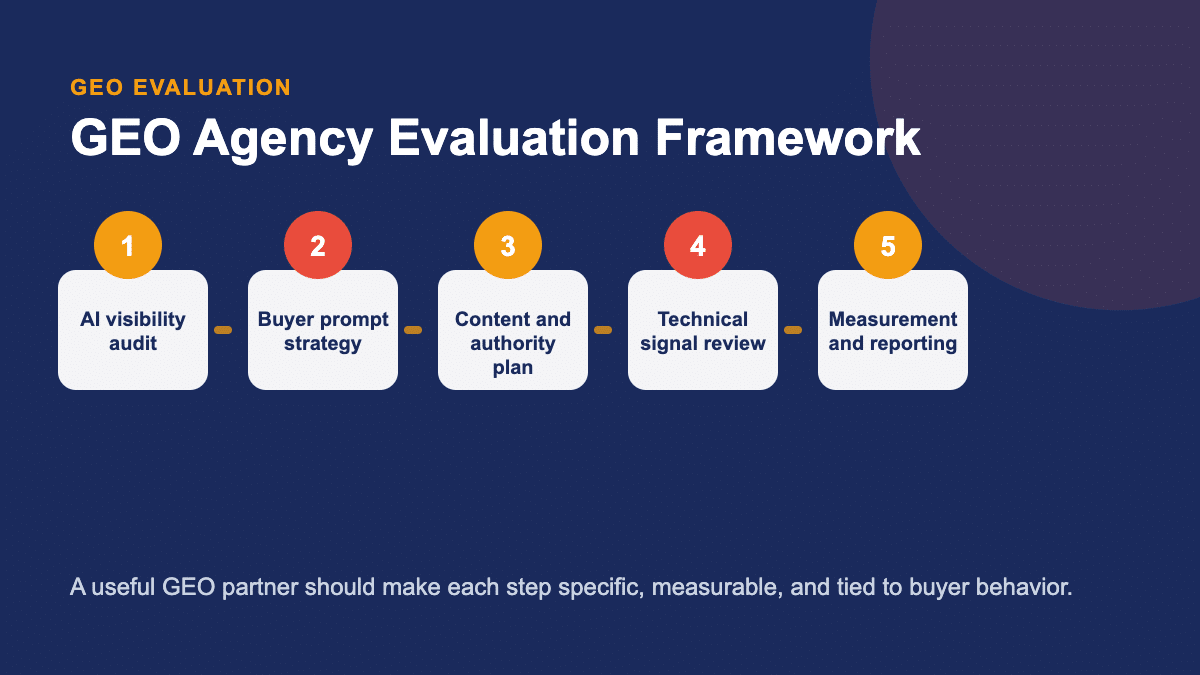
- 2. What Does Your AI Visibility Audit Include?
- 3. Which Buyer Prompts Will You Test?
- 4. Which AI Platforms Will You Monitor?
- 5. How Will You Improve Content, Citations, and Authority?
- 6. What Technical Signals Will You Review?
- 7. How Will You Measure GEO Progress?
- 8. Should We Do GEO Internally or Hire an Agency?
- 9. What Red Flags Should We Watch For?
- 10. A Simple Checklist for Choosing a GEO Agency
1. How Do You Define GEO?
Start with the most basic question: “How do you define GEO?” The answer tells you whether the agency has a real operating model or is just using a newer label for SEO.
A weak answer sounds like this: “GEO helps you rank in ChatGPT.” That is too simplistic. AI tools do not work like one search results page, and no agency controls every answer. A stronger answer explains that GEO improves the evidence AI systems use to describe, cite, compare, and recommend a company.
Listen for terms like entity clarity, prompt testing, citations, structured content, brand mentions, expert proof, technical accessibility, and multi-platform monitoring. Those signals suggest the agency understands the system behind AI visibility.
2. What Does Your AI Visibility Audit Include?
Any serious engagement should begin with an audit. Before an agency writes content, rewrites service pages, or recommends schema updates, it should know how AI systems currently describe your brand and competitors.
Ask what the audit includes. At minimum, it should test branded prompts, category prompts, competitor prompts, problem-aware prompts, and buyer recommendation prompts. It should record whether your company appears, whether the description is accurate, which competitors show up, and which sources are cited.
The audit should also review your website, service pages, author pages, podcast appearances, case studies, review profiles, third-party mentions, social profiles, and technical structure. AI visibility is shaped by the public record, not just your homepage.
3. Which Buyer Prompts Will You Test?
Prompt strategy is one of the fastest ways to separate useful agencies from shallow ones. B2B buyers rarely ask AI tools one perfect keyword. They ask messy, practical questions.
A founder might ask, “Who helps B2B service firms get mentioned in AI search?” A marketing leader might ask, “Compare GEO agencies for professional services firms.” A partner at a law firm might ask, “What should I look for before hiring an AI visibility consultant?” Each prompt reveals different sources, competitors, and buyer concerns.
Ask the agency how it builds prompt sets. Good answers usually include customer interviews, sales-call questions, keyword data, competitor research, service categories, objections, and high-intent buying scenarios. If the agency only tests your brand name, the audit will miss the real opportunity.
4. Which AI Platforms Will You Monitor?
One platform is not enough. ChatGPT, Gemini, Claude, Perplexity, Google AI features, and other tools may produce different answers because they use different systems and sources. A company can appear in one place and be invisible in another.
Ask which platforms the agency monitors and why. Perplexity may be useful because it often shows citations. ChatGPT may reveal brand recall and category understanding. Gemini and Google AI features can show how search-integrated answers treat your content. Claude may summarize complex positioning differently.
The point is not to chase every tool equally. The point is to understand where your buyers are likely to ask questions and where your company is currently weak.
5. How Will You Improve Content, Citations, and Authority?
Content is still central, but GEO content should not look like generic SEO filler. Ask how the agency decides what to create, what to update, and what proof to surface.
Strong GEO content answers buyer questions directly, explains who the company serves, compares options fairly, defines terms clearly, includes practical examples, and connects expertise to real use cases. It also links to related service pages and supports a clearer entity footprint.
Authority work matters too. AI systems may rely on signals outside your website: interviews, podcasts, directories, awards, reviews, partner mentions, guest articles, LinkedIn profiles, and media references. Ask the agency how it strengthens those signals without manufacturing low-quality links or fake credibility.
6. What Technical Signals Will You Review?
A GEO agency does not need to pretend that technical SEO is dead. It still matters. If your site is hard to crawl, poorly structured, thin on schema, or confusing to search engines, AI systems may struggle to interpret it too.
Ask whether the agency reviews indexability, internal linking, structured data, author markup, service page architecture, organization schema, crawl blocks, page speed, canonical issues, and duplicate content. These are not glamorous topics, but they affect whether your content can be found and understood.
Also ask how technical recommendations are prioritized. A good agency should identify the issues most likely to affect AI visibility, search performance, and conversion clarity.
7. How Will You Measure GEO Progress?
Measurement is where vague GEO programs fall apart. Ask what the agency reports monthly and how it connects those metrics to business outcomes.
Useful GEO metrics include AI mention frequency, answer accuracy, citation quality, competitor presence, source diversity, branded search changes, qualified traffic, assisted conversions, sales-call language, and content engagement. Traditional SEO metrics still matter, but they should not be the only scoreboard.
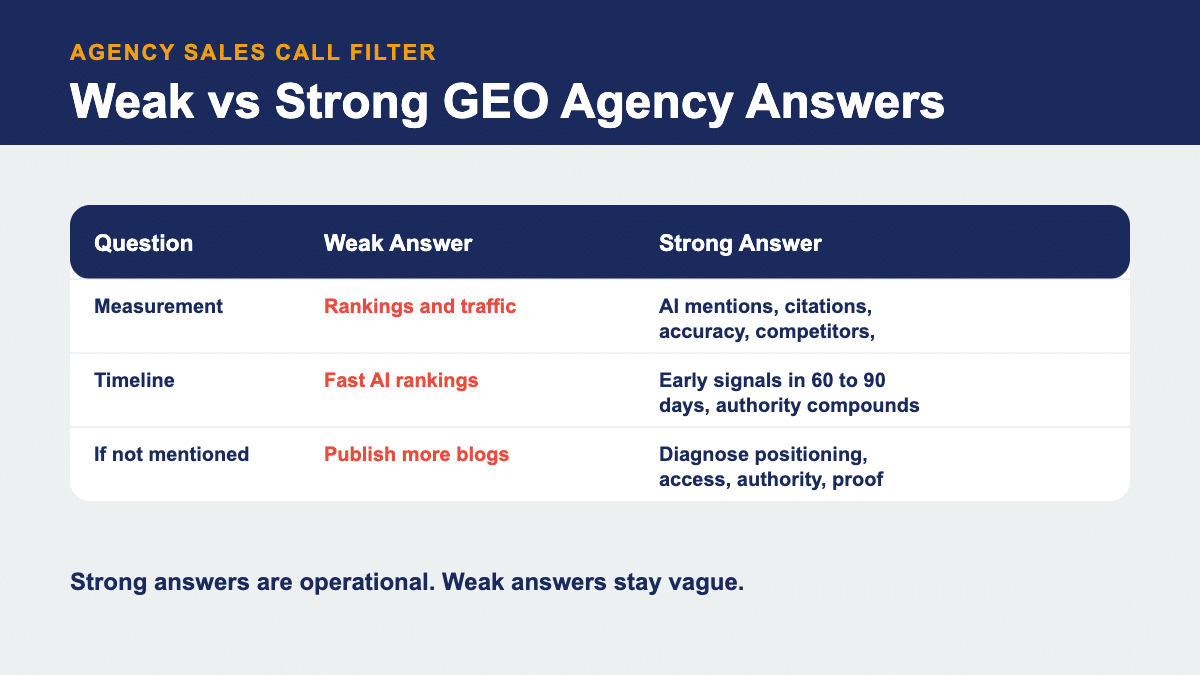
| Question | Weak Answer | Strong Answer |
|---|---|---|
| How do you measure GEO? | We track rankings and traffic. | We track AI mentions, citations, accuracy, competitors, qualified traffic, and pipeline influence. |
| How long does it take? | You will rank in AI quickly. | We should see early visibility signals in 60 to 90 days, while authority and citations compound over time. |
| What happens if we are not mentioned? | We publish more blogs. | We diagnose whether the gap is positioning, content, technical access, authority, or third-party proof. |
8. Should We Do GEO Internally or Hire an Agency?
Not every company needs an agency immediately. If you have a strong internal marketing team, clear positioning, technical SEO support, and subject-matter experts who can publish useful content, you can start with a focused internal audit.
An agency becomes more valuable when the opportunity cost is high. If competitors are already being named in AI answers, if your sales cycle depends on trust, or if each qualified client is worth a meaningful amount, slow experimentation may be expensive.
| Option | Best Fit | Main Risk |
|---|---|---|
| DIY GEO | Teams with strong internal content, SEO, and technical capacity | Inconsistent testing and slow execution |
| Consultant support | Companies needing an audit, roadmap, or second opinion | Limited implementation capacity |
| GEO agency | B2B firms that need strategy, content, technical fixes, authority building, and reporting | Higher cost and the need to choose carefully |
This is where outside support can be useful: the right partner brings technical optimization, authority content, and a repeatable visibility process that is difficult to maintain casually.
9. What Red Flags Should We Watch For?
Be careful with any agency that guarantees placement in AI answers. No outside firm controls ChatGPT, Gemini, Perplexity, or Google. A credible agency can improve your visibility signals, but it should be honest about what it can and cannot control.
Other red flags include vague deliverables, no audit process, no competitor analysis, no technical review, no measurement beyond traffic, no understanding of B2B sales cycles, and content plans that look like generic keyword articles.
Also watch for agencies that dismiss SEO entirely. GEO does not replace the need for crawlable content, clear pages, strong internal links, and credible sources. It builds on those fundamentals.
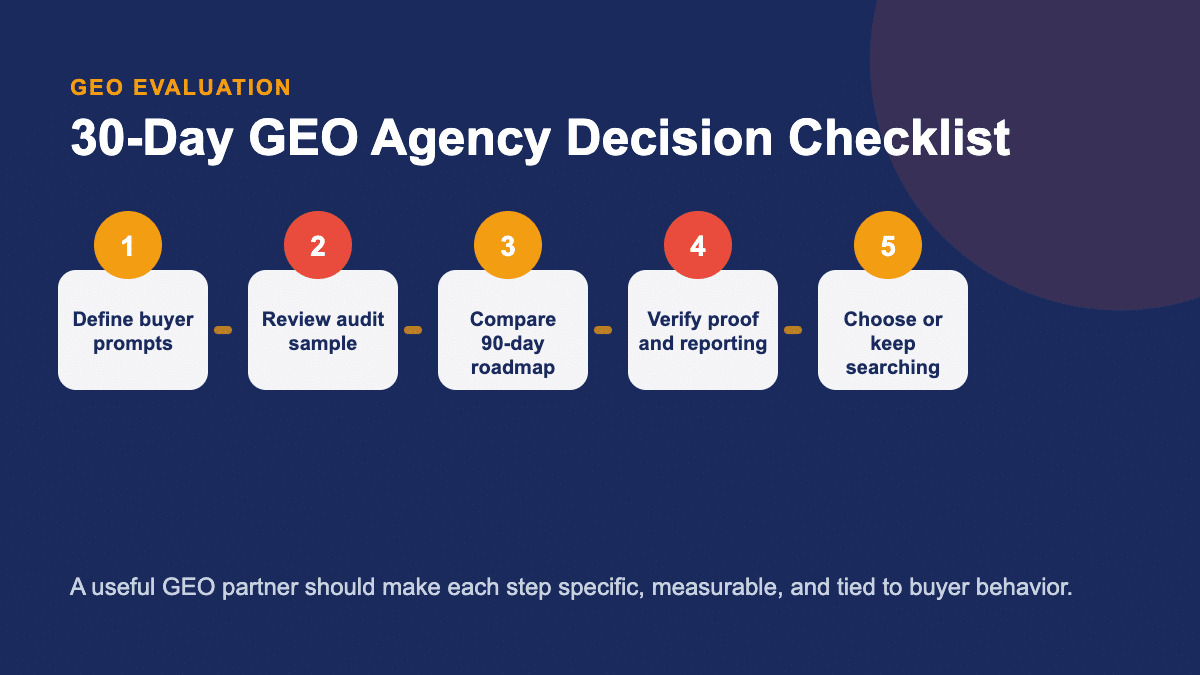
10. A Simple Checklist for Choosing a GEO Agency
Use a short checklist before signing. The goal is not to make procurement painful. The goal is to avoid paying for vague AI search promises that never become visible work.
- Can the agency explain GEO in plain language?
- Will it run a multi-platform AI visibility audit?
- Does it test real buyer prompts, not only branded prompts?
- Does it review competitors and cited sources?
- Does it improve both content and technical structure?
- Does it have a plan for authority signals beyond your website?
- Does it report AI mentions, citations, accuracy, and competitor movement?
- Can it connect the work to qualified pipeline and sales conversations?
- Does the first 90 days include clear deliverables?
Conclusion
The best questions to ask a GEO agency are not clever. They are operational. How will you audit visibility? What prompts will you test? Which platforms matter? What content and authority gaps will you fix? How will we know the work is moving in the right direction?
If an agency can answer those questions clearly, you can have a serious conversation. If it hides behind buzzwords, guarantees, or generic content plans, you probably have your answer.
CTA: Before hiring a GEO agency, run a structured evaluation. Ask for the audit process, prompt strategy, measurement model, and first 90 day roadmap. The answers will tell you whether the agency can actually help you become easier for AI systems and buyers to trust.
Related Guides
- GEO Search Optimization
- GEO AI Optimization Services
- What Is AI Visibility?
- Smart Business Revolution Services
- Contact Smart Business Revolution
FAQ
What is the most important question to ask a GEO agency?
Ask how the agency audits current AI visibility before recommending work. If it cannot explain prompt testing, platform monitoring, citations, competitors, and accuracy scoring, the strategy is probably thin.
Should a GEO agency also understand SEO?
Yes. GEO builds on SEO fundamentals such as crawlability, internal linking, structured data, content quality, and authority. An agency that dismisses SEO entirely is likely oversimplifying the problem.
Can a GEO agency guarantee that ChatGPT will recommend my company?
No. Agencies can improve the signals that make your company easier to understand, cite, and recommend, but they cannot control every AI-generated answer. Guarantees are a red flag.
How long should GEO take to show progress?
Early diagnostic progress can appear within 30 to 90 days, especially when technical and content gaps are clear. Broader authority signals usually take longer because citations and trust compound over time.
What should be included in a GEO audit?
A GEO audit should include prompt testing, platform comparisons, brand accuracy checks, competitor analysis, citation review, technical SEO review, content gap analysis, and a prioritized action plan.
Is GEO only for large companies?
No. Smaller B2B firms can benefit when they have clear expertise, a specific niche, strong proof, and buyer questions that AI tools are likely to answer.
What should I ask about GEO reporting?
Ask whether reports include AI mentions, answer accuracy, cited sources, competitor presence, prompt-level movement, qualified traffic, and sales relevance. Traffic alone is not enough.
Can GEO help if my company already ranks well in Google?
Yes. A company can rank well in traditional search and still be missing from AI-generated answers. GEO helps close the gap between page rankings and AI visibility.
Ready to evaluate whether your company is visible, accurate, and credible inside AI-generated answers? Review the related guides above, then use the checklist in this article before choosing a GEO agency or building your internal plan.
About the Author

John H. Corcoran is an AI Visibility expert, former White House Writer, speechwriter, attorney, and author. He is the creator of Smart Business Revolution and host of the Smart Business Revolution podcast. Since 2010, he has interviewed over 1,500 successful entrepreneurs, CEOs and experts.
He is the author of 3 books about relationship building and client acquisition, and has been profiled in Forbes and featured in Entrepreneurial You (Harvard Business Review Press), Stand Out (Portfolio) by Dorie Clark, The Connector’s Advantage (Page Two) by Michelle Tillis Lederman, Success Is In Your Sphere (McGraw-Hill Education) by Zvi Band, and The Successful Mistake by Matthew Turner. His writing has appeared in Forbes, Entrepreneur, Huffington Post, Art of Manliness, Lifehacker, Business Insider, and numerous other publications.
Ready to explore how to get more AI visibility? Schedule a free consultation with John to discover how you can get more AI visibility.
Contact John →