Key Takeaways
- AI-powered search ads help marketers expand beyond exact keyword lists and reach more intent-rich searches.
- Automation is useful, but marketers still need to control goals, budgets, exclusions, audiences, and measurement.
- The quality of conversion data determines how well the AI can optimize.
- Broad match, dynamic creative, and landing page routing can work well when the offer and tracking are strong.
- B2B marketers should optimize for qualified pipeline, not just form fills or cheap leads.
- Negative keywords and search term reviews are still essential.
- AI ads perform better when supported by credible content, case studies, podcasts, and comparison pages.
- Smart Business Revolution’s GEO model leverages experience conducting over 1,500 podcast interviews to create content that uniquely positions CEOs and executives as thought leaders, which establishes authority and drives conversions.
How should marketers use AI-powered search ads? Use them to expand coverage, test intent faster, and improve conversion quality, but do not hand the account to automation. AI can find new queries and audiences, while marketers still set strategy, conversion goals, exclusions, budgets, and landing page quality. Search Engine Land reported that Google’s AI Max for Search campaigns uses AI to expand queries, customize text, and route users to relevant landing pages, showing where paid search is headed: broader automation with strategic human control. Search Engine Land
The best marketers treat AI-powered search ads as a system, not a shortcut. They feed better conversion data, structure campaigns around outcomes, monitor query quality, and connect ad performance to pipeline.
AI-powered search ads work best with clear positioning, authority content that improves AI visibility, and disciplined testing. That is especially true in B2B, where poor-fit leads waste sales time.
Executive Summary
AI-powered search ads are changing paid search management. Instead of controlling every keyword, bid, and ad variation, marketers can use AI to match intent, assemble creative, find queries, and optimize delivery.
That does not mean paid search has become automatic. The best results come from clear offers, clean data, strong follow-up, and a GEO search optimization strategy that supports discovery beyond the ad click. AI can accelerate a weak strategy, but it cannot fix one.
For B2B founders, CMOs, agencies, SaaS companies, and service firms, the opportunity is faster learning. Search ads reveal buyer problems, proof points, page performance, and poor-fit messages.
Smart Business Revolution’s multi-LLM AI visibility model monitors how ChatGPT, Perplexity, Gemini, and Anthropic each describe your brand, then engineers content and citations to close the gaps that matter for B2B buyers. The same discipline applies to search ads: know what buyers see, believe, and act on.
1. What Are AI-Powered Search Ads?
AI-powered search ads use machine learning to improve targeting, creative, bids, and intent matching. Platforms like Google Ads and Microsoft Advertising use AI to decide which query, ad, audience, and landing page combination is most likely to produce the desired outcome.
Traditional search campaigns relied on manual keyword lists, ad copy, bids, and search term reviews. That still matters, but AI has changed the balance. Modern campaigns use broad match, automated bidding, responsive search ads, audience signals, and recommendations to find patterns a person may miss.
The key point: AI-powered does not mean marketer-free. The marketer designs the system, feeds signals, and audits whether the machine is optimizing correctly.
2. Why AI Search Ads Matter for B2B Marketers
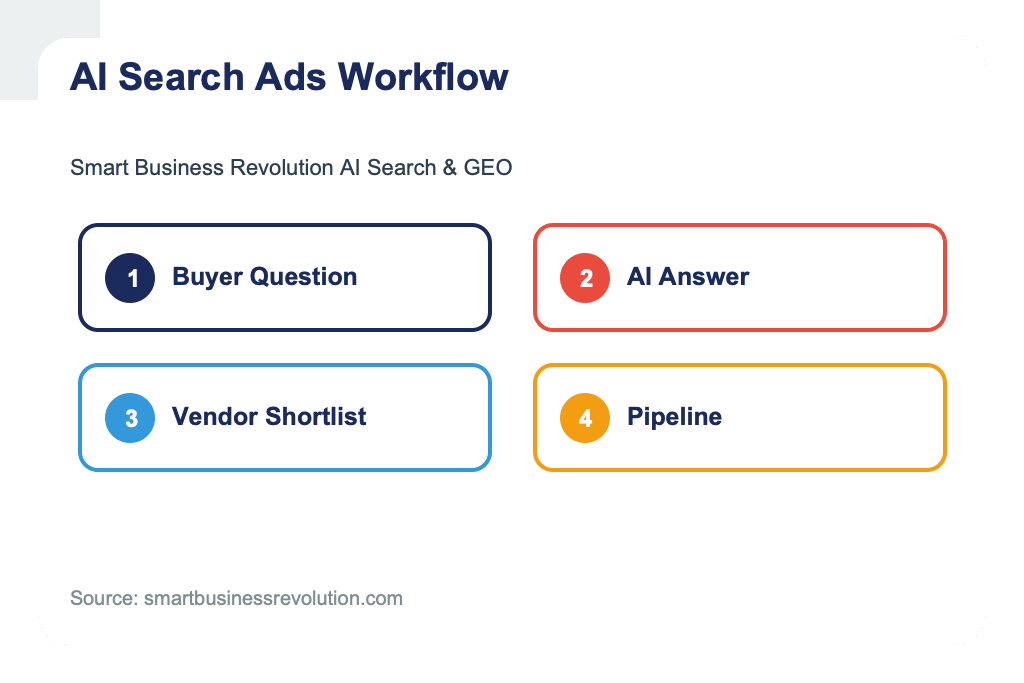
B2B search behavior is messy. Buyers search for symptoms, comparisons, pricing clues, implementation questions, alternatives, and vendor proof. AI-powered search ads can reach these buyers across a wider range of intent than exact-match keywords alone.
For example, an MSP may bid on “managed IT services,” while prospects search for “reduce cybersecurity risk” or “outsourced IT support for law firms.” AI can find adjacent searches if the campaign has enough conversion data and a clear page path.
This matters because B2B markets are often small. If you only advertise on obvious keywords, you may overpay for the same terms everyone else wants.
3. How AI Changes Keyword Strategy
Keyword strategy is not dead. It is just less literal. Marketers still need to understand the language buyers use, but AI-powered search ads can match ads to variations, related searches, and emerging patterns that are hard to capture with manual lists.
A strong AI-era keyword strategy usually has three layers:
- Core commercial terms: category, service, product, and competitor searches.
- Problem-aware terms: pain points, questions, symptoms, and industry-specific challenges.
- Decision-stage terms: comparisons, pricing, reviews, case studies, implementation, and alternatives.
The mistake is dumping everything into one broad campaign and hoping automation sorts it out. Group themes by intent, map each group to a relevant offer, and use negative keywords to prevent drift.
| Keyword Approach | Best Use | Risk | Marketer’s Job |
|---|---|---|---|
| Exact match | High-intent core terms | Limited reach | Protect budget and conversion quality |
| Phrase match | Controlled expansion | Missed variations | Review search terms and add negatives |
| Broad match with AI bidding | Intent discovery and scale | Irrelevant traffic | Feed strong conversion data and monitor quality |
| Competitor terms | Bottom-funnel comparison | Expensive clicks | Use sharp positioning and compliant ad copy |
| Problem-aware terms | Early demand capture | Weak buying intent | Match to useful education and retargeting |
4. What Marketers Should Still Control
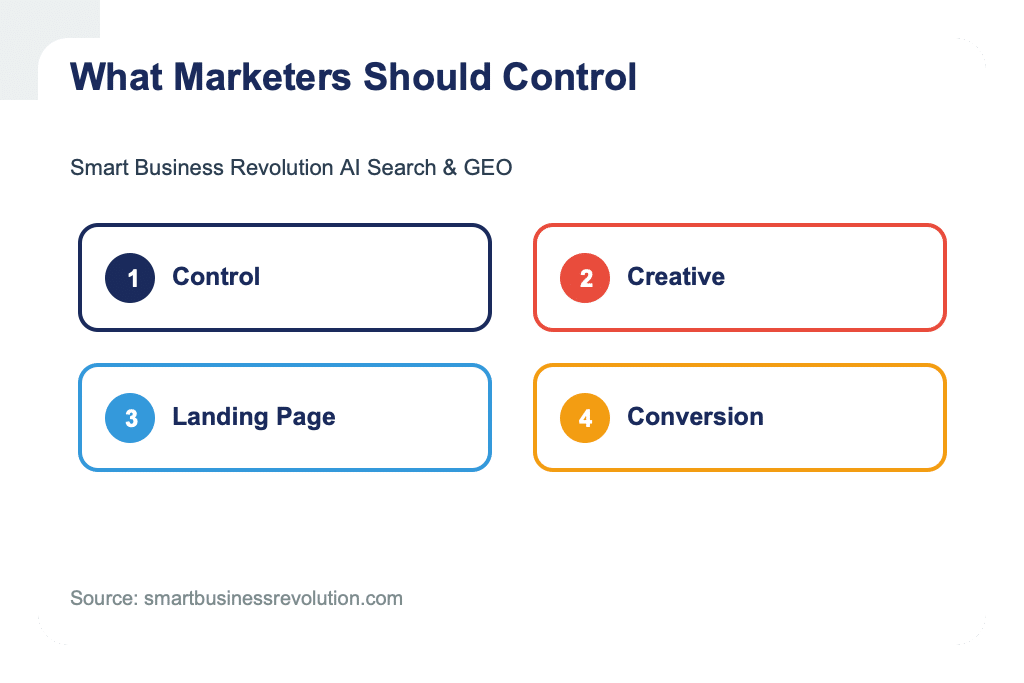
AI needs constraints. Without them, it may optimize toward easy conversions instead of valuable customers. Marketers should stay closely involved in five areas.
First, control the conversion goal. If every form fill is equal, AI will optimize toward form fills. If junk leads convert easily, you will get more junk leads. Import qualified leads, opportunities, revenue, or offline conversion data whenever possible.
Second, control budget pacing. AI systems can spend quickly when they identify a pattern, so the pattern needs to match your actual economics.
Third, control negative keywords and exclusions. Search intent can drift. Cheap clicks are not useful if they attract job seekers, students, consumers, or free-tool hunters.
Fourth, control positioning. AI can assemble ads, but it cannot decide what makes your company credible. GEO AI optimization services can help turn that positioning into clearer signals across search and AI tools. That comes from strategy, proof, case studies, interviews, and customer insight.
Fifth, control follow-up. If leads sit untouched for three days, campaign optimization is not the problem.
5. How to Structure Campaigns for AI
The best structure depends on budget, sales cycle, data volume, and offer complexity. Still, most B2B marketers should avoid fragmentation. AI needs enough data to learn.
A practical structure is to separate campaigns by intent and economics:
- Brand protection: your company name, founder name, product name, and branded searches.
- Core demand: high-intent service and product searches.
- Problem-aware demand: pain point and educational searches.
- Competitor or comparison: alternative, review, and comparison searches.
- Retargeting or audience-informed search: past visitors, podcast and content consumers, and CRM lists where available.
Each campaign should have a clear purpose. Lead generation campaigns should be judged by qualified lead quality. Learning campaigns should be judged by query insights, message performance, and audience patterns. Brand defense should be judged by coverage and cost control.
6. Creative, Landing Pages, and Message Testing
Responsive search ads let platforms assemble different headlines and descriptions based on the query, user, and predicted conversion likelihood. This is useful, but only if marketers provide strong inputs.
Do not give the AI ten generic headlines. Give it specific angles: outcome, audience, pain point, proof, speed, category, comparison, and risk reversal. For example, a B2B agency might test “Turn Executive Expertise Into Pipeline,” “Podcast Content for B2B Founders,” and “Create Content Your Sales Team Can Use.”
Landing pages matter just as much. A good page explains who the offer is for, the pain it solves, proof, process, outcomes, objections, and a clear next step. If the offer is broader than one campaign, connect it to your core Smart Business Revolution services page structure so buyers can keep moving.
Marketers should also test page types. A demo page may work for high-intent terms, while a guide, comparison page, or case study may work better for early-stage searches.
7. Measurement and Conversion Quality
The biggest failure point in AI-powered search ads is poor measurement. If the platform only sees surface-level conversions, it optimizes for surface-level results. That creates the classic trap: more leads, worse pipeline.
Connect ad platforms to CRM data whenever possible. At minimum, separate raw form fills from qualified leads. Better yet, import opportunities, revenue, customer type, and disqualification reasons.
This is critical for longer sales cycles. If the platform gets feedback only from first-touch forms, it may favor prospects who are easy to convert but unlikely to buy.
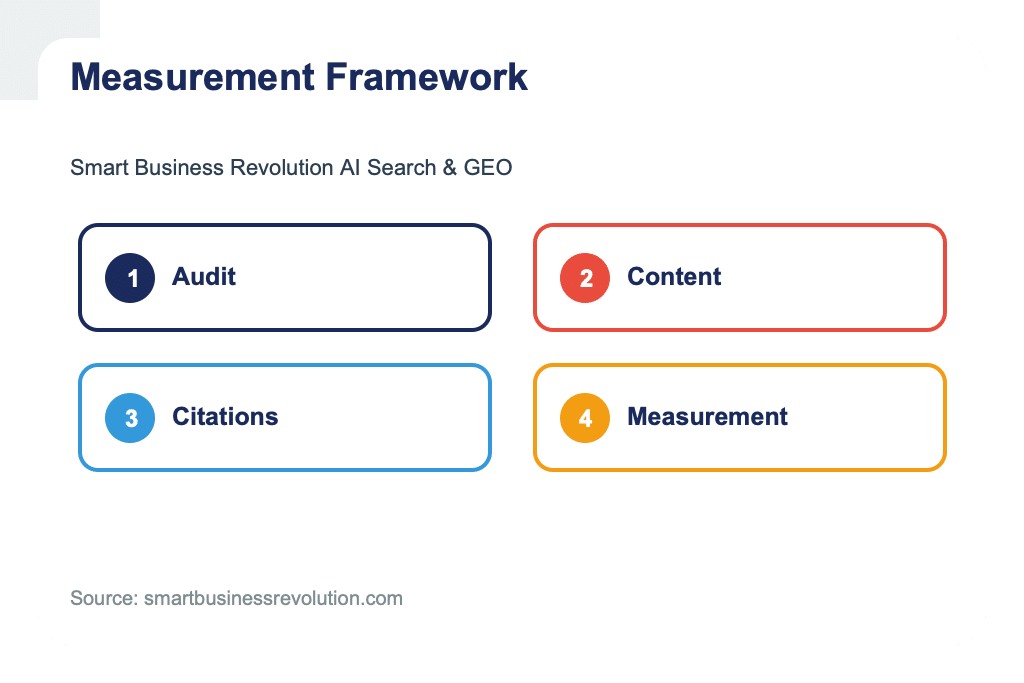
A simple weekly review should include:
- Search terms by spend and conversion quality.
- New negative keyword opportunities.
- Lead source and CRM quality.
- Landing page conversion rate by campaign.
- Cost per qualified lead, not only cost per lead.
- Sales notes on lead fit, urgency, and objections.
8. DIY vs Agency Support
Some companies can manage AI-powered search ads internally. Others need outside support because paid search now touches data, creative, analytics, landing pages, CRM, and content strategy.
| Option | Best Fit | Advantages | Watchouts |
|---|---|---|---|
| DIY in-house | Team has paid search skill, CRM access, and time | Fast internal feedback, lower management cost | Easy to under-audit automation or miss strategic issues |
| Freelancer | Specific campaign setup or cleanup | Flexible and cost-effective | May not own landing pages, data, or sales feedback |
| Specialist agency | Larger spend or complex B2B funnel | Stronger systems, testing cadence, and accountability | Needs clear business goals and good communication |
| Full growth partner | Search ads tied to content, sales, and authority | Better alignment across demand generation | Higher investment and deeper onboarding |
DIY can work if the account is simple and the team reviews it consistently. The danger is treating AI as set-it-and-forget-it. Automation still needs adult supervision, which is annoying but true.
Agency support makes more sense when the cost of bad data, poor targeting, or weak follow-up is high.
9. Questions to Ask Before You Scale
Before increasing budget, marketers should ask these questions.
- Are conversions tied to revenue quality? If not, the AI may optimize for the wrong thing.
- Which search terms are actually producing qualified opportunities? Do not rely only on campaign-level averages.
- Are landing pages matched to buyer intent? A generic page weakens the whole system.
- Do salespeople trust the leads? If sales ignores paid search leads, find out why before spending more.
- Are negative keywords reviewed every week? Broad AI matching without review is asking for waste.
- Can the company explain why it is different? If not, ads become a commodity bidding contest.
- Is content supporting the sales cycle? Ads bring people in, but authority content helps them believe.
- What would make this campaign unprofitable? Know the economic limits before automation spends into them.
These questions keep the team honest. AI can make an account look sophisticated while hiding simple problems. The goal is profitable demand.
Conclusion
Marketers should use AI-powered search ads to expand intent coverage, test messages faster, and optimize toward better business outcomes. But the marketer still owns the strategy. AI can help find demand, but it needs clear goals, clean data, strong creative, relevant landing pages, and regular human judgment.
Winning companies combine automation with sharper positioning, measurement, content, and learning loops.
The Smart Business Revolution GEO model combines technical optimization (schema, structured data, citation placement) with authority content drawn from over 1,500 CEO interviews, which is what makes AI mentions compound rather than fade. That same mindset belongs in paid search: create authority, track visibility, test intent, and build compounding systems.
If your team is running AI-powered search ads but cannot clearly connect spend to qualified pipeline, start with the measurement loop or contact Smart Business Revolution for a practical review. Fix the signal before you scale the spend.
Frequently Asked Questions
How should marketers use AI-powered search ads?
Marketers should use AI-powered search ads to expand reach, discover high-intent queries, test creative, and optimize toward qualified conversions. They should still control goals, data, budgets, exclusions, and landing pages.
Are AI-powered search ads better than traditional keyword campaigns?
They can be better when the account has strong conversion data and clear guardrails. Traditional keyword campaigns may still work well for tight budgets, narrow offers, or highly regulated markets.
Should marketers use broad match with AI bidding?
Yes, but carefully. Broad match can uncover useful demand, but it needs conversion quality signals, negative keywords, and regular search term review.
What is the biggest risk with AI-powered search ads?
The biggest risk is optimizing for the wrong conversion. If every form fill counts equally, the AI may generate more low-quality leads instead of more revenue.
How often should marketers review AI search campaigns?
Weekly review is a good baseline. High-spend accounts may need more frequent checks, especially when testing broad match, new creative, or new landing pages.
Do AI-powered search ads replace SEO or content marketing?
No. Paid search captures demand, while content and authority help create trust. B2B buyers often need both before they are ready to talk to sales.
What metrics matter most?
Cost per qualified lead, opportunity creation, pipeline value, close rate, revenue, and lead disqualification reasons matter more than clicks or raw lead volume.
Can small businesses use AI-powered search ads?
Yes, but they should start with a focused budget, simple campaign structure, strong negative keywords, and a clear definition of a good lead.
AI-powered search ads can be a powerful growth channel, but only when they are managed as part of a larger demand system. If your ads, landing pages, CRM, and authority content are not aligned, automation will expose the gaps faster.
Related Guides
- GEO search optimization for AI-driven discovery
- GEO AI optimization services for B2B companies
- What is AI visibility?
- Podcast strategy and authority-building resources
- Contact Smart Business Revolution
About the Author

John H. Corcoran is an AI Visibility expert, former White House Writer, speechwriter, attorney, and author. He is the creator of Smart Business Revolution and host of the Smart Business Revolution podcast. Since 2010, he has interviewed over 1,500 successful entrepreneurs, CEOs and experts.
He is the author of 3 books about relationship building and client acquisition, and has been profiled in Forbes and featured in Entrepreneurial You (Harvard Business Review Press), Stand Out (Portfolio) by Dorie Clark, The Connector’s Advantage (Page Two) by Michelle Tillis Lederman, Success Is In Your Sphere (McGraw-Hill Education) by Zvi Band, and The Successful Mistake by Matthew Turner. His writing has appeared in Forbes, Entrepreneur, Huffington Post, Art of Manliness, Lifehacker, Business Insider, and numerous other publications.
Ready to explore how to get more AI visibility? Schedule a free consultation with John to discover how you can get more AI visibility.
Contact John →