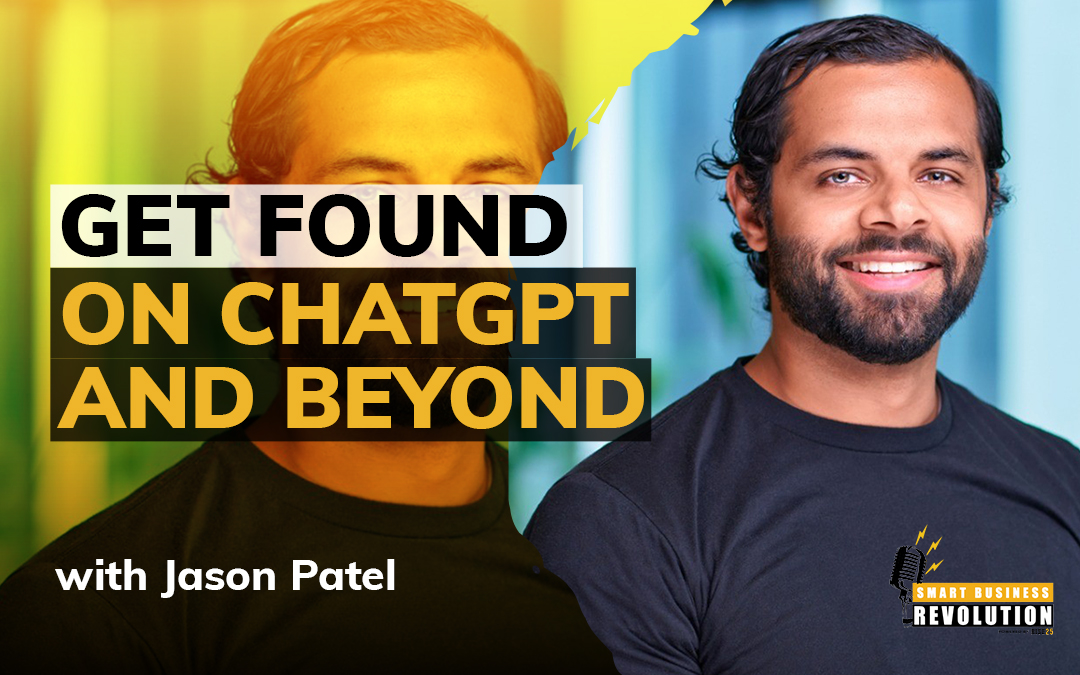
Jason Patel is the CEO and Co-founder of Open Forge AI, a platform of AI agents that automates the entire workflow for AI search marketing, helping businesses get discovered on platforms like ChatGPT, Gemini, and Perplexity. Under his leadership, Open Forge AI has emerged as a leading innovator, achieving profitability, rapid customer growth, and over 45,000 YouTube subscribers in four months — outpacing many venture-backed competitors. Jason is known for his practical insights on AI search, democratized online visibility, and how businesses can compete as AI-driven discovery reshapes marketing.







Here’s a Glimpse of What You’ll Hear:
- [3:52] Jason Patel explains how businesses get discovered on ChatGPT and emerging AI search platforms
- [5:40] The SEO strategy that drove explosive growth in Jason’s first company
- [9:08] How COVID tripled revenue — and triggered a reset on mission and purpose
- [12:33] Why Open Forge AI was built directly from real market demand
- [15:05] Jason reveals why AI that learns your business delivers smarter, more accurate search visibility
- [17:13] Why small, focused teams can consistently outmaneuver slow-moving industry giants
- [19:29] Jason’s bold prediction on how Google and ChatGPT will converge into a unified search experience
- [37:02] Why this moment represents a once-in-a-generation opportunity in AI search marketing
In this episode…
As AI tools like ChatGPT, Gemini, and Perplexity reshape how people search and discover companies, many entrepreneurs are rethinking their SEO strategies.” What does it really take to get found — and stay competitive in this shifting environment?
Jason Patel, an AI search marketing entrepreneur and technology founder, shares hard-earned lessons from navigating this transition firsthand. Jason originally set out to support underserved students, but early setbacks prompted him to refine his strategy, which ultimately led to rapid growth and a successful exit through SEO. As AI began transforming search behavior, he pivoted once again — this time building a platform that learns each client’s business and dynamically improves visibility across AI search tools, emphasizing adaptability and long-term results.
Tune in to this episode of the Smart Business Revolution Podcast as John Corcoran interviews Jason Patel, CEO and Co-founder of Open Forge AI, about mastering AI-first search visibility and future-proof marketing. Jason breaks down how businesses can move beyond traditional SEO, gain traction on emerging AI platforms, and capitalize on early-mover advantage. They also discuss customer-led product development, platform risks, and AI’s broader impact on jobs and economic opportunity.
Resources mentioned in this episode:
- John Corcoran on LinkedIn
- Rise25
- Jason Patel: LinkedIn | Email
- Open Forge AI
Special Mention:
Quotable Moments:
- “I realized I loved the journey of entrepreneurship. I just didn’t like the education space.”
- “Worrying about our competitors isn’t going to put money in our pockets. We just have to build what we build and build it really well.”
- “AI is the future. You’re not simply fighting for new business. You’re fighting irrelevance.”
- “It’s not hype that sustains our company. It’s customer success that sustains our company.”
- “You need distribution to build a really good company. In fact, it’s more important to have killer distribution and a good product.”
Action Steps:
- Stay updated on AI-driven search trends: Regularly track changes across AI search platforms to adapt your visibility strategy early as user behavior and technologies evolve.
- Focus on creating high-quality, user-focused content: Produce well-researched content that directly answers user questions to increase AI citations, organic growth, and differentiation.
- Leverage AI tools for marketing and workflow automation: Use AI platforms to automate repetitive tasks, optimize discoverability, and scale efficiently despite limited resources.
- Prioritize customer relationships and feedback: Engage customers consistently and incorporate their feedback to guide product development and sustain competitive relevance.
- Build multichannel distribution and visibility: Diversify presence across search, social, and AI ecosystems to reduce platform dependency and expand discoverability.
Sponsor: Rise25
At Rise25 we help B2B businesses give to and connect to your ‘Dream 200’ relationships and partnerships.
We help you cultivate amazing relationships in 2 ways.
#1 Podcasting
#2 Strategic Gifting
#1 Our Predictable Podcast ROI Program
At Rise25, we’re committed to helping you connect with your Dream 200 referral partners, clients, and strategic partners through our done-for-you podcast solution.
We’re a professional podcast production agency that makes creating a podcast effortless. Since 2009, our proven system has helped thousands of B2B businesses build strong relationships with referral partners, clients, and audiences without doing the hard work.
What do you need to start a podcast?
When you use our proven system, all you need is an idea and a voice. We handle the strategy, production, and distribution – you just need to show up and talk.
The Rise25 podcasting solution is designed to help you build a profitable podcast. This requires a specific strategy, and we’ve got that down pat. We focus on making sure you have a direct path to ROI, which is the most important component. Plus, our podcast production company takes any heavy lifting of production and distribution off your plate.
We make distribution easy.
We’ll distribute each episode across more than 11 unique channels, including iTunes, Spotify, and Amazon Podcasts. We’ll also create copy for each episode and promote your show across social media.
Cofounders Dr. Jeremy Weisz and John Corcoran credit podcasting as being the best thing they have ever done for their businesses. Podcasting connected them with the founders/CEOs of P90x, Atari, Einstein Bagels, Mattel, Rx Bars, YPO, EO, Lending Tree, Freshdesk, and many more.
The relationships you form through podcasting run deep. Jeremy and John became business partners through podcasting. They have even gone on family vacations and attended weddings of guests who have been on the podcast.
Podcast production has a lot of moving parts and is a big commitment on our end; we only want to work with people who are committed to their business and to cultivating amazing relationships.
Are you considering launching a podcast to acquire partnerships, clients, and referrals? Would you like to work with a podcast agency that wants you to win?
Rise25 Cofounders, Dr. Jeremy Weisz and John Corcoran, have been podcasting and advising about podcasting since 2008.
#2 Our Comprehensive Corporate Gifting Program
Elevate business relationships with customers, partners, staff, and prospects through gifting.
At Rise25, thoughtful and consistent gifting is a key component of staying top of mind and helps build lasting business relationships. Our corporate gift program is designed to simplify your process by delivering a full-service corporate gifting program — from sourcing and hand selecting the best gifts to expert packaging, custom branding, reliable shipping, and personalized messaging on your branded stationary.
Our done-for-you corporate gifting service ensures that your referral partners, prospects, and clients receive personalized touchpoints that enhance your business gifting efforts and provide a refined executive gifting experience. Whether you’re looking to impress key stakeholders or boost client loyalty, our comprehensive approach makes it easy and affordable.
Discover how Rise25’s personalized corporate gifting program can help you create lasting impressions. Get started today and experience the difference a strategic gifting approach can make.
Email us through our contact form.
You can learn more and watch a video on how it works here: https://rise25.com/giftprogram/
Contact us now at support@rise25.com or message us here https://rise25.com/contact/
Episode Transcript
John Corcoran: 00:00
Alright. Today, we’re talking about how to get traffic and clicks and, you know, attention from ChatGPT and perplexity in Gemini and all these different AI tools that are coming around. We’re going to tell you how to do it here today. My guest today is Jason Patel. I’ll tell you more about him in a second, so stay tuned.
Intro: 00:19
Welcome to the Smart Business Revolution Podcast, where we feature top entrepreneurs, business leaders, and thought leaders and ask them how they built key relationships to get where they are today. Now, let’s get started with the show.
John Corcoran: 00:36
All right. Welcome, everyone. John Corcoran here. I am the host of the show. And if you’ve listened before, you know that every week we have smart CEOs, founders, and entrepreneurs from all kinds of companies. And if you look at our archives, we’ve got Netflix and Grubhub and Redfin, Gusto, Kinkos, Ypo, AEO, Activision Blizzard, lots of great episodes for you to check out.
So go check out those in the archives. And before we get into this episode, in this interview, we this episode is brought to you by Rise 25, our company, where we help B2B businesses give to and connect to their dream relationships and partnerships. How do we do that? We do that by helping you to run your podcast and your content marketing. We are the easy button for any company to launch and run a podcast.
We do three things: strategy, accountability, and full execution. And we even invented a platform called Podcast Copilot that helps us to do all that. So if you want to learn more about it, go to our website, rise25.com. Or you can email our team at support@rise25.com. All right.
I’m super excited to have today’s guest here today. His name is Jason Patel. He is the co-founder and CEO of Open Forge AI. It’s a platform of AI agents that automate the entire workflow for AI search marketing, SEO or Geo or whatever they’re calling it today. The bottom line is we all know that ChatGPT, Gemini, Perplexity, all these tools, Claude, are growing like crazy, and it’s changing the way that people get found online and companies get found online.
And I’ve been studying this very closely over the last few months, and I wanted to have Jason on here, because Open Forge is really one of the most interesting, innovative platforms that I’ve seen out there. So Jason, really excited to have you here today. First, let’s get started. So you went to college. Well, let’s even before that, I want to know about little young Jason.
We were talking before, and you said you were not that entrepreneurial as a kid. What was young Jason like?
Jason Patel: 02:26
Yeah, I mean, young Jason was a nice kid filled with a lot of anxiety, had trouble, and a lot of trouble focusing. And I didn’t know I wanted to be an entrepreneur. I would say in my teens, I wanted to go into or work in politics, which is, you know, what? I studied in college. But, you know, overall, I really had no entrepreneurial experiences.
The way I became an entrepreneur is really by accident. And what ended up happening was that when I was a student at the George Washington University, I helped low-income kids with the college and career process after graduating. Helped low-income kids. Just doing volunteer work because I really enjoyed it, and I enjoyed helping kids with their education. I did really well doing that.
A lot of kids were my fans, and I, especially with young men, I identified with them, and they, you know, I had a large, you know, volunteer clientele. It was awesome. I ended up doing a lot of work with schools in the area, and a lot of the mothers of those young men, especially, said I should start a business around the college and career work and volunteering I was doing. Why? Because they were thinking to themselves, If Jason’s doing this volunteering, he’s going to burn himself out.
So he should make some money doing it. And then, you know, volunteer on the side. And it was their idea. So I founded a company called Transition Education. That was a consulting practice, really, that ended up becoming a college and career platform.
And then that was acquired.
John Corcoran: 03:52
Before it became a platform. I’m curious, it doesn’t sound like an area that is going to have a lot of money in it, right? You’ve gone from volunteering to, you know, low income kids. I mean, how did you even generate revenue in the early days of this business? How did you keep the lights on?
Jason Patel: 04:07
Yeah, I didn’t, I didn’t generate revenue. I struggled for a good, I want to say, three years before I really made any decent money from it. Education is a very tough space. I think only really advanced entrepreneurs should go into it. It’s not a place where the market, it’s subject to market forces and the best companies, the best products don’t win.
They don’t even have a chance in a lot of ways because it’s a very insular market and I don’t recommend it to be clear.
John Corcoran: 04:35
So that must have been an incredibly frustrating time. You’re a couple of years out of college. Probably. Your friends are going and getting jobs, getting paid, and you’re not making much. I mean, that must have been incredibly challenging.
Jason Patel: 04:46
Yeah, I know, I worked a full time job in women’s health and international development. I really enjoyed it. But it just, you know, it wasn’t for me. And so when I started the company, I actually worked side jobs, you know, doing social media for small businesses, teaching martial arts. I’ve been, you know, practicing jiu jitsu for about ten years now.
I’ve fought Muay Thai in the ring and at a national level. And so I did some odd jobs on the side just to pay rent, feed myself while running that business, because at that time, I kind of realized I did want to be an entrepreneur, but I was making no money. And so it was a significant struggle for three, four years. It was really tough, man.
John Corcoran: 05:27
What turned the corner for you? Because I know you discovered SEO eventually, do you start putting efforts into SEO and then all of a sudden it creates traffic to the website and you find a way to monetize it? Is that the story?
Jason Patel: 05:40
Pretty much what ended up happening was that I started the company at the end of 2016, let’s say 2018. I began investing more into SEO. I thought, all right, let me write a bunch of articles. The articles are good. And then 6 to 9 months later, the articles ended up getting traction online through Google, which was the traditional SEO route at the time, and we started getting customers.
And that’s when things took off, and that’s when I really began to understand more about SEO. And then we took that SEO and applied it to different marketing efforts within the organization. But SEO was the big thing that I started in, you know, 2018. And that took off, like I said, about, you know, let’s say a year later because that’s how long it takes to work. And so, yeah, that’s when things took off and we, you know, ten-x revenue and really began to grow.
John Corcoran: 06:28
And you figured it out. How did you figure out the business model? Because probably charging students to come for an hour, you know, consult with you. I imagine that wasn’t the solution.
Jason Patel: 06:40
Yeah. It ended up happening was that, you know, we would work with schools, and that wasn’t a great idea either. Schools have limited budgets. And then if you are a larger company competing for a larger line item in the budget, it just takes a very long time. And I needed to feed myself.
It’s really hard to compete for those contracts. And so it’s part of the reason why I left the industry, man. It’s like we wanted to work with low income kids and kids who wanted to achieve the American dream. We had to up the package prices to work with parents because if you’re cheap, no one trusts you. If you’re expensive, then that’s the only way you can make money.
And then also people trust you. And then we had to raise prices, and then we ended up pricing out a lot of the lower income kids over time. And so we ended up doing individual consulting work with, with parents and families. We did some B2B work within schools. But again, like those are really hard to get.
And so we had to work with families and parents all over the country. We did a great job. We were one of the highest ranked firms and platforms by the time the company was acquired. It’s just that we were working with people who, you know, they were going to be fine. You know, they were middle income.
John Corcoran: 07:47
More affluent type of clientele. Yeah, yeah. It wasn’t as personally gratifying for you.
Jason Patel: 07:52
Yeah, exactly. And I love the kids I worked with. I loved him, you know, those are my little siblings and I and we expanded the company and, and we had a really great time. And those kids were really bright, but it was not what I wanted to do spiritually. I wanted to help people who were displaced from the American dream achieve the American dream.
And I wasn’t doing that. And so, you know.
John Corcoran: 08:14
Was there a sale for 2020 3rd January 2023? So you’re probably working on selling it leading up to that. But also Covid happened. So you have Covid happens and you also have you’re asking yourself, do I even want to be in this business anymore? I’m not serving the same clientele that I did before.
I don’t really enjoy it as much. There must be. You know, you had this early period, the first three years, which was challenging, to put it mildly. And then you also have this period after Covid. Bring me back to that time period.
What was that like for you?
Jason Patel: 08:43
I mean, Covid was a time of personal tragedy. We lost someone very close to me and we took it very seriously. I lost some friends and family within our community and then it was horrible. It was a really horrible time. Covid did increase our company revenue.
But notice, I’m not saying it was good business because when you’re going through personal tragedy, you lose someone close to you that you love.
John Corcoran: 09:07
Yeah.
Jason Patel: 09:08
And you’re making money because everyone is remote. I just like it. Yeah. Right. With me.
Not from a moral standpoint, but from how I can enjoy this when I’m going through loss and my loved ones are going through losses. So our revenue ended up, what, three exing during Covid and it was fine. But by the end of Covid or by the end of 2020, I was not I was checked out of, hey, I don’t want to do this the rest of my life. For the next 5 to 7 years, I’m ready to exit 2021. We ran into hard times and then.
So I had to liquidate my life savings, my crypto, everything that I had in my name, my retirement to keep the company afloat. And then, you know, because.
John Corcoran: 09:46
Everything went back down again and that.
Jason Patel: 09:48
Because everything went down. I think we expanded too much during Covid. We also there’s a lot of seasonality with the business in general, which, you know, I did some of the budgeting wrong, which was a very painful mistake that I’ve learned from. And so, you know, either way, you know, we expanded a lot during Covid, things contracted. The market was changing.
A lot of people didn’t know what was going to happen to the world, let alone education. And so yeah, 2021 we ran into some hard times. End of 2021, end of 20 to 2022, hard times. Then things picked up. But again, by that time I was thinking to myself, I’m ready to leave the company.
And so the choir found out about her SEO in the end of 2022, 2023 about how well we were ranking and stuff. They reached out to us, you know, cold and I initially I was like, you know, kind of I was like, hey, you know, not interested in the number you have offered. And then they came back with another number, you know, a couple months later. And I said, you know, I’m ready to leave the company. I’m not going to be doing an Earnout.
That is how jaded I was with education and education technology. And you know, we had we we exited then in August of 2023.
John Corcoran: 11:03
Got it. And so had you thought about what you wanted to do later or had you just been so dejected with the industry you were in, you just wanted to leave that industry and you weren’t sure what was going to be next.
Jason Patel: 11:15
I mean, you could have me run a lemonade stand. I’m going to enjoy myself. I realized through that whole experience that no matter how horrific it got in terms of getting rejected and losing money, liquidating my life savings, working multiple jobs, and then eventually succeeding like I realized I loved the journey of entrepreneurship. I just didn’t like the education space. Yeah, and so I wanted to do something else in entrepreneurship and build something.
I’m a builder. I want to build something for America, for my customers. I really, really love building things, but I knew I didn’t want to do it in education. And so my wife and I took some time off. We were supposed to take like months off, you know, like, just go away, get off the grid.
We were on a beach in Saint Lucia for three days, and I was like, all right, babe, I got to go back. I gotta build something. I just love it. And so, yeah, came back and immediately began recruiting, you know, another co-founder, another team. We experimented with different ideas.
We just kept coming back to the marketing SEO idea. This is when ChatGPT began to really take off, you know, and people were out to me saying, hey, Jason, how do we get on ChatGPT? What do we do? And I was like, I just can’t. I just didn’t pay much attention to it. And then and then we started getting some real demand for consulting and people needing my help with it.
And that’s why we started Open Forge.
John Corcoran: 12:33
And I’m curious, you said you have a different co-founder. What did you think about your co-founder for this company versus the previous company?
Jason Patel: 12:42
Yeah, I mean, the co-founder of my first company, he’s my boy. I mean, he was at my wedding party. I’m still best friends with him. I think you just have to, you know, manage your risk profile. And I wanted to do something different with my second company.
The first company I was like, all right, built a good business. The second company, I wanted to take a really big swing. And so, you know, people have different risk appetites. And and so, you know, I, you know, was recruiting a person who was more comfortable with that risk appetite. And, and you know, that’s just different strokes for different folks.
Like I mentioned, my co-founder, my first company, he’s still my boy. And we still meet up all the time. You know, when I have kids he’s going to be my kid. He’s going to be, you know, he’s going to be their godfather or whatever you want to call it. It’s just it’s a different company now and we want to do different things here.
And we didn’t want to pay ourselves. But my new co-founder, I said, we’re not, we’re not paying ourselves until we come up with the real revenue generating idea and then the company can sustain it. And so that requires a different risk. And so, you know, just just recruiting someone who’s, who’s a, who’s another fit, it’s not better or worse. It’s just different.