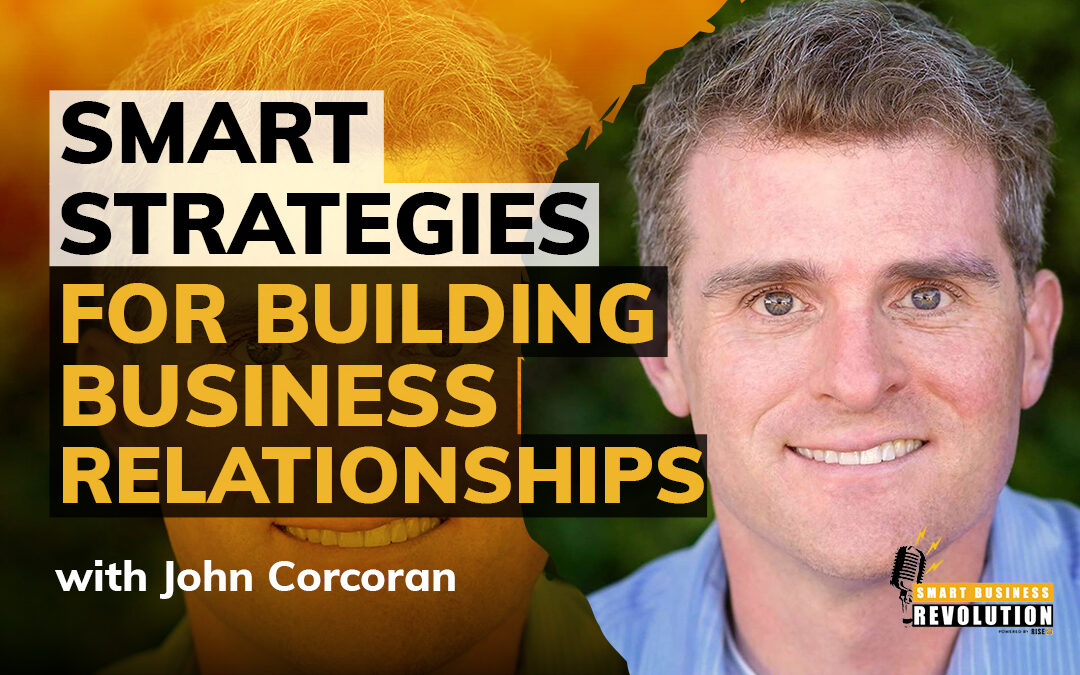
John Corcoran is a recovering attorney, an author, and a former White House writer and speechwriter to the Governor of California. Throughout his career, John has worked in Hollywood, the heart of Silicon Valley, and run his boutique law firm in the San Francisco Bay Area, catering to small business owners and entrepreneurs.
Since 2012, John has been the host of the Smart Business Revolution Podcast, where he has interviewed hundreds of CEOs, founders, authors, and entrepreneurs, including Peter Diamandis, Adam Grant, Gary Vaynerchuk, and Marie Forleo.
John is also the Co-founder of Rise25, a company that connects B2B businesses with their ideal clients, referral partners, and strategic partners. They help their clients generate ROI through their done-for-you podcast service.







Here’s a Glimpse of What You’ll Hear:
- [0:40] John Corcoran shares the must-use tool that’s quietly transforming B2B growth
- [2:43] Why true thought leadership goes far beyond LinkedIn posts and blog content
- [3:37] How AI note-taking tools dramatically improve meeting focus and follow-through
- [5:35] Turning raw meeting transcripts into clear, actionable SOPs with ChatGPT
- [7:09] Unlocking long-term value with a strategic, automated email welcome sequence
- [12:12] Why podcasting is one of the most powerful gateways to high-value business relationships
In this episode…
Many professionals struggle to stand out online and build the relationships that fuel business growth, often feeling overwhelmed or plagued by impostor syndrome as they step into thought leadership. With countless tools and platforms competing for attention, it’s hard to know where to focus. How can you overcome self-doubt, use modern tools effectively, and build meaningful B2B connections?
John Corcoran, a seasoned entrepreneur and relationship-building expert, faced these challenges directly by applying clear frameworks, smart technology, and a people-first mindset. Drawing on resources like Winnie Hart’s The Daily Thought Leader, John shares how consistent, practical content can build credibility and quiet self-doubt. He also explains how AI note-taking tools and intentional email welcome sequences helped him boost productivity, nurture prospects, and turn casual interest into lasting professional relationships.
Tune in to this episode of the Smart Business Revolution Podcast as Chad Franzen of Rise25 interviews John Corcoran about leveraging thought leadership and technology to build real B2B relationships. They discuss overcoming impostor syndrome, leveraging AI note-taking tools, and creating an effective email welcome series that nurtures leads and opens doors to new partnerships.
Resources mentioned in this episode:
Special Mention:
- EO (Entrepreneurs’ Organization)
- Winnie Hart on LinkedIn
- The Daily Thought Leader by Winnie Hart
- The Daily Thought Leader podcast
- Peter Lang on LinkedIn
- Agency Acquisitions and Exits podcast
- Fathom AI
- Google Gemini
- ChatGPT
Quotable Moments:
- “Sometimes people self-sabotage without even realizing it, so any advice on becoming a thought leader must address imposter syndrome.”
- “AI note takers have become a second brain, helping you be more productive and follow through on your commitments.”
- “A podcast can open up your funnel and get you into conversations with people you wouldn’t otherwise reach.”
- “If your emails provide value and educate, you’ll earn trust and people will even look forward to receiving them.”
- “You never know where a podcast conversation might lead — some of the best opportunities come from unexpected connections.”
Action Steps:
- Start creating and sharing thought leadership content regularly: Publishing valuable content consistently builds credibility and visibility while shifting focus from perfection to value-driven contributions.
- Leverage AI-powered tools to streamline meeting productivity: Use AI note-taking tools to capture discussions, generate summaries, and track follow-ups to improve accountability and execution.
- Implement an email welcome series for leads: Create an automated sequence that delivers relevant, structured content to nurture new subscribers and guide them toward engagement.
- Use podcasts as a networking and business development tool: Host a podcast to build relationships with ideal partners and prospects while expanding your business opportunities through meaningful conversations.
- Remain open to unexpected connections and opportunities: Engage broadly with contacts to unlock referrals, partnerships, and insights that may emerge from unanticipated conversations.
Sponsor: Rise25
At Rise25 we help B2B businesses give to and connect to your ‘Dream 200’ relationships and partnerships.
We help you cultivate amazing relationships in 2 ways.
#1 Podcasting
#2 Strategic Gifting
#1 Our Predictable Podcast ROI Program
At Rise25, we’re committed to helping you connect with your Dream 200 referral partners, clients, and strategic partners through our done-for-you podcast solution.
We’re a professional podcast production agency that makes creating a podcast effortless. Since 2009, our proven system has helped thousands of B2B businesses build strong relationships with referral partners, clients, and audiences without doing the hard work.
What do you need to start a podcast?
When you use our proven system, all you need is an idea and a voice. We handle the strategy, production, and distribution – you just need to show up and talk.
The Rise25 podcasting solution is designed to help you build a profitable podcast. This requires a specific strategy, and we’ve got that down pat. We focus on making sure you have a direct path to ROI, which is the most important component. Plus, our podcast production company takes any heavy lifting of production and distribution off your plate.
We make distribution easy.
We’ll distribute each episode across more than 11 unique channels, including iTunes, Spotify, and Amazon Podcasts. We’ll also create copy for each episode and promote your show across social media.
Cofounders Dr. Jeremy Weisz and John Corcoran credit podcasting as being the best thing they have ever done for their businesses. Podcasting connected them with the founders/CEOs of P90x, Atari, Einstein Bagels, Mattel, Rx Bars, YPO, EO, Lending Tree, Freshdesk, and many more.
The relationships you form through podcasting run deep. Jeremy and John became business partners through podcasting. They have even gone on family vacations and attended weddings of guests who have been on the podcast.
Podcast production has a lot of moving parts and is a big commitment on our end; we only want to work with people who are committed to their business and to cultivating amazing relationships.
Are you considering launching a podcast to acquire partnerships, clients, and referrals? Would you like to work with a podcast agency that wants you to win?
Rise25 Cofounders, Dr. Jeremy Weisz and John Corcoran, have been podcasting and advising about podcasting since 2008.
#2 Our Comprehensive Corporate Gifting Program
Elevate business relationships with customers, partners, staff, and prospects through gifting.
At Rise25, thoughtful and consistent gifting is a key component of staying top of mind and helps build lasting business relationships. Our corporate gift program is designed to simplify your process by delivering a full-service corporate gifting program — from sourcing and hand selecting the best gifts to expert packaging, custom branding, reliable shipping, and personalized messaging on your branded stationary.
Our done-for-you corporate gifting service ensures that your referral partners, prospects, and clients receive personalized touchpoints that enhance your business gifting efforts and provide a refined executive gifting experience. Whether you’re looking to impress key stakeholders or boost client loyalty, our comprehensive approach makes it easy and affordable.
Discover how Rise25’s personalized corporate gifting program can help you create lasting impressions. Get started today and experience the difference a strategic gifting approach can make.
Email us through our contact form.
You can learn more and watch a video on how it works here: https://rise25.com/giftprogram/
Contact us now at support@rise25.com or message us here https://rise25.com/contact/
Episode Transcript
John Corcoran: 00:00
All right. Today we’re going to change things up a little bit. And I’m going to share a tool. I recommend that you use an issue affecting the B2B industry. A thought leader I think you should be paying, paying attention to, and much more.
I’m going to be interviewed today by Chad from Rise25, so stay tuned.
Intro: 00:18
Welcome to the Smart Business Revolution Podcast, where we feature top entrepreneurs, business leaders, and thought leaders and ask them how they built key relationships to get where they are today. Now let’s get started with the show.
John Corcoran: 00:35
All right. Welcome everyone. John Corcoran here, I am, the host of this show. And you know, every week we have smart CEOs, founders, entrepreneurs, including we’ve had folks from Netflix, Grubhub, Redfin, Gusto, Kinkos, Ypo, AEO, Activision Blizzard, and LendingTree. So go check out check out the archives.
Lots of great episodes for you to check out there. And before we get into this interview, this episode is brought to you by Rise25. At Rise25. We help businesses to give to and connect to their dream relationships and partnerships. How do we do that?
We do that by helping you to run your podcast. We are the easy button for any company to launch and run a podcast. We do three things strategy, accountability in full execution. In fact, we invented what some are calling the Wix of B2B podcasting. It’s our platform podcast CoPilot.
So if you’d like to learn more, you can go to our website Rise25.com or email our team at support@rise25.com. All right. I’ll turn it over to you, Chad.
And you can take it away from here.
Chad Franzen: 01:28
Okay. Sounds good. Thanks so much for having me today, John. Let’s just kind of dive right into it. A recent book or podcast that has caught your attention.
John Corcoran: 01:35
All right, so I’ve been on a tear lately, reading a lot of books and one that I’m a fan of here is this one. It’s called The Daily Thought Leader. It’s by Winnie Hart, who’s a friend. I know her through the Entrepreneurs’ Organization. She’s very active there.
And what’s really cool about this is it is so practical for anyone who. And I know there’s a lot of people like this who want to start putting some thought leadership out there, their want to build their reputation and increase their visibility online and offline. And this is very practical, really kind of like a workbook. It’s even got places in here where you can write into it, and you can just flip it open each day and say, okay, well, here’s here’s something that I can do today. And it’s very pragmatic for someone who wants to get started.
And she also turned it into a podcast as well. She’s got 365 episodes in that podcast, so you can go check that out if you prefer to listen, you know, like I do. So definitely check that out. It’s The Daily Thought Leader by Winnie Hart.
Chad Franzen: 02:36
Is that something like like by thought leader you mean establishing yourself online, like on LinkedIn or on a blog or something like that?
John Corcoran: 02:43
I mean, including what we’re doing right now. So just. Yeah. Recording yourself. Yeah.
Could it’s blogging. It’s it’s podcasting. It’s videos. It’s sharing on LinkedIn on other social channels. So it’s all of those pieces.
Chad Franzen: 02:57
Okay. Very nice. Does it address thinking of yourself as a fraud or you could be exposed as a fraud.
John Corcoran: 03:04
Of course. Of course. That’s a big one, right? Yeah. I mean, so many people that struggle with that, that is one.
Even if people don’t, they don’t articulate it or they don’t realize it. But that is a super common one. And sometimes people kind of self-sabotage without even realizing or recognizing it. So, you know, any treatise or advice on how to become a thought leader really must address that issue?
Chad Franzen: 03:31
Okay, awesome. Well, check that out. A tool that you use. What’s one that you’ve found particularly valuable lately?
John Corcoran: 03:37
So here’s the one that I use on a daily basis, in fact, multiple times per week. And I haven’t even mentioned it before. So fathom fathom dot video fathom AI. Not sure exactly what the name of it is, but there’s lots of AI note takers out there. This is the one that we’ve chosen to use.
It’s very seamless. It comes into all my Zoom meetings, and if you haven’t used a note taker before, then You know, a lot of times people are a little bit resistant, hesitant, worried about privacy or something like that. They become so ubiquitous. You know, you come into meetings now and there’s, you know, sometimes more note takers than there are people. But it’s kind of become a second brain.
You know, I’m so used to it now to be able to take that transcript, transcribe your conversation really quickly, create a follow up email or create a follow up checklist of to do items. It’s amazing how it captures so many different things. So I’ve had other members of our team say, you know, I’ve said to them like, you need to get one of these as well. So we make sure that other members of the team do it too, because, you know, you have a meeting, there’s lots of ideas and action items and things like that that come out, and then it can be really difficult, any kind of meeting afterwards to think about, oh wait, what did we commit to doing and what do we need to do? And what was the next steps and what was the decision on that and who was going to be responsible for it?
And so these, you know, this crop of AI note takers that have come along that help with virtual meetings have been really incredible with helping you to be more productive and follow through on the things that you said that you’re going to do, including myself as well. So yeah, I’m a big fan of it for that reason.
Chad Franzen: 05:17
Yeah, it provides a video, provides a video recording of the call. Right. It provides a timestamped transcript of that video recording, and then also another section where it kind of breaks it down into notes and kind of bullet points and summaries.
John Corcoran: 05:35
You know, there’s a lot of different things you can do with it. And of course you can take that transcript and then you can do a lot with it. You can go into whatever your LM is of choice, ChatGPT, Gemini, whatever you paste it in there and then turn it into a lot of additional things. So we’ve started using it for creating SOPs. So if we want to create, you know, document a process around something that we do, I will go and record something on Zoom with Fathom and, you know, walk through that process and you’ve there, you’ve got a video, you’ve got a transcript.
You can then take that transcript. And using something like ChatGPT, turn it into a multi-step process and boom, you’ve you’re done.
Chad Franzen: 06:16
Okay. Next topic someone in your network who has impacted you recently.
John Corcoran: 06:21
Yeah. So I want to say thank you to Peter Lang, Peter Lang, who is an expert in agency mergers and acquisitions agencies, Agency Acquisitions and ExitsPodcast, as the name of his podcast. And he’s got lots of great guests on there. And he’s a guy who comes from the agency world. He’s been an advocate for us and introduced us to some people.
So we we really appreciate him and what he does. And and he shares a lot of wisdom. I had him as a guest on my podcast and shared a lot of wisdom there, so definitely wanted to give him a shout out and be sure you go check him out. Especially if you’re an agency owner and you’re curious about mergers and acquisitions. He’s got a lot to have wisdom to share.
Chad Franzen: 07:03
What about an issue in the B2B podcasting industry?
John Corcoran: 07:09
Yeah. So I thought about this one. And this is one I’ve been talking about recently because as we record this, it’s the end of the year. I look back in the last 12 months and I realized that we had a fairly significant bump in clients who became clients, in part because they had been activated by our Email Welcome series, aka Email Indoctrination Series. It’s a series of emails that you set up that go out to people who have opted in.
It’s not cold email, but people have opted in. They’ve come to your website, they’ve opted in to receive information from you, and the vast majority of people come to your website. Something like 90% of people who come to any website bounce within 60s and they never come back again. But if you have something that’s appealing on your website that they that your ideal client, your ideal prospect needs help with a pain point, a challenge, something like that, and you have something that can help them save time to achieve what they want to achieve faster than people, oftentimes not 100% of the time. But many people will give you your email, give you their email address in order to obtain that thing.
And when they do, then that gives you the permission to follow up with them. You can send a series of polite messages which are kind of like set it and forget it, because you set up these emails and they get dripped out over time. They also go in the order that you want them to. So there are certain questions that your ICP, your ideal client, probably has. And you want to address those questions, those challenges that they have in a particular order each time when they enter your website, who knows where they came through.
They could have come through an old blog post or something like that. So they don’t go in the same flow. They don’t go in the same order that you want to educate them. And so this allows you to do it as well as being a way of communicating with those people that would, would have otherwise just come to your website bounced and you’d never hear from them again. So that’s something that we’re going to be doing a lot more of in the in the year ahead.
After I took a look at it and I realized that it had been, you know, quite successful for us. So if you were a B2B business owner and you are thinking, you know, what is an email welcome series, or do I even need one, I would say absolutely, yes, you should do one. And it really differentiates you from a lot of other B2B businesses out there. Probably your competitors are not doing it, and that’s a big reason why if you do it, it can really be invaluable and can really distinguish you, you know, separate you from your competition.
Chad Franzen: 09:45
Okay. Very interesting. Is there kind of like a line that you want to make sure you don’t cry, you don’t want to overdo it. Even when somebody gives you permission to sign up or to send them emails.
John Corcoran: 09:55
Well, that’s the thing is you if you are careful about these things, you and you monitor them, you will know if you’ve gone over the line because your unsubscribe rate will spike.
Chad Franzen: 10:03
Right, right, right.
John Corcoran: 10:04
You know, so you you know, I don’t think you should be sending, you know, seven emails a day. You know, every there’s different frequencies work for different people. You know, I’ll say sending one email month is probably not going to do anything. You know, if someone comes. Think of it this way.
If someone comes to your website because they have a pain or a challenge and they need help with that thing, how urgent is that thing? For some people, maybe it’s not that urgent. For others, it’s really urgent. Like they need help with it right now. So if they’re going out educating themselves on different websites on the internet, then you probably want to send them messages that are that are appropriate to the level of urgency of the pain or the challenge that they have.
Right? You know, if you were in an urgent care facility, they might be going to your website because they have a broken arm or a hurt finger or something like that, and they really need some resolution ASAP. You know, for other businesses, it’s maybe a longer term sales cycle. And so you could send fewer emails. But I think certainly a couple of times a week, you know, we get so many emails that even if you send a couple of times a week, people aren’t going to see many of those emails at all, you know.
Or they might see them. They might not open it. So you got to send a lot of them. Yeah. I would recommend, you know, for most B2B businesses, you should probably have 20, 30, 40 emails.
We have at this point, I think 40 or 50. And we’re going to be adding more to it because our unsubscribe rate has not gone down substantially. It stayed rather steady. So if those emails that you send are educational, if they are helping people and if they, you know, lead with just providing value to people, then you will earn their trust and they will even look forward to those emails. You know, they’ll be waiting for the next one.
And then that allows them to learn more about you, and then they’re more likely to trust you enough to then reach out when the timing is right, and they need your assistance on what it is you do.
Chad Franzen: 12:01
Okay. Awesome. Last thing for you, a question related to client work, maybe a challenge that a client is facing, a case study, recent story, stories. Something like that.
John Corcoran: 12:12
Yeah. So we help B2B businesses to create podcasts and to use a podcast to get into conversation with our ideal clients, referral partners and strategic partners. And the thing that a podcast does, it does many different things. One of the main things it does is it can really open up your funnel. It can get you into conversation with people that you wouldn’t get into conversation with otherwise.
And so I’ve had billionaires and CEOs of publicly traded companies. Some of the busiest people on the planet have been on my podcast. And, you know, you won’t get 100% of people to say yes to be a guest on your podcast, but it is an amazing way to get an opening, to get a foot in the door with people you want to get a foot in the door with. And if you’re a B2B business and you are struggling to connect with people, that can be a godsend because it really can open up your funnel and some of those people are going to want nor want to know more about you and want to have a further conversation with you about what you do. And it’s especially helpful if you’re a B2B business and you can’t tell from the outside whether a business that you’re looking at is a whether that you know that they are they need your help or whether they’re an ideal client for you because it gets you into a conversation.
And then you can ask questions in the, you know, kind of the, the vicinity of the podcast or as you’re doing the podcast before, after that sort of thing, to figure out whether they could be a good client for you, you know, or vice versa. There’s many times that the opposite is true. So that’s the big thing that I want to say is that, you know, sometimes we’ve I’ve talked to many people who, you know, view the podcast as, oh, I need to I need to only talk to people that are my ideal, you know, client. Well, sometimes you can’t tell if a guest is an ideal client or not, but if they are in, in, you know, inside of a company that might be could be a good client for you or if they’re, you know, similar job title or if they’re well networked in the industry in which you play. Then I say open yourself up to a conversation using the purpose of the podcast, because you never know where it might lead.
And oftentimes, the best referrals and the best opportunities have come from people that are looking from the outside. I didn’t see it. You know, I thought, oh, maybe this isn’t going to be that good of a use of time. And then I go and have an amazing conversation for the purpose of the podcast. And they become an advocate.
They become a friend. They become a referral partner. They become a strategic partner. They introduce me to someone that I never would have met otherwise. So sometimes you just got to open yourself up to those types of opportunities.
Chad Franzen: 14:52
Yeah, absolutely. Sounds good. Hey, John, always great to talk to you. Very interesting and informative. Thanks so much for having me today.
John Corcoran: 14:56
Great. Thanks so much, Chad.
Chad Franzen: 14:58
So long, everybody.
Outro: 14:59
Thanks for listening to the Smart Business Revolution Podcast. We’ll see you again next time and be sure to click subscribe to get future episodes.