
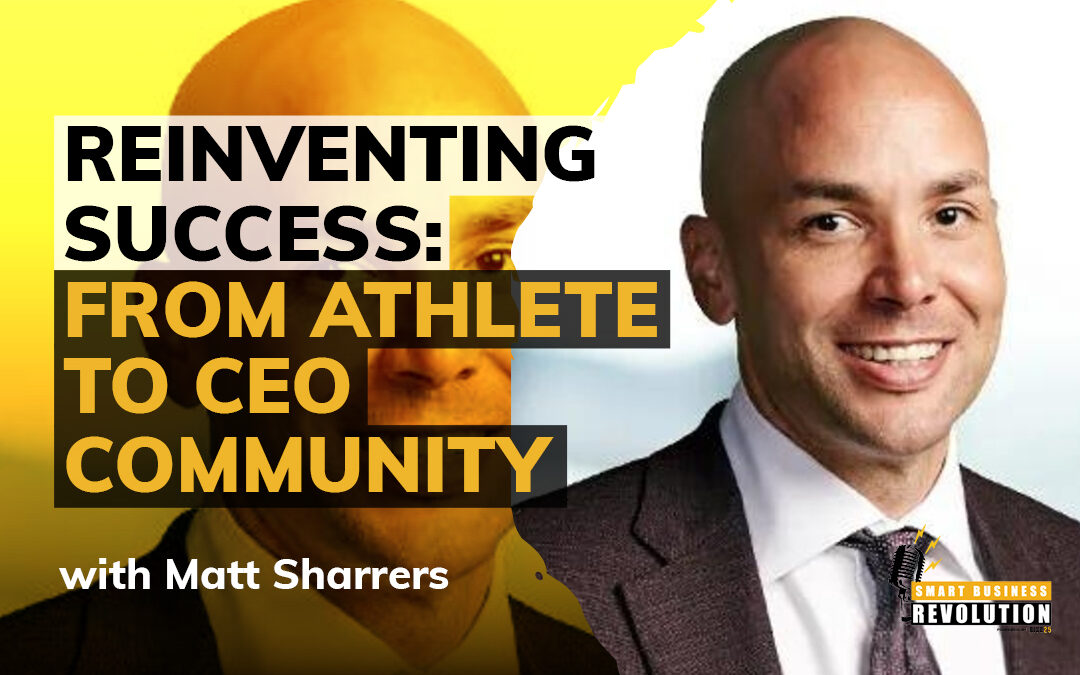
Matt Sharrers is the Managing Partner of ETJ Advisory and Founder of ETJ Life, a private, invitation-only community that supports CEOs backed by private equity in navigating leadership transitions and building fulfilling lives. As the former CEO of SBI, Matt helped scale the company and guided it through multiple successful exits, while his current ventures draw on decades of executive leadership and board advisory experience.
A former professional hockey player who represented Canada at the national level, Matt is passionate about helping both elite athletes and business leaders achieve their highest potential. His work and recent book, The Second CEO, focus on the unique challenges and opportunities faced by CEOs in high-pressure, private-equity-backed environments.







Here’s a Glimpse of What You’ll Hear:
- [1:38] How Matt Sharrers reinvented himself from a pro athlete to a successful entrepreneur
- [2:44] The childhood sales strategy that doubled Matt’s fundraising results
- [4:12] Family lessons that shaped Matt’s communication and leadership style
- [6:20] Inside Matt’s journey with Team Canada and his pro hockey career overseas
- [10:14] The turning point that led Matt to retire from professional sports
- [13:39] Why Matt left a high-paying sales career to pursue consulting and leadership work
- [16:04] How SBI built a strong foothold in the private equity advisory market
- [20:44] Matt’s proven roadmap for navigating major career transitions
In this episode…
The path to reinvention is rarely linear, especially when shifting from elite athletics to corporate leadership and then to entrepreneurship. Many high performers struggle to release old identities while stepping into roles that demand new skills, new mindsets, and deeper purpose. What does it really take to navigate such dramatic transitions, and how can you redefine success without losing yourself?
Matt Sharrers, an expert in executive leadership and CEO advisory, shares how he progressed from professional hockey to corporate sales and ultimately to building a respected advisory practice and CEO community. Matt explains how shedding his athletic identity taught him resilience, why stepping in after a charismatic founder required deliberate, disciplined leadership, and how professionalizing a fast-growing organization prepared him for future transitions. Through stories and lessons learned, Matt demonstrates that reinvention thrives on ongoing reflection, courage, and an unwavering commitment to meaningful impact.
Tune in to this episode of the Smart Business Revolution Podcast as John Corcoran interviews Matt Sharrers, Managing Partner of ETJ Advisory and Founder of ETJ Life, about navigating major career reinventions. Matt shares insights on scaling as a second CEO, building communities for high achievers, and designing a life anchored in purpose.
Resources mentioned in this episode:
- John Corcoran on LinkedIn
- Rise25
- Matt Sharrers on LinkedIn
- ETJ Life
- ETJ Advisory
- The Second CEO: Accelerating Scale When Following the Founder by Matt Sharrers
Special Mention(s):
Quotable Moments:
- “There’s no education better than starting a company, running a company, and selling a company — three different lessons, but they’re all good.”
- “Many people tell themselves they need one more run, but time is the most important asset you’ll ever have.”
- “Hard things force you to evolve at a rapid rate. I kind of like the deep end of the pool.”
- “Define what work means in your life, or someone else will define it for you.”
- “When you become chairman, define a scorecard for yourself and stay out of your CEO’s way.”
Action Steps:
- Embrace reinvention and adaptability: Seek new challenges continuously and stay open to changing your professional path to remain relevant and foster personal growth.
- Build and leverage key relationships: Actively cultivate connections with peers and mentors to gain guidance, support, and access to new opportunities.
- Invest in self-awareness and purposeful planning: Regularly assess your values, skills, and long-term goals to ensure each career move aligns with what matters most.
- Create clear succession and transition plans: Proactively define roles, expectations, and support structures to enable smooth and successful leadership transitions.
- Prioritize personal well-being and work-life balance: Intentionally design your career to allow time for health, family, and personal interests to prevent burnout and sustain high performance.
Sponsor: Rise25
At Rise25 we help B2B businesses give to and connect to your ‘Dream 200’ relationships and partnerships.
We help you cultivate amazing relationships in 2 ways.
#1 Podcasting
#2 Strategic Gifting
#1 Our Predictable Podcast ROI Program
At Rise25, we’re committed to helping you connect with your Dream 200 referral partners, clients, and strategic partners through our done-for-you podcast solution.
We’re a professional podcast production agency that makes creating a podcast effortless. Since 2009, our proven system has helped thousands of B2B businesses build strong relationships with referral partners, clients, and audiences without doing the hard work.
What do you need to start a podcast?
When you use our proven system, all you need is an idea and a voice. We handle the strategy, production, and distribution – you just need to show up and talk.
The Rise25 podcasting solution is designed to help you build a profitable podcast. This requires a specific strategy, and we’ve got that down pat. We focus on making sure you have a direct path to ROI, which is the most important component. Plus, our podcast production company takes any heavy lifting of production and distribution off your plate.
We make distribution easy.
We’ll distribute each episode across more than 11 unique channels, including iTunes, Spotify, and Amazon Podcasts. We’ll also create copy for each episode and promote your show across social media.
Cofounders Dr. Jeremy Weisz and John Corcoran credit podcasting as being the best thing they have ever done for their businesses. Podcasting connected them with the founders/CEOs of P90x, Atari, Einstein Bagels, Mattel, Rx Bars, YPO, EO, Lending Tree, Freshdesk, and many more.
The relationships you form through podcasting run deep. Jeremy and John became business partners through podcasting. They have even gone on family vacations and attended weddings of guests who have been on the podcast.
Podcast production has a lot of moving parts and is a big commitment on our end; we only want to work with people who are committed to their business and to cultivating amazing relationships.
Are you considering launching a podcast to acquire partnerships, clients, and referrals? Would you like to work with a podcast agency that wants you to win?
Rise25 Cofounders, Dr. Jeremy Weisz and John Corcoran, have been podcasting and advising about podcasting since 2008.
#2 Our Comprehensive Corporate Gifting Program
Elevate business relationships with customers, partners, staff, and prospects through gifting.
At Rise25, thoughtful and consistent gifting is a key component of staying top of mind and helps build lasting business relationships. Our corporate gift program is designed to simplify your process by delivering a full-service corporate gifting program — from sourcing and hand selecting the best gifts to expert packaging, custom branding, reliable shipping, and personalized messaging on your branded stationary.
Our done-for-you corporate gifting service ensures that your referral partners, prospects, and clients receive personalized touchpoints that enhance your business gifting efforts and provide a refined executive gifting experience. Whether you’re looking to impress key stakeholders or boost client loyalty, our comprehensive approach makes it easy and affordable.
Discover how Rise25’s personalized corporate gifting program can help you create lasting impressions. Get started today and experience the difference a strategic gifting approach can make.
Email us through our contact form.
You can learn more and watch a video on how it works here: https://rise25.com/giftprogram/
Contact us now at support@rise25.com or message us here https://rise25.com/contact/
Episode Transcript
John Corcoran: 00:00
All right. Today, we’re talking about reinvention, how to go from professional athlete to corporate sales to entrepreneur to now building a community of CEOs. My guest today did all of those things. His name is Matt Sharrers. I’ll tell you more about him in a second, so stay tuned.
Intro: 00:18
Welcome to the Smart Business Revolution Podcast, where we feature top entrepreneurs, business leaders, and thought leaders and ask them how they built key relationships to get where they are today. Now let’s get started with the show.
John Corcoran: 00:34
All right. Welcome, everyone. John Corcoran here. I’m the host of this show. And you know, every week we talk to smart CEOs, founders, and entrepreneurs from all kinds of companies.
And if you check out the archives, we’ve got episodes with Netflix and Grubhub, Redfin, Gusto, Kinko’s, Activision Blizzard, LendingTree, lots of great episodes. So go check out those archives. And before we get into this, this episode is brought to you by our company, Rise25, where at Rise25, we help businesses to give to and connect to their dream relationships and partnerships. How do we do that? We do that by helping companies run their podcasts.
We are the easy button for a company to launch and run a podcast. We do three things: strategy, accountability, and full execution. And we’ve even invented what some are calling the Wix B2B podcasting. It’s our platform, Podcast CoPilot. So to learn how you can get started, you can go to our website, rise25.com, or also email us, email the team at. support@rise25.com. All right. Quick shout-out to Greg Alexander of Collective 54, friend of the show. Been a guest before who gave us our recommendation of today’s guest. His name is Matt Sharrers.
He’s the managing partner at ETJ Advisory, which we’ll talk about what that stands for in a moment. He brings decades of experience in executive leadership, board advisory, and sales strategy, and he works with CEOs, particularly founders and CEOs and private equity-backed companies, helping them to navigate all the different things that they have to navigate like leadership transitions, scaling organizations, aligning, aligning teams for growth, that sort of thing. And before that, he was the chairman and CEO of SBI, a growth Advisory consulting firm focused on B2B revenue growth, and earlier in his career did sales and was even a professional athlete. So we’re going to talk about all of those things. But first, before we even get into those interesting topics, Matt, I’d love to know what people are like.
As a kid, you grew up in the British Columbia area and started out cutting grass for kids before moving into, sorry, cutting grass for neighbors before moving into lifeguarding. Tell us about young Matt Sharrers going around knocking on doors and signing up the neighbors as clients.
Matt Sharrers: 02:44
Yeah. First off, John, thanks for having me. To you and the team, life as a child. Well, I grew up in a small town in Western Canada, so hockey was a big part of my childhood, and every moment that I wasn’t playing hockey, I was very active, was a competitive swimmer, and played baseball. And yeah, when I was having to make some money, I think my first entrepreneurial venture was raising money for what we called the skate a thon, where you had to go around the rink, you know, 100 times or 200 times, and I’d go door to door and have people pledge me for how many rounds I could do when I was like nine years old.
That turned into.
John Corcoran: 03:27
How many rounds, by the way, did you do?
Matt Sharrers: 03:30
That is a good question. I whatever the number was, because it actually wasn’t that high of a bar. I think I was able to get over it. I think it was like either 100 or 150 laps around the arena. I think that it was more that was the early days of maybe everybody gets a ribbon because we were I think we were raising money.
John Corcoran: 03:50
I think I’m getting dizzy even thinking of it. But yeah.
Matt Sharrers: 03:53
Yeah man. yeah, early 80s, but I enjoyed back then even knocking on the door and giving people my pitch. And when they would say they pledge $0.25 I would often say most are pledging 50.
John Corcoran: 04:10
So it seemed.
Matt Sharrers: 04:12
Like I had maybe some commercial instincts as a young man.
John Corcoran: 04:15
And if they said 50, you said most are pledging 75.
Matt Sharrers: 04:18
I would say if you’re going to do 50, you might as well do a buck.
John Corcoran: 04:21
So that’s great. But did this come naturally to you? Did you have someone in your life that you learned this from?
Matt Sharrers: 04:30
Yeah, like my parents. Neither were in sales. My dad was a very authoritative speaker. He could command a room. So.
And he was he was my brother and my swim coach. So I would watch him as he would, like, captivate attention. And I started to mirror and I think probably still do some of the things that he would do just the way that he would articulate himself. And he was very big around our dinner table. You had to explain yourself.
If you didn’t understand what a word meant, you had to stop. You had to go to the dictionary, look up the word, and then come back to the table. True story.
John Corcoran: 05:11
Wow.
Matt Sharrers: 05:11
So. And if I ever said, dad, what does that word mean? He would always say, what do you think it means? And if I didn’t know, I had to go get the dictionary.
John Corcoran: 05:20
Did that teach you to not ask? Yes it does.
Matt Sharrers: 05:24
My older brother, my older brother Jay, would kick me under the table when I would say that because he was quieter than me and just looked at me and be like, don’t ask me.
John Corcoran: 05:35
So.
Matt Sharrers: 05:36
So that was my that was my upbringing. It was a.
John Corcoran: 05:38
Lot. So you learning sales? Actually, I was just interviewing someone else who followed this progression. This is a common progression where it goes from like door to door in the neighborhood selling something, chocolates, candy, whatever, you know, Pledges, and then eventually you realize, oh, there’s like a higher leverage types of sales that I can do. And then that draws people into the world of business like, rather than selling to my neighbors who are aren’t expecting to buy a chocolate bar on a Tuesday at 3:00.
Then I’ll sell to, you know, businesses that are actually looking for a solution that I can provide to them. And so eventually you end up in well, first there’s professional athlete. You become a professional athlete. What was it like being on the Canadian national team? That must have been phenomenal.
Matt Sharrers: 06:20
Yeah, that was a big that was a thrill. It was a highlight. I left college early to to sign with Team Canada in my at the end of my junior year. And I mean, as a young boy growing up in, in Canada, you dream about playing professional hockey and or putting on the jersey of your country. So that definitely was a highlight.
John Corcoran: 06:41
So there, you know, normally when someone says, I’m going to drop out of school to do x, y, z, a lot of times family members are like, oh, do you want to do that? Is that really a good idea? But I imagine in Canada, if you’re joining the national team to play hockey, there aren’t many people saying stop. They’re saying like, go, go, go, right?
Matt Sharrers: 06:58
Yeah, everyone. Everyone was pretty much, yeah, you should do that. And that’s a really good idea. So yeah, I left at the start of my senior year of college. And yeah, it was to this day one of the best experiences of my life.
John Corcoran: 07:16
All right. So you spend time with the national team and then you actually go and play pro in hockey leagues in, in Europe for a number of years. In your 20s. What was that experience like?
Matt Sharrers: 07:27
It was a great experience. I was, you know, when I was in college, John, my last couple of years, I actually thought that was going to be the end of the road, which I was very happy and comfortable, like, hey, playing college hockey, right? A lot of kids dream about being able to do that. Yeah, some of my schools being reimbursed. I mean, all this good stuff, and then things just kind of clicked.
My sophomore junior year started to get some attention from a couple of NHL teams. That kind of led me into what football people in the states would call the combine for the national team, which then led me to the national team. So that’s how I ended up there, played in Europe, and then had to have that realistic conversation with myself that said, okay, life is really good and comfortable. It looks like the door in the NHL is closed. Do I want to play hockey until my skates fall off, or do I want to move forward, kind of get going on the next chapter of my life?
John Corcoran: 08:25
And is Europe playing hockey in Europe? Obviously the goal is to get to NHL, right? Like playing hockey in Europe. I assume you’re not paid as much. It’s not as glamorous.
There aren’t as large teams there. Is that correct?
Matt Sharrers: 08:38
Well, at that time or even right now, I mean, it is a great option. And from a money standpoint, it’s the the next most lucrative to play in the NHL.
John Corcoran: 08:48
Okay.
Matt Sharrers: 08:48
In the 90s when I was playing mid 90s, if you went and played in Europe, you typically weren’t affiliated with an NHL team. You were playing, you know, in Germany, Switzerland, England, where I was. They pay for your house, they pay for your car. You get paid tax free. So if you compared, like my minor league contract for an NHL team with what I was making in Europe, I was making two and a half times in Europe what I would have been back in North America.
But I wasn’t kind of one phone call away from getting called up to the NHL. So it was more of like a lifestyle decision that a lot of guys would make. Some guys would make it. They’d play 3 or 4 years in the NHL, be on the fringe, go to Europe and play ten years, bank a bunch of money, live a great life.
John Corcoran: 09:35
Yeah.
Matt Sharrers: 09:37
And I had always had aspirations in business. And just I got to that point and honestly, my dad had passed away in 1996, right after I right before I made Team Canada. And my mom was really the one who said, hey, like, I know you’re having a good time, but like, you’re probably not going to play hockey for 40 years in Europe. Do you think maybe it’s time you got a good education? You went to a really good school.
You seem to have some other skill sets, you know. So I credit my mom for it.
John Corcoran: 10:14
Must have been a hard decision, though.
Matt Sharrers: 10:16
Oh, yeah? Yeah, because, I mean, I left home at 16. I’m retiring from hockey at 26. So for a decade, you were defined.
John Corcoran: 10:24
As everything.
Matt Sharrers: 10:24
By the sport.
John Corcoran: 10:26
Yeah, yeah.
Matt Sharrers: 10:27
And it’s nice to say to people, especially in Vancouver, hey, what do you do? Oh, I’m a hockey player.
John Corcoran: 10:33
Yeah, that must be glamorous.
Matt Sharrers: 10:36
Very glamorous. Right. I get into whatever bar I want. I get summers off. I’m playing a ton of golf.
Right, right. All this like you’re living this bubble gum, juicy fruit, commercial lifestyle. And then all of a sudden you’re like, oh, I’m an inside sales rep for Cintas.
John Corcoran: 10:51
Right, right. Doesn’t open as many doors.
Matt Sharrers: 10:53