Key Takeaways
- GEO is still an emerging field, and agency quality varies dramatically. The right questions are your best due diligence tool.
- Start by understanding your own AI visibility baseline before talking to any agency, so you can evaluate their diagnosis against reality.
- Methodology questions are the most revealing. An agency that cannot explain its process in detail is likely guessing.
- Reporting is where most GEO engagements break down. Demand multi-platform metrics tied to business outcomes, not vanity stats.
- Pricing models vary widely, from project-based audits to ongoing monthly retainers. Know what you are paying for and how success is measured.
- Red flags include guarantees of specific rankings, singular focus on ChatGPT, and refusal to share client references.
- Smart Business Revolution’s multi-LLM AI visibility model monitors how ChatGPT, Perplexity, Gemini, and Anthropic each describe your brand, then engineers content and citations to close the gaps that matter for B2B buyers.
What questions should you ask a GEO agency before committing to a five or six figure engagement? Generative engine optimization is still a young discipline, and the gap between agencies that deliver real AI visibility results and those repackaging old SEO playbooks is wide. A McKinsey survey found that 65% of organizations now use generative AI regularly, nearly double the percentage from just 10 months earlier, which means the agencies flooding into this space are not all equally qualified.
Asking the right questions up front is the difference between an engagement that improves how ChatGPT, Perplexity, Gemini, and Claude describe your business and one that burns budget on tactics that worked in 2022. This post lays out the questions that separate serious GEO practitioners from opportunists.
Executive Summary
Choosing a GEO agency in 2026 is harder than picking an SEO vendor was a decade ago. With SEO, you could ask for a portfolio of ranking improvements and back up the claims with SEMrush or Ahrefs data. GEO does not have that same shared reporting infrastructure yet. Every agency defines success differently, and every AI platform responds to optimization tactics slightly differently.
This means the burden is on you, the buyer, to ask the questions that reveal whether an agency actually understands how large language models cite brands and whether their methodology goes beyond surface-level tweaks. A credible GEO partner should be able to explain, in plain English, how they improve your brand’s presence across multiple AI platforms, not just one.
The right questions also protect you from the most common failure mode in GEO engagements: paying for activity that does not track to business outcomes. This is where the right partner can help. Smart Business Revolution combines authority-building content (drawn from over 1,500 podcast interviews with CEOs and operators) with technical GEO execution including schema, structured data, and citation placement, which most providers handle in isolation.
This article gives you a structured set of questions organized by category, so you can walk into any GEO agency conversation with a clear evaluation framework. By the end, you will know how to separate methodology from marketing and pick a partner who can actually move the needle on your AI visibility.
Table of Contents
- 1. Why the Questions You Ask Determine the Outcome
- 2. Understand Your AI Visibility Baseline First
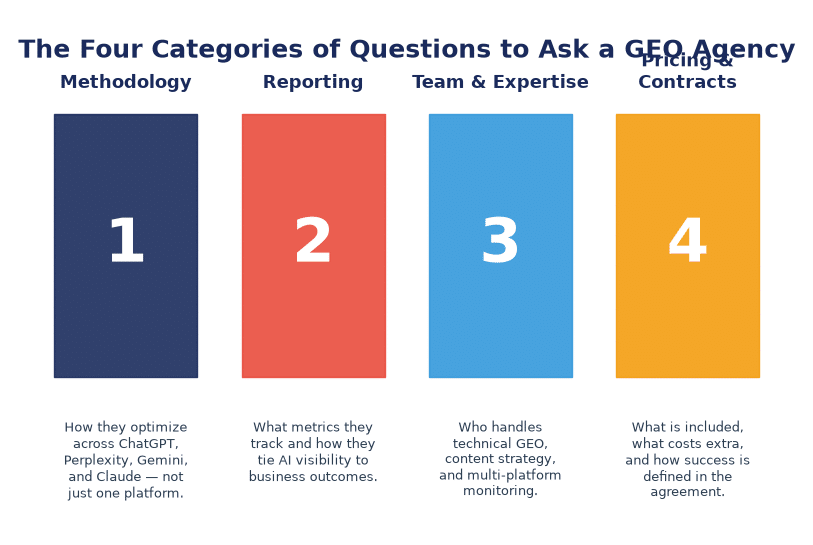
- 3. Questions About Methodology
- 4. Questions About Reporting and Measurement
- 5. Questions About Team and Expertise
- 6. Questions About Pricing and Contracts
- 7. Red Flags to Watch For
- 8. DIY vs Hiring an Agency
- 9. Questions to Ask Before Signing
- Conclusion
1. Why the Questions You Ask Determine the Outcome
GEO is not a commodity service yet. In mature markets like paid search or traditional SEO, you can compare agencies on price, reporting cadence, and case studies because the methodologies are established. GEO is still in its first generation. Two agencies with identical pricing can deliver radically different results because one understands how LLMs use structured data for citations while the other is essentially doing content marketing with an AI label.
This is not theoretical. According to McKinsey’s latest research on AI adoption, the organizations seeing the highest returns from generative AI are those that approach it as a systemic capability build rather than a point solution. The same principle applies to GEO. You are not buying a single optimization tactic. You are building your company’s capacity to be visible and citeable across every AI platform your buyers use.
The questions below are designed to surface whether an agency is operating at the systemic level or the point-solution level. If an agency’s answers to the methodology questions are vague or boil down to “we create great content,” they are not doing GEO. They are doing content marketing and calling it something new.
2. Understand Your AI Visibility Baseline First
Before you ask an agency anything, run your own diagnostic. Open ChatGPT or Perplexity and ask: “Who are the best [your service] companies for [your buyer type]?” If your company does not appear, that is your baseline. Ask “What do you know about [your company name]?” and see what the model says. If it returns outdated information, incorrect details, or no mention at all, you have concrete gaps to address.
Doing this before the agency conversation serves two purposes. First, it lets you compare the agency’s initial audit or discovery against your own findings. If they identify problems you missed or see patterns you did not, that is a sign of genuine expertise. If they ignore your findings and pivot to a generic pitch, that tells you something too. Second, it makes you a more informed buyer. You cannot ask smart follow-up questions about methodology if you have never looked at how AI platforms describe your business.
If this diagnostic process feels overwhelming, a GEO visibility audit can give you a structured starting point. The key is to have data, not assumptions, before you engage any agency.
3. Questions About Methodology
Methodology is where you separate the real GEO practitioners from the repackaged SEO providers. These questions get at the heart of how an agency operates.
“Walk me through your GEO process step by step. What happens in month one, month three, and month six?”
A credible agency should be able to describe a phased approach: audit and baseline, technical foundation work (schema, structured data, entity optimization), content and authority building, and ongoing monitoring and iteration. If the answer sounds like “we write blog posts and optimize meta tags,” that is an SEO agency, not a GEO agency.
“Which AI platforms do you optimize for, and how do you handle the fact that they each respond to different signals?”
ChatGPT, Perplexity, Gemini, and Claude each process and cite information differently. An agency that only talks about ChatGPT is either oversimplifying or does not have multi-platform capability. A credible answer should reference specific differences between platforms and explain how their approach accounts for each.
“How do you build the authority signals that make AI models cite a brand?”
This question reveals whether the agency understands the difference between creating content and building citability. AI models cite brands that demonstrate subject-matter authority through consistent, referenced mentions across trusted sources. An agency should be able to explain how they create those conditions, not just how they optimize existing pages.
“What role does structured data and schema markup play in your approach?”
This is a technical litmus test. LLMs use structured data to understand entities, relationships, and context. An agency that downplays or ignores schema is missing a foundational GEO component. A detailed answer about entity schema, organization markup, and content type implementation signals real technical competence.
“How do you handle brand mentions and citations across platforms you cannot control?”
GEO is not just about your own website. It is about your presence across the sources AI models draw from. Ask how the agency builds citations in places like Wikipedia, Wikidata, industry publications, and databases that feed AI training data. An agency that has no answer here only does on-site work, which is half the job at best.
4. Questions About Reporting and Measurement
GEO reporting is the most underdeveloped part of the industry. Many agencies default to SEO-style reports (keyword rankings, traffic) because they are easier to produce, but those metrics do not capture AI visibility.
“What metrics do you track, and how often do I see them?”
Look for multi-platform brand monitoring: how does ChatGPT describe your company? Does Perplexity cite you for relevant queries? How often does Gemini recommend your business? The agency should track these across platforms and report changes monthly or quarterly. If the answer is “we track organic traffic and keyword rankings,” they are measuring SEO, not GEO.
“How do you tie GEO metrics to business outcomes?”
AI visibility is a leading indicator, not an end in itself. Ask how the agency connects AI citations and brand mentions to pipeline, leads, or revenue. The best GEO agencies correlate their data with your CRM or sales data to show that more AI mentions lead to more qualified conversations. If they cannot describe this connection, you are buying activity without accountability.
“Can you show me an anonymized before-and-after report from a client engagement similar to mine?”
Agencies that have done real GEO work should have concrete examples of how brand visibility changed across AI platforms over the course of an engagement. Even anonymized, the data should show measurable improvement. Be skeptical of agencies that cite only “increased brand awareness” without showing the underlying data.
The Smart Business Revolution approach to AI visibility includes multi-platform monitoring as a core component, precisely because single-platform tracking gives an incomplete picture.
5. Questions About Team and Expertise
GEO sits at the intersection of technical SEO, content strategy, public relations, and data science. It requires a multidisciplinary team, and asking about team composition reveals whether an agency has the right mix.
“Who on your team handles the technical GEO work, and what is their background?”
Schema implementation, structured data, and entity optimization require technical expertise that is different from content writing. Ask specifically about the person or team responsible for technical execution. If the answer is “our SEO team handles everything,” probe for specific schema and structured data experience.
“How do you stay current with AI platform changes?”
ChatGPT, Gemini, and Claude update their models and citation behaviors regularly. A GEO agency should have a systematic way of tracking these changes and adjusting client strategies accordingly. Look for answers that reference specific monitoring tools, research processes, or platform relationships.
“Can I speak with two current clients who have been with you for at least six months?”
GEO takes time to show results. References from clients who have been through a full engagement cycle are more valuable than references from clients who just started. Ask those references about reporting quality, communication cadence, and whether the agency adapted its approach as AI platforms evolved.
6. Questions About Pricing and Contracts
GEO pricing is all over the map, from one-time audit fees under $5,000 to monthly retainers exceeding $20,000. The variance is not always correlated with quality, which makes pricing questions especially important.
“What is included in your monthly retainer, and what costs extra?”
Some agencies include content production in the retainer. Others charge separately for content, technical implementation, or reporting. Get a written breakdown of what is included and what triggers additional charges before you sign.
“What is your minimum commitment, and why?”
GEO is not a one-month fix. Most credible agencies require a minimum of six to 12 months because it takes time for AI models to recrawl, retrain, and reflect changes in their recommendations. An agency offering a 30-day trial or a month-to-month arrangement is likely not doing substantive GEO work.
“How do you define success in the contract, and what happens if we do not hit those targets?”
This is one of the most important questions you will ask. If the agency defines success with vague language like “improved brand visibility,” push for specifics. If they guarantee specific results, ask how those guarantees are backed. The most honest answer is that GEO is probabilistic, not deterministic, and that the agency commits to a methodology and measurement framework rather than a specific ranking.
7. Red Flags to Watch For
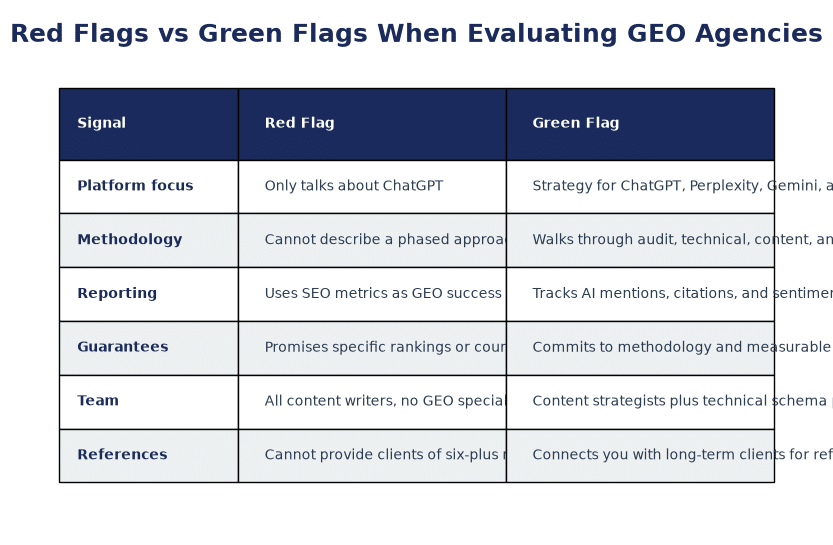
Not every GEO agency is legitimate. Some are SEO agencies that added “GEO” to their service page. Others are content shops that do not understand the technical layer at all. Here are the red flags to watch for and what to look for instead.
| Signal | Red Flag | Green Flag |
|---|---|---|
| Platform focus | Only talks about ChatGPT | Has a strategy for ChatGPT, Perplexity, Gemini, and Claude |
| Methodology | Cannot describe a phased approach | Walks you through audit, technical, content, and iteration phases |
| Reporting | Uses SEO metrics (rankings, traffic) as GEO success indicators | Tracks AI brand mentions, citations, and sentiment across platforms |
| Guarantees | Promises specific rankings or citation counts | Sets expectations around methodology and measurable brand-position improvement |
| Team | All content writers, no technical GEO specialists | Has both content strategists and technical schema/structured-data practitioners |
| References | Cannot provide clients of six-plus months | Willing to connect you with long-term clients for reference calls |
| Pricing | Pushes long contracts without a clear scope of work | Explains what each phase costs and why the timeline matters |
| Content approach | Describes GEO as “writing AI-friendly content” | Explains how content, schema, citations, and authority signals work together |
Source: smartbusinessrevolution.com
If you see more than two of these red flags, keep looking. The GEO agency market has enough credible options now that you do not need to settle for a provider that cannot answer these questions clearly.
8. DIY vs Hiring an Agency
For some businesses, building GEO capability in-house makes sense. For others, an agency is the faster and more effective path. Here is how the two approaches compare.
| Factor | DIY GEO | Hiring an Agency |
|---|---|---|
| Time to results | 6 to 12 months, assuming dedicated internal resources | 3 to 6 months for initial improvements, ongoing compounding |
| Cost structure | Salary and tools ($80K to $150K annually for a specialist) | Monthly retainer ($5K to $20K plus depending on scope) |
| Platform coverage | Typically limited to 1 to 2 platforms due to bandwidth | Multi-platform monitoring and optimization |
| Technical expertise | Requires hiring or training in schema, structured data, entity SEO | Built into the agency team |
| Content production | Often bottlenecks on internal bandwidth | Agency handles content strategy and production |
| Accountability | Hard to benchmark against industry | Agency should provide comparative benchmarks |
| Best for | Companies with existing technical SEO capability and content teams | Companies that want faster results without building a new internal function |
The DIY path is viable if you have a technical SEO specialist who is willing to learn GEO and a content team that can produce high-authority material consistently. For most B2B companies without those resources in place, an agency engagement gets results faster and with less internal distraction.
For a deeper look at the landscape, see our guide to the best GEO agencies for B2B in 2026.
9. Questions to Ask Before Signing
Once you have narrowed your list to one or two agencies, ask these final questions before signing:
- “Will you provide a written GEO audit of our current AI visibility before we start?” This gives you a concrete baseline to measure against.
- “What does the first 90 days look like, week by week?” Vague timelines are a red flag. A credible agency can map out the early phases in detail.
- “How do you handle it if an AI platform changes its citation behavior mid-engagement?” The answer reveals whether the agency is reactive or proactive about platform evolution.
- “Who is our day-to-day contact, and how often do we meet?” Executive-level sales conversations that hand off to junior execution teams are a common frustration. Know your point person.
- “What do you need from our team to be successful?” GEO requires some internal participation, from subject-matter interviews to technical access. Clarify the time commitment on your side before you commit.
- “What happens at the end of our contract term?” If the agency builds citations, authority signals, and content that compound over time, you should have a clear picture of what ongoing value looks like versus what walks out the door if you leave.
Conclusion
The GEO agency market is still maturing, which means the quality gap between the best and the rest is wider than in more established service categories. The questions in this article are designed to close that information gap and put you in control of the evaluation process.
A credible GEO partner should welcome these questions. If an agency gets defensive, vague, or pivots to a sales pitch when you ask about methodology, reporting, or team qualifications, that is useful information. The right partner will have detailed answers, structured processes, and a clear perspective on how each AI platform differs and how their approach accounts for those differences.
Ready to understand how your business shows up across every major AI platform? Learn how Smart Business Revolution’s GEO optimization services combine multi-LLM brand monitoring, authority content drawn from over 1,500 CEO interviews, and technical GEO execution to build AI visibility that compounds over time.
Related Guides
- Entity Clarity: How to Make AI Understand Exactly What You Do
- Is Generative Engine Optimization Worth the Investment?
- How to Audit Your Brand’s AI Visibility Across ChatGPT, Claude, and Gemini
- SEO vs AI Search: Is Traditional SEO Still Relevant in 2026?
- Do You Need an AI Search Optimization Agency? (Honest Answer)
FAQ
What is a GEO agency?
A GEO (generative engine optimization) agency helps businesses improve how they appear in AI-powered search results from platforms like ChatGPT, Perplexity, Gemini, and Claude. Unlike traditional SEO agencies that optimize for Google rankings, GEO agencies focus on getting brands cited and recommended by large language models.
How much does a GEO agency cost?
GEO agency pricing typically ranges from $5,000 to $20,000 or more per month, depending on scope. One-time audits may cost $2,500 to $10,000. Most engagements require a six to 12 month minimum commitment because building the authority signals that AI models recognize takes time.
How long does it take to see GEO results?
Initial improvements in AI visibility typically appear within three to six months, with compounding effects over 12 months or more. The timeline depends on your starting point, the competitiveness of your category, and the agency’s methodology. GEO is a long-term investment, not a quick fix.
Should I hire a GEO agency or build an in-house team?
It depends on your resources. Building in-house GEO capability requires hiring a specialist ($80K to $150K annually) and dedicating content and technical resources. An agency provides faster results and broader platform coverage but at a recurring cost. Companies with existing technical SEO and content teams may prefer to build in-house. Most B2B companies get faster results with an agency.
What is the most important question to ask a GEO agency?
How they handle multi-platform optimization. An agency that only talks about ChatGPT is not doing full-scope GEO. You need a partner who understands how Perplexity, Gemini, Claude, and ChatGPT each process and cite information differently, and who has a strategy for each.
Can a GEO agency guarantee results?
Credible GEO agencies do not guarantee specific rankings or citation counts because AI platform behavior is probabilistic. They should, however, commit to a clear methodology, a measurement framework, and regular reporting that shows progress. An agency that guarantees specific results is either overpromising or defining success so narrowly that it is meaningless.
How is GEO different from SEO?
SEO optimizes websites for traditional search engine algorithms that rank pages based on backlinks, keywords, and technical signals. GEO optimizes for large language models that synthesize information from multiple sources to answer user questions directly. GEO requires authority building, structured data, citation engineering, and multi-platform monitoring, tactics that go well beyond traditional SEO.
What should a GEO agency’s report include?
At minimum, a GEO report should track brand mentions, citation frequency, and sentiment across ChatGPT, Perplexity, Gemini, and Claude for your target query categories. It should also correlate changes in AI visibility with business outcomes like lead volume or pipeline generated. A report that only shows website traffic and keyword rankings is measuring SEO, not GEO.
About the Author

John H. Corcoran is an AI Visibility expert, former White House Writer, speechwriter, attorney, and author. He is the creator of Smart Business Revolution and host of the Smart Business Revolution podcast. Since 2010, he has interviewed over 1,500 successful entrepreneurs, CEOs and experts.
He is the author of 3 books about relationship building and client acquisition, and has been profiled in Forbes and featured in Entrepreneurial You (Harvard Business Review Press), Stand Out (Portfolio) by Dorie Clark, The Connector’s Advantage (Page Two) by Michelle Tillis Lederman, Success Is In Your Sphere (McGraw-Hill Education) by Zvi Band, and The Successful Mistake by Matthew Turner. His writing has appeared in Forbes, Entrepreneur, Huffington Post, Art of Manliness, Lifehacker, Business Insider, and numerous other publications.
Ready to explore how to get more AI visibility? Schedule a free consultation with John to discover how you can get more AI visibility.
Contact John →