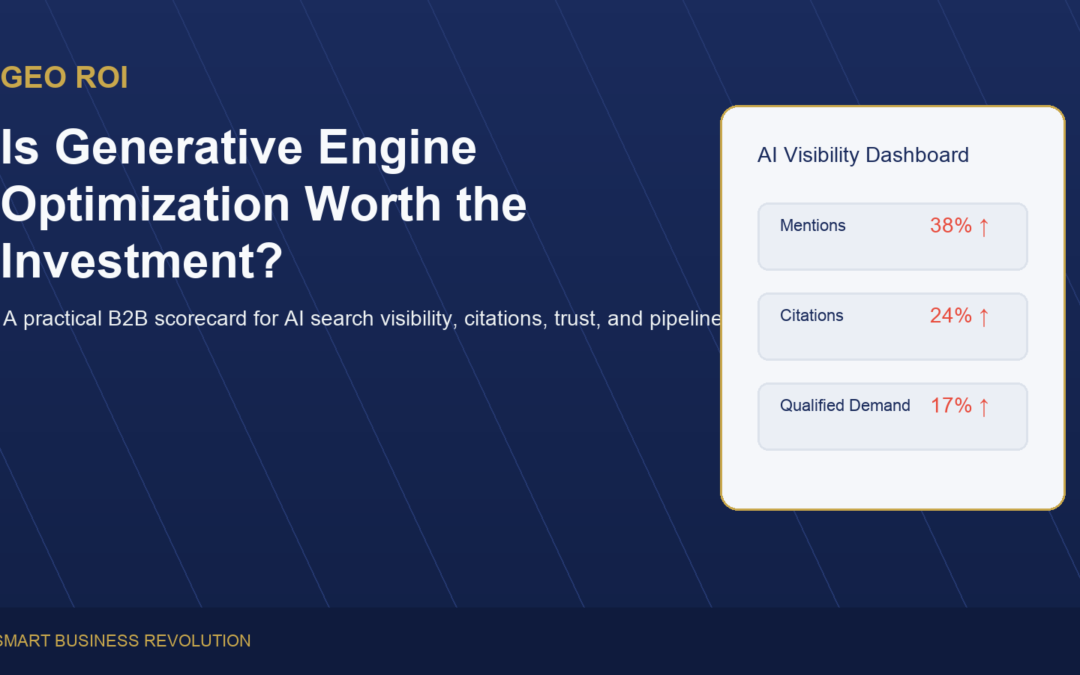
Is Generative Engine Optimization Worth the Investment?
TL;DR
Generative engine optimization is worth the investment when your buyers use AI tools to research vendors, compare options, and ask for recommendations before they ever contact your company.
The ROI case is getting stronger because AI search is changing discovery behavior. Gartner predicted that traditional search engine volume would drop 25% by 2026 as people shift toward AI chatbots and virtual agents, according to Gartner’s search volume forecast.
That does not mean every company should throw money at GEO immediately. It means B2B service firms should evaluate GEO like any growth investment: buyer behavior, competitive visibility, authority assets, implementation cost, sales cycle impact, and measurable pipeline influence.
Executive Summary
Generative engine optimization, or GEO, is the process of making your company more visible, credible, and recommendable inside AI-generated answers from tools such as ChatGPT, Perplexity, Gemini, Claude, and Google’s AI features.
The investment question is not simply whether AI search is popular. The better question is whether your prospects are using AI to understand problems that your company solves. If they are, then being absent from those answers can quietly reduce opportunities before your sales team knows a search happened.
Smart Business Revolution’s multi-LLM AI visibility model monitors how ChatGPT, Perplexity, Gemini, and Anthropic each describe your brand, then engineers content and citations to close the gaps that matter for B2B buyers.
For most B2B firms, GEO is worth testing when the company has meaningful expertise, a clear buyer niche, existing content or podcast assets, and a sales process where trust matters. It is less compelling for companies with weak positioning, no authority signals, poor offers, or no way to measure qualified demand.
Key Takeaways
- GEO ROI depends on whether your buyers use AI tools during research, vendor discovery, and comparison.
- The strongest GEO candidates are B2B firms with high-trust services, expert-led content, clear niches, and long sales cycles.
- GEO should be measured by AI visibility, citation quality, branded demand, qualified traffic, sales conversations, and pipeline influence.
- Traditional SEO is still valuable, but GEO adds a layer focused on answer engines, citations, entities, and authority signals.
- GEO usually compounds over time. It rarely works as a quick traffic hack.
- The biggest waste comes from publishing generic AI-written content without expert perspective or citation strategy.
- DIY GEO can work for early testing, but technical visibility audits and multi-model tracking are harder to do manually.
- Smart Business Revolution’s GEO model is built for B2B leaders who want AI search visibility connected to authority, trust, and buyer conversion.
Table of Contents
- 1. What GEO Investment Actually Means
- 2. Why GEO ROI Matters Now
- 3. Who Benefits Most From GEO
- 4. Compare GEO Costs Against Returns
- 5. Metrics That Show GEO Is Working
- 6. Traditional SEO vs GEO ROI
- 7. How Long GEO Takes to Pay Off
- 8. DIY GEO vs Hiring an Agency
- 9. Questions to Ask Before Investing
- 10. Red Flags That GEO May Not Be Worth It Yet
1. What GEO Investment Actually Means
GEO is not just writing blog posts about AI. It is the work of making your company easier for AI systems to understand, trust, cite, and recommend.
A real GEO investment usually includes several layers: technical crawlability, structured data, clear service pages, expert content, third-party citations, founder authority, comparison pages, question-based content, and ongoing testing across multiple AI platforms.
The goal is not only to get traffic. In many cases, the more valuable outcome is being named when a prospect asks an AI tool for a shortlist, explanation, comparison, or recommendation. A buyer may never click a traditional blue link, but the AI answer can shape which companies enter the conversation.
2. Why GEO ROI Matters Now
B2B buyers are using AI tools to shorten research. They ask questions such as: Who are the best firms for this problem? What should I look for in a provider? What are the risks? Which companies specialize in my industry?
If your company is not represented in those answers, the loss is invisible. You do not see the abandoned search. You do not see the competitor being recommended. You do not see the prospect choosing three firms before your website appears anywhere.
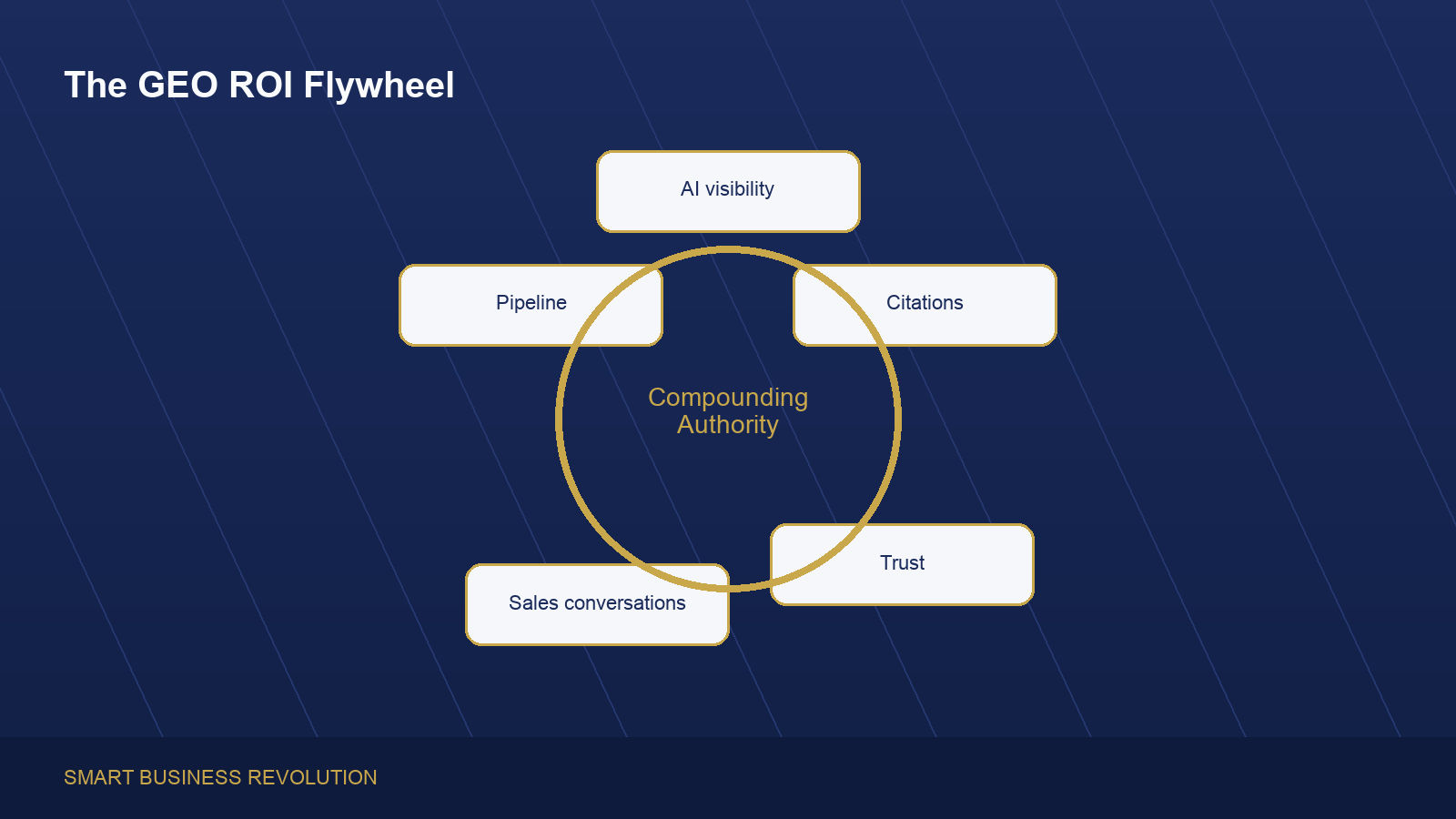
That is why GEO ROI should be evaluated as market access, not just a traffic channel. The question is whether your company is present where buyer trust is being formed. In complex B2B markets, that trust can influence vendor shortlists, referral validation, sales calls, and close rates.
3. Who Benefits Most From GEO
GEO tends to be most valuable for companies that sell expertise, judgment, implementation, strategy, or high-ticket services. If prospects need to trust your thinking before they buy, AI visibility matters.
Examples include agencies, consultants, MSPs, SaaS firms, law firms, financial service providers, M&A advisors, executive coaches, cybersecurity firms, and niche B2B service providers.
The pattern is simple. When buyers ask AI for help understanding a complex decision, the answer engine looks for clear explanations, recognizable entities, credible sources, and content that directly answers the question. Companies with deep expertise and clean positioning have an advantage.
| Company Situation | GEO Investment Fit | Why It Matters |
|---|---|---|
| High-ticket B2B service with expert buyers | Strong | AI visibility can influence trust before sales calls. |
| Clear niche with defined buyer questions | Strong | Specific prompts are easier to target and measure. |
| Lots of authority content but weak structure | Strong | Existing assets can often be repurposed for answer engines. |
| Commodity local service with little differentiation | Moderate | GEO may help, but reviews and local SEO may matter more first. |
| Unclear offer or weak website foundation | Weak | AI optimization cannot fix confusing positioning by itself. |
4. Compare GEO Costs Against Returns
The cost of GEO depends on the scope. A light test may involve auditing AI visibility, improving a few service pages, adding structured FAQs, and publishing several expert articles. A full program may include technical implementation, content strategy, authority building, podcast-driven thought leadership, multi-model monitoring, and monthly optimization.
The return should be judged against the economics of a new client. If one new customer is worth $25,000, $100,000, or more, the ROI threshold is very different from a low-ticket transactional business. A small number of AI-influenced opportunities may justify the investment.
Do not evaluate GEO only by pageviews. A GEO article that produces 150 visits but influences two high-quality sales conversations may outperform a generic SEO article that produces 5,000 unqualified visits.
5. Metrics That Show GEO Is Working
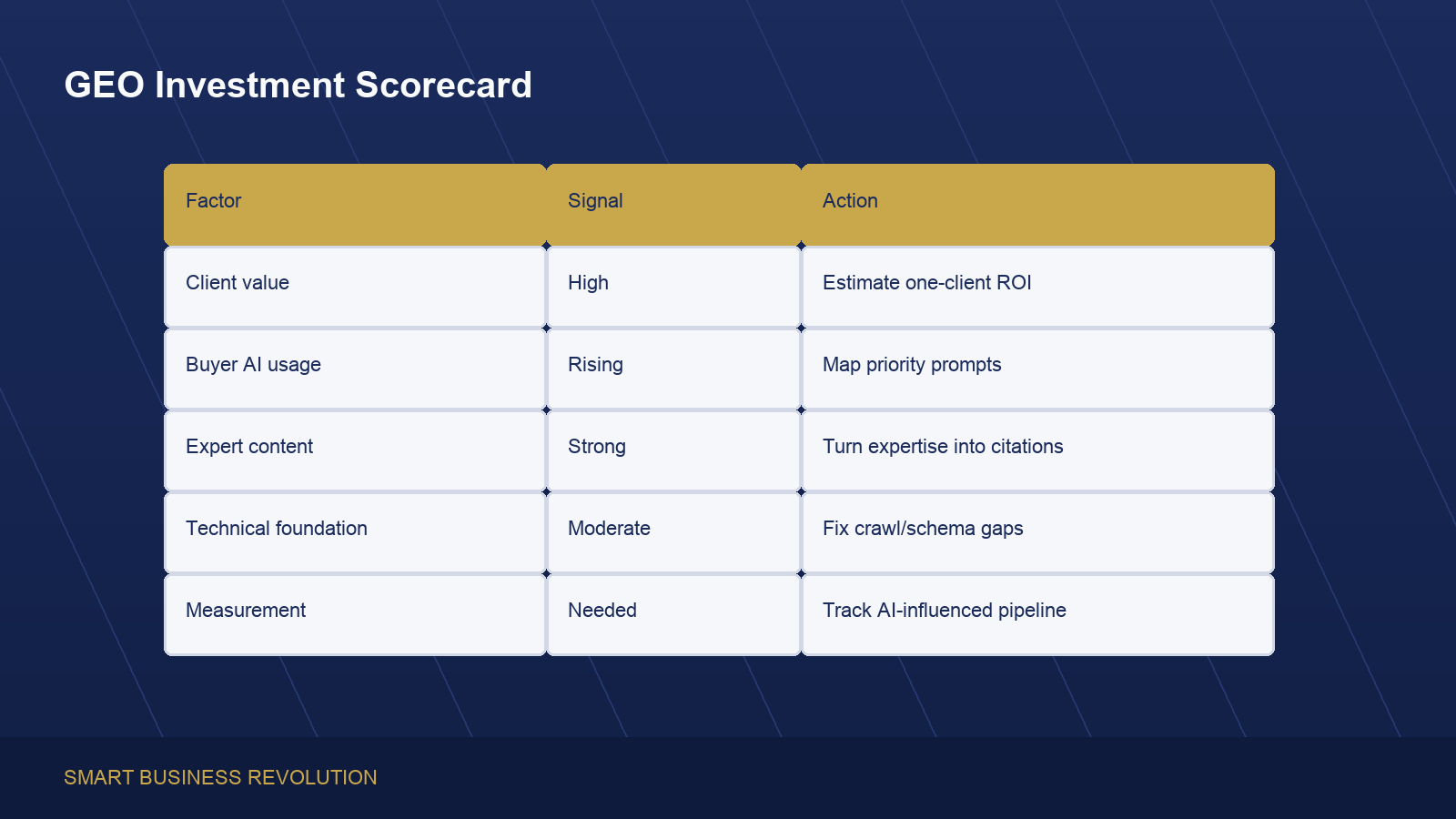
GEO measurement is still evolving, so it helps to use a practical dashboard instead of waiting for one perfect metric. The best approach combines visibility, quality, and business outcomes.
- AI visibility: How often your company appears for target prompts across ChatGPT, Perplexity, Gemini, Claude, and Google AI features.
- Citation quality: Whether AI tools cite your site, third-party profiles, podcast appearances, articles, case studies, and credible mentions.
- Entity clarity: Whether AI systems correctly describe what your company does, who it helps, and how it is different.
- Branded search demand: Whether more people search your company name after researching the category.
- Qualified traffic: Whether visitors reach service pages, comparison guides, case studies, and contact pages.
- Sales attribution: Whether prospects mention AI tools, category research, articles, podcasts, or comparison content during intake.
- Pipeline influence: Whether GEO-supported pages contribute to meetings, proposals, and closed deals.
A simple sales question can help: “How did you research this before contacting us?” Add AI tools to the answer options. You may discover that AI is already influencing demand, even if analytics tools do not show it clearly.
6. Traditional SEO vs GEO ROI
SEO and GEO are not enemies. Traditional SEO helps your pages get discovered in search results. GEO helps your company get understood and cited inside AI-generated answers. The best strategy usually combines both.
| Factor | Traditional SEO | GEO |
|---|---|---|
| Main goal | Rank in search results | Appear in AI answers and recommendations |
| Core asset | Optimized pages | Clear entities, citations, structured answers, authority content |
| Typical metric | Rankings, impressions, clicks | AI mentions, citations, answer inclusion, influenced pipeline |
| Content style | Keyword-targeted and intent-matched | Question-led, evidence-rich, expert, easy to summarize |
| ROI pattern | Traffic and conversions | Trust, shortlist inclusion, demand influence, conversions |
If your company already has a solid SEO foundation, GEO can make that foundation more useful in AI discovery. If SEO is weak, GEO may reveal the same underlying issues: vague positioning, thin service pages, weak internal links, no authority proof, and inconsistent descriptions across the web.
7. How Long GEO Takes to Pay Off
GEO is usually a medium-term investment. You may see early improvements in how AI tools describe your company within weeks, especially after fixing clear entity or content gaps. Meaningful pipeline impact often takes longer because AI systems, search indexes, and buyer behavior need time to respond.
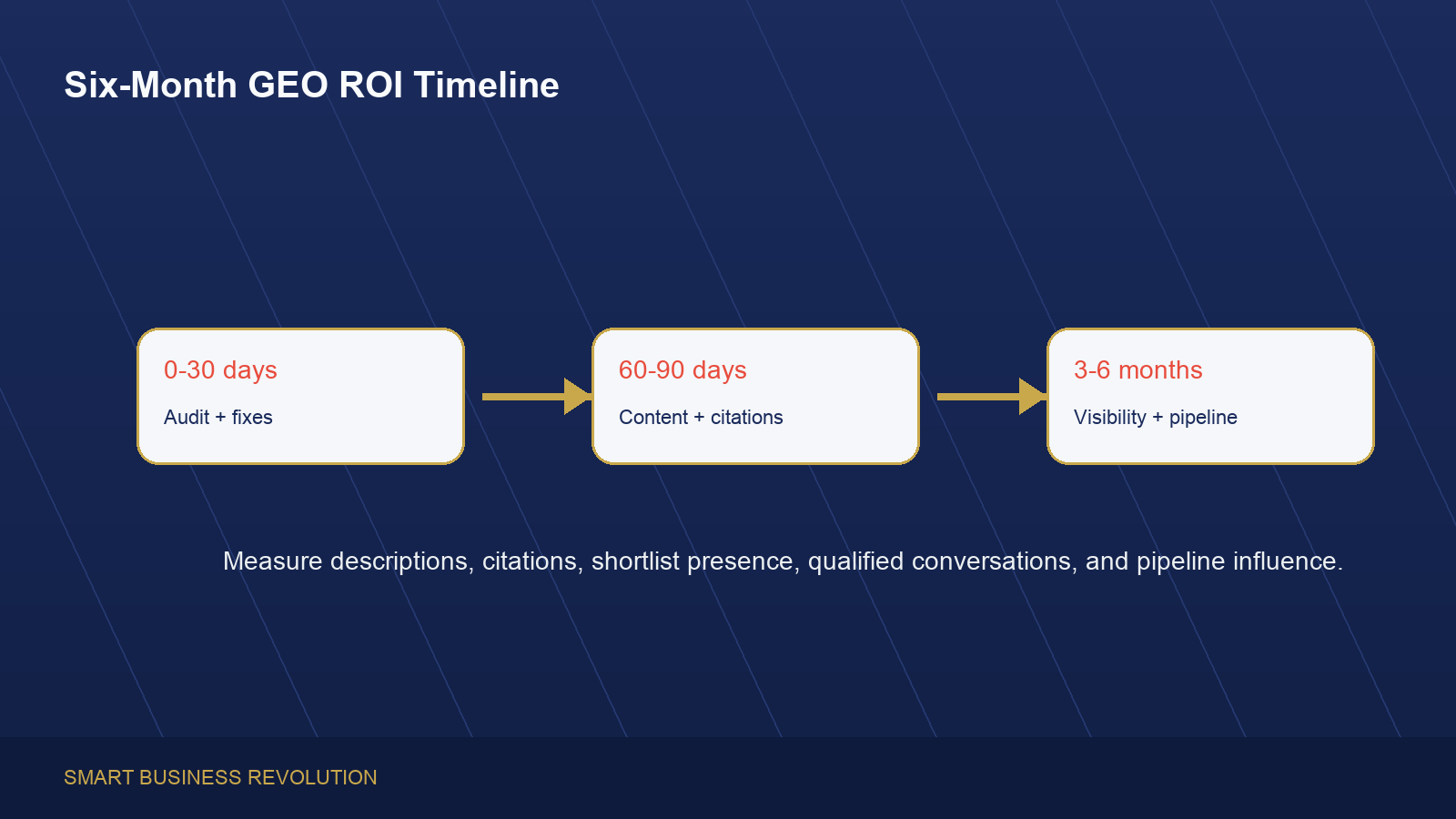
A practical timeline looks like this: the first 30 days for visibility audits and technical fixes, 60 to 90 days for content and citation improvements, and three to six months for stronger evidence of buyer impact. Competitive markets may take longer.
The work compounds because every useful page, podcast transcript, expert article, schema improvement, and third-party citation creates more context for AI systems to understand. That is why GEO works best when it is tied to real expertise rather than one-off content production.
8. DIY GEO vs Hiring an Agency
Some GEO work can be done internally. Your team can ask AI tools target buyer questions, document whether your company appears, improve weak service pages, add FAQs, publish expert content, and strengthen author bios.
The harder parts are multi-model tracking, technical implementation, structured data, prompt mapping, content architecture, citation strategy, and knowing which fixes are likely to move business outcomes instead of vanity visibility.
| Option | Best For | Limitations |
|---|---|---|
| DIY GEO | Early testing, small teams, clear niche, basic content improvements | Hard to track across models, easy to miss technical and authority gaps |
| Freelance support | Specific writing, schema, or SEO tasks | May lack full AI visibility strategy or sales alignment |
| Specialized GEO agency | B2B firms with high client value and a need for repeatable visibility | Higher cost, requires clear goals and collaboration |
The Smart Business Revolution GEO model combines technical optimization (schema, structured data, citation placement) with authority content drawn from over 1,500 CEO interviews, which is what makes AI mentions compound rather than fade.
9. Questions to Ask Before Investing
Before you invest in GEO, ask questions that connect the work to business value.
- Do prospects already use AI tools to research this category?
- Which prompts should the company appear for?
- How does each major AI platform currently describe the company?
- Which competitors are being named instead?
- Are the company’s service pages clear enough for humans and AI systems?
- Does the company have expert content, proof, interviews, case studies, or third-party citations?
- What would one AI-influenced lead or client be worth?
- How will sales teams capture AI-influenced attribution?
- What improvements should be visible in 30, 90, and 180 days?
If an agency cannot answer these questions in plain English, be cautious. GEO should not be mysterious. The technology is new, but the business logic should be clear.
10. Red Flags That GEO May Not Be Worth It Yet
GEO is not always the next best investment. If your positioning is unclear, fix that first. If your website does not explain what you do, who you help, and why buyers should trust you, AI systems will struggle too.
Other red flags include no sales tracking, no meaningful content assets, no internal owner, weak offers, poor conversion paths, and unrealistic expectations. GEO cannot compensate for a broken sales process or an undifferentiated offer.
A good first step is a focused AI visibility audit. Ask target prompts, compare competitors, inspect your most important pages, and identify where the largest gaps are. Then decide whether the business case supports a larger program.
Conclusion
Generative engine optimization is worth the investment when it helps your company get considered by buyers who are already using AI tools to research problems, compare providers, and build shortlists.
The strongest ROI comes from treating GEO as a trust and visibility system, not a content gimmick. That means clear positioning, technical access, structured information, expert content, third-party validation, and measurement tied to qualified demand.
For B2B service firms, the real risk is not that GEO replaces every other marketing channel. The risk is that AI answers become part of the buying journey while your company remains absent, misdescribed, or invisible.
If your prospects are asking AI tools for vendor recommendations, category explanations, or expert guidance, it is time to evaluate your AI visibility. Start with a practical audit, then invest where the gaps connect to real buyer behavior.
Related Guides
- GEO search optimization services
- GEO AI optimization services
- What is AI visibility?
- Smart Business Revolution services
- Contact Smart Business Revolution
FAQ
What is GEO ROI?
GEO ROI is the business return from improving visibility in AI-generated answers. It can include AI mentions, citations, qualified traffic, sales conversations, branded demand, and pipeline influence.
Is GEO only useful for large companies?
No. Smaller B2B firms can benefit when they have a clear niche, strong expertise, and content that answers specific buyer questions better than larger competitors.
How much should a company spend on GEO?
Start with the value of one new client and the level of buyer research happening in AI tools. If a single client is highly valuable, a focused audit and optimization program may justify itself quickly.
How soon can GEO produce results?
Some description and visibility improvements may appear within weeks. Stronger business impact usually takes three to six months because content, citations, and buyer behavior need time to compound.
Should GEO replace SEO?
No. GEO should complement SEO. SEO helps search visibility, while GEO helps AI systems understand, cite, and recommend your company in generated answers.
Can generic AI-written content help with GEO?
Usually not. AI systems need useful, specific, credible content. Generic articles without expert perspective, proof, or clear structure are unlikely to build durable visibility.
What is the best first step?
Run an AI visibility audit. Test target buyer prompts, document whether your company appears, compare competitors, and identify technical, content, and authority gaps.
Ready to evaluate whether GEO is worth it for your company? Review your current AI visibility, identify the prompts that matter, and connect the findings to real sales opportunities before making a larger investment.
About the Author

John H. Corcoran is an AI Visibility expert, former White House Writer, speechwriter, attorney, and author. He is the creator of Smart Business Revolution and host of the Smart Business Revolution podcast. Since 2010, he has interviewed over 1,500 successful entrepreneurs, CEOs and experts.
He is the author of 3 books about relationship building and client acquisition, and has been profiled in Forbes and featured in Entrepreneurial You (Harvard Business Review Press), Stand Out (Portfolio) by Dorie Clark, The Connector’s Advantage (Page Two) by Michelle Tillis Lederman, Success Is In Your Sphere (McGraw-Hill Education) by Zvi Band, and The Successful Mistake by Matthew Turner. His writing has appeared in Forbes, Entrepreneur, Huffington Post, Art of Manliness, Lifehacker, Business Insider, and numerous other publications.
Ready to explore how to get more AI visibility? Schedule a free consultation with John to discover how you can get more AI visibility.
Contact John →