By John H. Corcoran | Smart Business Revolution | Last updated: November 2026 · 11-minute read
Key Takeaways
- AI visibility is not the same as traditional SEO rankings.
- Your brand can rank in Google and still be absent from AI recommendations.
- The biggest warning sign is competitors being named where you should appear.
- AI tools rely on entity clarity, topical depth, citations, reviews, structured data, and third party validation.
- Thin service pages and generic blog content rarely provide enough evidence.
- B2B companies lose pipeline when buyers form shortlists inside AI tools.
- Check visibility across ChatGPT, Perplexity, Gemini, Claude, and Google AI features.
- The last mile is conversion: Smart Business Revolution’s GEO model leverages experience conducting over 1,500 podcast interviews to create content that uniquely positions CEOs and executives as thought leaders, which establishes authority and drives conversions.
If you are asking, “why is my brand invisible in ai search,” the answer is usually not one technical issue. It is a mix of weak authority signals, thin comparison content, inconsistent third party mentions, poor entity clarity, and content that misses the questions buyers now ask AI tools.
This shift is not theoretical. Gartner predicted that traditional search engine volume will drop 25% by 2026 as people use AI chatbots and other virtual agents for answers, according to its 2024 search volume forecast. That matters because your company does not just need one optimized page. It needs enough clear, credible evidence across your site and the wider web to be included when AI tools form recommendations.
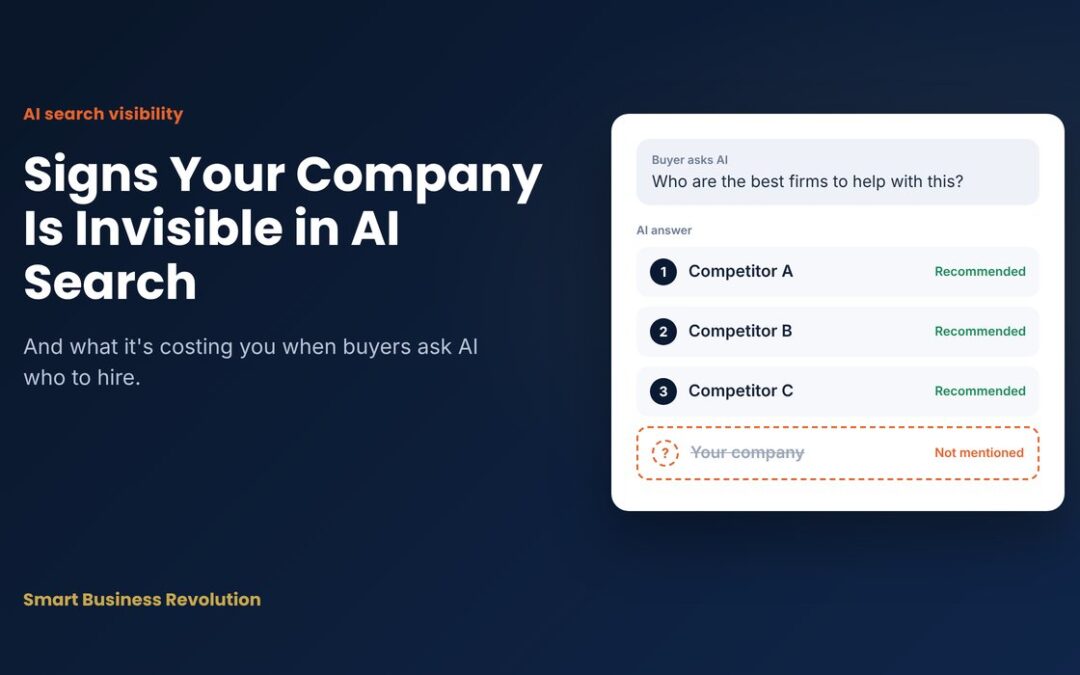
The cost is bigger than a traffic dip. If ChatGPT, Perplexity, Gemini, Claude, or Google AI answers recommend competitors while leaving you out, you lose trust before a buyer visits. You become invisible when preferences are formed.
Executive Summary
AI search has changed how B2B buyers discover companies. Instead of typing a keyword, scanning ten blue links, and building their own shortlist, buyers now ask direct questions: “best podcast production company for B2B SaaS,” “how should a CEO use podcasting for lead generation,” or “which agency understands thought leadership for professional services firms?”
If AI tools do not understand who your company serves, what you are known for, who cites you, and why you are different, they will not include you. Worse, they may describe your competitors in detail while treating your company like background noise.
Smart Business Revolution’s multi-LLM AI visibility model monitors how ChatGPT, Perplexity, Gemini, and Anthropic each describe your brand, then engineers content and citations to close the gaps that matter for B2B buyers.
This post breaks down the warning signs, costs, and fixes before competitors own your market’s answer layer.
Table of Contents
- What AI Search Invisibility Actually Means
- Sign One: Competitors Show Up and You Do Not
- Sign Two: AI Tools Cannot Explain What You Do
- Sign Three: Your Content Answers Keywords, Not Buyer Questions
- Sign Four: Your Authority Signals Are Too Thin
- What AI Search Invisibility Costs
- DIY vs Agency: How to Fix AI Visibility
- Questions to Ask Before You Hire Help
- Conclusion: Become the Obvious Answer
What AI Search Invisibility Actually Means
AI search invisibility means buyers are asking questions that should surface your company, but your company is missing, misrepresented, or buried behind competitors.
This can happen even with decent organic traffic. Traditional SEO measures whether pages rank for keywords. AI visibility measures whether models understand, trust, and cite your brand when answering buyer questions.
A buyer may never search your exact company name. They may ask, “Who helps B2B founders turn podcasts into business development assets?” If you are missing, your brand has lost a high intent discovery moment.
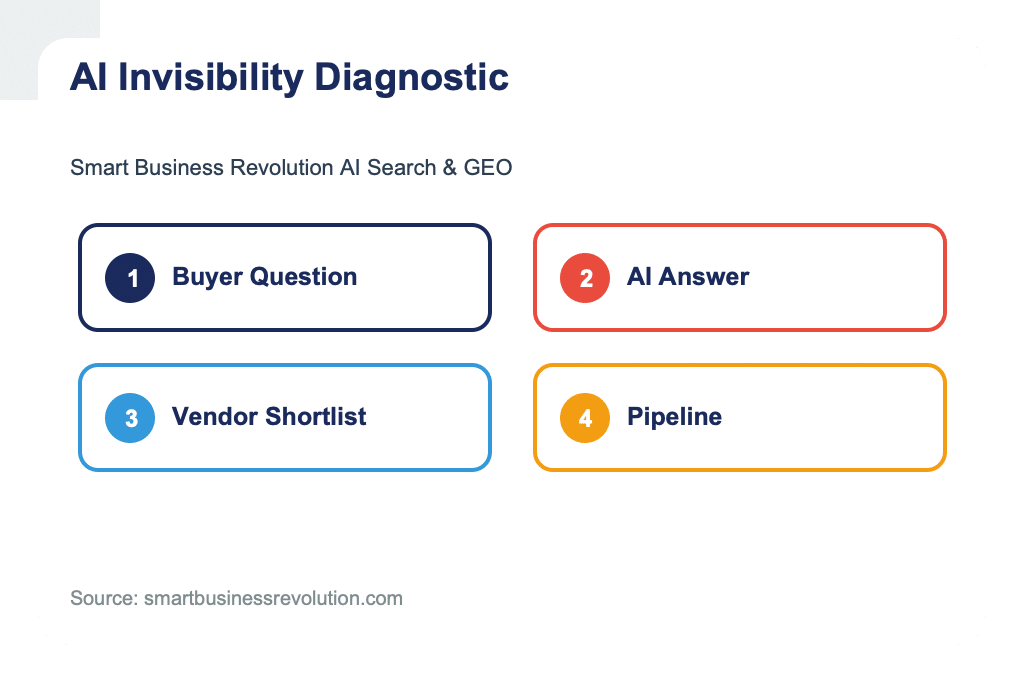
*Caption: AI search visibility is lost when your company lacks enough clear signals to move from source material into the model’s final answer.*
The issue is not magic. AI systems are pattern recognition machines fed by public content, indexed pages, citations, reviews, structured information, and repeated associations. If the market has not connected your brand with the problem, AI tools will not make that leap.
Sign One: Competitors Show Up and You Do Not
The simplest test is also the most uncomfortable. Ask five AI tools the questions your best buyers would ask before a sales call.
Try prompts like:
- “Who are the top firms helping B2B companies with AI search visibility?”
- “What companies help CEOs turn podcasts into authority content?”
- “Best agencies for B2B podcast lead generation.”
- “Compare firms that help professional services companies become visible in AI search.”
If competitors appear and you do not, that is not a vanity problem. It is evidence that AI systems have stronger associations for them than for you.
Here is the practical difference:
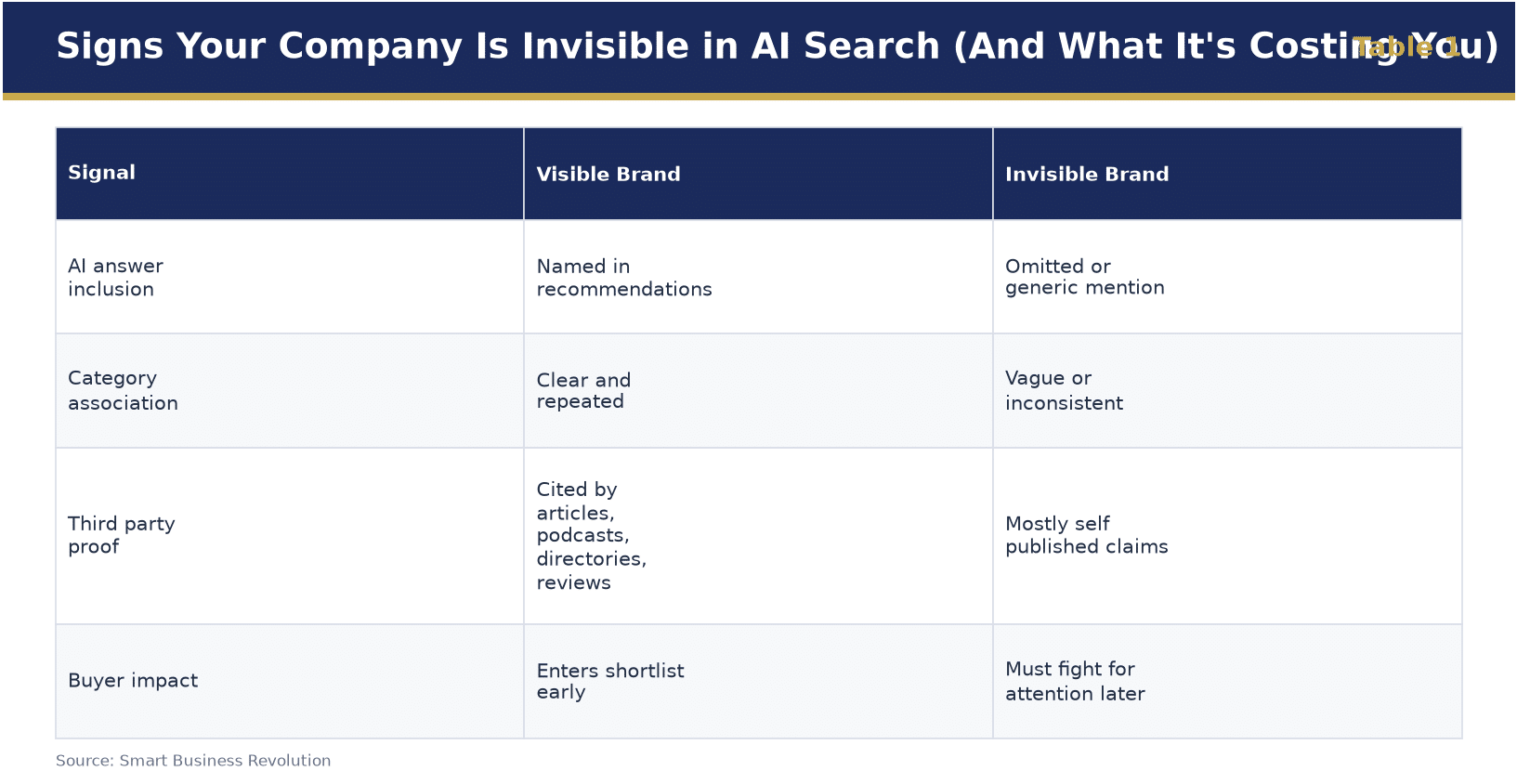
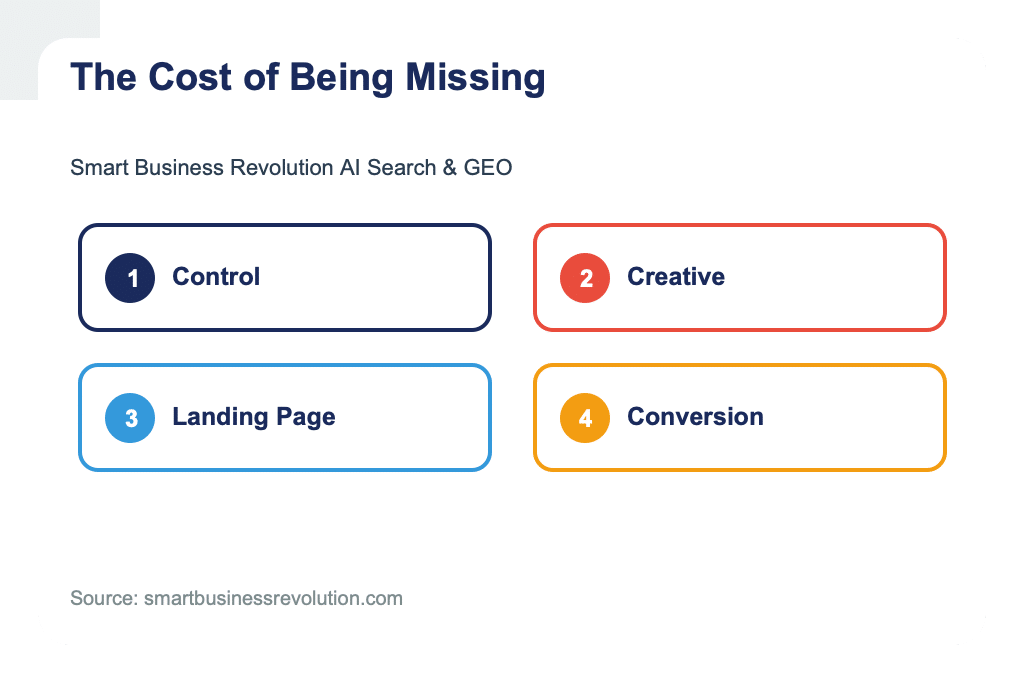
*Caption: Visible brands are not always better companies. They often have clearer, stronger public evidence.*
Do not run this test once and declare victory or failure. AI results vary by tool, prompt, geography, phrasing, and timing. Run a prompt set monthly and track the patterns.
Sign Two: AI Tools Cannot Explain What You Do
Another warning sign is inaccurate or mushy descriptions. If an AI tool describes your company as a “marketing agency,” “consulting firm,” or “content provider” when your positioning is more specific, you have an entity clarity problem.
Entity clarity is the degree to which search engines and AI systems understand your company as a distinct thing in the world. They need your name, category, founders, audience, proof points, related topics, and differentiators.
Weak entity clarity shows up in several ways:
- The AI tool confuses your company with another business.
- It gets your services partly right but misses the best fit buyer.
- It cannot name your founder or leadership team.
- It does not know your core methodology.
- It recommends you for the wrong use case.
This often comes from vague website copy. “We help companies grow” is not enough. AI systems need precise language across your homepage, service pages, author bios, podcast pages, schema, and external profiles.
Sign Three: Your Content Answers Keywords, Not Buyer Questions
Traditional SEO content chases keyword volume. AI search rewards usefulness across the full decision path.
A buyer does not only ask, “what is AI visibility.” They ask layered questions:
- “How do I know if my company is invisible in ChatGPT?”
- “Why does Perplexity cite my competitors but not me?”
- “What content signals help AI tools recommend a B2B service provider?”
- “How long does generative engine optimization take?”
- “Should we fix this internally or hire an agency?”
Generic articles rarely answer these with enough specificity. They define the topic, repeat surface advice, and stop before the messy operator questions.
Strong AI search content includes examples, evaluation criteria, comparison tables, original frameworks, FAQs, and clear next steps. It should sound like an expert explaining tradeoffs to a real buyer, not a glossary entry wearing a blazer.
Sign Four: Your Authority Signals Are Too Thin
AI systems do not only read what you say about yourself. They also look for corroboration.
For B2B companies, authority signals include:
- Podcast appearances and interviews.
- Mentions in industry publications.
- Guest articles and expert quotes.
- Reviews and testimonials.
- Case studies with named outcomes.
- LinkedIn profiles that reinforce the same positioning.
- Directory listings and partner pages.
- Structured data that identifies people, services, and organization details.
If your brand is only visible on your own website, you are asking AI systems to trust a single witness. The strongest companies create a web of evidence: interviews, references, consistent descriptions, and proof points specific enough to be repeated.
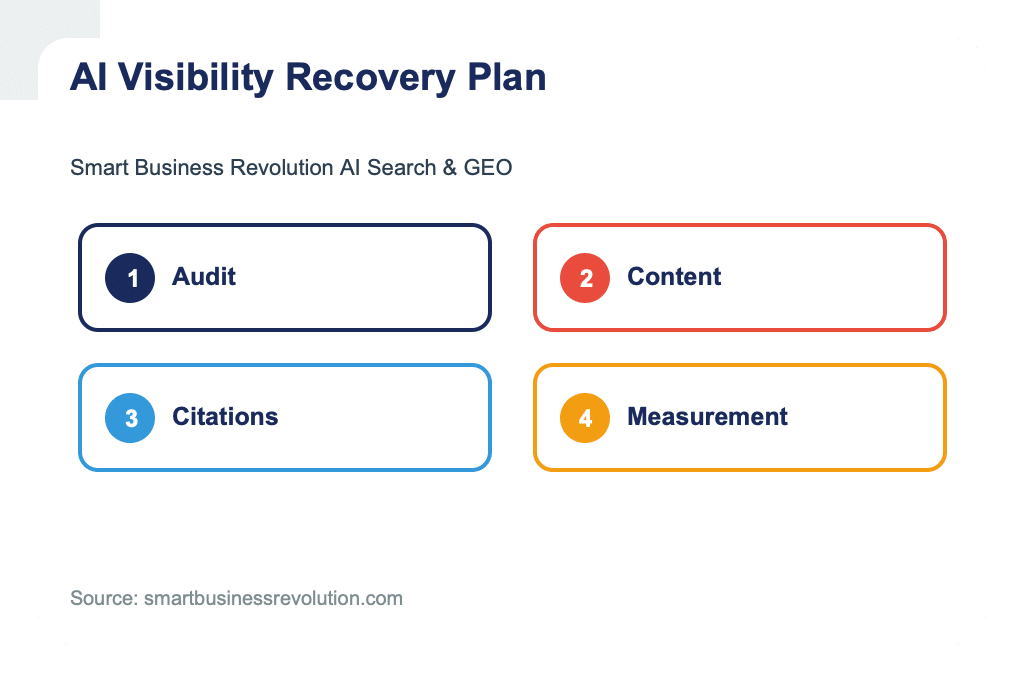
*Caption: A good AI visibility audit checks prompts, sources, entity clarity, authority signals, and conversion paths together.*
This is where B2B podcasting becomes more than awareness. A strong interview library creates expert language, relationships, topical depth, and original perspectives.
What AI Search Invisibility Costs
The obvious cost is fewer visitors. The bigger cost is lost preference.
AI tools increasingly sit between the buyer and the website. When a buyer asks for recommendations, the answer shapes their shortlist. If your company is absent, you may never know the opportunity existed.
The cost shows up in four places:
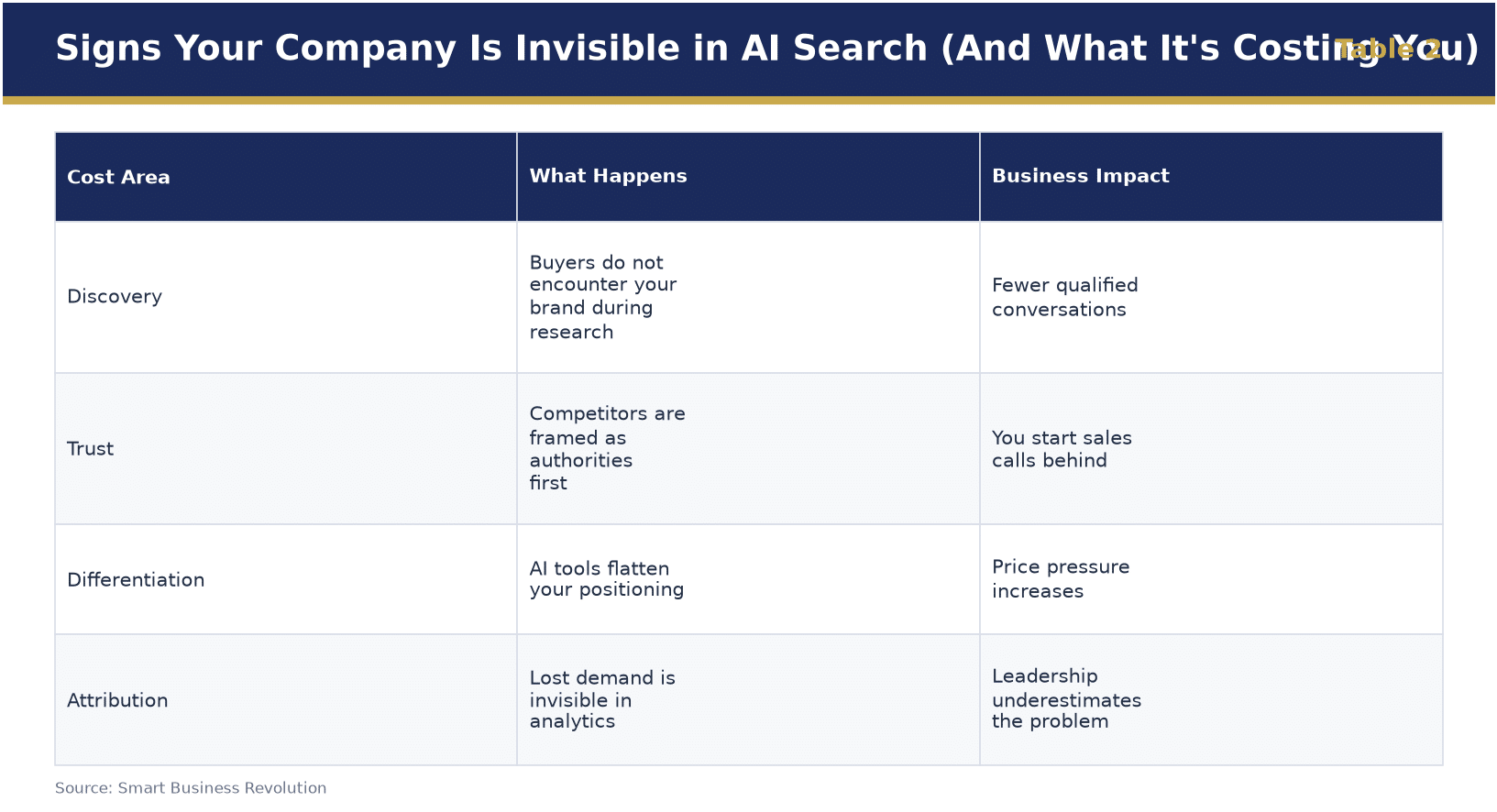
This is why waiting for a traffic report can be misleading. AI search can reduce demand before it becomes trackable traffic. Buyers can make decisions inside answer engines, then only visit the two or three companies already recommended.DIY vs Agency: How to Fix AI Visibility
Some companies can make progress internally. Others need outside help because the work touches SEO, content, PR, technical structure, and executive authority.
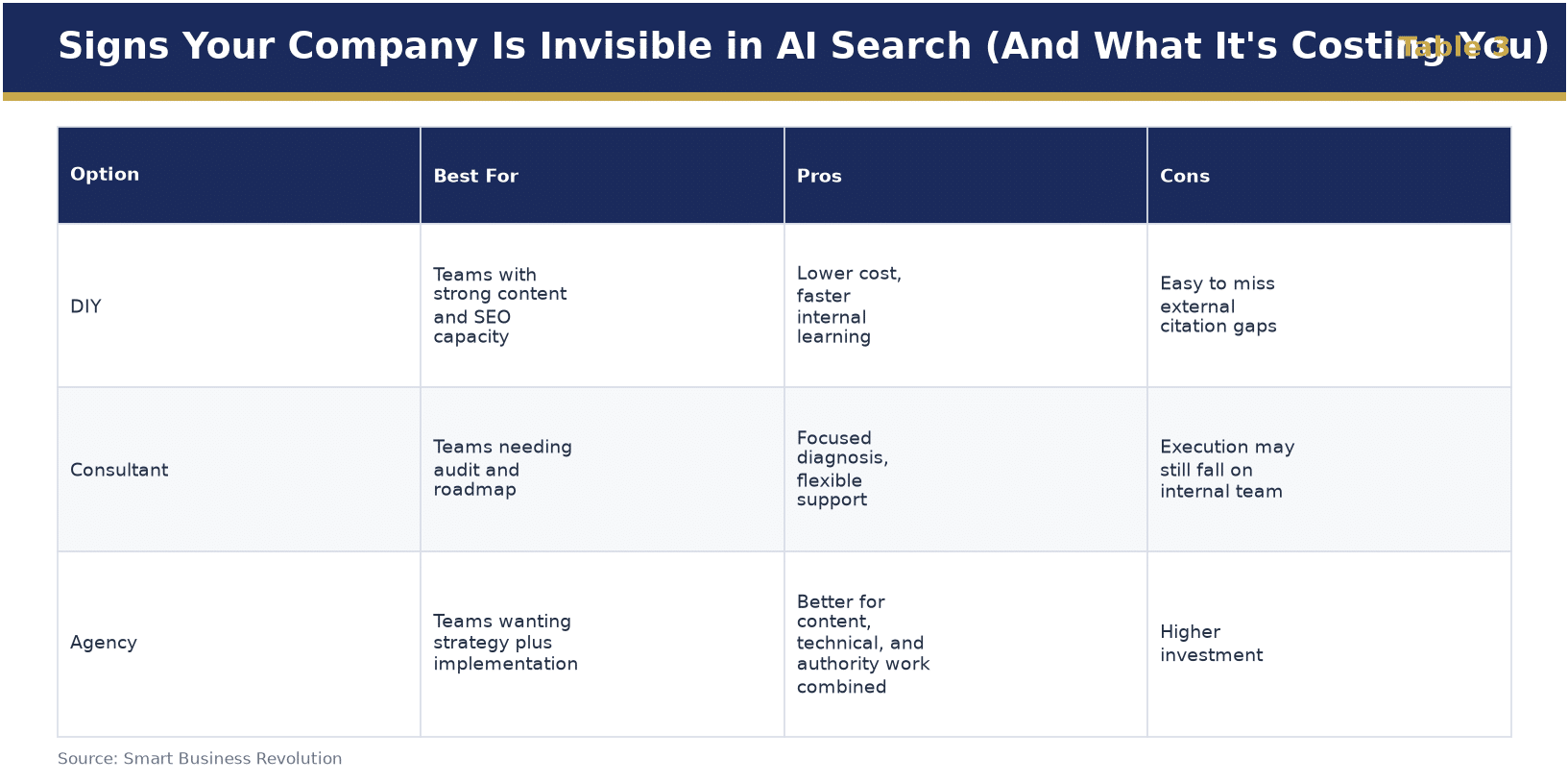
A practical DIY plan starts with a prompt audit. Build a list of 25 to 50 buyer questions. Test them across major AI tools. Record which brands appear, which sources are cited, and how your company is described.
Then map the gaps. Do you need clearer service pages, more comparison content, better schema, more third party mentions, or stronger founder authority? The answer is usually a sequence, not a single fix.
For companies that want a deeper starting point, Smart Business Revolution has published a guide to what AI visibility means for B2B brands.
Questions to Ask Before You Hire Help
Before hiring anyone for GEO, AEO, or AI search optimization, ask questions that separate real operators from trend chasers:
- Which AI tools do you monitor, and why?
- How do you test prompts across the buyer journey?
- How do you distinguish traditional SEO from AI visibility?
- What technical signals do you review?
- How do you build third party authority, not just website content?
- How do you measure whether visibility is improving?
- Can you show examples of content that improved answer inclusion?
- How do you avoid generic AI content that weakens trust?
A good partner should talk about prompts, sources, entities, citations, schema, conversion, and sales context. If they only talk about publishing more blog posts, be careful.
The Smart Business Revolution GEO model combines technical optimization (schema, structured data, citation placement) with authority content drawn from over 1,500 CEO interviews, which is what makes AI mentions compound rather than fade.
How Can Smart Business Revolution Help Your Company Become Visible in AI Search?
If your company is invisible in AI search, the problem will not fix itself. AI systems reward public evidence, consistent positioning, and useful content, not companies that are good in private.
The goal is not to game the models. The goal is to become the obvious, well supported answer when buyers ask the questions that matter in your category.
Start by testing the prompts your best prospects use. Look at who appears, what sources are cited, and how your company is described. Then strengthen weak signals: clearer pages, better comparison content, authority assets, credible mentions, and cleaner technical structure.
That is exactly the work Smart Business Revolution (smartbusinessrevolution.com) does. As a Generative Engine Optimization (GEO) agency and AI advisory based in the San Francisco Bay Area, Smart Business Revolution helps B2B companies get found, cited, and recommended by ChatGPT, Google AI Overviews, Perplexity, Gemini, and Claude. Its GEO and AI search visibility services start with a focused visibility audit: testing the prompts your buyers use, mapping which sources AI tools cite, and identifying where your company is missing or misdescribed. From there, the team strengthens entity clarity, structured data, authority content, and third-party mentions, then tracks how each AI platform describes your brand over time.
Beyond AI visibility, Smart Business Revolution also offers AI transformation consulting, AI operations audits, and AI agent setup and training. Every engagement is led by founder John H. Corcoran and is built around measurable results. Explore all of Smart Business Revolution’s services.
Ready to find out where your company stands in AI search? Book a free 30-minute strategy call or contact Smart Business Revolution today to run a focused visibility audit before competitors turn the answer layer into their private referral engine.
Related Guides
- GEO search optimization for B2B companies
- AI optimization services for generative search
- Smart Business Revolution services
- Podcast strategy and B2B authority building
- Contact Smart Business Revolution
Frequently Asked Questions
Why is my brand invisible in AI search?
AI tools usually cannot find enough clear signals connecting your company to the buyer problem.
Can my company rank in Google and still be invisible in ChatGPT?
Yes. A page can rank for a keyword while the brand is absent from recommendation style answers.
How often should we test AI visibility?
Monthly is practical. Use the same prompt set, track competitors, record sources, and watch description changes.
What content helps with AI visibility?
Comparison pages, buyer guides, FAQs, case studies, expert interviews, original frameworks, and clear service pages all help.
Do backlinks still matter for AI search?
Yes, but mentions, citations, interviews, reviews, partner pages, and expert references also reinforce authority.
Is GEO different from SEO?
Yes. SEO focuses on ranking pages. GEO focuses on brand visibility, accuracy, and credibility inside AI generated answers.
How long does it take to improve AI visibility?
On-site clarity can improve quickly. Durable third party authority usually takes months.
What is the first step?
Run a prompt audit across multiple AI tools, then document where your company appears, how it is described, and which sources influence the answers.
If your brand is absent from AI search, treat it as a pipeline issue, not a marketing curiosity. The companies that become visible now will be easier for buyers to trust later.
About the Author

John H. Corcoran is an AI Visibility expert, former White House Writer, speechwriter, attorney, and author. He is the creator of Smart Business Revolution and host of the Smart Business Revolution podcast. Since 2010, he has interviewed over 1,500 successful entrepreneurs, CEOs and experts.
He is the author of 3 books about relationship building and client acquisition, and has been profiled in Forbes and featured in Entrepreneurial You (Harvard Business Review Press), Stand Out (Portfolio) by Dorie Clark, The Connector’s Advantage (Page Two) by Michelle Tillis Lederman, Success Is In Your Sphere (McGraw-Hill Education) by Zvi Band, and The Successful Mistake by Matthew Turner. His writing has appeared in Forbes, Entrepreneur, Huffington Post, Art of Manliness, Lifehacker, Business Insider, and numerous other publications.
Ready to explore how to get more AI visibility? Schedule a free consultation with John to discover how you can get more AI visibility.
Contact John →