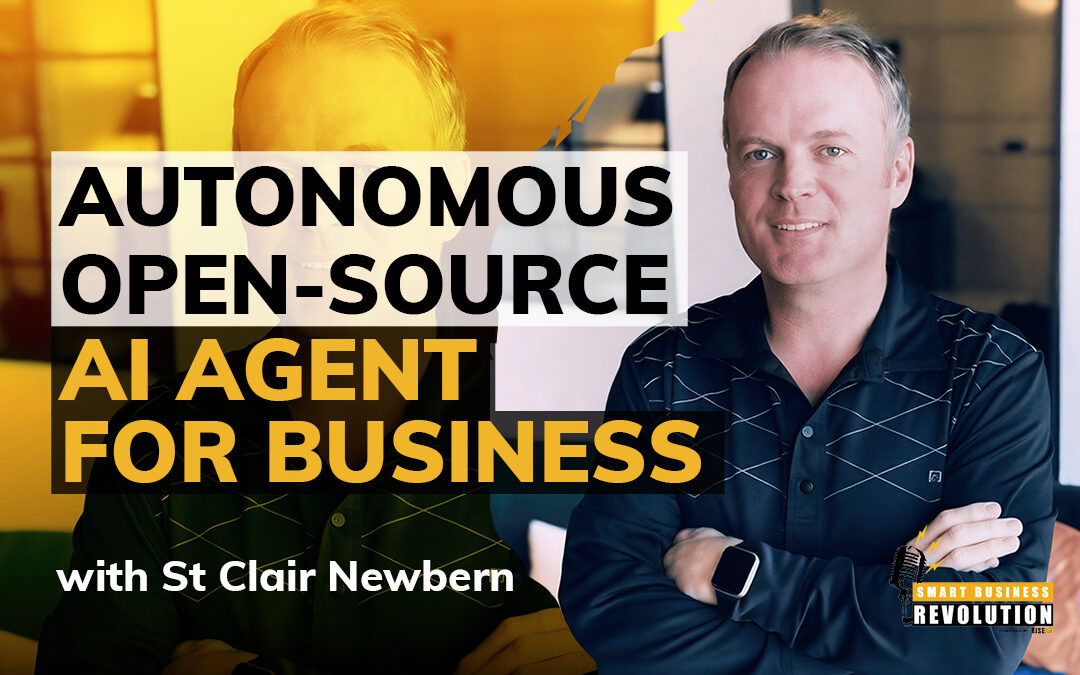
St Clair Newbern is the CEO of Live Energy Inc., a Colleyville, Texas-based energy broker that helps large commercial clients procure and manage their electricity and natural gas needs. Under his leadership, Live Energy has served businesses across the country for over 20 years, leveraging industry expertise and technology to optimize energy strategies for clients — he also boasts an extensive entrepreneurial background. In addition to his energy industry work, St Clair has recently launched an AI consultancy, diving deep into practical applications of autonomous AI agents and building innovative solutions for knowledge work.







Here’s a Glimpse of What You’ll Hear:
- [1:55] St Clair Newbern explains the concept of an autonomous open-source AI agent
- [3:39] How the AI agent, Clawdbot, works like the best employee you’ve ever had
- [9:48] Customizing AI preferences and communication styles for a more proactive virtual assistant
- [15:56] How Clawdbot autonomously tracks projects, tasks, and manages complex workflows without supervision
- [19:45] St Clair demonstrates using AI for voice calls and real-time project management
- [33:45] How Clawdbot responds autonomously to security threats
- [42:36] How Clawdbot generates daily briefings and proactive updates to increase productivity
- [53:00] Clawdbot’s ability to complete tasks much faster than human workers
In this episode…
In a world where automation is becoming increasingly crucial, how far can we push AI to truly enhance business operations? Imagine an AI agent that doesn’t just assist with tasks but takes full ownership, running seamlessly 24/7. Could this be the future of work?
According to St Clair Newbern, a seasoned entrepreneur with deep roots in AI and energy, the future lies in giving AI true autonomy. Drawing from his experience building autonomous systems, St Clair explains how an open-source AI agent, capable of managing complex projects, sending emails, and even performing research while you sleep, could revolutionize productivity. The real magic, he argues, lies in the model’s ability to self-manage, persistently learn, and maintain continuity across tasks — an unprecedented level of automation that empowers businesses to scale without increasing headcount.
Tune in to this episode of the Smart Business Revolution Podcast as John Corcoran interviews St Clair Newbern, the CEO of Live Energy Inc., to discuss building and harnessing an autonomous open-source AI agent for business. St Clair shares insights on creating AI that acts like a high-performing employee, the architecture behind persistent memory in AI, and how businesses can leverage AI agents to streamline operations.
Resources mentioned in this episode:
Special Mention(s):
- Entrepreneurs’ Organization (EO)
- EO San Francisco
- Peter Steinberger on LinkedIn
- Clawdbot
- Cloudflare
- Twilio
- ElevenLabs
- Claude
- OpenAI
- Opus Clip
- Deep Seek
- Grok
- Fathom
- Lang Chain
- EC2
Quotable Moments:
- “It feels like the freaking the best employee you’ve ever had.”
- “This is not a chatbot. Chatbots answer when asked and forget after session ends. No accountability for outcomes.”
- “The first takeaway right here is so we’re capturing all this important stuff and we’re keeping it in one spot.”
- “When you get it installed and you start running it for a day or two, you’re like, holy shit.”
- “I’m not a security expert, but I have a friend who is. I’m like, dude, does this look about right?”
Action Steps:
- Implement persistent memory for AI agents: Ensuring AI systems maintain continuous context across sessions enables them to provide more efficient, personalized support and task management.
- Customize AI preferences and communication styles: Tailoring the AI’s settings to individual needs ensures it evolves into a more proactive, reliable assistant that anticipates requirements and enhances productivity.
- Integrate multi-channel interfaces for seamless interaction: Providing various communication platforms like email, Telegram, and web dashboards ensures that the AI agent fits seamlessly into your team’s workflow.
- Automate project tracking with AI agents: By using AI to manage projects and tasks, you can improve accountability, prevent duplication, and keep projects on track with minimal manual oversight.
- Regularly monitor and optimize AI model usage: Continuously reviewing AI costs and performance ensures you use the right models for each task, maximizing efficiency and minimizing unnecessary expenditures.
Sponsor: Rise25
At Rise25 we help B2B businesses give to and connect to your ‘Dream 200’ relationships and partnerships.
We help you cultivate amazing relationships in 2 ways.
#1 Podcasting
#2 Strategic Gifting
#1 Our Predictable Podcast ROI Program
At Rise25, we’re committed to helping you connect with your Dream 200 referral partners, clients, and strategic partners through our done-for-you podcast solution.
We’re a professional podcast production agency that makes creating a podcast effortless. Since 2009, our proven system has helped thousands of B2B businesses build strong relationships with referral partners, clients, and audiences without doing the hard work.
What do you need to start a podcast?
When you use our proven system, all you need is an idea and a voice. We handle the strategy, production, and distribution – you just need to show up and talk.
The Rise25 podcasting solution is designed to help you build a profitable podcast. This requires a specific strategy, and we’ve got that down pat. We focus on making sure you have a direct path to ROI, which is the most important component. Plus, our podcast production company takes any heavy lifting of production and distribution off your plate.
We make distribution easy.
We’ll distribute each episode across more than 11 unique channels, including iTunes, Spotify, and Amazon Podcasts. We’ll also create copy for each episode and promote your show across social media.
Cofounders Dr. Jeremy Weisz and John Corcoran credit podcasting as being the best thing they have ever done for their businesses. Podcasting connected them with the founders/CEOs of P90x, Atari, Einstein Bagels, Mattel, Rx Bars, YPO, EO, Lending Tree, Freshdesk, and many more.
The relationships you form through podcasting run deep. Jeremy and John became business partners through podcasting. They have even gone on family vacations and attended weddings of guests who have been on the podcast.
Podcast production has a lot of moving parts and is a big commitment on our end; we only want to work with people who are committed to their business and to cultivating amazing relationships.
Are you considering launching a podcast to acquire partnerships, clients, and referrals? Would you like to work with a podcast agency that wants you to win?
Rise25 Cofounders, Dr. Jeremy Weisz and John Corcoran, have been podcasting and advising about podcasting since 2008.
#2 Our Comprehensive Corporate Gifting Program
Elevate business relationships with customers, partners, staff, and prospects through gifting.
At Rise25, thoughtful and consistent gifting is a key component of staying top of mind and helps build lasting business relationships. Our corporate gift program is designed to simplify your process by delivering a full-service corporate gifting program — from sourcing and hand selecting the best gifts to expert packaging, custom branding, reliable shipping, and personalized messaging on your branded stationary.
Our done-for-you corporate gifting service ensures that your referral partners, prospects, and clients receive personalized touchpoints that enhance your business gifting efforts and provide a refined executive gifting experience. Whether you’re looking to impress key stakeholders or boost client loyalty, our comprehensive approach makes it easy and affordable.
Discover how Rise25’s personalized corporate gifting program can help you create lasting impressions. Get started today and experience the difference a strategic gifting approach can make.
Email us through our contact form.
You can learn more and watch a video on how it works here: https://rise25.com/giftprogram/
Contact us now at support@rise25.com or message us here https://rise25.com/contact/
Powered by Rise25 Podcast Production Company
Episode Transcript
Intro: 00:02
Welcome to the Smart Business Revolution Podcast , where we feature top entrepreneurs, business leaders and thought leaders and ask them how they built key relationships to get where they are today. Now let’s get started with the show.
John Corcoran: 00:19
Hey everyone, John Corcoran here. I am the Co-founder of Rise25 and a member of EO San Francisco. And this is a little bit different format here. So this is we’re doing a live webinar right now. We’re going to go about 30 minutes.
This will also be a recording which I’ll share on YouTube and share as a podcast episode as well. And so that others can benefit from this. But we’re recording this on February 6th, 2026. And so it’s very early on. We’re going to be talking about Clawdbot slash OpenClaw slash book slash, whatever it’s called.
This has been a phenomenon that has taken the internet by storm. It’s really incredible how much excitement there is around this particular tool. But first of all, for those of you who are here on the live webinar, we have some. We’re doing a regular webinars on various different topics, so I wanted to just preview a few of those to make sure they’re on your radar screen. So first of all, February 11th, 2026 at 3:00 Eastern Time, How To Drive Authority And Trust To Get More Traffic And Sales in 2026. February 25th at 3:00 PM Eastern Time, How To Get More How To Get Seen by ChatGPT and Other LLMs with Jason Patel, who’s the CEO and Founder of Open Forge. And then after that, we also have on March 11th, we have How to Code Your Next Startup in a Weekend with Replit, with Tyler Olson of Bionic Wave AI, and with St Clair. Do you want me to just turn over to you? Do you want me to give a little overview of what Clawdbot is, or do you want to?
Do you want to give an overview of what Clawdbot is?
St Clair Newbern: 01:49
Maybe you could try and then I’ll then I’ll tell you whether I agree or not.
John Corcoran: 01:53
Okay. That sounds good. All right.
St Clair Newbern: 01:55
Well, yeah, I’m happy to. You know, I did I just did a presentation for my forum yesterday so I can jump into that. And that’s, that will show like what it actually does. And based on you know, so some people want like a more tech. One of the really important things to understand right now is like the paradigm, the paradigm shift like that this has caused.
And so I think it’s important to cover that too. And I’ll explain basically how like the way that he built this, this open source project, it’s kind of like just demolished the way that everyone’s been thinking about building agentic systems and why that’s probably the key takeaway for everybody right now.
John Corcoran: 02:30
So I guess to kind of dumb it down for everyone, keep it kind of simple. So it’s a it’s an open source AI assistant that can run 24 over seven on a server. And you can, you know, everyone’s the funny thing is people are running out and buying Mac, MacBook minis or Mac Minis because it’s an easy way to run it. And we’ll get into some of the security risks around it. But this is an idea that was just unveiled a couple of weeks ago.
It was unveiled by this guy. He’s the creator, Peter Steinberger, and I went to an event this week. This Wednesday in San Francisco that he was speaking at. And it was wild, you guys. There were like 500 people there, 600 people there maybe.
It was absolutely nuts. There was, you know, typical San Francisco type of stuff. They had like a robot humanoid robot walking around and things like that and all kinds of crazy people. You know, more junior engineers from Meta and Uber than you could shake a stick at. All vibe coding some startup on the weekend, but a lot of excitement around this thing.
And so it’s really cool to to see. So yeah. So why don’t you take it over? Sinclair, why don’t you explain? Kind of because you understand the concept behind this.
St Clair Newbern: 03:39
Yeah. So yeah, what he built is, is like a basically a really elegant system for creating a user experience. That is, it’s like blowing people’s minds and like Peter Diamandis and people like that. They were on a podcast yesterday talking about, you know, this is when people will say, oh, we got AGI because it feels when you when you get this loaded up and you start, start interacting with it, it feels like a freaking the best employee you’ve ever had. And so like I there’s a lot of people talking about, oh, this is like, you know, what would I do with it?
And like, that’s just insane. Because if you’re like a busy person and you got a bunch of stuff going on, it’s like a godsend. It’s literally like, the most productive employee I’ve ever had. And so, you know. Yeah.
So essentially what it, you know, why don’t I jump in? Why don’t I show my show, this deck that I created for my EO forum yesterday? Okay. Because I think, you know, what most people want to see is like, well, what what can it do for you? And this is like just a fraction of the stuff because it’s done so much more.
And I’ll tell you what more it’s done. But for now, let me just let me share this little presentation.
John Corcoran: 04:45
And Sinclair, tell us about what your business is. So we have that background knowledge okay.
St Clair Newbern: 04:50
So I’ve got a couple businesses. I’ve got an AI, AI consultancy that we’re just kind of kicking off, and I’ve been like way down the rabbit hole the past three years. And so we’re, we’re we’re literally working in this field, you know, building agents and stuff like that. But for 20 years I’ve been in the energy business. So I’ve, I started an energy brokerage company in 2001 where we helped large consumers of electricity and natural gas throughout the country buy and manage their energy.
Okay. So yeah. So let me let me share my screen here and we’ll burn through this. I’ll try to go through it pretty quickly. And then we can answer questions.
John Corcoran: 05:31
And people do have questions along the way. You can put them in the chat and I’ll try and interject them. Or we can save them for the end. In the meantime, again, speaking about the event on Wednesday, there’s a woman walking around. I mentioned this in some of the chats, so some people saw this already, but there’s a woman walking around her name tag said Marissa m a r I s s a.
And I was like, I think I recognize her. And it was Marissa Mayer who was the CEO of Yahoo! At one point, she was employee number 20 at Google. It was a really big hotshot executive. She wasn’t even speaking.
She was just walking around in the crowd. It was crazy to see people. And she’s on the board of Starbucks right now, but she was there to just experience it.
St Clair Newbern: 06:05
Is that going? Can you see that now?
John Corcoran: 06:07
We see it now. Yeah.
St Clair Newbern: 06:08
Okay, so so I, I started using Clawdbot like probably ten days ago or something like that when I did when I had it and like a few days ago I said, hey, just look at all the stuff we’ve done and create a deck that I can share with my EO forum about all the cool stuff you’ve done for me. That’s the instructions I gave it. That’s it, and it and it went out to it, created it, looked at all the stuff we’ve done, and it tried to create a little slide deck that I could present to my forum. So for example, that’s one of the things it can do. Wow.
When you do the setup, it’s like, hey, give me a name. So I called my Billy. So how AI agents really work. This is a seven day case study revealing what happens when you give an AI agent true autonomy, persistent memory, and accountability. This isn’t theory.
It’s a document experiment, documented experiment in high agency artificial intelligence. So the stats 21 projects managed 200 plus tasks completed, 300 million tokens consumed. I’m not going to read all of it, but not a chatbot, not a toy. A fucking workhorse that operates 24 over seven with complete documentation and zero bullshit. And it will start to talk like you so you can tell that I cuss a lot.
I’m not a chatbot. Chatbots answer questions, I ship shit. What chatbots do answer when asked. Forget after session ends. No accountability for outcomes.
Wait passively for prompts. What Billy does ships production code, fixes bugs autonomously, sends professional emails, manages complex projects, works while you sleep, documents everything, commits changes to get. What makes me different? This is what. What happens when you build an AI agent, right?
File based memory, not ephemeral, survives restarts and maintains continuity across sessions. Multi-channel. Telegram. Email. Web dashboard.
Same brain. Seamless experience. Autonomous work proactively executes tasks without waiting for prompts. Full accountability. Task tracking.
Cost monitoring. Complete audit trails Self-hardening automatically improves security runs tests, fixes vulnerabilities. No vendor lock in. Not a black box. Open source foundation with custom extensions you can audit and control.
Foundation. It’s MIT license. This is not important. So the the really interesting thing is when you look at the architecture and how how this, this whole thing works, it’s based on a file structure. So how I remember everything AI models don’t remember.
Every session starts with complete amnesia. So if you think about it, you know, if you’re on if you’re using open AI ChatGPT. And then you go over and you use Claude and then you use grok, none of that shit is synced up, so it has no idea. But when you have a a file structure that that captures all the information you need, which this does, and you have a harness that taps into the models, it creates this persistent memory and the ability to execute this loop. So the files that are underlying this are like the sole MD file.
Sole MD, MD stands for markdown. A lot of AI agents want to read markdown files. It’s like a text file that they can read very easily. So the sole file is where the personality values and boundaries live. The user MD files were like my user preferences and communication style exist.
Agents MD is my complete operating instructions, tools or all my capabilities and how to use them. Memory our daily logs of everything that I do. Memory is curated. Long term memories and insights. Files are truth.
Memory is fallible. So the like the first takeaway right here is so we’re capturing all this important stuff and we’re keeping it in one spot. So if we’re switching between models or, or if a model dies or if we run out of context window and it needs to restart, it can wipe its its short term memory clean. And then it just goes and looks at all these files and goes, oh, here’s where we are.
John Corcoran: 10:06
That’s that’s amazing.
St Clair Newbern: 10:07
So it can pick right up.
John Corcoran: 10:08
Let me ask you about did you have to set your preferences and communication style in the beginning.
St Clair Newbern: 10:13
Yeah. So like when you do the very first setup it’s going to ask you a few questions and you’ll give it something like for example, you could like, like what do you want me to be for you? And you could say, hey, I want you to be like a little bot that creates gamma presentations. And if you told it that, that’s all it would do. But if you say like, I want you to be the most proactive virtual assistant I’ve ever had, I want you to, like, pay attention to what I’m doing, and I want you to help me think of of what I should do next.
And I want you to help, like in my case. It’s like I want you to help me keep track of all this stuff. It will try to. It will try to become that. And over time, it gets better and better at, like, becoming what you told it you want it to be.
John Corcoran: 10:51
And then the, the other can you go back one slide. So the previous slide, it said I think agents damned my complete operating instructions. So like for example my company we have a ton of SOPs. We some people use training. We use suite process.
Could you like upload all that to an agents on file. And it would have access to all of your SOPs.
St Clair Newbern: 11:11
Yes.
John Corcoran: 11:12
Wow.
St Clair Newbern: 11:12
Absolutely. And so and so here’s the thing. This it’s really important to understand this. This is not like you where you normally you go install some software and the software has all the capabilities. The perfect way to think about this is, is you you hired a person who has a PhD in everything.
And like a great computer, if you did that tomorrow, they wouldn’t know anything about you. They have all the intelligence because they’ve got a PhD and everything and they’re like a crack coder. They’re they can do anything you can think of with a computer, but they don’t know who the hell you are yet. So you’ve got to tell it, here’s who I am. Here’s the things that I need you to do.
And then for everything that it doesn’t understand how to do, it creates a skill. So like when I loaded it up, it didn’t know how to go out and create gamma presentations. But I said, hey, I need you to be able to create presentations. And it’s like, sweet, what do you want to do? How do you want to do that?
I’m like, well, I like gamma. It’s like, great, grab me an API key. Okay, here’s the API key. 30s later. It’s like, cool.
I just read the API docs. I know how to do that. Let me see if the key works. The key works. Let’s test it.
And I’m like make me a Hello world presentation. It’s like sweet. Here you go. Here’s the link. That’s how.
That’s how it is with every, every single, every single skill you want to do. So if you think about training an employee, you know, if you’re if you hired an employee for 500 grand a year, you’d probably have to train him to do all this, like high value stuff for you. And you’d want to give them.