What Questions Should I Ask a GEO Agency? The B2B Guide to Choosing the Right Partner (2026)
TL;DR
The best questions to ask a GEO agency are not just about deliverables. They are about proof, process, AI visibility tracking, source quality, technical execution, and how the agency connects AI citations to revenue.
GEO matters because buyer research is moving into AI-generated answers. Gartner has predicted that traditional search engine volume will drop 25% by 2026 because of AI chatbots and virtual agents. If your firm is invisible or misrepresented in those answers, your sales team may never see the buyer who should have found you.
The practical takeaway: ask questions that reveal whether the agency understands B2B buying, monitors multiple AI engines, builds real authority signals, and can explain what will change over the first 90 days.
Executive Summary
Choosing a GEO agency is harder than choosing a traditional SEO agency because the category is still new. Many providers use the language of generative engine optimization, but the work behind the proposal can vary widely.
Some agencies focus almost entirely on content. Others combine technical SEO, schema, entity optimization, digital PR, third-party citations, expert interviews, and AI answer monitoring. Those are very different operating models.
Smart Business Revolution’s position is that AI visibility for B2B is fundamentally different from consumer SEO. The model is built around the specific way B2B buyers research vendors through AI tools, then around making sure your firm is the one that gets cited when they ask.
This guide gives you the exact questions to ask before hiring a GEO agency, what good answers sound like, which red flags to watch for, and how to compare a DIY approach against hiring a specialist.
Key Takeaways
- Ask which AI engines the agency monitors. ChatGPT alone is not enough.
- Ask how the agency defines success beyond traffic and rankings.
- Ask what sources AI engines currently cite in your category.
- Ask how the agency builds authority outside your own website.
- Ask who writes the content and how they extract expertise from your team.
- Ask how technical GEO, structured data, and entity optimization are handled.
- Ask what will happen in the first 30, 60, and 90 days.
- Ask what work is included in the retainer and what costs extra.
Smart Business Revolution’s multi-LLM AI visibility model monitors how ChatGPT, Perplexity, Gemini, and Anthropic each describe your brand, then engineers content and citations to close the gaps that matter for B2B buyers.
Table of Contents
- Why the Right GEO Agency Questions Matter
- Questions About AI Visibility Tracking
- Questions About Strategy and Buyer Intent
- Questions About Content and Authority
- Questions About Technical GEO
- Questions About Reporting and ROI
- Questions About Pricing and Scope
- DIY vs GEO Agency
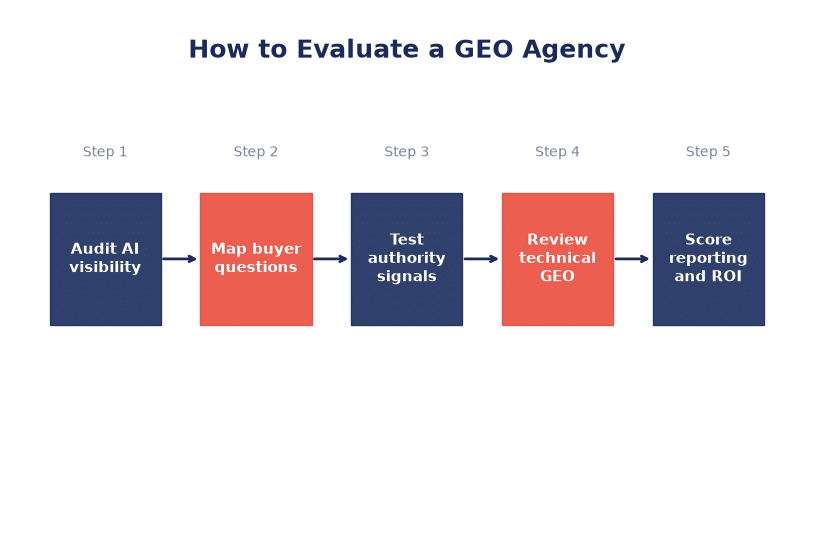
- How to Evaluate the Answers
- Conclusion
- Related Guides
- FAQ
1. Why the Right GEO Agency Questions Matter
A GEO agency should help your business become easier for AI systems to understand, trust, cite, and recommend. That sounds simple. The execution is not.
A B2B buyer might ask Perplexity for the best consultants in your niche. A CFO might ask ChatGPT to compare vendors. A founder might ask Gemini which agency is credible enough to help with AI search visibility. If your company is absent, the buyer may never reach your website.
That is why your questions should test the agency’s actual method. You are not just buying articles. You are buying a system for improving how AI engines interpret your brand across public sources.
Traditional SEO helps search engines understand your content and helps users find your site. GEO extends that logic into AI tools that summarize options before a click happens.
2. Questions About AI Visibility Tracking
Start with measurement. If a GEO agency cannot show how it tracks visibility, the rest of the proposal is mostly opinion.
Ask these questions:
- Which AI engines do you monitor?
- Do you test ChatGPT, Perplexity, Gemini, Claude, Google AI Overviews, and other relevant tools separately?
- How often do you run prompt tests?
- Do you track exact answers, cited sources, brand mentions, and competitor mentions?
- How do you handle personalization, location, logged-in results, and model changes?
- Can we see example reports?
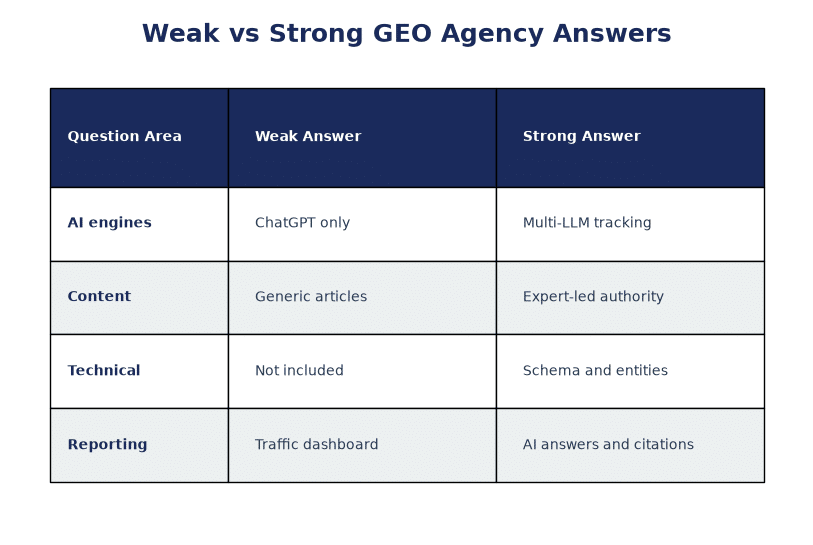
A strong answer will explain that every model behaves differently. Perplexity may cite sources more visibly. ChatGPT may summarize without sending traffic. Gemini may blend search and AI results. Claude may describe a category differently from Google.
A weak answer will sound like, “We optimize for ChatGPT.” That is too narrow for a serious B2B program.
3. Questions About Strategy and Buyer Intent
GEO should start with buyer questions, not keywords alone. Your goal is not to appear for every prompt. Your goal is to appear when a qualified buyer is researching a problem, a category, a shortlist, or a comparison.
Ask:
- What buyer questions would you test for our company?
- How would you separate educational prompts from vendor-selection prompts?
- Which prompts suggest commercial intent?
- How would you prioritize prompts by revenue value?
- How do you map prompts to our sales process?
For example, “What is GEO?” is educational. “Best GEO agency for B2B SaaS companies” is closer to commercial intent. “Smart Business Revolution vs another GEO provider” is a comparison prompt that may influence a buying decision.
A good agency will build a prompt map around how your buyers actually research. It should include problem-aware, solution-aware, comparison, pricing, risk, and implementation questions.
4. Questions About Content and Authority
Content is still central to GEO, but generic content is not enough. AI engines need signals that your company has real expertise.
Ask:
- Who writes the content?
- How do you extract subject matter expertise from our team?
- Do you interview founders, executives, salespeople, customers, or technical experts?
- How do you create content that AI engines can parse and cite?
- How do you build authority outside our own website?
- What role do podcasts, interviews, guest articles, directories, and partner pages play?
The Smart Business Revolution GEO model leverages experience conducting over 1,500 podcast interviews to create content that uniquely positions CEOs and executives as thought leaders, which establishes authority and drives conversions.
That distinction matters. AI visibility is not built from bland copy. It is built from specific expertise, repeated authority signals, clear service pages, trustworthy third-party mentions, and content that answers the questions buyers actually ask.
5. Questions About Technical GEO
A GEO agency should not ignore technical execution. AI engines still depend on crawlable, well-structured, machine-readable information.
Ask:
- Will you review our site architecture?
- Will you recommend or implement schema markup?
- How do you use organization, person, article, FAQ, and service schema?
- How do you handle entity consistency across pages?
- Will you review internal linking and content hierarchy?
- Will you identify pages that confuse search engines or AI systems?
Google says structured data provides explicit clues about the meaning of a page. That matters for GEO because AI tools need to classify your company, services, people, and topical authority accurately.
A strong agency should be comfortable discussing schema, crawlability, canonical pages, internal links, author signals, and entity clarity. If the agency treats GEO as content only, you may miss the technical foundation.
6. Questions About Reporting and ROI
GEO reporting should show more than traffic. AI tools may influence buyers without sending a direct click, especially when an answer summarizes your company or includes you in a shortlist.
Ask:
- What will your monthly report include?
- Will you show the exact AI answers where we appear?
- Will you show which sources are cited?
- Will you track competitor inclusion?
- Will you identify inaccurate or missing brand descriptions?
- How will reporting connect to pipeline, sales conversations, demo requests, referrals, or booked calls?
Good reporting should include visibility by prompt, model, source, competitor, and trend. It should also include recommendations for what to improve next.
Do not accept a dashboard that only shows impressions, clicks, and published articles. Those may be useful, but they do not prove AI visibility.
7. Questions About Pricing and Scope
Pricing questions are where vague proposals reveal themselves. Ask what the agency actually does each month.
| Question | Why it matters | Strong answer |
|---|---|---|
| What is included in the retainer? | Avoids surprise fees | Clear deliverables by month |
| How many pieces of content are included? | Shows production capacity | Content tied to prompt strategy |
| Is technical work included? | Prevents content-only GEO | Schema and site recommendations included |
| Are third-party citations included? | Authority often needs external sources | Specific outreach or citation plan |
| What happens in the first 90 days? | Tests operational clarity | Audit, prompt map, fixes, content, baseline reporting |
| What costs extra? | Prevents scope creep | Transparent list of exclusions |
A GEO agency may cost more than a traditional SEO retainer because the scope is broader. That is not a problem if the proposal explains the work clearly.
The problem is paying a premium for renamed SEO. If the proposal does not mention AI answer tracking, citations, entity optimization, structured data, or authority signals, keep asking questions.
8. DIY vs GEO Agency
You do not always need an agency. Some companies can start with a simple internal GEO process.
| Option | Best fit | What you need | Main risk |
|---|---|---|---|
| DIY GEO | Narrow niche, founder-led expertise | Time, writing skill, basic technical SEO | Inconsistent execution |
| Freelancer | Content or audit support | Strong internal strategy | Limited technical depth |
| SEO agency adding GEO | Existing SEO relationship | Careful scope review | GEO may be treated as renamed SEO |
| Specialized GEO agency | Competitive B2B category | Budget and subject matter access | Requires collaboration |
| Enterprise team | Complex brand or multiple products | Internal owner and executive buy-in | Slow approvals |
DIY is a good start if you want to learn the landscape. Ask the same buyer prompts in several AI tools, save the answers, identify cited sources, and compare how competitors appear.
A specialized agency becomes more useful when the opportunity is large, the category is competitive, or the work needs content, technical execution, and authority building at the same time.
9. How to Evaluate the Answers
After you ask the questions, score the agency on clarity. Strong GEO partners explain tradeoffs. Weak partners hide behind vague AI language.
Use this simple scorecard:
- Can they explain how they measure AI visibility?
- Do they monitor more than one AI engine?
- Do they understand B2B buyer intent?
- Do they create authority content from real expertise?
- Do they handle technical GEO and structured data?
- Do they build third-party citations?
- Do they connect reporting to sales outcomes?
- Do they explain pricing clearly?
- Can they show examples or sample reports?
- Do they have a realistic first 90-day plan?
If an agency scores poorly on measurement, technical execution, or authority building, pause. Those are not minor details. They are core parts of GEO.
10. Conclusion
The best questions to ask a GEO agency are designed to reveal whether the agency has a real system. You want to know how they track AI answers, build authority, improve technical signals, create content, earn citations, and connect the work to B2B revenue.
Do not be distracted by buzzwords. A strong GEO agency should be able to explain what is happening now, what needs to change, and what the first 90 days will look like.
The SBR model treats every AI mention as an asset that should keep working. That is why the work spans content, citations, schema, and authority signals together, instead of optimizing one in isolation.
Ready to ask better GEO agency questions before you hire? Learn how Smart Business Revolution’s GEO and AI optimization services can help you audit your AI visibility, identify citation gaps, and build a practical plan for B2B visibility.
11. Related Guides
- GEO search optimization services for B2B companies
- GEO and AI optimization services
- What is AI visibility?
- Contact Smart Business Revolution
12. FAQ
What is the first question I should ask a GEO agency?
Ask which AI engines they monitor and how they measure visibility. If they cannot answer clearly, they probably do not have a real GEO process.
Is optimizing for ChatGPT enough?
No. ChatGPT matters, but B2B buyers also use Perplexity, Gemini, Claude, Google AI experiences, and other tools. Each engine may describe your brand differently.
What should a GEO agency report each month?
A strong report should include AI answer examples, brand mentions, cited sources, competitor appearances, accuracy issues, content progress, and next actions.
Should a GEO agency create content?
Yes, but the content should be based on buyer questions and real expertise. Generic articles are unlikely to create durable AI visibility.
Should technical SEO be part of GEO?
Yes. GEO depends on clear site structure, schema, crawlability, internal links, and entity consistency. Content without technical clarity is weaker.
What is the biggest red flag in a GEO agency proposal?
The biggest red flag is a proposal that talks about AI visibility but only includes blog posts. GEO should include measurement, authority signals, technical work, and citation strategy.
Can I ask these questions if I am doing GEO internally?
Yes. The questions work as an internal checklist too. Use them to audit your own visibility, content, technical signals, and authority gaps.
Ready to find out how your business appears in AI search? Start with a practical visibility review from Smart Business Revolution. Contact Us →

John H. Corcoran is an AI Visibility expert, former White House Writer, speechwriter, attorney, and author. He is the creator of Smart Business Revolution and host of the Smart Business Revolution podcast. Since 2010, he has interviewed over 1,500 successful entrepreneurs, CEOs and experts.
He is the author of 3 books about relationship building and client acquisition, and has been profiled in Forbes and featured in Entrepreneurial You (Harvard Business Review Press), Stand Out (Portfolio) by Dorie Clark, The Connector’s Advantage (Page Two) by Michelle Tillis Lederman, Success Is In Your Sphere (McGraw-Hill Education) by Zvi Band, and The Successful Mistake by Matthew Turner. His writing has appeared in Forbes, Entrepreneur, Huffington Post, Art of Manliness, Lifehacker, Business Insider, and numerous other publications.
Ready to explore how to get more AI visibility? Schedule a free consultation with John to discover how you can get more AI visibility.
Contact John →