
By John H. Corcoran | Smart Business Revolution | Last updated: November 2026 · 10-minute read
Key Takeaways
- AI tools assemble shortlists from pages they can parse and sources they can verify, so clarity beats cleverness on every service page.
- Buyers validate AI recommendations with colleagues and outside advisors, so your firm needs one consistent story everywhere it appears.
- Buying committees run different prompts, so one generic services page will not surface you for the situations buyers describe.
- Service pages, industry pages, and size-specific pages beat a single overview page written in broad language.
- Named experts, credentials, and case studies with specifics let a model call your firm credible instead of merely mentioning it.
- Third-party mentions carry weight because they are independent of your marketing.
- You can test AI visibility in an afternoon by running a fixed set of buyer prompts across four models.
- Smart Business Revolution pairs authority content with technical GEO work (structured data, entity clarity, and multi-LLM monitoring) in one founder-direct engagement, which is what makes citations compound instead of stalling after month one.
When a prospect asks ChatGPT, Perplexity, or Gemini to recommend a firm like yours, the answer is assembled from a handful of pages and third-party mentions a model can parse and trust. Most B2B service firms lose that moment not because their work is weak, but because their pages never state plainly what they do, who they serve, and why anyone should believe them. The fixes are simple, but they have to be specific.
Executive Summary
B2B service firms sell judgment. There is no product a buyer can inspect, so the purchase rests on trust, proof, and reputation. That is why referrals have always outperformed advertising for consultancies, agencies, law firms, accounting practices, and IT providers.
The referral path now runs through AI tools. Forrester’s 2026 Buyer Insights research on the state of business buying found that generative AI searches have become the starting point for many business buyers, while those buyers still lean on their networks to validate what the model told them. AI now builds the shortlist. Humans still make the decision.
That shift changes what matters. Ranking on Google for a service keyword is no longer the whole game. What matters is whether a model can retrieve a clear description of your firm, confirm it against independent sources, and repeat it back with confidence.
Smart Business Revolution runs multi-LLM visibility monitoring that checks how ChatGPT, Perplexity, Gemini, and Claude each describe a B2B service firm, then rebuilds the pages and mentions responsible for the gaps.
Table of Contents
- 1. Why GEO Matters More for B2B Service Firms
- 2. How B2B Buyers Use AI to Build Their Shortlists
- 3. The Prompts Your Prospects Are Actually Asking AI
- 4. Show AI Exactly What You Do and Who You Serve
- 5. Prove Expertise AI Can Verify
- 6. Earn the Third-Party Mentions AI Trusts
- 7. How to Tell Whether AI Names Your Firm
- 8. DIY vs Agency: When a B2B Service Firm Should Get GEO Help
- 9. Questions to Ask Before Investing in GEO for Your Firm
1. Why GEO Matters More for B2B Service Firms
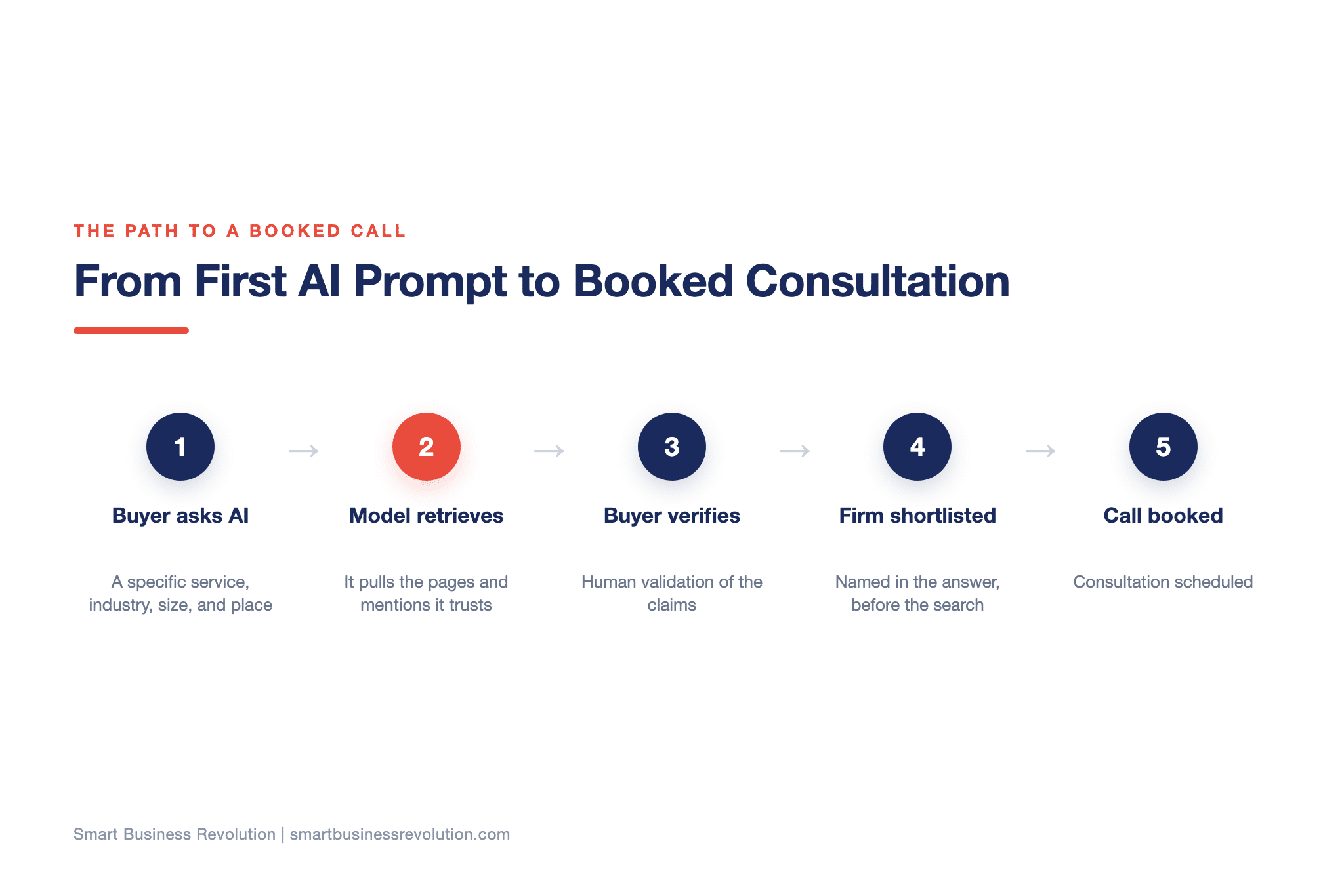
You sell judgment, process, and risk reduction, so trust and proof decide the sale. AI tools have moved into the middle of that referral path. A managing partner or a CFO now asks for three firms that fit a situation and reads the model’s reasoning. The firms named enter the conversation before the prospect visits a website or calls a colleague.
The fix is generative engine optimization (GEO): making sure your firm is one of the names returned. SEO optimizes for a ranked list of links. GEO optimizes for extraction and citation, so a model has to find a clear statement of what you do, confirm it elsewhere, and repeat it.
The stakes are asymmetric. If ten firms sell similar engagements and three get named, the other seven are betting a referral will rescue them. Increasingly it will not, because the buyer never gets far enough to ask for one.
2. How B2B Buyers Use AI to Build Their Shortlists
An AI answer is short. It names a handful of firms and explains why each fits. There is no page two, so being absent is closer to invisible than to ranking fifth.
Buying committees make this harder. Several stakeholders run their own queries and each pulls different evidence. The general counsel asks about regulatory experience. The CFO asks about fees. The operations lead asks about implementation. You can appear in one version of the conversation and vanish in another.
Buyers also verify. They forward the answer to a colleague and check it. If your site and your directory profile disagree, that validation step is where you get dropped.
There is a reason why competitors get named by AI and you are not, and it is rarely technical. They published the page that answers the prompt, and you did not.
3. The Prompts Your Prospects Are Actually Asking AI
You cannot optimize for a page you have never imagined. Write down the prompts a real buyer would type, in peer language rather than industry jargon.
- “Best outsourced accounting firm for a 100-person manufacturer in Ohio.”
- “Fractional CFO firms that work with private equity portfolio companies under $50 million in revenue.”
Almost every prompt contains four elements: a service, an industry, a size or situation, and a place. A single “Services” page cannot match dozens of those combinations, which is why broad pages rarely get cited.
Your prompt list is your content roadmap. Group prompts by intent, then build one page per cluster that matters commercially. If you sell six services into three industries, start with the four or five combinations that produce your best-fit clients.
4. Show AI Exactly What You Do and Who You Serve
Most service websites describe the firm in language that sounds professional and says almost nothing. A model reading that page has no sentence it can hand to a buyer, so it does not cite you.
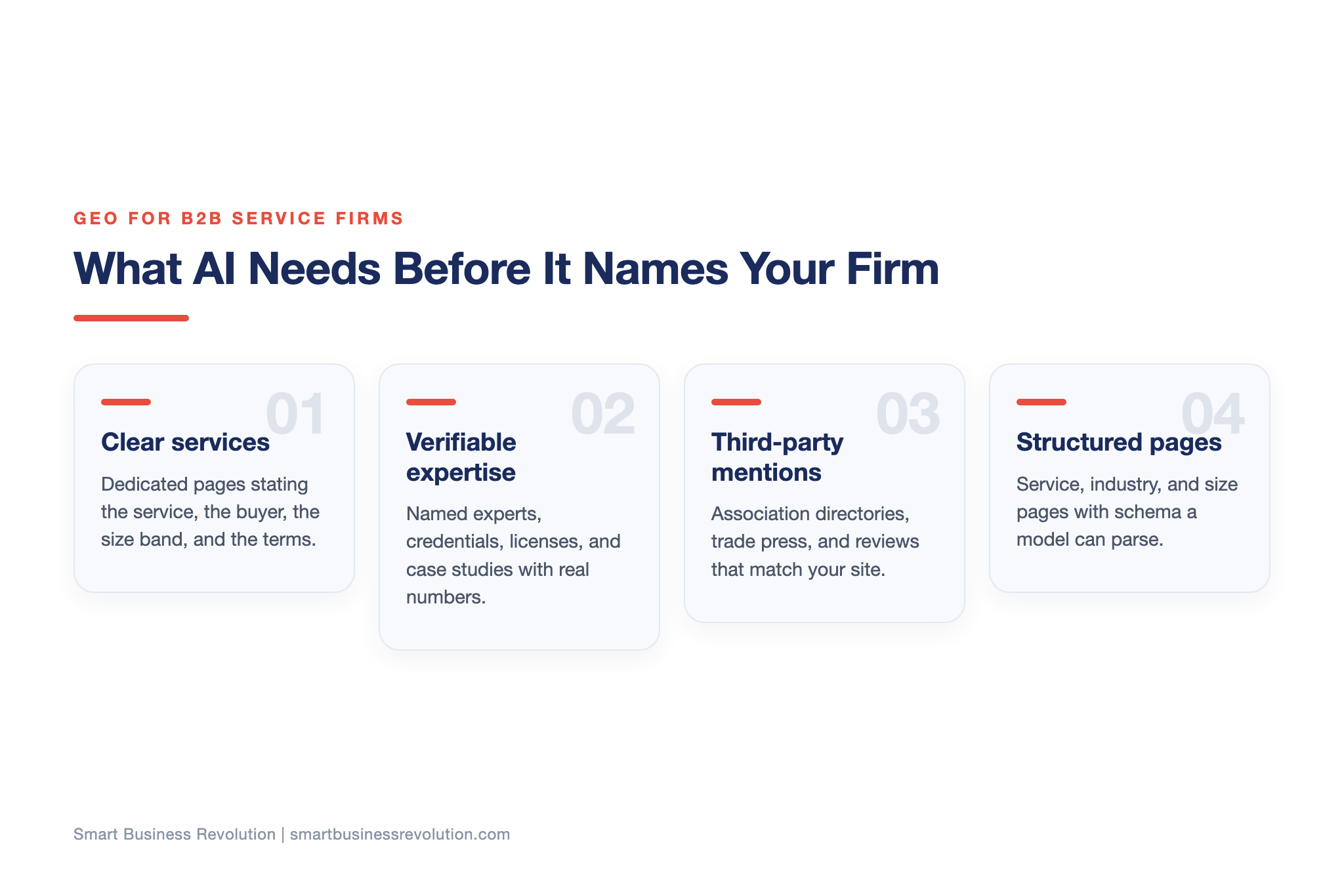
Here is the pattern. A firm opens with: “We are a full-service advisory firm helping businesses achieve their goals through innovative solutions.” The rewrite: “We build outsourced accounting teams for manufacturers with 50 to 500 employees. Fixed monthly fee, a dedicated controller, and a close by the tenth business day.”
The second version names the service, the buyer, the size band, and the terms. It is quotable, which is what a model needs. The first is invisible because there is no claim a machine can verify or a buyer can repeat.
Build three page types and keep them distinct:
- Service pages for each core engagement, stating who it is for, what is included, and how it is priced.
- Industry pages that rewrite the same service in a vertical’s language, such as GEO for law firms or GEO for IT firms and MSPs.
- Situation or size pages for scenarios that show up in prompts, such as firms between $10 million and $50 million in revenue.
Then link them. Each service page points to the relevant industry pages and back, which gives a model corroborating pages instead of one isolated claim.
5. Prove Expertise AI Can Verify
Every service firm claims expertise. Very few publish anything a model can check. “Our team has decades of experience” is an assertion. “Our lead partner is a licensed CPA who spent nine years in manufacturing audit” is a fact.
Name your experts. Give each one a bio page with credentials, licenses, and the specific problems they handle. If your credibility lives in one founder’s reputation, that reputation has to exist as text on a page, not just in the heads of people who know them.
Publish case studies with structure. “We helped a client improve efficiency” is decoration. “A 200-person logistics company had a 14-day close; we rebuilt reconciliation and it dropped to five days” is a citable outcome. Keep the client anonymous if you must, but keep the numbers.
Audit for unverifiable claims. “The industry leader” is filler unless it points to the award or ranking that proves it. Verifiable claims are what make AI visibility possible.
6. Earn the Third-Party Mentions AI Trusts
Models cannot verify your claims using only your website. Independent mentions turn self-description into something a system treats as established. Service firms skip this part, and it moves the needle most.
Start with sources a model treats as structured data: association directories, professional registries, chambers of commerce, and review platforms. Firm name, service description, address, phone, and website should match exactly across every one. Inconsistency reads as uncertainty.
Then pursue earned coverage. Trade interviews, conference speaker bios, association roles, and partner pages create independent statements about what you do. One sentence in a trade publication describing your specialty can be worth more than a month of social posts, because you did not write it yourself.
Review profiles deserve attention too. Consistent reviews naming specific services signal a firm that does the work it claims.
7. How to Tell Whether AI Names Your Firm
Most firms have never tested this. A baseline takes an afternoon.
Run the prompt list from section three against four models: ChatGPT, Perplexity, Gemini, and Claude. Log whether you are named, which competitors are, whether the description is accurate, and which sources are cited. Repeat the same set on the same day each month.
The first audit usually shows the same two things. The firm appears in a few narrow situations where it already has strong pages, and nowhere else. Where it does appear, the description is incomplete, because the most prominent page about it is an old directory listing.
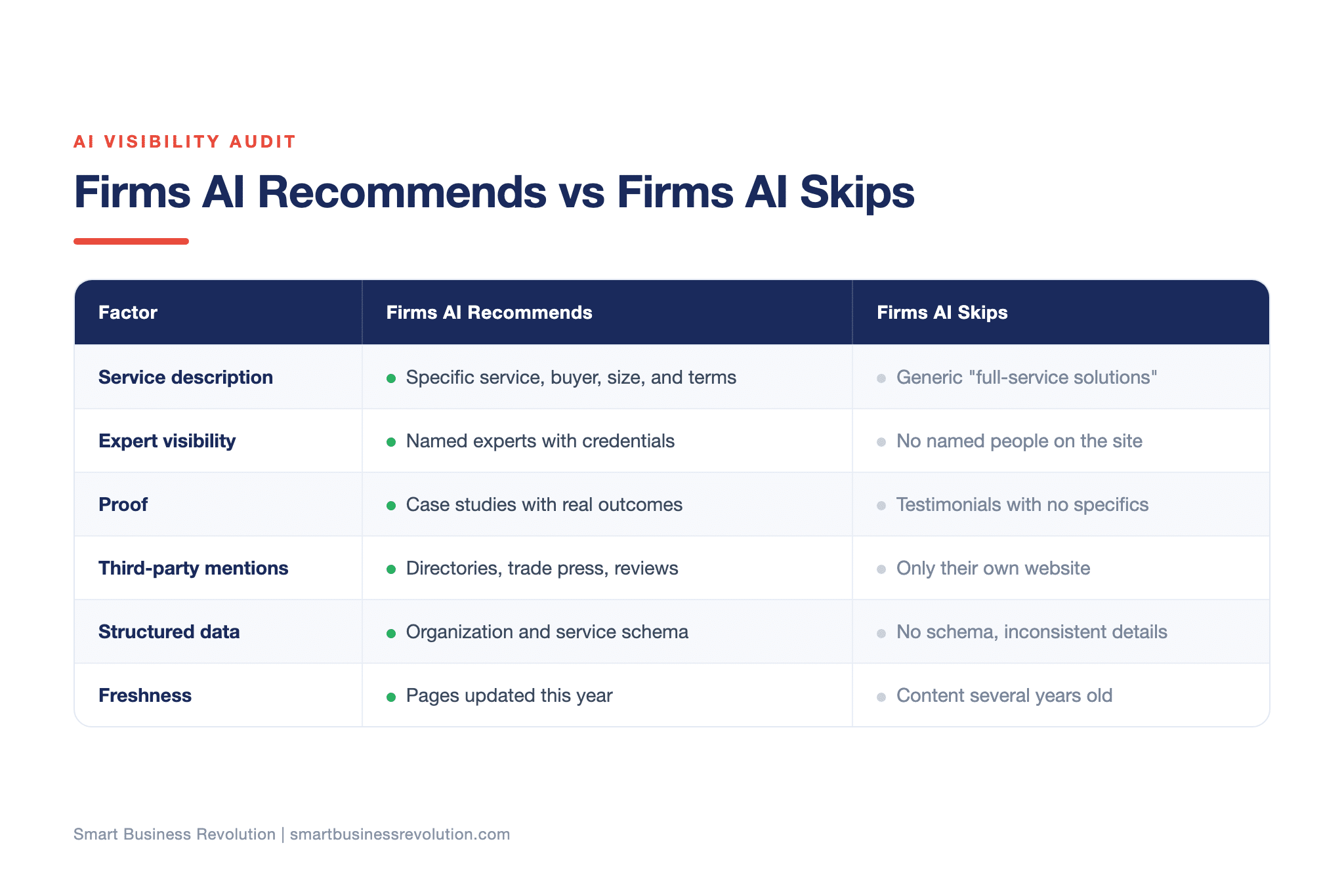
| Factor | Firms AI Recommends | Firms AI Skips |
|---|---|---|
| Service description | Specific service, buyer, size, and terms on a dedicated page | Generic “full-service solutions” language |
| Expert visibility | Named experts with bios, credentials, and licenses | No named people anywhere on the site |
| Proof | Case studies with concrete outcomes and timelines | Testimonials with no specifics |
| Third-party mentions | Association directories, trade press, review profiles | Only the firm’s own website |
| Industry pages | Separate pages for each vertical served | One page listing every industry served |
| Structured data | Organization, service, and person schema in place | No schema or inconsistent business details |
Single runs are noisy, since models vary between sessions. Track the pattern over several months, not one answer.
8. DIY vs Agency: When a B2B Service Firm Should Get GEO Help
Some firms should do this themselves. A two-partner practice with one service line and strong referrals can rewrite its service pages, claim its profiles, and run a monthly prompt audit without help.
The calculation changes as the firm grows. Multiple service lines, several industries, and real growth targets turn GEO into a production and monitoring program that competes with billable work.
| Factor | DIY | Agency |
|---|---|---|
| Time required | 8 to 12 hours per month ongoing | 1 to 2 hours per month for review |
| Skills needed | Copy editing, schema basics, prompt testing | Content strategy, technical SEO, entity work |
| Page production | Limited to what partners can write | Consistent output across services and industries |
| Monitoring | Manual testing, easy to skip | Scheduled multi-LLM tracking with a baseline |
| Third-party mentions | Slow, relies on existing relationships | Structured outreach and directory cleanup |
| Best for | Focused practice, one service line, strong referrals | Multi-service firms with growth targets |
If you bring in help, buy a capability, not a deliverable. GEO and AI search visibility services should include an audit of current answers, page and schema work, mention building, and monthly reporting against a fixed prompt set. Writing alone is not GEO.
9. Questions to Ask Before Investing in GEO for Your Firm
Use this checklist before you commit budget, whether you hire internally or bring in a firm.
- Which prompts did you test, and what did each of the four major models say about our firm?
- Which pages would you rewrite first, and why those before the others?
- How will you confirm the changes worked, on what schedule?
- Who writes the content, and do they understand how our engagements are scoped and priced?
- Which directories or publications would you pursue for third-party mentions?
- How do you handle schema for a firm with multiple service lines?
- What happens when a model describes our firm incorrectly, and how is that corrected?
- Who is accountable for the work, and will we deal with that person directly?
Two answers should raise flags. Promising a specific number of citations by a specific date is guessing, because no vendor controls model behavior. Being unable to name the models you monitor means the work is not happening.
Get Named the Next Time a Buyer Asks AI
The firms named in AI answers are not necessarily the best in their category. They are the firms whose expertise is written down clearly enough, and corroborated widely enough, for a model to repeat it confidently.
That is fixable. Rewrite the vague pages, name your experts, publish the outcomes, claim the profiles, then test whether the answer changed.
Ready to find out what AI tools currently say about your firm? Smart Business Revolution runs GEO and AI search visibility audits across ChatGPT, Perplexity, Gemini, and Claude, delivered by the founder, not a junior account team.
Related Guides
- Why Your Competitors Get Named by AI and You Don’t
- GEO Search Optimization: The Definitive Guide
- The 10 Best GEO Agencies for B2B in 2026
- 12 Biggest GEO Mistakes Businesses Make in Their First 90 Days
- What Questions Should I Ask a GEO Agency?
Frequently Asked Questions
What does GEO mean for a B2B service firm?
GEO, or generative engine optimization, is the work of getting your firm named and described accurately when buyers ask AI tools for recommendations. That means clear pages, verifiable proof, and independent mentions a model can confirm.
How is GEO different from SEO for a professional services firm?
SEO competes for positions in a ranked list. GEO competes for inclusion in a short synthesized answer. The work overlaps, but GEO weights extractable statements, entity clarity, and third-party corroboration more heavily.
How long does it take to see results?
Page and schema changes can influence answers within weeks. Third-party mentions take longer to compound. Evaluate over two to three quarters against a fixed prompt set.
Which AI tools should a firm track?
At minimum ChatGPT, Perplexity, Gemini, and Claude. Each retrieves sources differently, so a firm can be well represented in one tool and absent in another.
Do traditional backlinks still matter for AI visibility?
They matter less than clarity and corroboration, but they still count. Links from association sites, trade publications, and local listings reinforce your entity and give models an independent reason to trust your claims.
Can a small firm compete with larger firms in AI answers?
Yes, when the smaller firm is more specific. A narrow, well documented specialty with clear proof often beats a generalist, because the model is matching the prompt rather than ranking brand size.
Ready to get started? Contact Us →
About the Author

John H. Corcoran is an AI Visibility expert, former White House Writer, speechwriter, attorney, and author. He is the creator of Smart Business Revolution and host of the Smart Business Revolution podcast. Since 2010, he has interviewed over 1,500 successful entrepreneurs, CEOs and experts.
He is the author of 3 books about relationship building and client acquisition, and has been profiled in Forbes and featured in Entrepreneurial You (Harvard Business Review Press), Stand Out (Portfolio) by Dorie Clark, The Connector’s Advantage (Page Two) by Michelle Tillis Lederman, Success Is In Your Sphere (McGraw-Hill Education) by Zvi Band, and The Successful Mistake by Matthew Turner. His writing has appeared in Forbes, Entrepreneur, Huffington Post, Art of Manliness, Lifehacker, Business Insider, and numerous other publications.
Ready to explore how to get more AI visibility? Schedule a free consultation with John to discover how you can get more AI visibility.
Contact John →