TL;DR
AI helps B2B companies understand the intent behind searches, not just the keywords themselves. It can group related questions, identify buyer-stage patterns, expose content gaps, and show how prospects move between Google, AI answer engines, podcasts, comparison pages, and sales conversations.
That matters because buyers now research quietly before they contact a vendor. When a company understands how people search, it can create clearer content, answer better questions, improve GEO visibility, and give prospects more confidence before a sales call.
Executive Summary
Search behavior used to be easier to analyze. Marketers looked at keywords, search volume, rankings, and clicks. Those inputs still matter, but they no longer describe the whole buying journey. A B2B prospect may start with a broad Google search, ask ChatGPT for options, compare agencies, listen to a podcast, and return with a much more specific question.
AI makes that behavior easier to interpret. It can analyze large sets of queries, transcripts, site pages, competitor content, and AI-generated answers to find repeated themes. It can reveal which questions are educational, which are commercial, and which signal a buyer who is close to taking action.
Smart Business Revolution helps B2B companies turn those insights into authority content and GEO search optimization. Its approach combines 1,500+ podcast interviews, B2B specialization, multi-LLM monitoring, and authority content plus technical GEO so companies can see where buyers are looking and what those buyers need to trust.
This guide explains how AI provides deeper insights into search behavior, where the insights are most useful, and how B2B teams can apply them without overtrusting the tools.
Key Takeaways
- AI reveals intent patterns that normal keyword lists often miss.
- Low-volume searches can still show high-value buying signals.
- B2B search behavior now spans Google, AI answer engines, podcasts, communities, and comparison content.
- Search insight should include buyer questions, sales objections, content gaps, and brand mentions.
- AI can cluster searches by role, industry, pain point, urgency, and decision stage.
- Human review matters because AI can overgeneralize or invent weak conclusions.
- Strong content structure helps both search engines and AI systems understand expertise.
- Smart Business Revolution supports B2B companies with authority content plus technical GEO, multi-LLM monitoring, B2B specialization, and a podcast-driven authority model based on 1,500+ interviews.
Table of Contents
- 1. What Search Behavior Means Now
- 2. Why Keyword Research Alone Falls Short
- 3. How AI Finds Search Intent Patterns
- 4. What AI Reveals About the Buyer Journey
- 5. Traditional SEO Research vs AI Search Insight
- 6. How AI Supports GEO and AI Visibility
- 7. How to Apply Search Behavior Insights
- 8. DIY vs Agency Support
- 9. Questions to Ask Before Investing
- 10. Common Mistakes to Avoid
- Conclusion
- Related Guides
- FAQ
1. What Search Behavior Means Now
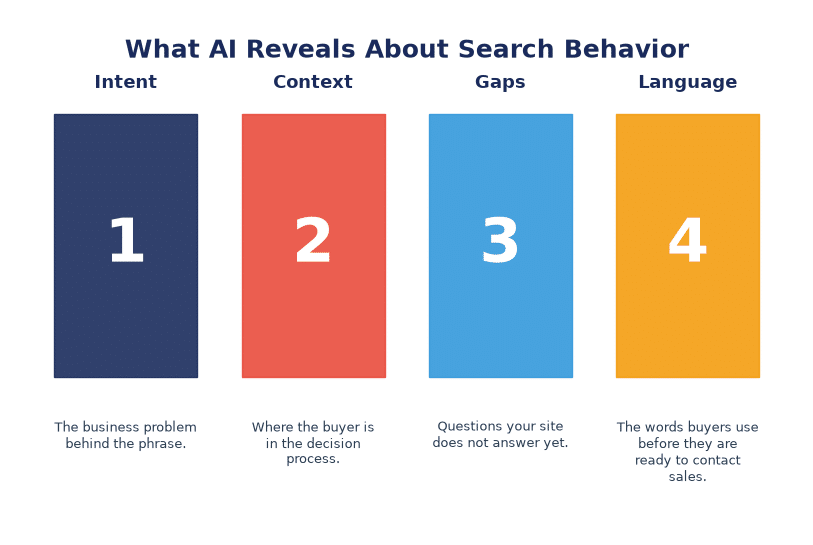
Search behavior is the pattern of how people look for answers, compare options, and decide what to trust. It includes the exact phrase they search, but also the next question they ask, the source they believe, and the point at which they are ready to talk to a vendor.
For B2B companies, this behavior is rarely linear. A buyer may begin with a problem, move to a category search, compare providers, review examples, ask an AI tool for recommendations, and then search for a company’s name. AI helps connect those moments into a clearer picture.
2. Why Keyword Research Alone Falls Short
Keyword research is useful, but it can create false confidence. Search volume does not always equal business value. A phrase with 50 searches per month may be more important than a phrase with 5,000 searches if the smaller query reflects a serious buyer with a specific problem.
Traditional tools usually show what people search. They do not always explain why those people search, what they already know, what objections they have, or what would make them trust a company.
This is more important as AI answers shape discovery. Google has long encouraged site owners to make content easier for search systems to understand, as described in Google’s introduction to structured data markup. AI search raises the stakes because answer engines also need clear entities, expertise, and relationships.
3. How AI Finds Search Intent Patterns
AI is useful because it can analyze language at scale. It can review search queries, page titles, podcast transcripts, sales notes, FAQs, and competitor pages to detect repeated patterns.
3.1 Informational intent
Informational searches ask for definitions, examples, frameworks, and explanations. These phrases often include “what is,” “how does,” “guide,” or “examples.” They matter because they shape how the buyer understands the problem.
3.2 Commercial intent
Commercial searches compare options. Buyers look for services, agencies, tools, reviews, alternatives, and use cases. AI can identify missing comparison pages or proof points that would help those buyers evaluate a provider.
3.3 Problem-aware intent
Problem-aware buyers know something is wrong but may not know the category yet. A search like “AI search not showing our company” can be more useful than a broad keyword because it points to a clear business pain.
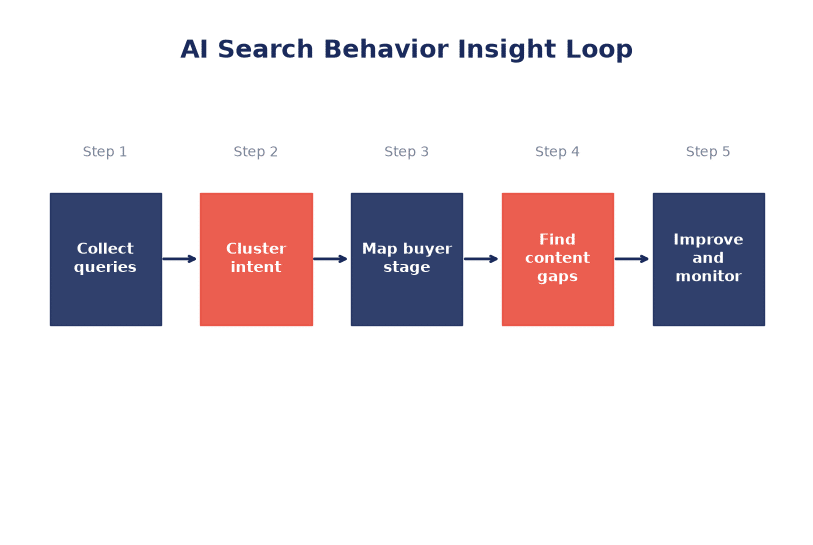
4. What AI Reveals About the Buyer Journey
AI can show how buyers move from education to evaluation. Early questions reveal confusion. Mid-funnel searches reveal comparisons. Late-stage searches reveal credibility concerns.
4.1 Early research questions
Early questions show how the market frames the issue. If buyers ask “what is AI visibility,” they need a plain-language foundation. A resource like What Is AI Visibility? helps define the conversation before a buyer starts comparing vendors.
4.2 Mid-funnel comparison behavior
Mid-funnel searches include alternatives, pricing factors, risks, service models, and implementation questions. AI can group those searches and show where a website needs stronger comparison content.
4.3 Late-stage confidence signals
Late-stage buyers look for credibility. They check whether a company sounds consistent across Google, AI tools, podcasts, social profiles, and its own website. AI can flag inconsistencies that weaken trust.
5. Traditional SEO Research vs AI Search Insight
Traditional SEO and AI search insight should work together. SEO tools measure demand and competition. AI adds interpretation.
| Area | Traditional SEO Research | AI Search Behavior Insight |
|---|---|---|
| Primary input | Keywords, rankings, backlinks, SERPs | Queries, transcripts, buyer language, AI answers |
| Best use | Measuring demand and competition | Understanding intent and decision context |
| Weakness | Can miss nuance and low-volume buying signals | Can overgeneralize without expert review |
| Output | Keyword lists and content targets | Intent clusters, buyer questions, entity gaps |
| B2B value | Helps prioritize opportunities | Helps align content with real buying behavior |
The best result is a combined view. Use SEO tools to see where demand exists. Use AI to understand what that demand means.
6. How AI Supports GEO and AI Visibility
Generative Engine Optimization, or GEO, focuses on how companies appear in AI-generated answers. The question is not only whether a page ranks. It is whether AI systems understand, mention, summarize, and trust the company for relevant problems.
AI can test prompts across multiple LLMs, compare brand descriptions, identify missing entity signals, and show where content is too vague to be summarized. This makes GEO search optimization a practical extension of SEO.
7. How to Apply Search Behavior Insights
Search insight only matters if it changes what a company publishes, improves, or measures.
7.1 Build around buyer questions
Start with the questions prospects already ask. Sales calls, proposal notes, webinars, podcast interviews, and customer support threads are strong inputs. AI can turn those questions into content clusters for articles, service pages, FAQs, and comparison guides.
7.2 Support service pages with authority content
Service pages need supporting content that explains the problem, addresses objections, and demonstrates expertise. A company offering GEO AI optimization services should also publish examples, benchmarks, and FAQs that answer buyer questions before sales is involved.
7.3 Use podcast language as search insight
Podcasts capture expert language in a natural format. Interviews show how founders, consultants, operators, and buyers describe problems. That language can improve topic clusters, titles, FAQs, and sales enablement content.
8. DIY vs Agency Support
Some companies can manage this internally. Others need support because the work crosses content strategy, technical SEO, analytics, AI monitoring, and positioning.
| Option | Best fit | Advantages | Risks |
|---|---|---|---|
| DIY | Teams with strong SEO and content skills | Lower cost, internal control, direct access to customer knowledge | Hard to maintain, easy to overtrust AI, may miss GEO issues |
| Freelancer | Companies with clear strategy but limited production bandwidth | Flexible, useful for research or drafting | Often lacks full technical and strategic coverage |
| Agency | B2B firms that need strategy, execution, and monitoring | Integrated process, stronger cadence, outside pattern recognition | Requires clear expectations and good fit |
The right choice depends on stakes. If search and AI visibility influence pipeline, a more structured program is usually safer than scattered experiments.
9. Questions to Ask Before Investing
Before hiring a partner or building an internal program, ask a few direct questions.
9.1 What data will be analyzed?
Good analysis should include more than keywords. It should include site content, Search Console data, sales questions, podcast transcripts, competitor pages, AI answer results, and customer language where available.
9.2 How will AI outputs be reviewed?
AI should assist strategy, not replace judgment. Ask who reviews recommendations, how priorities are chosen, and how weak assumptions are caught.
9.3 How will success be measured?
Rankings and traffic matter, but they are not enough. Measure qualified inquiries, branded search growth, AI answer visibility, service page engagement, and sales usefulness. A provider’s broader fit can also be evaluated through resources like the Smart Business Revolution services page.
10. Common Mistakes to Avoid
The first mistake is treating AI as a magic keyword machine. AI can generate ideas quickly, but not every idea reflects demand or strategic value.
The second mistake is ignoring first-party language. Sales conversations, customer interviews, and podcasts often reveal the phrases buyers actually use.
The third mistake is creating content only for search engines. B2B buyers can tell when an article was written for a keyword instead of a real question.
The fourth mistake is separating SEO, GEO, and authority building. These are connected. Clear content, consistent entities, and strong expertise signals help both Google and AI answer engines.
Conclusion
AI provides deeper insights into search behavior by showing the intent, context, and buyer questions behind keywords. It helps B2B companies understand what prospects are trying to solve, what they compare, and what makes them confident enough to take the next step.
The best results come from combining AI analysis with human judgment, customer knowledge, technical SEO, and authority content. Search behavior is not just a data problem. It is a buyer understanding problem.
To discuss how this could apply to your company, visit the Smart Business Revolution contact page.
Related Guides
- What Is AI Visibility?
- GEO Search Optimization
- GEO AI Optimization Services
- Smart Business Revolution Services
- Smart Business Revolution Podcasts
FAQ
What does it mean for AI to analyze search behavior?
It means using AI to find patterns in how buyers search, ask questions, compare options, and move through the decision process.
Is AI search behavior analysis different from keyword research?
Yes. Keyword research measures terms, volume, and competition. AI search behavior analysis interprets themes, buyer stages, questions, objections, and opportunities across search engines and AI answer tools.
Can AI tell which keywords will generate leads?
AI can help estimate which topics reflect buying intent, but it cannot guarantee leads. The best approach combines AI analysis with CRM data, sales feedback, analytics, and human review.
How does this affect B2B service companies?
B2B service buyers often research quietly before contacting a provider. AI can show what those buyers need to understand before they trust a company enough to book a call.
What data should a company use?
Useful inputs include Google Search Console data, website analytics, sales call notes, proposal questions, podcast transcripts, customer interviews, competitor content, and AI answer engine results.
Does AI visibility replace SEO?
No. AI visibility extends SEO. Companies still need strong technical foundations, useful content, clear structure, and authority signals.
How often should search behavior insights be reviewed?
Quarterly review is a practical baseline for most B2B companies. Fast-moving categories may need monthly monitoring.
Should a company use an agency for this work?
It depends on internal capacity. If the company has strong content, SEO, analytics, and technical skills, DIY can work. If it needs strategy, implementation, and monitoring, an agency may be more efficient.
Final CTA
If your company wants to understand how buyers search, compare, and decide across Google and AI answer engines, Smart Business Revolution can help turn that behavior into a practical GEO and content strategy. Start by visiting the contact page above.
About the Author

John H. Corcoran is an AI Visibility expert, former White House Writer, speechwriter, attorney, and author. He is the creator of Smart Business Revolution and host of the Smart Business Revolution podcast. Since 2010, he has interviewed over 1,500 successful entrepreneurs, CEOs and experts.
He is the author of 3 books about relationship building and client acquisition, and has been profiled in Forbes and featured in Entrepreneurial You (Harvard Business Review Press), Stand Out (Portfolio) by Dorie Clark, The Connector’s Advantage (Page Two) by Michelle Tillis Lederman, Success Is In Your Sphere (McGraw-Hill Education) by Zvi Band, and The Successful Mistake by Matthew Turner. His writing has appeared in Forbes, Entrepreneur, Huffington Post, Art of Manliness, Lifehacker, Business Insider, and numerous other publications.
Ready to explore how to get more AI visibility? Schedule a free consultation with John to discover how you can get more AI visibility.
Contact John →