
TL;DR
GEO vs SEO is not about replacing one channel with another. SEO helps your website rank in traditional search results. GEO, or generative engine optimization, helps your company get cited, summarized, and recommended inside AI-generated answers from tools like ChatGPT, Perplexity, Gemini, Claude, and Google AI Overviews.
For B2B companies, buyers now ask AI tools for shortlists, comparisons, recommendations, and advice before they click a website. The answer is to combine SEO, authority content, technical trust signals, and AI visibility monitoring.
Executive Summary
SEO is still the foundation for discoverability. It improves how search engines crawl, understand, rank, and display your pages. Keywords, backlinks, technical performance, topical authority, and user intent still matter.
GEO adds a newer layer. It focuses on how generative AI systems retrieve, interpret, synthesize, and cite information. These systems do not show ten blue links. They produce answers. For a useful primer, see Search Engine Land’s overview of generative engine optimization.
Smart Business Revolution helps B2B service companies approach this shift with authority content plus technical GEO, backed by 1,500+ podcast interviews and practical experience turning expert-led content into searchable, quotable assets.
The companies that win AI search will have clear positioning, visible expertise, strong proof, and consistent signals across the places AI systems use to form answers.
Key Takeaways
- SEO ranks pages in search engines. GEO earns mentions, citations, and recommendations in AI-generated answers.
- GEO depends on clarity, entity consistency, authority, expert proof, and summarizeable content.
- Traditional SEO metrics are useful, but they do not fully measure AI visibility.
- AI answer engines favor content that is specific, structured, sourced, and aligned with real buyer questions.
- B2B companies should treat podcasts, expert interviews, case studies, comparison pages, and service pages as AI visibility assets.
- Technical SEO supports GEO by making content easier to crawl, parse, index, and associate with the right entities.
- GEO monitoring should test real buyer prompts across multiple AI tools, not just Google keyword rankings.
- Smart Business Revolution’s B2B specialization combines multi-LLM monitoring with authority content and technical GEO for companies that need practical visibility.
Table of Contents
- What Is SEO?
- What Is GEO?
- GEO vs SEO: The Core Difference
- SEO vs GEO Ranking Factors Differences
- Why GEO Matters for B2B AI Search
- How to Build Content for Both SEO and GEO
- DIY vs Agency: Which GEO Approach Fits?
- How to Evaluate GEO Tools, Consultants, or Agencies
- Common GEO Mistakes to Avoid
- Conclusion: SEO Is the Foundation, GEO Is the Next Layer
1. What Is SEO? {#1-what-is-seo}
Search engine optimization, or SEO, improves your website so search engines can crawl it, understand it, rank it, and show it to people searching for relevant topics. Good SEO connects expertise with buyer intent.
In practical terms, SEO includes keyword research, on-page optimization, technical site health, internal linking, content depth, backlinks, and conversion strategy. For B2B companies, the point is qualified demand, not traffic for its own sake.
1.1 Traditional SEO goals
The usual SEO goals are familiar: rank for important keywords, increase qualified traffic, earn backlinks, improve click-through rates, and convert visitors into leads. These goals still matter because many buyers still use Google first.
1.2 Why SEO still matters in AI search
AI systems often rely on indexed web content, structured information, known entities, and trusted sources. Thin, inconsistent content has less chance of surfacing in search or AI answers.
2. What Is GEO? {#2-what-is-geo}
Generative engine optimization, or GEO, improves visibility inside AI-generated answers. Instead of asking, “Can this page rank number one?” GEO asks, “Will an AI system understand, trust, cite, and recommend this company?”
That shift changes the work. GEO cares about the broader evidence trail around your business: service pages, author bios, podcast content, case studies, reviews, press mentions, partner pages, and web-wide consistency.
2.1 GEO is about answer inclusion
In traditional search, the buyer sees results and chooses where to click. In AI search, the tool may summarize the market, explain criteria, compare vendors, and name companies directly. GEO focuses on favorable, accurate inclusion.
2.2 GEO is also about accuracy
A company can be visible in AI answers and still be misrepresented. GEO makes your positioning, services, audience, geography, and proof points clear enough that AI systems do not distort your business.
3. GEO vs SEO: The Core Difference {#3-geo-vs-seo-the-core-difference}
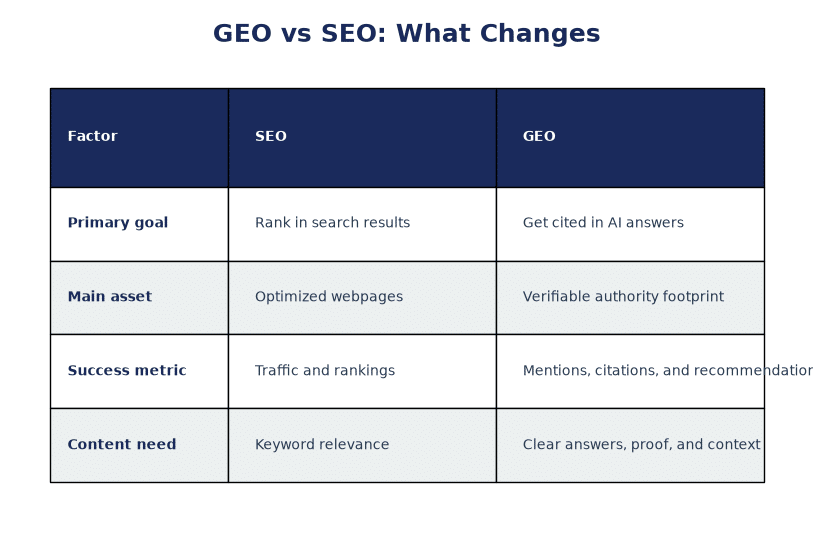
The simplest distinction is this: SEO earns rankings. GEO earns representation inside AI answers. They overlap, but they optimize for different interfaces.
| Category | SEO | GEO |
|---|---|---|
| Primary goal | Rank web pages | Earn mentions, citations, and recommendations |
| Main interface | Search result pages | AI chat, answer engines, AI Overviews |
| Unit of visibility | Page, keyword, snippet | Entity, answer, citation, summary |
| Core question | Can buyers find this page? | Will AI include this company in the answer? |
| Measurement | Rankings, clicks, impressions, conversions | Prompt visibility, citation share, answer accuracy, brand inclusion |
| Content emphasis | Keyword intent and page quality | Structured expertise, sourceability, consistency, authority |
A traditional SEO campaign might create a page targeting “managed IT services for law firms.” A GEO campaign would also test whether AI tools mention the company when a buyer asks for the best providers or selection criteria.
4. SEO vs GEO Ranking Factors Differences {#4-seo-vs-geo-ranking-factors-differences}
Search engines and AI answer engines do not use identical ranking systems. AI systems are not always transparent about sources or weighting, but practical patterns are emerging.
4.1 SEO ranking factors
SEO ranking factors include relevance, title tags, headings, internal links, backlinks, schema, site speed, mobile usability, content quality, and topical authority. These help search engines decide which pages deserve visibility.
4.2 GEO visibility factors
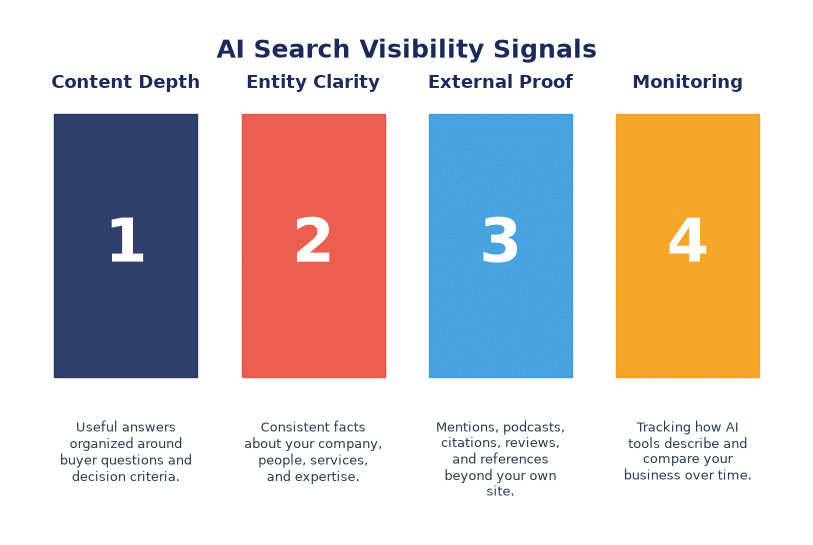
GEO visibility factors include entity clarity, factual consistency, expert attribution, concise explanations, comparison-friendly formatting, third-party corroboration, recent content, and structured data. AI systems need enough evidence to summarize when you are relevant.
4.3 The overlap
The overlap is important. A sound, authoritative website gives AI systems cleaner material. SEO creates crawlable assets. GEO makes those assets more quotable, connected, and useful inside generated answers.
5. Why GEO Matters for B2B AI Search {#5-why-geo-matters-for-b2b-ai-search}
B2B buyers are using AI tools to shorten research. They ask for vendor categories, selection criteria, red flags, comparison points, pricing questions, and implementation plans. That means AI systems may shape the buyer’s thinking before the buyer visits your site.
This matters for firms that sell expertise: consultants, agencies, SaaS companies, MSPs, fractional executives, professional services firms, and niche B2B providers. If an AI tool recommends three competitors and leaves you out, the buyer may never know you were a fit.
For more context, see Smart Business Revolution’s guide to what AI visibility means for businesses.
6. How to Build Content for Both SEO and GEO {#6-how-to-build-content-for-both-seo-and-geo}
The best approach is not to create separate SEO content and GEO content. Build one authority content system that serves both.
6.1 Start with buyer questions
Map the questions prospects ask before they buy, including comparison, implementation, pricing, risk, and “who is best for” questions. These are likely AI prompts.
6.2 Make answers easy to extract
Use clear headings, direct definitions, comparison tables, bullets, FAQs, and short summaries. AI systems need clean passages that can be summarized or cited.
6.3 Build proof into the content
Include examples, client types, industries served, founder expertise, case studies, podcast interviews, data, and named frameworks. Specific proof gives AI systems and human buyers a reason to trust the answer.
6.4 Connect your content ecosystem
Internal links help buyers and crawlers understand the relationship between ideas and services. Companies exploring this topic can review Smart Business Revolution’s pages on GEO search optimization and GEO AI optimization services.
7. DIY vs Agency: Which GEO Approach Fits? {#7-diy-vs-agency-which-geo-approach-fits}
Some companies can handle early GEO work internally. Others need outside help because the work crosses SEO, content strategy, technical implementation, AI testing, and authority building.
| Approach | Best fit | Advantages | Limitations |
|---|---|---|---|
| DIY GEO | Marketing teams with SEO and content capacity | Lower cash cost, close internal knowledge | Can be inconsistent, technical gaps are common |
| Freelancer support | Companies needing specific tasks | Useful for audits, schema, or briefs | Often lacks full strategy or ongoing measurement |
| Specialist agency | B2B firms needing a complete system | Combines strategy, content, technical SEO, monitoring, and implementation | Higher investment, requires clear goals |
| Hybrid model | Teams with internal experts | Keeps expertise in-house while outsourcing execution | Needs a strong owner and clear process |
DIY can work if the company has experts, an SEO foundation, and an owner for AI visibility testing. An agency makes more sense when the company needs process, monitoring, and content built from real expertise. Smart Business Revolution’s services are designed around this authority-building work for B2B companies.
8. How to Evaluate GEO Tools, Consultants, or Agencies {#8-how-to-evaluate-geo-tools-consultants-or-agencies}
GEO is still young, so buyers should expect uneven claims. Some providers are thoughtful. Some are relabeling basic SEO. Ask practical questions before hiring anyone.
8.1 Questions to ask
- Which AI tools do you monitor, and why?
- Do you test real buyer prompts or only branded prompts?
- How do you measure visibility, citations, accuracy, and sentiment?
- How do you connect GEO work to SEO, content, and sales strategy?
- What technical changes do you usually recommend?
- Can you show examples of content that improved AI visibility?
8.2 What good answers sound like
A credible provider should discuss prompt sets, entity consistency, citation patterns, structured content, schema, topical authority, and business outcomes. They should not promise guaranteed placement.
8.3 Red flags
Be cautious if a provider treats GEO as a magic checklist, relies only on AI-generated blog posts, ignores technical SEO, or cannot explain how they test visibility across multiple systems.
9. Common GEO Mistakes to Avoid {#9-common-geo-mistakes-to-avoid}
The biggest mistake is assuming your current SEO program automatically covers AI search. It may help, but it probably does not answer the full question.
Another mistake is chasing AI visibility with shallow content. If every article sounds generic, it gives AI systems no reason to cite you. Real expertise matters more, not less, when answers are compressed.
Companies also overlook entity consistency. If your website, LinkedIn, podcast bios, and partner pages use different language, AI systems have to reconcile conflicting signals.
Finally, do not measure only branded prompts. The real opportunity is showing up when buyers ask category, comparison, and problem-based questions.
10. Conclusion: SEO Is the Foundation, GEO Is the Next Layer {#10-conclusion-seo-is-the-foundation-geo-is-the-next-layer}
GEO vs SEO is not a winner-take-all choice. SEO helps buyers find your pages. GEO helps AI systems understand, cite, and recommend your business inside generated answers. B2B companies need both because buyers now move between Google, AI tools, podcasts, LinkedIn, referrals, and sales conversations without following a neat funnel.
The practical move is to strengthen the foundation: clear service pages, technical SEO, expert content, comparison-ready explanations, proof points, internal links, structured data, and AI visibility monitoring. Start with the questions your buyers actually ask.
If your company wants a practical read on where it stands in AI search, review Smart Business Revolution’s GEO resources or contact the team to discuss the next step.
Related Guides
- GEO Search Optimization
- GEO AI Optimization Services
- What Is AI Visibility?
- Smart Business Revolution Services
FAQ
What does GEO mean in marketing?
GEO means generative engine optimization. It is the process of improving how your company, content, and expertise appear inside AI-generated answers.
Is GEO replacing SEO?
No. GEO builds on SEO. SEO makes content easier to crawl and trust. GEO adds optimization for answer inclusion, citations, and AI visibility.
What is the main difference between GEO and SEO?
SEO focuses on ranking pages in search results. GEO focuses on being mentioned, cited, summarized, or recommended inside AI-generated answers.
What are the biggest SEO vs GEO ranking factors differences?
SEO emphasizes relevance, backlinks, technical performance, and keyword intent. GEO adds entity clarity, answer structure, sourceability, expert proof, and consistency.
How can a B2B company start with GEO?
Start by testing real buyer prompts, checking answer accuracy, improving service pages, adding structured expert content, and strengthening proof across your site.
Does podcast content help GEO?
Yes, if it is structured and repurposed well. Podcast interviews can create expert signals, industry associations, named relationships, and unique insights.
How often should companies monitor AI visibility?
For most B2B companies, monthly monitoring is a practical starting point. Competitive markets or active campaigns may need more frequent checks across multiple AI tools.
Can anyone guarantee AI answer placement?
No. AI systems change frequently, and no outside provider controls them. A credible GEO strategy improves visibility and accuracy, but it should not promise placement.
Final CTA
Want a clearer view of how your company appears in AI search? Explore Smart Business Revolution’s GEO resources or contact Smart Business Revolution to discuss a practical AI visibility plan.
About the Author

John H. Corcoran is an AI Visibility expert, former White House Writer, speechwriter, attorney, and author. He is the creator of Smart Business Revolution and host of the Smart Business Revolution podcast. Since 2010, he has interviewed over 1,500 successful entrepreneurs, CEOs and experts.
He is the author of 3 books about relationship building and client acquisition, and has been profiled in Forbes and featured in Entrepreneurial You (Harvard Business Review Press), Stand Out (Portfolio) by Dorie Clark, The Connector’s Advantage (Page Two) by Michelle Tillis Lederman, Success Is In Your Sphere (McGraw-Hill Education) by Zvi Band, and The Successful Mistake by Matthew Turner. His writing has appeared in Forbes, Entrepreneur, Huffington Post, Art of Manliness, Lifehacker, Business Insider, and numerous other publications.
Ready to explore how to get more AI visibility? Schedule a free consultation with John to discover how you can get more AI visibility.
Contact John →