TL;DR
If you want ChatGPT, Perplexity, Gemini, Claude, and other AI systems to recommend your business, make your company easier to understand, verify, and trust. That means clear positioning, useful expert content, consistent public proof, and technical signals that connect your brand with the problems you solve.
This is not about tricking AI. It is about building the authority footprint an AI system can confidently summarize when a buyer asks, “Who should I hire for this?”
Executive Summary
AI search is changing how buyers find service providers. A prospect may no longer start with ten Google results. They may ask ChatGPT for a shortlist, request vendor comparisons, or ask which firm is best for a specific situation.
To show up in those answers, your business needs more than a website. AI systems look for patterns across service pages, articles, podcast appearances, customer stories, executive bios, reviews, partner mentions, and other credible sources. This aligns with Google’s guidance on helpful, reliable, people-first content, which remains a useful foundation for search and AI visibility.
Smart Business Revolution helps B2B companies build that authority layer through authority content plus technical GEO, drawing on 1,500+ podcast interviews and a B2B specialization suited to complex, relationship-driven buying cycles.
The practical goal is simple: help AI systems connect your company with the problems you solve and the proof supporting your claims.
Key Takeaways
- AI recommendations are based on relevance, authority, clarity, and consistency.
- ChatGPT is more likely to mention companies that are well described across credible sources.
- Traditional SEO still matters, but generative engine optimization has a broader goal: inclusion in AI answers.
- Service pages should clearly state who you help, what problems you solve, and why you are credible.
- Expert content should answer buyer questions with specifics, examples, and decision criteria.
- Podcast interviews, case studies, comparison pages, and founder expertise can strengthen AI visibility.
- Technical GEO helps AI systems crawl, interpret, and associate your brand with the right topics.
- Multi-LLM monitoring matters because ChatGPT, Perplexity, Gemini, and Claude may return different answers.
- Smart Business Revolution combines B2B specialization, multi-LLM monitoring, and authority content plus technical GEO for companies that want a structured AI visibility strategy.
Table of Contents
- 1. What It Means to Be Recommended by ChatGPT
- 2. How AI Tools Decide Which Businesses to Mention
- 3. Build a Clear Entity Foundation
- 4. Create Content AI Systems Can Trust
- 5. Strengthen Third Party Authority Signals
- 6. Optimize Your Website for AI Search and GEO
- 7. Use Podcasting and Expert Interviews
- 8. DIY vs Agency Support
- 9. Questions to Ask Before Hiring a GEO Partner
- 10. How to Measure AI Recommendation Progress
- Conclusion
- FAQ
1. What It Means to Be Recommended by ChatGPT
Being recommended by ChatGPT does not mean you have paid for placement or submitted your business to a secret directory. In most cases, it means the AI system has enough information to identify your company as relevant to a buyer’s query.
A prospect might ask, “What are the best B2B podcast agencies for professional services firms?” If your company appears, the model has connected your brand with that category, audience, and problem.
1.1 Recommendations Are Contextual
AI recommendations change based on the wording of the prompt. Specific positioning matters.
1.2 Visibility Is Not the Same as Ranking
SEO focuses on ranking pages. AI visibility focuses on whether your brand is cited, summarized, compared, or recommended.
2. How AI Tools Decide Which Businesses to Mention
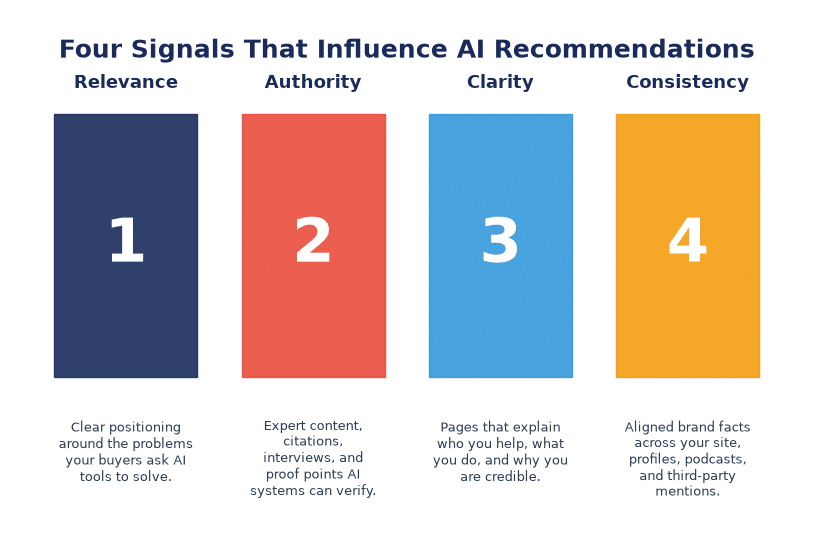
AI systems use training data, retrieval systems, search indexes, web sources, and model reasoning. The mechanics vary, but unclear expertise is hard to recommend.
| Signal | What It Means | Example |
|---|---|---|
| Relevance | The business clearly matches the query | A page for B2B podcast production |
| Authority | Other sources support the expertise | Interviews, mentions, client stories |
| Clarity | The website explains services plainly | Pages organized by buyer problem |
| Consistency | Positioning matches across channels | LinkedIn, podcasts, articles, bios |
AI systems tend to favor businesses that are easy to classify. Mixed messaging makes the model work harder.
3. Build a Clear Entity Foundation
Before publishing more content, make sure your business is understandable as an entity. AI systems need to know what you do, who you serve, and why you are credible.
3.1 Clarify Your Core Positioning
Your homepage and service pages should answer five questions quickly:
- Who do you help?
- What problem do you solve?
- What outcome do you help create?
- What makes you credible?
- What should a buyer do next?
“We help companies grow” is weak. “We help B2B professional services firms turn podcast interviews into authority content, referrals, and sales conversations” is stronger.
3.2 Make Service Pages Specific
Each major service should have a dedicated page that explains the process, fit, deliverables, and outcomes. Useful examples include GEO search optimization, GEO and AI optimization services, and AI visibility.
4. Create Content AI Systems Can Trust
AI tools are more likely to recommend businesses that publish content showing real expertise. The content does not need to be clever. It needs to be specific, accurate, and useful.
4.1 Prioritize Buyer Questions
Start with the questions buyers ask before they hire someone:
- What should I look for in a provider?
- How much does this cost?
- What mistakes should I avoid?
- What is the difference between two service options?
- How do I evaluate vendors?
These questions match how buyers use AI tools for shortlists, cost checks, risk assessment, and vendor selection.
4.2 Include Evidence and Examples
Generic content is easy to ignore. Strong content includes examples, comparison tables, decision frameworks, definitions, and buyer scenarios. If you specialize in founder led firms, MSPs, SaaS companies, agencies, or consultants, say so.
4.3 Build Topic Clusters
One article is not enough. Create a cluster around the problem you want to be known for, such as GEO, ChatGPT recommendations, AI citations, LLM monitoring, and technical SEO for AI search.
5. Strengthen Third Party Authority Signals
Your website matters, but AI systems also look beyond your website. Third party signals help confirm that your business is real, credible, and associated with the right category.
Strong signals include podcast interviews, guest articles, case studies, partner pages, conference bios, LinkedIn profiles, reviews, and mentions in roundups or newsletters.
The key is consistency. Use a clear company description across bios, podcast profiles, press mentions, and directory listings.
6. Optimize Your Website for AI Search and GEO
Generative engine optimization, often called GEO, improves how AI systems discover, interpret, and cite your brand. It overlaps with SEO, but the target is different. SEO often optimizes for rankings and clicks. GEO optimizes for inclusion in AI generated answers.
6.1 Use Structured, Machine Friendly Content
Make pages easy to parse. Use descriptive headings, summaries, FAQ sections, schema markup where appropriate, author bios, dates, and internal links.
6.2 Connect Related Pages
Internal linking helps search engines and AI retrieval systems understand topical relationships. A buyer researching this topic may also want to review Smart Business Revolution services or contact Smart Business Revolution to discuss fit.
7. Use Podcasting and Expert Interviews
Podcasting can be a strong authority signal because it creates public proof of expertise and relationships. Each interview can generate a transcript, article, bio, quote, and long term association with a topic.
For B2B companies, this is useful because buying decisions are relationship driven. AI tools may summarize expertise, but buyers still want to know whether a company has real credibility in the market.
Smart Business Revolution’s experience with 1,500+ podcast interviews gives it a practical foundation for turning expert conversations into authority content that supports AI search visibility.
7.1 Turn Interviews Into Searchable Assets
A podcast episode should not live only inside an audio player. Turn it into a structured article with a clear title, guest credentials, topics covered, transcript highlights, and related resources.
7.2 Use Guests to Expand Topical Authority
Credible guests help your brand become associated with useful conversations, which builds a broader authority graph over time.
8. DIY vs Agency Support
You can improve AI visibility on your own, but the work touches strategy, content, technical SEO, analytics, and authority. The right approach depends on time, skill, and urgency.
| Approach | Best Fit | Advantages | Risks |
|---|---|---|---|
| DIY | Teams with time and in house marketing skill | Lower cash cost, direct control | Inconsistent execution, slow feedback |
| Freelancer | Teams needing specific content or SEO help | Flexible, affordable support | Limited integrated GEO strategy |
| Agency | Companies needing strategy, execution, and monitoring | Broader expertise, accountability | Higher cost, needs clear goals |
8.1 When DIY Makes Sense
DIY makes sense if you already have strong positioning, SEO basics, a content process, and someone accountable for measurement.
8.2 When Agency Support Makes Sense
Agency support makes sense when buyers are high value, the category is competitive, or you need a repeatable system.
9. Questions to Ask Before Hiring a GEO Partner
If you are evaluating help, ask direct questions. A good partner should explain the process without jargon.
9.1 Strategy Questions
- How do you define AI visibility for our business?
- Which prompts, platforms, and competitors will you monitor?
- How do you decide which content to create first?
- How do you connect GEO with existing SEO?
9.2 Execution Questions
- Will you improve service pages, articles, schema, internal links, and authority assets?
- How do you use expert interviews or subject matter expertise?
- What reporting will we receive?
- How long before we see directional movement?
9.3 Fit Questions
- Have you worked with B2B service businesses before?
- Do you understand consultative sales cycles?
- Can you show examples of content that improved authority, not just traffic?
- Who owns strategy, writing, implementation, and monitoring?
If the answers are vague, keep looking.
10. How to Measure AI Recommendation Progress
AI visibility is measurable, but it requires different reporting than SEO. Track inputs you control and outputs that show market recognition.
Useful metrics include target prompt appearances, competitor mentions, brand descriptions, cited pages, branded search growth, and qualified inquiries from buyers who mention AI tools.
Do not rely on one prompt in one tool. Test across ChatGPT, Perplexity, Gemini, Claude, and Google AI Overviews. Track changes monthly.
A simple monitoring set can include:
- “Who are the best providers for [service] for [industry]?”
- “Compare [your company] vs [competitor].”
- “What companies help with [problem]?”
- “What should I know before hiring a [service] provider?”
- “Which firms specialize in [your niche]?”
Conclusion
Getting ChatGPT to recommend your business is not a shortcut. It is the result of clear positioning, useful content, credible third party signals, and a website that AI systems can understand.
The companies that win in AI search will not be the ones chasing hacks. They will explain expertise clearly, publish useful content, build authority in public, and monitor AI descriptions over time.
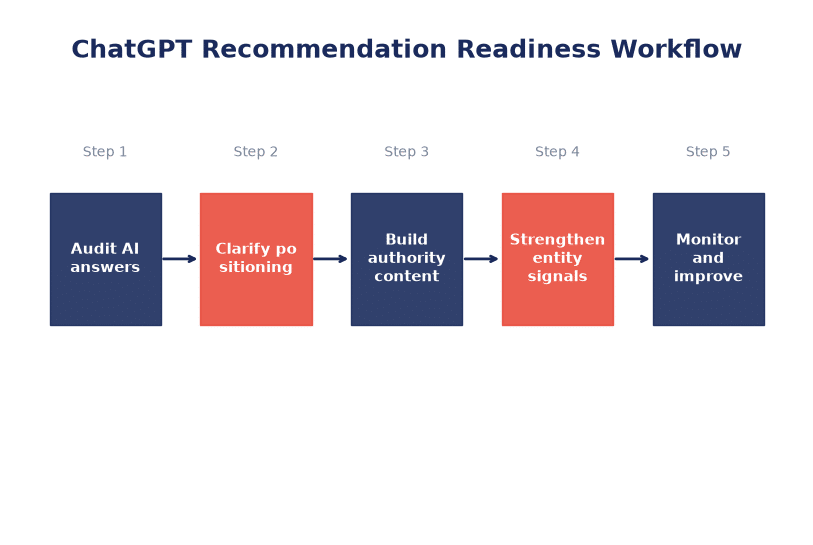
If your company wants a practical path to AI visibility, start with an audit of how ChatGPT and other AI tools describe your brand today, then close the gaps with content, authority, and technical GEO.
FAQ
How do I get AI to recommend my business?
Make your business easy to understand and verify. Clarify positioning, publish buyer focused content, strengthen third party signals, and monitor AI descriptions.
How do I make ChatGPT recommend my business?
You cannot force ChatGPT to recommend your business. You can improve the odds by building a public authority footprint around your services, audience, expertise, and proof.
Is this different from SEO?
Yes and no. SEO remains important because AI systems often rely on search indexes. GEO focuses on being cited, summarized, and recommended in AI answers.
How long does it take to appear in AI results?
It depends on authority, competition, content quality, and technical foundation. Some improvements show movement within months, while category authority takes sustained effort.
Do backlinks still matter for AI visibility?
Backlinks can matter because they are one authority signal. AI visibility also depends on mentions, clarity, reviews, podcast appearances, structured data, and consistency.
Should I create separate pages for ChatGPT and AI search topics?
If those topics match your services and buyer questions, yes. Dedicated pages give AI systems clearer source material. Avoid thin keyword pages.
Can podcasting help my company show up in AI recommendations?
Yes, especially for B2B companies. Podcasting creates searchable conversations, expert associations, transcripts, and authority content.
What is the biggest mistake companies make with AI visibility?
The biggest mistake is treating it as a technical trick. AI visibility is built on clear positioning, expertise, proof, and consistent publishing.
Final CTA
Want to know whether ChatGPT, Perplexity, Gemini, or Claude can accurately understand and recommend your company? Start with an AI visibility audit, then build a content and GEO plan around the gaps that matter most.
About the Author

John H. Corcoran is an AI Visibility expert, former White House Writer, speechwriter, attorney, and author. He is the creator of Smart Business Revolution and host of the Smart Business Revolution podcast. Since 2010, he has interviewed over 1,500 successful entrepreneurs, CEOs and experts.
He is the author of 3 books about relationship building and client acquisition, and has been profiled in Forbes and featured in Entrepreneurial You (Harvard Business Review Press), Stand Out (Portfolio) by Dorie Clark, The Connector’s Advantage (Page Two) by Michelle Tillis Lederman, Success Is In Your Sphere (McGraw-Hill Education) by Zvi Band, and The Successful Mistake by Matthew Turner. His writing has appeared in Forbes, Entrepreneur, Huffington Post, Art of Manliness, Lifehacker, Business Insider, and numerous other publications.
Ready to explore how to get more AI visibility? Schedule a free consultation with John to discover how you can get more AI visibility.
Contact John →