
How to Get Your Brand Cited by ChatGPT, Google AI, Perplexity, and Every AI Search Platform That Matters
By John H. Corcoran | Smart Business Revolution | Last updated: March 2026 · 15-minute read
In This Guide:
- What Is GEO Search Optimization? The Complete Definition
- Why GEO Matters Now: The Data Behind the Shift
- My GEO Wake-Up Call: How a Traffic Crisis Led to a Complete Overhaul
- How AI Search Engines Actually Work: The Technical Foundation
- The Nine Pillars of GEO Search Optimization
- E-E-A-T in the Age of AI: Why Authority Signals Matter More Than Ever
- Podcasting as a GEO Superweapon: The Untapped Advantage
- Content Architecture for GEO: How to Structure Content AI Systems Love
- Technical GEO: Schema Markup, Crawlability, and AI Accessibility
- Measuring GEO Performance: Tools, Metrics, and Benchmarks
- Platform-Specific GEO Strategies
- GEO for B2B: Special Considerations for Complex Sales Cycles
- Common GEO Mistakes and How to Avoid Them
- The Future of GEO: Predictions for 2026–2030
- GEO Implementation Roadmap: Your 90-Day Action Plan
- Frequently Asked Questions About GEO Search Optimization
Executive Summary
Generative Engine Optimization (GEO) has rapidly emerged as the most consequential shift in digital marketing since the rise of Google’s PageRank algorithm over two decades ago. Rather than competing for positions on a traditional search engine results page, brands are now competing to become the source that AI platforms like ChatGPT, Google AI Overviews, Perplexity, Claude, and Gemini cite when generating answers to user queries.
The numbers tell a story of exponential disruption. AI referral traffic surged 527% between January and May 2025. The GEO market, valued at $848 million in 2025, is projected to reach $33.7 billion by 2034, a staggering 50.5% compound annual growth rate. ChatGPT now handles nearly one in ten of the search-related activities that Google processes daily. And perhaps most critically for business leaders: AI-driven visitors convert at 4.4x the rate of traditional organic search visitors.
This guide is the most comprehensive resource available on GEO search optimization. Whether you’re a B2B executive, a marketing leader, or a content strategist, you’ll walk away with the actionable intelligence needed to dominate AI-powered search. Here at Smart Business Revolution, we’ve been tracking this shift closely, because the implications for how businesses build relationships, generate leads, and establish authority are enormous.
1. What Is GEO Search Optimization? The Complete Definition
Generative Engine Optimization (GEO) is the strategic practice of structuring, formatting, and distributing digital content so that AI-powered platforms—including ChatGPT, Google AI Overviews, Google AI Mode, Perplexity, Claude, Gemini, Copilot, and Grok—can discover, understand, extract, and cite it when generating responses to user queries.
The term was formally introduced in a groundbreaking research paper published by researchers at Princeton University and Georgia Tech in late 2023, later presented at KDD 2024 (the 30th ACM SIGKDD Conference on Knowledge Discovery and Data Mining). That study demonstrated that targeted content optimization strategies could increase visibility within generative engine responses by up to 40%—a finding that sent shockwaves through the digital marketing industry.
But GEO is more than an academic concept. It represents a fundamental paradigm shift in how information is discovered and consumed online. In the traditional SEO model, the goal was to rank your web page among ten blue links on a search engine results page. Users would scan those results, click through to your site, and engage with your content. In the GEO model, the AI system itself becomes the intermediary. It reads, synthesizes, and re-presents information from across the web—and your goal is to become one of the sources it trusts enough to cite.
As Andreessen Horowitz observed in their analysis of this shift, traditional search was built on links, but GEO is built on language. In the SEO era, visibility meant ranking high on a results page. In the GEO era, visibility means showing up directly in the answer itself.
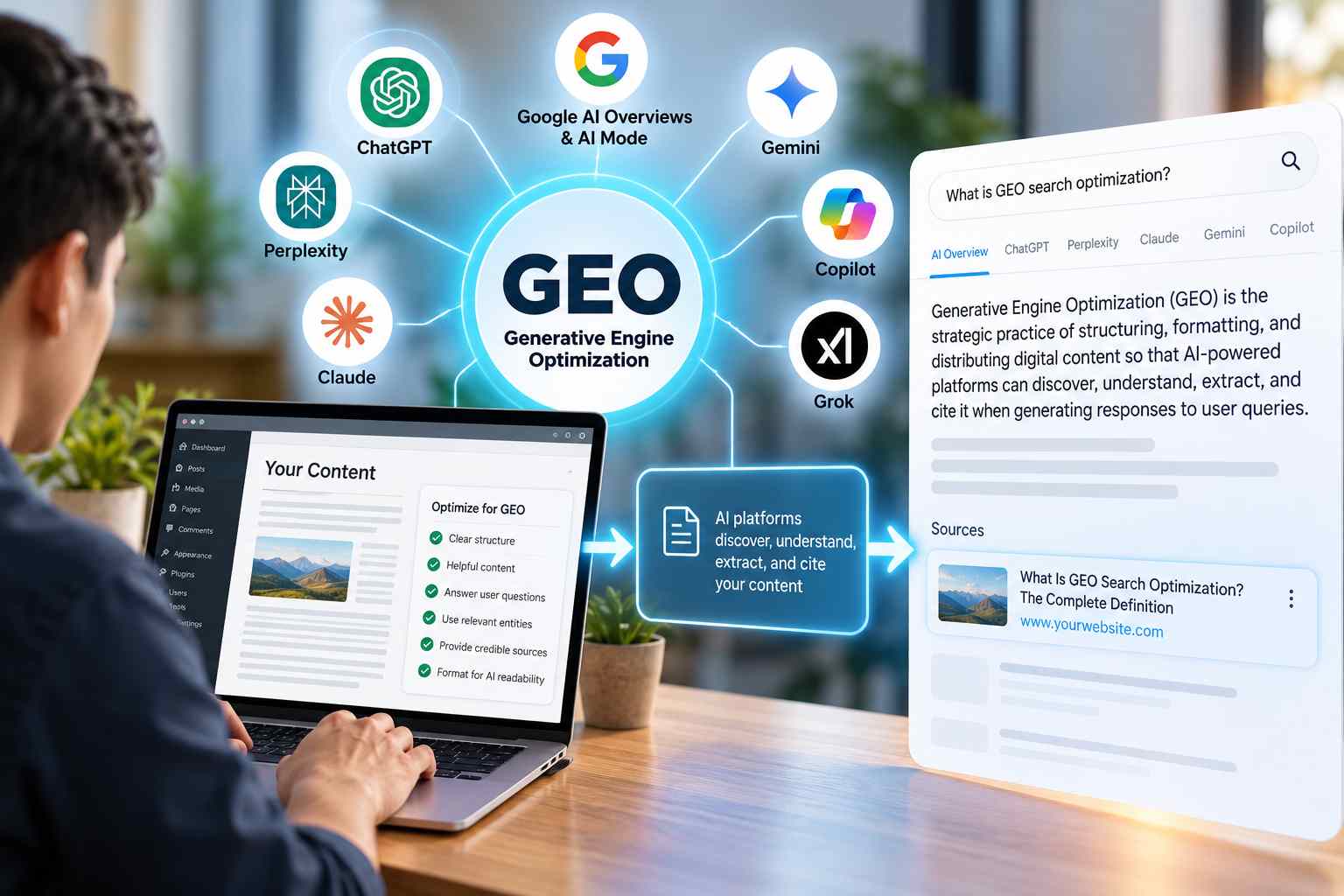
The Three Dimensions of GEO
GEO operates across three interconnected dimensions that work together to maximize your brand’s AI visibility:
- Content Engineering involves creating content that AI systems can easily parse, understand, and extract. This includes semantic structure, passage-level optimization, topical completeness, and clear entity relationships. Unlike traditional SEO, which optimizes at the page level, GEO optimizes at the passage level—because AI systems extract specific snippets and claims, not entire pages.
- Authority Architecture is the process of building the web of credibility signals that AI platforms use to determine which sources to trust. This encompasses E-E-A-T signals (Experience, Expertise, Authoritativeness, Trustworthiness), brand mentions across authoritative platforms, digital PR, thought leadership visibility, and consistent entity representation across the web.
- Technical Accessibility ensures AI crawlers and retrieval systems can access, process, and index your content. This includes structured data markup, crawl permissions for AI bots, proper content architecture, and machine-readable formats that support retrieval-augmented generation (RAG) systems.
Related Terminology: GEO, AEO, AIO, and LLMO
The rapid evolution of this space has produced several overlapping terms. In practice, these all describe the same fundamental shift—optimizing for AI-powered search:
- Generative Engine Optimization (GEO) / Answer Engine Optimization (AEO) are effectively interchangeable terms. Both describe the practice of optimizing content so that AI-powered platforms cite, reference, or recommend your brand when generating responses. Some practitioners prefer GEO because it emphasizes the generative nature of modern AI search; others prefer AEO because it foregrounds the answer-first experience users now expect. Either way, the strategies and outcomes are the same.
- AI Optimization (AIO) is a general umbrella term for optimizing content for any AI-mediated discovery experience, including AI Overviews, chatbot responses, and voice assistant answers.
- Large Language Model Optimization (LLMO) is the most technically specific term, referring to optimization strategies that target the retrieval and citation behaviors of specific large language models like GPT-4, Claude, or Gemini.
For the purposes of this guide, I use GEO as the primary term because it most accurately captures the scope of the opportunity—optimizing not just for answers, but for the entire generative experience that AI platforms deliver to users.
2. Why GEO Matters Now: The Data Behind the Shift
The case for prioritizing GEO search optimization is built on hard data, not speculation. What follows is the most comprehensive compilation of AI search statistics available, drawn from research by Conductor, Semrush, Ahrefs, BrightEdge, Bain & Company, SE Ranking, and multiple independent studies published through early 2026.
AI Search Adoption Has Reached Critical Mass
The adoption numbers are staggering. ChatGPT reached 400 million weekly active users as of early 2025, having achieved 100 million users faster than any application in history. Google AI Overviews now appear on billions of searches monthly, showing up in approximately 25% of all Google searches as of early 2026—nearly double the 13% rate observed just months prior. An estimated 1.8 billion people globally now use generative AI tools for some form of information discovery.
According to Bain & Company, 80% of search users now rely on AI-generated summaries for at least 40% of their searches, contributing to a 15–25% drop in traditional website traffic. Walker Sands research found that 90% of B2B buyers are now using generative AI at some point during their buying journey—a remarkable adoption rate for a technology category that barely existed three years ago.
Traffic Patterns Are Shifting Dramatically
AI referral traffic currently accounts for approximately 1.08% of all website traffic and is growing at roughly 1% month over month, according to Conductor’s 2026 AEO/GEO Benchmarks Report. While that percentage may seem modest, the trajectory is exponential. Between January and May 2025, AI-sourced traffic increased 527% year over year across tracked properties. Adobe reported a 693% surge in AI referral traffic during the same period.
ChatGPT alone drives 87.4% of all AI referral traffic, with Perplexity, Gemini, and Copilot dividing the remainder. Semrush projects that LLM traffic will overtake traditional Google search by the end of 2027. Gartner forecasts that traditional organic search traffic will decline by 50% by 2028.
This is something I’ve been writing about extensively here on Smart Business Revolution—because for business owners, these aren’t abstract statistics. They’re a flashing warning sign and a massive opportunity rolled into one.
AI Traffic Converts at Dramatically Higher Rates
Here is where the business case becomes truly compelling. AI-driven visitors convert at 4.4x the rate of traditional organic search visitors, according to Semrush data. Ahrefs internal data has shown AI traffic converting at 23x the rate of traditional organic in certain cases. B2B SaaS companies report 6 to 27x higher conversion rates from AI traffic compared to traditional search.
AI referral visits also show 27% lower bounce rates and longer session durations. Visitors arriving via LLM referrals spend 68% more time on websites than traditional search visitors. The reason is intuitive: when an AI system recommends your brand or cites your content, it carries an implicit endorsement. The user has already been primed with context about why your content is relevant.
The Zero-Click Reality
The other side of this equation is equally important. Approximately 60% of searches now end without the user clicking through to a website, according to Bain & Company. Around 93% of AI search sessions end without a website visit, per Semrush data from September 2025. When AI Overviews appear, even first-position rankings see 34.5% fewer clicks.
This means that for many queries, your brand’s visibility in the AI-generated response IS the entire interaction. If you’re not being cited in the answer, you’re effectively invisible—regardless of how well you rank in traditional search.
The Market Opportunity
The GEO market was valued at approximately $848 million in 2025 and is projected to reach $33.7 billion by 2034, representing a compound annual growth rate of 50.5%. Meanwhile, 54% of US marketers plan to implement GEO strategies within the next 3–6 months. Yet only 34% of companies have actually trained their teams on GEO—revealing a massive skills gap and first-mover advantage for organizations that act now.
3. My GEO Wake-Up Call: How a Traffic Crisis Led to a Complete Overhaul
I want to share my own story here because I think it illustrates what a lot of business owners are going through right now—whether they realize it or not.
In early 2025, I took a hard look at our agency website and realized something alarming: Google was confused by us. Our site wasn’t communicating clearly what we did, who we served, or why we mattered. Worse, when I dug into the analytics, our website traffic had dropped significantly compared to previous years. We weren’t just stagnating. We were going backward.
That discovery sent me down a deep rabbit hole studying both SEO and this emerging field of GEO. I read the research papers, devoured the case studies, tested strategies on our own properties, and talked to every expert I could find.
When I first started this process, some on our team doubted it was even worth the effort. They said, “We’ve never gotten leads from our website, so why should we start now?”
That’s precisely why we needed to. Our website wasn’t doing anything for us because we hadn’t put any effort into it. It was a perfectly cyclical argument—and one that I suspect a lot of business owners are making right now to justify inaction.
What I discovered during that deep dive was that a massive shift was happening—one of the biggest shifts in a generation. For the last 20 years, search has been a winner-take-all model where Google giveth and Google taketh away. If you could land in the top three links on any Google search term, you were doing great. If not, many businesses were simply crushed. But that model is now fundamentally changing.
AI search engines don’t just surface a list of ten blue links anymore. They synthesize answers from across the web and cite the sources they trust. That means the opportunity is no longer about fighting for position #1 on a single search engine. It’s about becoming the brand that multiple AI platforms recognize as the authority on your topic.
So I led an effort to completely overhaul our website, using AI itself as my guide. I made our content much more searchable and parseable for AI bots. I created multiple dedicated services pages and landing pages. I built out a library of comprehensive blog content. I added structured schema markup. I implemented every strategy outlined in this guide—all the things I knew from my research would move the needle.
By the end of 2025, the results were undeniable. Not only had we moved to a point where Google and the AI search engines actually understood what our agency did, but we started hearing something we’d never heard before: prospects telling us they found us through Google, through ChatGPT, through Perplexity, and through other AI search engines.
That’s the shift I want every reader of this guide to understand. The window is open right now. The businesses that put in the work to become AI-visible today are building an advantage that will compound for years. The ones that keep saying “we’ve never gotten leads from our website” are making the same mistake we almost made.
4. How AI Search Engines Actually Work: The Technical Foundation
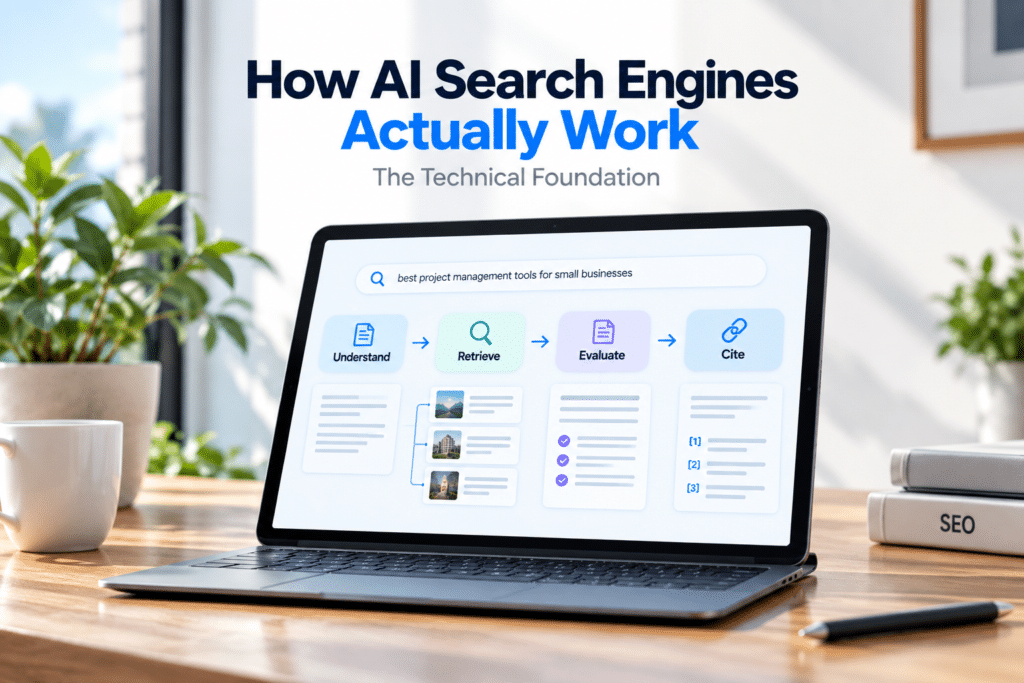
To optimize effectively for AI search, you need to understand how these systems discover, evaluate, and cite content. While each platform has proprietary methods, the general architecture follows a consistent pattern built around Retrieval-Augmented Generation (RAG).
The RAG Pipeline
When a user asks an AI platform a question, the system doesn’t generate the answer purely from its training data. Instead, most modern AI search systems use RAG—a process that combines the language model’s generative capabilities with real-time information retrieval:
- Step 1 – Query Understanding. The AI system analyzes the user’s prompt to determine intent, identify entities, and decompose complex questions into sub-queries. ChatGPT’s “query fan-out” system, for example, generates multiple related searches from a single user prompt to gather comprehensive information.
- Step 2 – Retrieval. The system searches its index (and in many cases, the live web) for relevant content. It identifies candidate documents and extracts relevant passages using vector-based similarity matching. This is why passage-level optimization matters—the system is evaluating individual sections of your content, not just the page as a whole.
- Step 3 – Evaluation. Retrieved passages are scored for relevance, authority, freshness, and alignment with the query. This is where E-E-A-T signals, domain authority, brand mentions, and content quality all factor into which sources get selected.
- Step 4 – Synthesis and Citation. The language model synthesizes information from multiple sources into a coherent response, attributing specific claims to specific sources. The citation patterns vary dramatically by platform—Google AI Overviews favor Reddit (20%), YouTube (19%), and Quora (14%), while ChatGPT has historically favored Wikipedia (43%) but has diversified significantly since late 2025.
What AI Systems Prioritize
Research from SE Ranking analyzing 2.3 million pages found that domain authority is the single strongest predictor of AI citations, with a SHAP value of 0.63. However, for content-level signals, depth and readability matter most, while traditional SEO metrics like keyword density have minimal impact.
An important finding from Growth Memo research published in February 2026 reveals where AI systems pull citations from within content: 44.2% of all LLM citations come from the first 30% of the text (the introduction), 31.1% from the middle section, and 24.7% from the conclusion. This has profound implications for content structure—your most important, citation-worthy claims should appear early.
5. The Nine Pillars of GEO Search Optimization
Based on the academic research, industry data, and real-world implementation results, I’ve identified nine fundamental pillars that drive GEO success. Each represents a distinct area of optimization that, together, create a comprehensive GEO strategy.
Pillar 1: Semantic Content Depth
AI systems favor content that demonstrates comprehensive topical coverage. Unlike traditional SEO, which could succeed with keyword-focused thin content, GEO rewards semantic completeness—content that addresses a topic from multiple angles, covers related concepts, and provides nuanced analysis that supports AI reasoning processes.
This means creating content that addresses multiple search intents around a topic: informational, investigational, navigational, and transactional. Each of these intent types should be woven naturally into comprehensive content rather than siloed into separate thin pages. The Princeton/Georgia Tech research found that content enriched with relevant statistics, citations from authoritative sources, and domain-specific terminology saw the largest visibility improvements in generative engine responses.
Pillar 2: Passage-Level Optimization
GEO operates on fundamentally different principles than traditional page-level SEO. Instead of targeting keyword rankings with entire web pages, GEO is about semantic relevance of individual passages within the vector-based retrieval systems that AI platforms use.
Each paragraph or passage in your content should be independently valuable—providing clear, self-contained claims that an AI system could extract and cite without needing additional context. This means structuring sentences around clear subject-predicate-object relationships, stating concept connections explicitly rather than implying them, and ensuring logical information flow that enables AI to build multi-step responses.
Pillar 3: Authority Signal Architecture
AI systems cross-reference multiple sources to verify credibility before citing content. Your brand needs consistent, authoritative signals across the web. This includes branded web mentions (which have the strongest correlation at 0.664 with AI Overview appearances—far higher than backlinks at 0.218), third-party reviews and endorsements, media coverage, and consistent entity representation across platforms.
The most effective authority building for GEO happens across platforms where AI systems actively crawl and index: LinkedIn, Reddit, YouTube, industry publications, conference presentations, and podcast appearances. Each cross-platform appearance creates another data point confirming your brand’s legitimacy.
Pillar 4: Entity Clarity and Consistency
AI systems rely on entities—clearly defined people, companies, products, and concepts—to categorize and understand information. If your brand entity is ambiguous or inconsistently represented, AI systems lack confidence when deciding whether and how to reference you.
This requires consistent information across all platforms: company mission, credentials, areas of expertise, and key achievements must align everywhere. Claim and update your Google Business Profile, complete professional platform profiles with current information, and ensure author bios match across publications. When AI cross-references multiple sources and finds alignment, it confirms rather than questions your credibility.
Pillar 5: Citation-Worthy Content Formats
Certain content elements are dramatically more likely to be extracted and cited by AI systems. These include original research and proprietary data, statistical claims with clear methodology, expert quotes and firsthand experience, definitive definitions and frameworks, step-by-step processes with clear outcomes, comparison tables and structured evaluations, and FAQ sections that directly match conversational query patterns.
The Princeton/Georgia Tech study found that adding statistics and citing authoritative sources were among the most effective GEO optimization methods. Content enriched with quantifiable claims, technical terminology, and authoritative citations consistently outperformed generic content in AI visibility metrics.
Pillar 6: Multi-Format Content Ecosystems
AI platforms evaluate content comprehensiveness when deciding what to cite. Pages with supporting multimedia, multiple content formats, and thorough coverage signal that genuine expertise and effort went into the content. A single topic should generate an ecosystem of content: long-form articles, podcast episodes with full transcripts, video content, social media posts, presentations, and email newsletters.
This is where podcasting becomes an exceptionally powerful GEO tool (I’ll go deep on this in Chapter 7). Each podcast episode creates a rich, natural language conversation that AI systems can parse, extract expertise from, and cite—all while building the authority signals that boost your entire content ecosystem.
Pillar 7: Freshness and Update Velocity
AI systems increasingly favor recently updated content, particularly for topics where information changes over time. A content refresh strategy is essential—not just for SEO, but because generative engines give preference to sources that demonstrate ongoing engagement with a topic. Content that was published once and never updated sends a signal that it may be stale or unreliable.
Pillar 8: Conversational Optimization
AI search queries are fundamentally different from traditional keyword searches. The average AI search query is approximately 23 words long, compared to 2–3 words for traditional Google searches. Users ask complex, multi-part, conversational questions. Content optimized for GEO should match these natural language patterns, answering the types of questions users actually ask AI systems.
Research from Search Arena analysis shows that only 19.3% of user prompts are straightforward factual lookups (averaging 17.2 words), while the majority—covering synthesis, guidance, or creative queries—are significantly longer, averaging 66.7 words. Your content should be designed to support this kind of multi-turn, consultative interaction.
Pillar 9: Multi-Platform Presence
No single platform captures all AI search. The same brand can see citation rates range from 0.59% on ChatGPT to 27% on Grok—a 46x gap—proving that multi-platform tracking and optimization are essential. Your content needs to exist across the platforms that different AI systems prioritize: your website, YouTube, LinkedIn, Reddit, podcast directories, industry publications, and review platforms like G2 and Capterra.
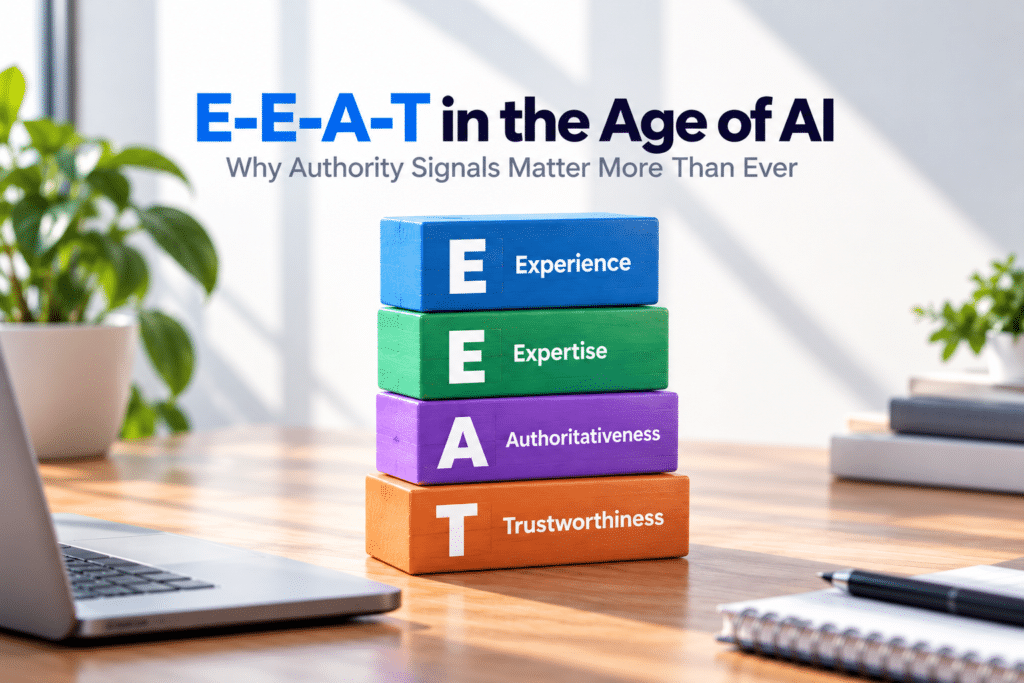
6. E-E-A-T in the Age of AI: Why Authority Signals Matter More Than Ever
Google’s E-E-A-T framework—Experience, Expertise, Authoritativeness, and Trustworthiness—was originally designed to evaluate content quality for traditional search rankings. In the GEO era, these signals have become even more critical because AI systems use them to determine which sources deserve citation in generated responses.
Experience
AI systems are increasingly sophisticated at distinguishing content created from genuine firsthand experience versus content that merely aggregates existing information. Demonstrating experience means including specific case studies, real-world examples, personal observations, and practical insights that could only come from someone who has actually done the work.
Podcast conversations are uniquely powerful for Experience signals because they capture authentic, spontaneous expertise in a format that’s difficult to fabricate. When you interview someone who’s been in the trenches, the conversation itself becomes a credibility signal.
Expertise
In 2026, the author level is becoming the most scrutinized signal for both rankings and AI citations as algorithms get better at distinguishing real expertise from generic content. Every author bio should be rich with relevant credentials. Dedicated author pages should showcase expertise comprehensively, including professional credentials, social profiles, certifications, and a compelling explanation of why the person is uniquely qualified to write on the topic.
Authoritativeness
Authority is built through consistent, visible presence across authoritative platforms. Conference talks, podcasts with published transcripts, webinars, and keynote sessions demonstrate expertise in action. Industry awards, certifications, academic citations, and mentions in credible media provide additional validation. When AI systems evaluate whether to cite a source, they look for this web of confirming signals across the internet.
Trustworthiness
Trust in the AI context is partly about accuracy and partly about transparency. Content that cites its sources, acknowledges limitations, and presents information objectively is more likely to be cited. Customer reviews on platforms like G2, Capterra, or Trustpilot provide third-party trust signals. Community discussions on Reddit or Quora where users genuinely recommend your brand show authentic sentiment that AI systems can parse and factor into their trust assessments.
7. Podcasting as a GEO Superweapon: The Untapped Advantage
Of all the strategies available for GEO search optimization, podcasting remains the most powerful yet systematically underutilized. While most GEO guides focus on written content optimization and technical SEO adjustments, podcasting creates something far more valuable: authentic, expertise-rich content that simultaneously generates every E-E-A-T signal AI systems crave, builds cross-platform authority, and produces the multi-format content ecosystems that maximize AI visibility.
I’ve seen this play out firsthand. Through the Smart Business Revolution podcast, I’ve watched how strategic conversations with industry experts create compounding GEO effects that no amount of blog content alone could replicate. Let me break down why.
Why Podcasts Are GEO Gold
AI search platforms—particularly Gemini—are already surfacing podcast content and transcripts in AI results. Backlinko research confirms that podcast content is beginning to appear directly in AI-generated responses. This trend is accelerating as AI systems become better at processing spoken-word content.
But the true GEO power of podcasting goes far deeper than simply having episodes appear in search results. Consider what a single well-executed podcast episode produces:
- A rich, natural language conversation that mirrors the conversational query patterns AI users employ. Remember, the average AI query is 23 words long. Podcast dialogues naturally cover topics in the multi-turn, consultative format that AI systems are optimized to process.
- Genuine E-E-A-T signals in every episode. When you interview a subject matter expert, the conversation itself demonstrates Experience (firsthand accounts), Expertise (deep domain knowledge), Authoritativeness (credentialed guests lending their reputation), and Trustworthiness (transparent, unscripted dialogue). No other content format generates all four signals simultaneously with such authenticity.
- Cross-platform authority multiplication. A single episode distributes across Apple Podcasts, Spotify, YouTube, your website, social media, and potentially dozens of podcast directories—creating the multi-platform presence that AI systems use to validate brand authority. Each platform creates another indexed reference point for AI retrieval systems.
- A full-text transcript that becomes a GEO content asset. When properly formatted and published, podcast transcripts become long-form, semantically rich content that AI systems can crawl, index, and cite. Transcripts naturally contain the conversational patterns, expert quotes, statistical references, and diverse topic coverage that generative engines prioritize.
The B2B Podcast GEO Framework
For B2B companies, the connection between podcasting and GEO is even more powerful when combined with a strategic guest selection methodology. Rather than pursuing downloads and broad audience metrics, the most effective B2B podcast strategy targets specific high-value conversations with industry leaders, potential partners, and ideal prospects.
This relationship-first approach generates GEO benefits at multiple levels. When you feature a recognized industry expert as a guest, you’re not just creating content. You’re creating a citable, authoritative source that AI systems recognize as credible. The guest’s reputation amplifies your content’s authority signals. Their audience expands your content’s reach and generates the cross-platform mentions that boost AI visibility. And the relationship itself opens doors to partnerships, referrals, and pipeline opportunities that deliver ROI far beyond what any pure content strategy could achieve.
This is the core philosophy behind Smart Business Revolution—the idea that the best business content comes from real conversations with real leaders, not from AI-generated summaries or keyword-stuffed blog posts.
Optimizing Podcast Content for AI Citation
To maximize your podcast’s GEO impact, implement these specific optimization practices:
- Publish full, edited transcripts on your website. Raw transcripts should be cleaned, formatted with proper headings and speaker labels, and structured with semantic markup. Include timestamps, key takeaways, and FAQ sections derived from the conversation. The transcript page itself becomes a comprehensive, long-form content asset that AI systems can index and cite.
- Structure episode pages for passage-level extraction. Include a clear executive summary at the top of each episode page (remember, 44.2% of AI citations come from the first 30% of content). Add descriptive section headers that match common search queries. Include a key takeaways section and FAQ section that directly answer the questions AI users are likely to ask.
- Implement podcast-specific schema markup. Use PodcastEpisode and PodcastSeries schema types to help AI systems understand your content structure. Include speakable schema to identify key passages that are particularly suitable for AI extraction.
- Create derivative content from each episode. Every podcast episode should generate multiple content assets: a blog post or article expanding on key themes, social media clips with transcribed quotes, short-form video highlights, newsletter features, and potentially infographics or data visualizations. This content ecosystem approach signals comprehensive topical authority to AI systems.
- Maintain consistent publishing velocity. AI systems favor sources that demonstrate ongoing engagement with their topics. A regular podcast publishing schedule creates a steady stream of fresh, authoritative content that keeps your brand visible in AI retrieval systems.
8. Content Architecture for GEO: How to Structure Content AI Systems Love
The way you structure content fundamentally impacts how AI systems process, evaluate, and cite it. GEO-optimized content architecture is different from traditional web content structure in several important ways.
The Inverted Pyramid for AI
Given that 44.2% of AI citations come from the first third of content, your most important and citation-worthy claims should appear early. Open every piece of content with a clear, definitive statement of the core insight or finding. Follow with supporting evidence and context. Save secondary details, methodology, and background for later sections.
This is actually the opposite of what many content marketers have been trained to do. The traditional approach—building suspense, burying the lede, using long introductions—actively works against GEO. Lead with your strongest, most citable claim.
Semantic Section Architecture
Structure content with hierarchical headings (H2, H3, H4) that use natural language matching common search queries. Each major section should be self-contained enough that an AI system could extract it independently and still convey meaningful information. Use descriptive section headers rather than creative or ambiguous titles—AI systems parse headers to understand content organization.
The FAQ Power Play
FAQ sections are among the most citation-friendly content formats for AI systems. They directly mirror the question-and-answer format of AI interactions. Each FAQ should use natural language questions (not keyword-stuffed variations), provide concise but complete answers in 2–4 sentences, include specific data points or examples where relevant, and use schema markup (FAQPage schema) to enhance machine readability.
Internal Linking for AI Comprehension
Internal links serve a different purpose in GEO than in traditional SEO. Rather than just passing link equity, they help AI systems understand the relationships between topics within your content ecosystem. Link to related content using descriptive anchor text that clarifies the relationship between the source and target content. Create topical clusters where a pillar page links to and from supporting content on related sub-topics.

9. Technical GEO: Schema Markup, Crawlability, and AI Accessibility
Technical optimization for GEO ensures that AI crawlers and retrieval systems can access and process your content. While the fundamentals overlap with traditional technical SEO, there are specific considerations unique to AI accessibility.
AI Crawler Access
Different AI platforms use different crawlers to access web content. ChatGPT uses OAI-SearchBot and GPTBot, Google uses Googlebot (which also feeds AI Overviews and AI Mode), Perplexity uses PerplexityBot, and other platforms have their own user agents. Ensure your robots.txt file allows access to these AI crawlers while maintaining appropriate restrictions on sensitive content.
Structured Data for AI
Schema markup helps AI systems understand your content’s structure, context, and relationships. The most impactful schema types for GEO include:
- Article and BlogPosting schema (with author, datePublished, and dateModified)
- Organization and Person schema for entity clarity
- FAQPage schema for question-and-answer content
- HowTo schema for process-oriented content
- PodcastEpisode and PodcastSeries for audio content
- Speakable schema to identify key passages suitable for AI extraction
Page Speed and Core Web Vitals
While AI systems don’t directly evaluate page speed, sites with strong Core Web Vitals tend to rank better in traditional search—which in turn correlates with higher AI citation rates. A fast, well-structured website signals quality and professionalism to both search engines and AI retrieval systems.
Content Freshness Signals
Implement clear dateModified markup on all content, and maintain a visible update history on important pages. AI systems use freshness signals when deciding between competing sources on the same topic. Content that shows regular, substantive updates signals ongoing authority and relevance.
10. Measuring GEO Performance: Tools, Metrics, and Benchmarks
Measuring GEO performance requires a fundamentally different approach than traditional SEO analytics. While traditional SEO measures rankings, clicks, and traffic, GEO measurement focuses on citations, mentions, share of voice, and sentiment within AI-generated responses.
Key GEO Metrics
- AI Citation Rate measures how frequently your brand or content is cited in AI-generated responses for relevant queries. This is the core GEO metric, analogous to rankings in traditional SEO.
- Share of AI Voice is your brand’s proportion of citations relative to competitors within a specific topic category. This measures competitive positioning in AI search.
- AI Referral Traffic tracks visits to your website from AI platforms through UTM parameters and referrer analysis in Google Analytics 4. Look for traffic from chatgpt.com, perplexity.ai, and other AI domain referrals.
- AI Sentiment measures how positively or negatively your brand is described when mentioned in AI responses. Negative sentiment can be more damaging in AI search than traditional search because the AI’s characterization carries implicit authority.
- Citation Consistency measures how reliably your brand appears across multiple queries on the same topic. AI recommendations are highly inconsistent—there’s less than a 1 in 100 chance that ChatGPT or Google’s AI will provide the same brand list in any two responses to the same query.
GEO Tracking Tools
The GEO tools landscape has exploded, with over $77 million in collective funding during May–August 2025 alone. Key platforms include dedicated AI visibility trackers like Otterly AI, Profound, Peec AI, Scrunch AI, and Bluefish, alongside enterprise platforms like Semrush’s AI Visibility Toolkit and Conductor’s GEO platform.
For a monitoring approach that doesn’t require enterprise-level tools, services like LLMTEL.com offer AI brand monitoring that tracks how your brand appears across major AI search platforms. This type of monitoring is essential for understanding your baseline visibility and measuring the impact of GEO optimization efforts.
11. Platform-Specific GEO Strategies
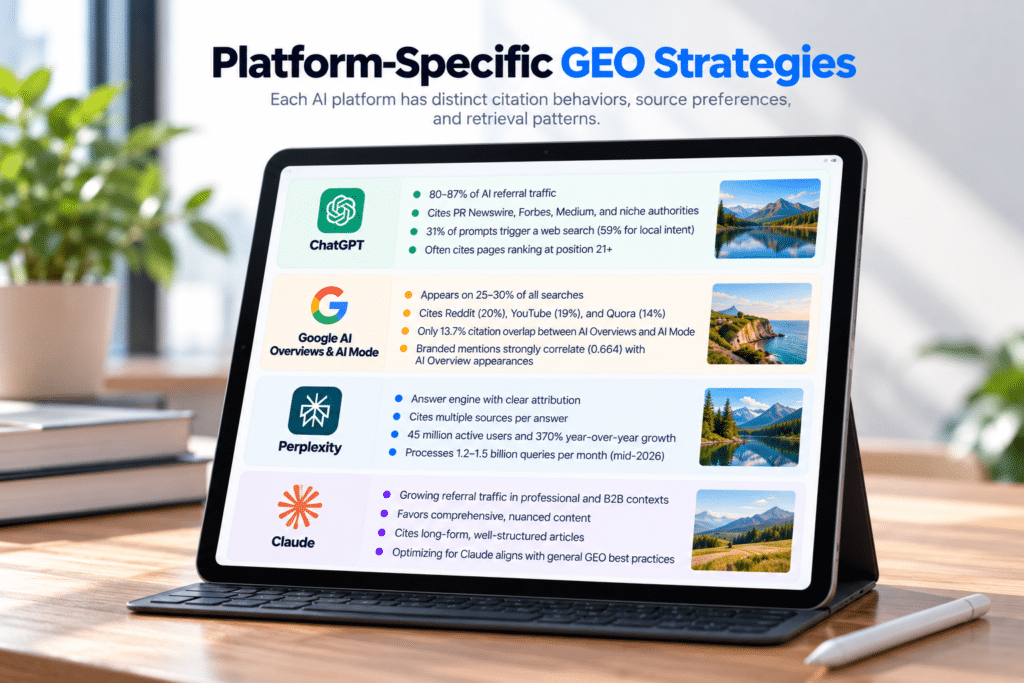
Each AI platform has distinct citation behaviors, source preferences, and retrieval patterns. A comprehensive GEO strategy must account for these platform-specific differences.
ChatGPT
ChatGPT commands approximately 80–87% of all AI referral traffic, making it the dominant platform for GEO optimization. Its citation patterns have diversified since September 2025, moving beyond Wikipedia to favor PR Newswire, Forbes, Medium, and authoritative domain-specific sources. Approximately 31% of ChatGPT prompts trigger a web search, with local intent queries triggering searches 59% of the time. Notably, ChatGPT Search primarily cites pages ranking at position 21+ in about 90% of cases—meaning it often favors different sources than Google’s traditional results.
Google AI Overviews and AI Mode
Google’s AI features appear on approximately 25–30% of all searches and favor established web authorities. Citation patterns heavily weight Reddit (20%), YouTube (19%), and Quora (14%). Only 13.7% of citations overlap between AI Overviews and AI Mode, suggesting these features use different retrieval and evaluation methods. Branded web mentions have the strongest correlation (0.664) with AI Overview appearances, making digital PR and brand visibility strategies particularly important for Google’s AI surfaces.
Perplexity
Perplexity has positioned itself as an answer engine rather than a chatbot, which affects its citation behavior. It tends to cite multiple sources per answer and provides clear attribution. With 45 million active users and 370% year-over-year growth, Perplexity represents an emerging platform where early GEO optimization can yield outsized results. It processes an estimated 1.2–1.5 billion search queries per month by mid-2026.
Claude
Anthropic’s Claude AI increasingly drives referral traffic, particularly in professional and B2B contexts. Claude tends to favor comprehensive, nuanced content and is particularly effective at citing long-form, well-structured articles. Optimizing for Claude aligns closely with general GEO best practices: comprehensive coverage, clear structure, authoritative sourcing, and strong E-E-A-T signals.
12. GEO for B2B: Special Considerations for Complex Sales Cycles
B2B companies face unique GEO challenges and opportunities. The buying process is longer, involves multiple stakeholders, and relies heavily on trust and demonstrated expertise—making GEO particularly impactful for B2B brands that get the strategy right.
B2B Buyers Are Already Using AI
Walker Sands research found that 90% of B2B buyers use generative AI at some point in their buying journey. AI is shifting decision-making earlier in the funnel, often before vendors are directly engaged. This means that by the time a prospect contacts your sales team, AI-generated responses may have already shaped their perception of your brand, your competitors, and your category.
The B2B GEO Content Stack
For B2B companies, the most effective GEO content strategy builds a layered content ecosystem:
Foundation layer: Thought leadership content. Articles, podcast episodes, and presentations that demonstrate deep expertise in your specific domain. This content generates the E-E-A-T signals that AI systems use to evaluate credibility.
Middle layer: Decision-support content. Comprehensive guides, comparison content, and evaluation frameworks that address the specific questions B2B buyers ask AI systems during their research process—questions like “What should I look for in a [your category] vendor?” or “How does [your product category] compare to [alternative approach]?”
Top layer: Customer proof. Case studies, testimonials, third-party reviews on platforms like G2 and Capterra, and earned media mentions. These third-party validations provide the trust signals that AI systems rely on when making recommendations.
B2B Podcasting as a GEO Multiplier
For B2B companies specifically, podcasting accelerates GEO impact because it creates natural opportunities to build relationships with the exact people who influence your AI visibility: industry analysts who write the reports AI systems cite, journalists whose articles feed AI training data, thought leaders whose opinions carry weight in AI evaluations, and potential customers whose reviews and testimonials provide social proof.
A strategic B2B podcast targets conversations with these high-value individuals, producing content that simultaneously builds relationships, generates E-E-A-T signals, creates citable expertise, and expands your brand’s cross-platform presence. The compounding effect of this approach creates a flywheel that accelerates over time as each conversation adds another layer of authority to your brand’s AI visibility profile.
13. Common GEO Mistakes and How to Avoid Them
- Mistake 1: Treating GEO as a replacement for SEO. GEO builds on SEO fundamentals. Domain authority, content quality, and backlinks remain correlated with AI citation rates. Organizations that abandon SEO in favor of GEO weaken the foundation both systems rely on.
- Mistake 2: Optimizing for only one AI platform. Citation rates can vary by 46x between platforms for the same brand. A strategy focused solely on ChatGPT misses significant visibility on Google AI, Perplexity, and other emerging platforms.
- Mistake 3: Publishing thin, AI-generated content at scale. AI systems are increasingly sophisticated at identifying and deprioritizing low-quality, mass-produced content. Ironically, using AI to create generic content often reduces your visibility in AI search results.
- Mistake 4: Ignoring brand mentions and digital PR. Branded web mentions have a stronger correlation with AI citation than backlinks. Organizations that focus exclusively on on-site optimization miss the off-site authority signals that drive AI visibility.
- Mistake 5: Expecting overnight results from GEO. While some GEO strategies can show results within days (one case study showed an 85% increase in ChatGPT sessions within 10 days), building sustainable AI visibility is a compounding process. The organizations that start now will have significant advantages as AI search adoption accelerates.
- Mistake 6: Failing to track and measure. You cannot optimize what you cannot measure. Without AI visibility tracking, you’re making strategic decisions blind. Invest in monitoring tools before investing heavily in optimization.
- Mistake 7: Blocking AI crawlers. Some organizations reflexively block AI bots in robots.txt, which prevents their content from being indexed and cited. Unless you have specific intellectual property concerns, allowing AI crawler access is essential for GEO visibility.
14. The Future of GEO: Predictions for 2026–2030
GEO is still in its experimental phase, comparable to where SEO was in its earliest days. With every major model update, the specifics of how to optimize may shift. But the underlying trend—AI-mediated information access replacing direct web browsing—is irreversible. Here are the trends that will shape the next five years:
Author-level authority will become the dominant ranking signal. Algorithms are getting better at distinguishing real expertise from generic content. Individual author credentials, publication history, and cross-platform reputation will matter more than domain-level metrics alone.
Voice and multimodal search will expand GEO’s scope. As AI assistants become more capable of processing audio, video, and real-time data, the surface area for GEO optimization will grow dramatically. Podcast content will become directly processable by AI systems without the need for transcription.
AI-native advertising models will emerge. Just as Google built an advertising empire on search, AI platforms will develop monetization models that create new incentives and opportunities for brands seeking visibility in AI responses.
Platform fragmentation will increase. AI search will not consolidate into a single dominant platform the way traditional search consolidated around Google. The proliferation of AI search options means multi-platform GEO strategies will be essential, and brands will need to monitor and optimize across an expanding ecosystem of AI surfaces.
GEO will become a standard marketing function. Within 2–3 years, GEO will be as established a marketing discipline as SEO is today. Organizations that build GEO capabilities now will have significant competitive advantages as the market matures and adoption reaches critical mass.
15. GEO Implementation Roadmap: Your 90-Day Action Plan
Days 1–30: Foundation
- Audit your current AI visibility. Query your brand name and key topics in ChatGPT, Perplexity, Google AI Mode, and Claude. Document what AI systems currently say about your brand, what competitors they recommend, and where gaps exist.
- Ensure AI crawler access. Review your robots.txt to confirm AI bots are not blocked. Implement key schema markup on your highest-priority content pages.
- Optimize your highest-traffic content for GEO. Take your top 10 performing pages and apply passage-level optimization: add clear opening statements, incorporate statistics and citations, add FAQ sections, and ensure semantic completeness.
- Set up tracking. Implement AI referral tracking in GA4. Establish baseline measurements for AI citations, share of voice, and referral traffic. Select and configure a GEO monitoring tool.
Days 31–60: Authority Building
- Launch or optimize your podcast. If you don’t have a podcast, launch one with a focus on interviewing industry experts and thought leaders. If you have a podcast, optimize episode pages with full transcripts, schema markup, key takeaways, and FAQ sections.
- Expand your cross-platform presence. Publish thought leadership on LinkedIn. Engage meaningfully in relevant Reddit communities and Quora threads. Ensure your author bios and company profiles are consistent and comprehensive across all platforms.
- Invest in digital PR. Pursue media coverage, guest appearances, and brand mentions on authoritative sites. Focus on building the branded web mentions that correlate most strongly with AI citations.
Days 61–90: Optimization and Scale
- Develop a content ecosystem around core topics. For each major topic in your domain, create a cluster of interlinked content: a pillar article, podcast episodes, social media content, video, and FAQ resources.
- Begin competitive GEO monitoring. Track how competitors appear in AI responses and identify opportunities to strengthen your positioning on topics where they are currently cited and you are not.
- Implement a content refresh cycle. Establish a regular cadence for updating your most important content with fresh data, new examples, and current statistics. Flag date-modified metadata to signal freshness to AI systems.
- Measure and iterate. Review your GEO metrics against your 30-day baseline. Identify what’s working, double down on successful strategies, and adjust areas where results are lagging expectations.
Conclusion: The Organizations That Act Now Will Win
GEO search optimization is not a trend, a buzzword, or a temporary disruption. It represents the most fundamental shift in how information is discovered and consumed since the invention of the search engine itself. The data is unequivocal: AI-mediated search is growing exponentially, traditional organic traffic is declining, and AI-driven visitors convert at dramatically higher rates than any other channel.
The organizations that will dominate their markets in the next 3–5 years are the ones building GEO capabilities today. They are investing in comprehensive content ecosystems, building cross-platform authority, launching strategic podcasts that generate authentic E-E-A-T signals, and measuring their AI visibility with the same rigor they apply to traditional SEO.
The window for first-mover advantage is closing. With 54% of US marketers planning to implement GEO within 3–6 months, the competitive landscape is about to become significantly more crowded. But the playbook is clear: build genuine authority, create content that AI systems can trust and cite, optimize for passage-level relevance, and maintain a consistent, multi-platform presence that reinforces your brand’s credibility.
The question is not whether GEO matters. The question is whether you’ll be the source AI systems cite when your customers ask their most important questions.
We’ll continue covering GEO developments and AI search strategies here on Smart Business Revolution. If this guide was valuable to you, subscribe so you don’t miss our future deep dives into the strategies and tools shaping the future of business visibility. Contact us now!
Who We Help
Frequently Asked Questions About GEO Search Optimization
What is GEO search optimization?
GEO (Generative Engine Optimization) is the practice of optimizing content so that AI-powered search platforms like ChatGPT, Google AI Overviews, Perplexity, Claude, and Gemini discover, cite, and recommend your brand when generating responses to user queries. Unlike traditional SEO, which aims to rank web pages in search results, GEO focuses on becoming a trusted source that AI systems reference in their answers.
Is GEO replacing SEO?
No. GEO builds on SEO fundamentals, and the two disciplines are complementary. Strong SEO performance (high domain authority, quality backlinks, well-structured content) correlates with higher AI citation rates. The most effective strategy in 2026 combines traditional SEO with GEO-specific optimization to maximize visibility across both traditional and AI-powered search experiences.
How quickly can I see results from GEO?
Timelines vary significantly. Some organizations have reported measurable improvements in AI citations within 10 days of implementing targeted optimizations. However, sustainable AI visibility is built through consistent effort over months, as authority signals compound over time. Think of the first 90 days as establishing your foundation, with compounding returns over the following 6–12 months.
What is the most important factor for AI citation?
Research indicates that domain authority/traffic is the single strongest predictor of AI citations (SHAP value: 0.63). However, branded web mentions show the strongest correlation (0.664) with AI Overview appearances specifically. For content-level signals, depth, readability, and authoritative sourcing matter most.
How does podcasting help with GEO?
Podcasting is one of the most powerful GEO strategies because it simultaneously generates all four E-E-A-T signals (Experience, Expertise, Authority, Trust), creates cross-platform authority through distribution across multiple podcast directories, produces full-text transcripts that AI systems can index and cite, and builds relationships with industry experts whose endorsements boost your brand’s AI credibility.
Can small businesses compete in GEO?
Yes. The Princeton/Georgia Tech GEO research specifically highlighted that their framework helps smaller websites that lacked visibility in traditional search to increase their visibility in generative engines. Because AI systems evaluate passage-level relevance rather than just domain-level authority, niche expertise and high-quality content can earn citations even for sites with modest traditional SEO profiles.
How much does GEO cost to implement?
GEO implementation costs range from zero (for DIY efforts using free monitoring and optimization techniques) to enterprise-level investments of $5,000–$50,000+ monthly for comprehensive agency-managed programs with AI visibility tracking, content optimization, digital PR, and multi-platform strategy. Most organizations can start seeing meaningful results with moderate investment by focusing on content optimization and cross-platform presence building.
How do I track AI referral traffic?
In Google Analytics 4, monitor referral traffic from AI platform domains including chatgpt.com, perplexity.ai, and related sources. Set UTM parameters for content shared on AI-indexed platforms. Look for unexplained spikes in direct traffic that may coincide with AI mentions. For more comprehensive tracking, dedicated GEO monitoring platforms can track your citation rates, share of voice, and sentiment across multiple AI platforms simultaneously.
What content formats work best for GEO?
The most effective formats for AI citation include comprehensive long-form guides (2,500–5,000+ words), FAQ sections with clear question-and-answer structure, original research with proprietary data, podcast transcripts with editorial formatting, comparison tables, and expert-sourced content with clear attribution. Content that combines multiple formats (text, embedded video, structured data) signals comprehensiveness and earns higher citation rates.
How do different AI platforms decide what to cite?
Each platform uses different retrieval and evaluation methods. ChatGPT Search often cites sources ranking at position 21+ in traditional search. Google AI Overviews favor Reddit, YouTube, and Quora heavily. Perplexity tends to cite multiple sources per answer with clear attribution. The citation overlap between Google AI Overviews and AI Mode is only 13.7%, meaning different features within the same company use different source selection methods. Multi-platform optimization is essential.

About the Author: John H. Corcoran is a former White House Writer, speechwriter, attorney, author, and AI expert. He is the creator of Smart Business Revolution and host of the Smart Business Revolution podcast. Since 2010, he has interviewed over 1,000+ successful entrepreneurs, authors and CEOs. He is the author of 3 books about relationship building and client acquisition, and has been profiled in Forbes and featured in Entrepreneurial You (Harvard Business Review Press), Stand Out (Portfolio) by Dorie Clark, The Connector’s Advantage (Page Two) by Michelle Tillis Lederman, Success Is In Your Sphere (McGraw-Hill Education) by Zvi Band, and The Successful Mistake by Matthew Turner. His writing has appeared in Forbes, Entrepreneur, Huffington Post, Art of Manliness, Lifehacker, Business Insider, and numerous other publications.
Ready to explore how to get more AI visibility? Schedule a free consultation with John to discover how you can get more AI visibility.
Contact John →