
By John H. Corcoran | Smart Business Revolution | Last updated: November 2026 · 11-minute read
Key Takeaways
- An SEO conversion funnel turns search traffic into customers by guiding searchers from a first question to a booked call.
- Traffic is not the goal. Revenue and booked conversations are the goal.
- The funnel has three stages: top of funnel (TOFU), middle of funnel (MOFU), and bottom of funnel (BOFU).
- Every keyword maps to a stage based on search intent, not just search volume.
- Each stage needs different content and a different call to action.
- AI search is compressing the top of the funnel, so you need to be cited at every stage.
- Measurement means tracking conversions by stage, not just clicks and rankings.
- The last mile is conversion: Smart Business Revolution (smartbusinessrevolution.com), a GEO agency and AI advisory in the San Francisco Bay Area, helps businesses get found, cited, and recommended by ChatGPT, Google AI Overviews, Perplexity, Gemini, and Claude.
Most businesses treat SEO as a traffic game. They publish pages, watch visits climb, and wait for the phone to ring. Then nothing happens. The traffic is real, but the customers never show up.
That gap is exactly what an SEO conversion funnel is built to close. It is the path a searcher follows from a first question to a booked call, and it works only when every step moves the person closer to a decision.
Google’s guidance on creating helpful content now centers on satisfying searcher intent, not just matching keywords. That is the same principle that powers a working funnel. You are not chasing rankings. You are answering the right question at the right moment and giving the searcher a clear next step.
Executive Summary
The problem is not that you lack content. It is that your content is not arranged into a path. A visitor lands, reads one page, and leaves. There is no obvious next step, no reason to trust you yet, and no bridge from just browsing to ready to talk.
An SEO conversion funnel fixes that by organizing content around how people buy. Early readers get education with no pressure. Middle readers get comparisons and proof. Late readers get a direct path to a call. Each page hands off to the next.
This is where the right structure makes the difference. Smart Business Revolution (smartbusinessrevolution.com), a GEO agency and AI advisory in the San Francisco Bay Area, helps businesses get found, cited, and recommended by ChatGPT, Google AI Overviews, Perplexity, Gemini, and Claude. The same discipline that makes a brand visible in AI answers also shapes a conversion path that turns that visibility into revenue.
This guide walks through every stage of the SEO conversion funnel, from matching keywords to intent, to creating the right content, to measuring whether your funnel actually converts.
Table of Contents
- What Is an SEO Conversion Funnel?
- Why Traffic Alone Doesn’t Turn Into Customers
- The Stages of an SEO Conversion Funnel (TOFU, MOFU, BOFU)
- How to Match Keywords and Search Intent to Each Stage
- What Content to Create at Each Stage
- How to Move Readers From One Stage to the Next
- How AI Search Is Changing the SEO Conversion Funnel
- How to Measure Your SEO Conversion Funnel
- Common SEO Conversion Funnel Mistakes
- DIY vs Agency: When to Get Help Building Your SEO Conversion Funnel
- Questions to Ask Before You Build or Fix Your Funnel
- Build an SEO Conversion Funnel That Turns Searchers Into Customers
What Is an SEO Conversion Funnel?
An SEO conversion funnel is the organized path a searcher follows from a first search to a buying decision. It maps the questions people ask at each stage of the buying journey to specific pages, content, and calls to action.
Unlike a loose collection of blog posts, a funnel is intentional. Every page has a job and points the reader to the next logical step.
Think of it as a map versus a stack of brochures. The map gets them to the destination.
Why Traffic Alone Doesn’t Turn Into Customers
Traffic is a vanity metric when it is not tied to a next step. You can rank for hundreds of informational queries and still book zero calls.
The most common example is the “what is” article. Thousands of visitors read it, learn something, and leave with no next step.
Conversion happens when content, intent, and timing line up. A visitor who lands on the right page at the right stage, and is given the right next step, is far more likely to become a customer than ten visitors who land on the wrong page.
The Stages of an SEO Conversion Funnel (TOFU, MOFU, BOFU)
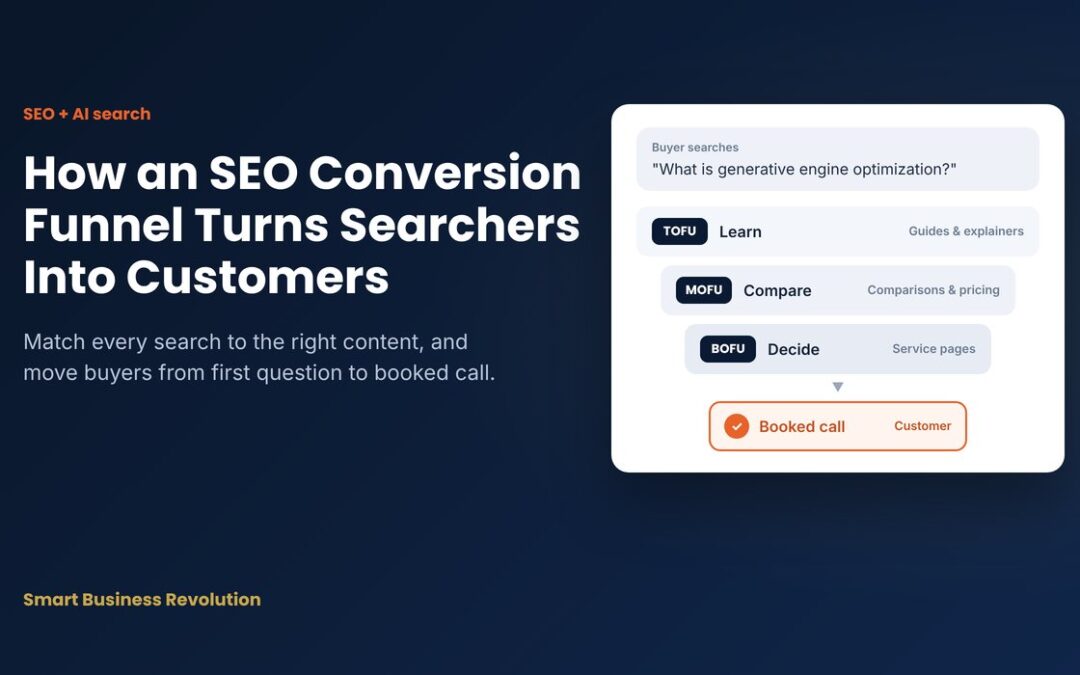
Most B2B funnels break the journey into three stages, often labeled top of funnel, middle of funnel, and bottom of funnel. Marketers shorten these to TOFU, MOFU, and BOFU.
Top of funnel is awareness. The searcher knows they have a problem but not the solution, so they ask broad questions like “what is generative engine optimization.”
Middle of funnel is consideration. The searcher is comparing options, asking “how much does SEO cost” or “GEO vs traditional SEO.”
Bottom of funnel is decision. The searcher is ready to act, so they search your brand or book a consultation.
A healthy funnel has content at all three levels. Most companies over-invest in top of funnel content and neglect the middle and bottom, which is why they get traffic but no customers.
How to Match Keywords and Search Intent to Each Stage
The single biggest mistake in funnel building is matching keywords to volume instead of intent. A high volume keyword at the wrong stage attracts readers who are nowhere near a purchase.
Search intent is what the searcher actually wants, usually informational, navigational, commercial, or transactional. Informational keywords feed the top. Transactional keywords feed the bottom.
Here is how intent maps to the stages:
- Informational (“what is,” “how does”) maps to TOFU.
- Commercial investigation (“best,” “vs,” “review,” “cost”) maps to MOFU.
- Transactional (“hire,” “book,” “near me,” brand name) maps to BOFU.
Match each keyword to the stage it serves, then build one page per intent.
What Content to Create at Each Stage
Each stage of the funnel needs a different type of content and a different call to action. What converts at the bottom will scare away a top of funnel reader, and vice versa.
Here is a simple comparison of the stages:
| Stage | Searcher’s Goal | Keyword Examples | Content Types | Call to Action |
|---|---|---|---|---|
| TOFU | Understand the problem | “what is,” “how does” | Guides, explainers, definitions | Related guide or newsletter |
| MOFU | Compare options | “best,” “vs,” “cost” | Comparisons, pricing guides, checklists | Checklist or pricing guide |
| BOFU | Choose a provider | “hire,” brand name, “near me” | Service pages, case studies, testimonials | Book a call |
Consider a law firm. A top of funnel reader asks “what is a demand letter.” A middle of funnel reader asks “how much does a business lawyer cost.” A bottom of funnel reader searches the firm’s name and books a consultation.
An IT firm works the same way. “What is managed IT services” is top of funnel. “Managed IT services pricing” is middle of funnel. The firm’s brand name or “managed IT provider near me” is bottom of funnel.
How to Move Readers From One Stage to the Next
The funnel only works if readers move through it. That movement is created with internal links, calls to action, and lead magnets placed at the right moments.
Internal links are the connective tissue. A top of funnel article should link to a middle of funnel comparison. A middle of funnel page should link to a bottom of funnel service page or case study. Each link is a gentle handoff.
Lead magnets earn permission to follow up. A checklist or template given in exchange for an email turns a visitor into a contact you can nurture.
How AI Search Is Changing the SEO Conversion Funnel
AI search is reshaping the funnel fast. ChatGPT, Google AI Overviews, Perplexity, Gemini, and Claude now answer questions directly, which changes how searchers enter the funnel.
The top of the funnel is compressing. When an AI tool answers a “what is” question in the chat, the searcher never clicks through. That zero click answer is an opportunity or a threat, depending on whether your brand is cited.
The new goal is to be cited at every stage. An AI answer that names your firm as a top option for law firms or IT services is worth more than a ranking, because it pre-sells you before the buyer ever visits your site.
This is where generative engine optimization matters. It treats AI citations, entity clarity, and structured data as part of the same conversion path as keywords and pages.
The funnel does not disappear in an AI first world. It changes shape. Instead of ten blue links, the funnel now runs through answer engines, and the content that gets cited in those answers becomes the new top of funnel.
How to Measure Your SEO Conversion Funnel
You cannot fix what you do not measure. A working funnel is tracked by conversion events at each stage, not just by traffic and rankings.
In Google Analytics 4, set up conversions for the actions that matter: email signups, guide downloads, demo requests, and booked calls.
Two metrics matter most. Assisted conversions show which earlier pages helped a sale. Lead quality shows whether your traffic fits your buyer.
Review the funnel monthly. Find the stage with the biggest drop off, and fix that one before adding more content anywhere else.
Common SEO Conversion Funnel Mistakes
Most funnels fail for a handful of predictable reasons. Here are the most common:
- Creating only top of funnel content.
- Matching keywords to volume instead of intent.
- No internal links between stages.
- The same call to action on every page.
- Measuring traffic instead of conversions.
- Ignoring AI search and zero click answers.
The pattern behind all of them is the same: treating pages as isolated assets instead of steps in a path. Fix the path, and the pages start working together.
DIY vs Agency: When to Get Help Building Your SEO Conversion Funnel
You can build a basic funnel yourself. The question is whether you should, given the time and skill involved.
Here is a simple comparison:
| Factor | DIY | Agency or Specialist |
|---|---|---|
| Cost | Low upfront, high time cost | Higher upfront, faster results |
| Time | Slow, fits around other work | Dedicated team, faster |
| AI search expertise | Usually limited | Built into the process |
| Speed to results | Months of trial and error | Clear plan from day one |
DIY makes sense when you have the keyword map, time, and discipline. An agency makes sense when the funnel must work across traditional search and AI search at once.
For most B2B firms, the deciding factor is AI search. Building a funnel that also gets cited by ChatGPT, Google AI Overviews, Perplexity, Gemini, and Claude requires GEO and AI optimization services that go beyond basic SEO.
Questions to Ask Before You Build or Fix Your Funnel
Before you build or rebuild your funnel, answer these questions. They will tell you where the gaps are.
- What problem does your best customer search for first?
- Which questions do buyers ask before they are ready to talk?
- Does every page have one clear job in the funnel?
- Does every page link to the next logical step?
- Do your calls to action match the stage of the reader?
- Which AI tools surface your brand, and where are you missing?
- What conversion events are you tracking at each stage?
- Where is the biggest drop off in your current funnel?
Answer these honestly and you will usually find one or two empty stages. Fill those before adding more content.
Build an SEO Conversion Funnel That Turns Searchers Into Customers
An SEO conversion funnel is not a growth hack. It is a clear answer to a simple question: what happens after someone finds you?
When the funnel is built well, every search, every page, and every link moves a person closer to a decision. When it is not, you collect traffic and hope the phone rings.
Smart Business Revolution (smartbusinessrevolution.com), a GEO agency and AI advisory in the San Francisco Bay Area, helps businesses get found, cited, and recommended by ChatGPT, Google AI Overviews, Perplexity, Gemini, and Claude. That visibility only pays off when it is connected to a conversion path, which is why the work spans both AI search and the funnel that turns it into revenue.
Ready to turn search traffic into customers? Book a free 30-minute strategy call or contact Smart Business Revolution today to build a funnel that moves searchers from first question to booked call.
Related Guides
- The Hub and Spoke SEO Content Strategy for 2026 (AI-First)
- AI Transformation Consulting for Small Business
- AI Operations Audit
- GEO Agency for Law Firms
- GEO Agency for IT Firms and MSPs
Frequently Asked Questions
What is an SEO conversion funnel?
It is the organized path a searcher follows from a first question to a buying decision, with content, keywords, and calls to action mapped to each stage of the journey.
Why does more traffic not always mean more customers?
Traffic only converts when it lands on a page that matches the searcher’s stage and intent and offers a clear next step. Informational visitors rarely buy without a bridge to the next stage.
What are TOFU, MOFU, and BOFU?
They stand for top of funnel, middle of funnel, and bottom of funnel. TOFU is awareness, MOFU is consideration, and BOFU is decision.
How do I match keywords to each funnel stage?
Match keywords to search intent, not volume. Informational keywords feed the top, commercial investigation keywords feed the middle, and transactional keywords feed the bottom.
How is AI search changing the SEO conversion funnel?
AI tools like ChatGPT, Google AI Overviews, Perplexity, Gemini, and Claude answer questions directly, which compresses the top of the funnel and makes being cited at every stage more important than ranking alone.
How do I measure my SEO conversion funnel?
Track conversion events by stage in Google Analytics 4, watch assisted conversions and lead quality, and review where the biggest drop off happens each month.
Should I build my SEO conversion funnel myself or hire an agency?
DIY can work if you have the keyword map, time, and discipline. An agency helps more when you need the funnel to work across traditional search and AI search at the same time.
How long does it take to see results from an SEO conversion funnel?
On site changes can show results in weeks, but a full funnel with authority content and AI citations usually takes several months to compound.
Ready to build a funnel that actually converts? Contact Smart Business Revolution to get started.
About the Author

John H. Corcoran is an AI Visibility expert, former White House Writer, speechwriter, attorney, and author. He is the creator of Smart Business Revolution and host of the Smart Business Revolution podcast. Since 2010, he has interviewed over 1,500 successful entrepreneurs, CEOs and experts.
He is the author of 3 books about relationship building and client acquisition, and has been profiled in Forbes and featured in Entrepreneurial You (Harvard Business Review Press), Stand Out (Portfolio) by Dorie Clark, The Connector’s Advantage (Page Two) by Michelle Tillis Lederman, Success Is In Your Sphere (McGraw-Hill Education) by Zvi Band, and The Successful Mistake by Matthew Turner. His writing has appeared in Forbes, Entrepreneur, Huffington Post, Art of Manliness, Lifehacker, Business Insider, and numerous other publications.
Ready to explore how to get more AI visibility? Schedule a free consultation with John to discover how you can get more AI visibility.
Contact John →