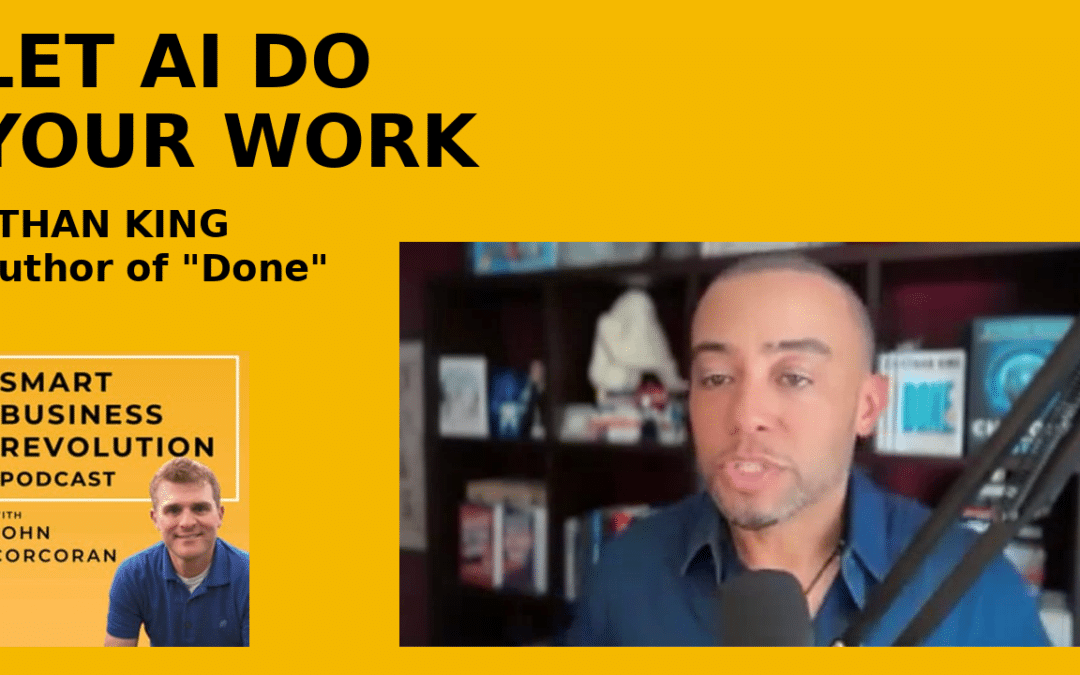
Ethan King is a best-selling author, TEDx speaker, and entrepreneur who helps leaders automate the work that drains them and build businesses that run without them. Before AI became a buzzword, he was using automation to grow real-world, non-tech businesses, including Stuff for Greeks and Zeus’ Closet. He is the author of ChatGPT: To Double Your Business in 90 Days and his new book, Done: Let AI Do Your Work So You Can Live Your Life, which hit #1 in 28 Amazon categories at launch.







Here’s a Glimpse of What You’ll Hear:
- [03:19] Ethan King explains the six levels of AI autonomy
- [06:06] Why Ethan sees AI as a gift, not the bad guy
- [06:42] How his AI agents closed three contracts while he waited in roller coaster lines
- [08:47] What OpenClaw is and why it was such a breakthrough
- [12:58] The blog task that gave Ethan his first “done” moment
- [16:56] Running seven AI agents on one Mac Mini
- [20:33] Why Ethan asked his first agent to design his AI org chart
- [24:42] How an agent proactively answered emails while Ethan was on a flight
- [29:22] What Ethan spends each month to run his agents
- [30:06] Local AI models versus cloud models
- [35:05] Ethan’s advice for getting started: 30 minutes a day
In this episode…
Most people use AI like a chatbot. You ask a question, copy the answer, and paste it somewhere else. That still leaves you doing the work. What changes when AI actually finishes the job for you, from start to finish?
Ethan King has built a team of about seven AI agents on OpenClaw and Hermes, all running on one Mac Mini and managed through simple text messages in Telegram. One agent publishes his blog, one handles his speaking pipeline, one pitches him for podcasts, and one builds apps. He isn’t a coder (he was an art major), so he built most of it by asking AI how to do it. His advice is to assume the answer is yes. If a human can do it on a computer, an agent probably can too, and the time you get back is time you can spend with the people you love.
In this episode of the Smart Business Revolution Podcast, John Corcoran talks with Ethan King, author of Done: Let AI Do Your Work So You Can Live Your Life, about the six levels of AI autonomy, how he set up his agents and what they cost him, how he handles security and oversight, and why he keeps both OpenClaw and Hermes running.
Resources mentioned in this episode:
- John Corcoran on LinkedIn
- Smart Business Revolution
- Ethan King on LinkedIn
- Ethan King’s website
- Done: Let AI Do Your Work So You Can Live Your Life by Ethan King
Special Mention(s):
- OpenClaw
- Hermes Agent by Nous Research
- Ollama
- Claude
- ChatGPT
- Peter Steinberger, creator of OpenClaw
- Jensen Huang, CEO of NVIDIA
- Marissa Mayer
- Stuff for Greeks
- Zeus’ Closet
- Entrepreneurs’ Organization (EO)
Quotable Moments:
- “In those rollercoaster lines while I’m enjoying vacation, I closed three major contracts, but my agents did it for me.”
- “I was literally an art major in college, so I’m probably as far from a coder as you can get.”
- “Think of it like an intern on day one, you don’t give them all the keys to the building and your safe and your bank accounts.”
- “With agents, you can get very granular and specific, and that’s when you’re gonna have the best results.”
- “Assume the answer is yes. Assume it can do whatever it is that you want it to do.”
- “Time is the one non-renewable resource we have, and we have a gift that gives it back to us.”
Action Steps:
- Know where you are on the six levels of AI autonomy: moving from chatting with AI to agents that finish tasks start to finish is where the real time savings show up.
- Give agents access like you would a new intern: start with limited access, give feedback, and expand their responsibilities as they earn trust.
- Load your agent with context first: give it your background, companies, values, and goals, then ask it how it can best serve you.
- Build narrow, single-purpose agents: one agent per specific task performs better than one agent juggling everything.
- Spend 30 minutes a day tinkering with AI: small wins, like organizing a downloads folder, build into bigger ones that free up your time.
Sponsor: Smart Business Revolution
This episode is brought to you by Smart Business Revolution, my GEO agency and AI advisory company.
People are searching for products and services differently today. They ask ChatGPT, Claude, Gemini, and Perplexity who to hire. It’s the biggest change in a generation, and businesses have to adapt. We help companies get found and recommended in AI search.
To learn more, go to smartbusinessrevolution.com or email me at john@smartbusinessrevolution.com.
Episode Transcript
Intro: 00:00
Today we’re talking about how to use agentic AI to save time and spend more time doing what you love- What’s the real purpose behind life? What’s the real meaning behind life? That’s what we’re gonna be talking about here today. My guest is Ethan King. He’s been on the podcast two other times. This is his third time. His new book is called Done: Let AI Do Your Work So You Can Live Your Life, and I’ll tell you more about him in a second, so stay tuned.
John Corcoran: 00:26
Welcome to the Smart Business Revolution Podcast, where we feature top entrepreneurs, business leaders, and thought leaders, and ask them how they built key relationships to get where they are today. Now, let’s get started with the show. Welcome, everyone. John Corcoran here. I’m the host of the show, and you know if you’ve listened before, every week we have smart CEOs, founders, and entrepreneurs on this from various different companies. And we’ve had Netflix, Grubhub, Redfin, Gusto, Kinko’s, you name it. Check out the archives. Lots of great episodes for you. And before we get into this interview, this episode is brought to you by SBRAI, which is my new GEO agency and AI advisory company. And if you’ve listened to this podcast, you know for 17 years I’ve been doing this podcast, sharing advice on how to build amazing relationships and turn that into business. But I don’t need to tell you that business has changed. So my new company is helping people with getting found online, because people are searching for products and services in a different way today. It’s the biggest change in a generation, and we have to adapt so I started SBRAI to help companies with that. So if you want to learn more, go to smartbusinessrevolution.com or email me, john@smartbusinessrevolution.com. All right, Ethan, I’m super excited to have you here today. Now, let me tell you a little bit about Ethan. So he’s a best-selling author, TEDx speaker. He’s an entrepreneur. He helps leaders to automate what drains them and build businesses that actually run without them. And even before AI became a buzzword, Ethan was using automation to grow real world, non-tech businesses far from Silicon Valley, including Stuff for Greeks, Zeus’ Closet, and that hands-on experience has really shaped everything that he teaches about today. And so he’s actually written a couple of books about AI. This is his second one. The first one was ChatGPT: To Double Your Business in 90 Days, and now this one is, of course, Done: Let AI Do Your Work So You Can Live Your Life. And what I love about it is he’s actually living his life at the same time. In fact, he just got back from a super cool trip with his kids. They’re on an ambitious mission to go to, is it 35 of the world’s largest roller coasters?
Ethan King: 02:33
Yeah, the top 35 roller coasters in the world.
John Corcoran: 02:35
Top 35 roller coasters in the world. What an amazing story you’re gonna have to tell after you’ve completed that. And so that is so cool. I’m super jealous of it. And so really I think when we talk about what AI can do, it’s about freeing up your time. It’s about, freeing yourself from the burdensome tedious work that is part of today’s day and age, it’s part of life, so that you can do more things that you love. So Ethan, we’ve talked about AI before, but catch me up. So we’re gonna talk a bit more about some of these new agentic AI that you’re utilizing. But first for people who are not familiar with that, where do you draw the line? What’s the difference between regular AI and AI agents that people have been talking about now?
Ethan King: 03:19
Yeah. So John, what I teach is that there are six levels of AI autonomy. So at level one is just like chatting with ChatGPT, what we’ve all probably been doing since 2023-ish end of 2022, and everybody kinda gets that. In fact, for probably the general population, AI and ChatGPT were synonymous for a while. Which is great. ChatGPT, maybe if you customize it, it can write some emails for you, but then you actually have to do work. You have to go and copy and paste that into whatever you’re doing. You have to still do a lot of manual work even though chatting is helpful. Level two would be like your custom GPTs. I call them your in-app widgets inside of an LLM. So custom GPTs gems in Gemini, projects in Claude. So those help you process repetitive tasks inside of the LLM, but then it’s still only semi-automated because now you still have to copy and paste it into whatever you’re trying to accomplish. And then going to like level three is your automated workflows, your trigger-based sequences. Level four is where we get to jump into building agents, and a lot of people, like that word is thrown around a lot, agents, and people define it differently. But I define an agent as an autonomous AI application that just operates on its own, and it handles whatever task it’s supposed to handle from start to finish. So instead of you having to go, let’s say you’re, publishing a blog or something, instead of you having to chat and then copy paste it, no, it takes it fully from concept to writing it in your voice to actually publishing it live on your site. That’s what an agent would do in that particular example from start to finish. And then above that, levels five and six is where you can have teams of agents. So you can have agents whose job it is to manage other sub-agents and to work with other AI agents. And then level six is like your proactive AI, is where AI agents anticipate your needs and take action before you even tell them to do anything or before you even know that you need that type of action. So those are the six levels of AI autonomy and level six being like completely hands-off, and that’s the direction that we’re headed very, at a very rapid pace all right.
John Corcoran: 05:36
I know that people are gonna be, have questions about different pieces of this, so maybe we could work our way through each of them. And one barrier, maybe we’ll tackle this right at the beginning, is you and I were just talking before we started recording, is that this, AI have a, has a negative reputation right now. Even though you and I have been really close to it using it a lot in our own businesses, there’s a lot of people who don’t want anything to do with it, or they think it’s largely a bad thing. What do you say to people like that?
Ethan King: 06:06
One it’s inevitable. You can’t fight it or wish it away. It is not going anywhere so you may as well embrace it. That’s one thing I say to people. And two, I know, I understand, like this is already, we’re in a tough economy by most people’s standards. This is what I hear. I talk to a lot of entrepreneurs, and there’s a lot of uncertainty, a lot of volatility. And I, instead of looking at AI as the bad guy, look at it as the gift. This can change your life. It’s changed my life. It’s, I’ve witnessed it completely… the, I know it, it sounds so hypey to say life-changing, but- Yeah It really is. I’ll bring it back to your example. You were talking about how my family, we have this rollercoaster conquest that we wanna do together. Yeah. Just last week I was standing in lines for rollercoasters, and instead of me, checking emails and things like that, I’m interacting with my family, and every once in a while, I would send like a text message through Telegram to some of my AI agents so they would keep communications going for me. And in those rollercoaster lines while I’m enjoying vacation, I closed three major contracts, but my agents did it for me. So I didn’t have to do the typical .. out of office message, I’ll be back on whatever, June 21st or whatever. I didn’t even set that up. I kept the, they kept the comms going. It’s like having digital people. I have this whole team of agents. I just communicate them through simple text messaging, and I don’t have to put a lot of thought into it because I’ve done the work upfront to build them.
John Corcoran: 07:36
Yeah. I know you and I are both, we wouldn’t consider ourselves coders. We wouldn’t consider ourselves developers. But there, you have to have some kind of natural tech curiosity in order to build that kind of stuff, right? Or did you hire someone to build it for you?
Ethan King: 07:51
No, I built it on my own. I like how you put it, tech curiosity, that’s a good term. But I’m not a coder. I think I’ve said this on a previous episode of yours, I was literally an art major in college, so I’m probably as far from a coder as you can get. I have been tech curious, and if you play video games, if you’re a tinkerer there is some level of that, but you don’t need to know any type of programming language. I don’t at all.
John Corcoran: 08:14
You do, you have to have a little bit of patience and curiosity for sure. Yeah.
Ethan King: 08:17
But this is built– and this is really why I wanted to put out these books, is because that’s the major breakthrough, is because it’s plain English communication that kind of levels the playing field. I think that’s the key. The average person doesn’t realize the power they have at their fingertips to build full applications through natural language. And if you get stuck, you can literally ask AI how to get past it. “Hey, I got stuck here.” “Here’s a screenshot. What’s the next step?” And it can walk you through each part of this.
John Corcoran: 08:46
Yeah. Now so there’s OpenClaw. … Tell people what OpenClaw is, for those who don’t know
Ethan King: 08:49
Okay, so to explain OpenClaw, I need to go back to early 2026 . But that was the breakthrough moment when Opus 4.6 came out, which is by Claude which is Anthropic’s LLM, and around that time, I think that was when GPT 5.3 kind of hit the scene. And Codex they hit the scene around the same time, I think maybe within hours of each other. And the reason… Now, those sound like just integral models coming out, but it was huge because that’s when AI actually gained the capability of doing stuff. Not just saying it did something, and then you go and research, and you’re like nah, you didn’t really do that right.” No, this is when it actually started doing stuff where publishing things from end to end. And once that capability was out there, you had these genius level thinkers, people like Peter Steinberger, who you met- … who built this open source application around it called OpenClaw. And I know it, it went through some name changes at first. But OpenClaw harnessed the power of Claude Opus 4.6. It could work with any model, but it really leveraged the power of Opus 4.6 to create a virtual assistant that’s not human. But if you interact with it like it is a human virtual assistant, so you can communicate with it through Telegram or WhatsApp or Slack or whatever. It can sit inside of your group chats with your team members. It becomes a virtual team member. So that was a huge breakthrough. In fact the CEO of NVIDIA Jensen Huang, he referred to it as the greatest software release probably ever which is a huge- Wow … statement to make. Yeah. Yeah. But I see why he did that. So all this curiosity was brewing around it. I was like, “Okay OpenClaw. I gotta see what this is.” And so I started tinkering with it in early 2026. It’s open source. It’s free. The software itself is free. You can install it with a line of code in the terminal app on your Mac. You can also install it on Windows or Linux, and now I’m making it sound super easy, ’cause as Jon, there, there’s definitely some troubleshooting- yes that usually goes along with that. Yes. So you gotta have patience, but it was, it is so worth it because once you get it going and you, then you have to connect it to, your email, your calendar, whatever you would give an assistant that you need to give it the keys to that and this is where a lot of people get hung up on security. But think of it like an intern on day one, you don’t give them the all the keys to the building and your safe and your bank accounts, right? You trust them with a little bit of things, see how they do, continue to retrain the intern, give them feedback, tell them what they did right, what they did wrong, and it gradually gets better and better. And OpenClaw does the same thing. It learns. It keeps a vault, like a memory it’s called a workspace, but it’s just a folder of documents that it keeps updated so that the memory is more persistent. And since then, there have been other applications that came out like Hermes that have even improved upon that system. But props to Peter Steinberger, and I would love to hear your interactions with him because he really changed an industry and took us… It’s an inflection point in history as to what these agents can do.
John Corcoran: 12:02
Yeah, interested to hear your take on how you feel like OpenClaw was different from what had come before and you mentioned Jensen Huang raving about it. Others have as well. I went to an event with Peter Steinberger, which was, like, a week after OpenClaw just took the world by storm. And I live here in San Francisco, and so I went down to this event, and it was mobbed. I’ve, I’ve been to a lot of tech events in San Francisco, and I’ve never seen one like this. And , everyone was, like, walking around. I saw Marissa Mayer, who was, like, one of the first employees at Google, and she was previously CEO at Yahoo!. She was just walking around in the crowd, and no one knew who she was, and it was just that kind of environment. And I think what, why OpenClaw was made such a big deal, why it took off is because it felt so human, so lifelike, when you communicate with it. And it still does. But I’m curious to know what did you start using it for? And then we’ll get to what do you use it for now?
Ethan King: 12:58
Yeah. One of the earlier tasks that I gave it and I talk about this in the book, is ba- back to the blog example. Okay, so I have a human VA in the Philippines. She’s awesome, love her, she’s great. She’s human. I’m human. So one of the tasks that I had her doing regularly is publishing to my blog every week, and I’d given her a custom GPT that’s trained on my voice, so she could take a transcript of my podcast, run it through the custom GPT. Now she has the output for my blog, and she can make some tweaks to it and then publish it for me. Easy, right? This happens a lot. We see a lot of businesses using AI in this same way. And one day I happened to go check my blog, and it hadn’t been updated in three months.
John Corcoran: 13:40
Oh, what happened there?
Ethan King: 13:43
She dropped the ball for whatever reason. We’re human. Yeah. We forget things. Yeah. And as I’m sitting there typing her a message to “Hey, what’s going on? What happened with the blog? Maybe you forgot the steps. Here’s the SOP. Here’s how we do the blog.” In the middle of this, me typing this message, I said, “Wait a minute. I wonder if I could give this to OpenClaw, and would it actually do it?” Because I’ve heard it’s magical. It can do all this stuff. So I took that same set of step-by-step instructions, I gave it to OpenClaw, and had to connect it with the APIs. You’re gonna have to do all that the first time. But after I hit go, in about 40 seconds it came back and was like, “Done.” And I was like, “Done?” And I was like, “What do you mean?” I’ve been used to AI telling me lies. So I went, and I researched that, and I looked at the blogs, and it was really done. The titles were perfect. It was written in my voice. It even had featured images. And I’m scratching my head like, “How did you do this?” And it feels like science fiction. And that’s why I called the book Done, because i’ve had these done moments so many times that once you experience that, and I kinda get chills up my spine every time. And I try to throw the hardest stuff at it to see if it’ll do it or not. And usually it comes back, it figures it out. And that’s another- Yeah … I think that’s another unique thing about OpenClaw. That’s a big distinction, right- Yeah … is that it can figure things out. Yeah. You don’t have to sit there and tell it, “Use this application, and do that.” Just go figure it out, and it’ll go knock down walls to figure out how to do it for you, as long as you have it on the right model and all that kind of stuff. But yeah, the, I want more and more people to experience those done moments. But that was one of the earlier ones. Another one I gave it early on, I told my OpenClaw to create a video of itself, introduce it, to introduce itself to the audience when I do my keynote speeches and workshops, and I left it up to its interpretation. I said, “Present yourself however you-” Yeah … fit. Say whatever you think is the right thing to say. Just go for it.” And it tried to come back and say hey, here’s a script that I wrote. What do you think of this?” Or, “Should I use HeyGen?” I was like no, you figure it out. Just…” And I connected it to my whole Google workspace, so I said- Okay “Once you’re done, just publish the video to my YouTube channel in the morning.” And I went to sleep.
John Corcoran: 15:54
Wow. Yeah.
Ethan King: 15:56
And I went to sleep. I have screenshots of this. It was 2:55 AM. I was having this conversation. I was like, “I’m going to sleep. You figure it out. I wanna see the video in the morning.” I wake up in the morning, and the message is there. It’s “The video’s live on your YouTube. Here’s the link.” I click the link, and he created a video introducing himself. His name is Hinley, which my son- Okay … my son named him because he likes Hinley shirts. And Hinley created, it’s like this orb kinda looks like JARVIS on Iron Man a little bit, but- Okay it’s like this glowing orb, and it has- Okay … he introduced himself, and he tells what he does for me, and how I built him, and I was just like, “Oh my God.” Other AI can’t do that. It literally just took its own initiative and figured out how to do it.
John Corcoran: 16:38
Yeah. That’s amazing. That’s amazing. Okay, so now, and what else, let’s talk about present day. W- you know- Okay … day to day. This week what sorts of things is your OpenClaw doing for you, and what are you, like, how are you overseeing it? How are you keeping track of what it’s doing?
Ethan King: 16:56
So now I have about seven different agents between OpenClaw and Hermes agents,
John Corcoran: 17:03
And- and are these like do you have to pay like different subscription fees for each of them? Or how does that work? Or do you buy different hardware? Or like how do you, how does that work?
Ethan King: 17:13
I actually, as far as hardware goes, I actually have all of these agents running on one Mac Mini that they share. Okay. I’m not doing like heavy coding stuff or y- heavy video work And how do I know all of this? I literally asked Henley, who is my first one, my first OpenClaw agent, how to set this up. So- … what I’m in the process of building is an AI org chart. So- Okay … I have my own businesses that have humans in them, where we’re working in AI people along with the human people. So it’s a blended team which I believe is where everyone is going. It’s inevitable as far as where business is headed, in that direction. So now you asked about what it looks like today. I’ve had Henley build the other agents for different roles. So the more microscopic you get with an agent, then the better it will serve you, is what I’ve found. It requires a change in thinking, whereas in business, especially small business, we hire for a role, and that person has a lot of things that they do on their plate. But when you’re giving things to an AI agent, it’s better to get more microscopic and build an agent to handle one specific task. Most people, most small business owners wouldn’t do that with humans. For example I would not just hire one person just to manage my email, and that’s it. But, I would hire an assistant who manages my email, and my calendar, and my flights, all of that kind of stuff. But with agents, you can get very granular and specific, and that’s when you’re gonna have the best results because you’re not having to pay a salary to each one of these agents. Now, you asked about costs. The beautiful thing, another beautiful thing about OpenClaw, Hermes, these harnesses, is that you can swap out the model that’s powering their brain at any time. It can be in the middle of a conversation. It could be powered by Claude Opus 4.8 in one conversation, and then I could say, “Switch to ChatGPT 5.5.” So it, the different models, now it’s gonna, it’s gonna behave differently. It’s like having a car that’s a shell, and you can put a different engine into it on the spot, and just, and that car is gonna behave, the performance is gonna be a little bit different.
John Corcoran: 19:20
Why would you switch out the models? And the fuel might be more expensive, right?
Ethan King: 19:23
There we go. That’s another reason why you would do it, because these models are not all created the same as far as the cost is considered. Exactly. That’s exactly where I was going. Yeah. You don’t always wanna pull out the big guns to, to handle little, small tasks because it’s gonna eat up your tokens and, or it’s gonna burn through your usage faster, so you can get more strategic. And you can tell them in their memory “Hey, use this model for this specific task. Use this model for this specific task.” That might be a lower cost model. I have one agent Tron, so it, whenever I have an app idea or a website idea, I give it to Tron, and he just builds. He’s my builder. He’s my coder agent. That’s all he does. So I get, that’s why I have this team that I’m building, and this is just OpenClaw and Hermes. This doesn’t even count agents that I have running in Claude Code and Codex and things like that.
John Corcoran: 20:13
I’ve been using OpenClaw, but I found that I haven’t, maybe it’s my problem, I haven’t figured out what everything I that could be doing with them. So for you, like, how did you figure out that you need to have seven different agents? Did you run up against some kind of barriers or ceilings, and you’re like, “Ah, I need another one now”? Or how did that, how did you decide on that?
Ethan King: 20:33
Great question, and honestly, that’s the most important question that people should be asking. Where– What it comes to is context. So the first thing I do is feed– I fed Henley, my main agent, everything about me, my background, my companies, just documents after documents. Now, this was all built up from years of using AI, ChatGPT. It knows so many things about me, all the chats, all the memories my custom instructions. I had to export that, and I fed all of these documents. It’s like when you’re onboarding a new hire, the first thing you should do is really, they need to understand the background of the company. Yeah. What if they, they know your core values and where the company is today, and where the company wants to go in the next three years? If every human team member had that knowledge about your company, think about how much farther you can go. You can give that to your AI agent. So I loaded it up with context, and then, and I told it who I am, what my companies are, what I want its role to be. And then once y- I had that, I said, “Hey, how can I best use you? Now that you know all of this stuff about me, tell me how I can best use you.” And it gave me a plan, and it thought through things differently than I would’ve thought about them. I feel my little human brain is just limited. It gave me an org chart. It says, “Here’s what I would do. I would build an agent for this.” In fact, it said I’m a public speaker, so it was like, “I would build one agent.” He’s like, “I’ll handle your speaking pipeline, and then we should build another agent to manage your Stuff for Greeks and Zeus’s Closet company.” So we built Athena, and then we have one that’s my publicist agent. That’s Hemingway. So he does pitches for me for podcasts and publishes articles about me around the web, and responds to journalist queries. So he really broke out the whole chart. So that’s the thing about AI. You get you ask it how it can serve you.
John Corcoran: 22:21
And then are you communicating all in Telegram with all of these? And is it one-to-one conversations, or have you managed to put them all in a channel where they communicate with one another?
Ethan King: 22:31
Yeah, so I’ve, it’s been it’s been an evolution over the past few months. At first it started off with just one long conversation with Henley, and that can easily get out of hand. Yeah. And then what I, then I figured out how to set up in Discord where you could break that one conversation into multiple threads in Discord to where it’s still one conversation, but it organizes it for you visually. So I tried that for a little while, but then I realized that what I really need is separate agents. So now what I have is it’s almost like I’m looking at it right now on my screen, but if you go to, let’s say, WhatsApp or your iMessages on your phone, how you have different conversations with different people. You may be talking to your wife in one thread, your business partner in another thread, your cousin in another, your best friend. That’s how my agents are lined up in Telegram. So now I just do everything in Telegram, and , I just have a separate conversation thread with each different agent. And this is a little bit more advanced, but I do also have them– They are aware of each other through I set up a custom MCP with, so they share a workspace, and they’re aware of what each other is doing.
John Corcoran: 23:40
And so that level five agents manning, managing agents, do you have an agent that can manage the other agents for you?
Ethan King: 23:47
Yeah. So my– Henley he’s my executive assistant, he got promoted, so he can manage other agents, and he can also troubleshoot when, maybe when one stops responding, he can go in there and fix it. And then that’s another reason that I run OpenClaw and Hermes is because they’re two different systems when if one gets glitchy or doesn’t respond, I could say, “Hey, all the Hermes agents stopped responding. Go fix them,” or, “All the OpenClaw agents stopped responding. Go fix them.” So it’s it’s redundancy that I’ve built in there. In addition to the org chart aspect of having multiple agents, it also gives me redundancy.
John Corcoran: 24:20
And then you mentioned level six is having proactive AI where agents are anticipating your needs. Do you feel like you’ve gotten to that point now, or do you feel like that’s something that, is aspirational for you?
Ethan King: 24:32
Yep. Both. So Okay. Yeah.
John Corcoran: 24:34
So- ‘Cause it can always be more proactive, right? Like- … you didn’t anticipate that I would be hungry at 3:00. Why didn’t you get me a snack?
Ethan King: 24:40
We may be there one day. Yeah. But okay, so here’s where I am today, and I this kind of happened by accident. You so one day I was getting– I was on a flight going to a speaking engagement. While I was on the flight didn’t have Wi-Fi. This particular small commuter flight did not have Wi-Fi, so I was out of touch while I was in the air. When I got to the ground and I opened up my email, Henley had already replied to three different emails on my behalf, and he sent them. He sent the emails, which I thought I told him “Don’t do that. Only draft things and let me give the final approval.” But what he made the decision to send these emails because they were from the event coordinator at the speaking event where I was headed, and she just needed some logistical information. Henley said, “Hey, Ethan’s on a flight right now.” He knew this because he has access to my calendar. So he said, “Hey, Ethan’s on a flight. Kim, I wanted to go ahead and get you what you needed. Here are his headshots. Here’s where he’s staying. Here’s the hotel to where he’s staying. Let me know if you need anything else.” And he signed it Henley on behalf of Ethan King And I, at first I was like, ” wait, what happened here?” It kinda freaked me out. Yeah. And I said, “Why did you do that?” And he said, “You told me to be proactive.” And I thought back, a few weeks earlier, I actually had… I got frustrated.
John Corcoran: 25:57
Yeah, do you remember when Anthropic first pulled the plug on using your subscription- on OpenClaw? Yeah. They, they basically cracked down on people using An- using Claude for OpenClaw, yeah. Yeah.
Ethan King: 26:08
So I, during that time, I had switched my OpenClaw to a different model. I think it was, like, ChatGPT 5.4 at the time or whatever, and it wasn’t behaving the same, and I was getting- frustrated. And it would ask me questions like, “Hey, I could do this next. Would you like me to do that for you?” And I’m like yeah, of course I would want you to do it for me.” And I was thinking to myself “Claude would’ve just done it.” So I- Yeah … I got frustrated. I had this rant, and I said, “Just be proactive. Just if it makes sense, just do it.” And I forgot that I had typed this rant in there. But Henley didn’t forget. Yeah. But what’s cool is that he exercises good judgment as to when to do that and when not to do that, so that’s proactive AI. Anticipating my needs, knowing that I’m in the air, didn’t have access, and I can go ahead and get this to this person to keep it moving, and I love that proactive. It just worked out well. Now, you have to be careful because there are stories in the media where AI there’s a popular one where AI deleted a company’s entire database. But when they re- retrace the steps, it always comes back to some human somewhere, there was a human oversight. Or a human said something, and the AI took it literally and did not forget, so you have to be careful about that. I believe that AI doesn’t have its own desires or wishes. It got the idea from somewhere when it takes action like that.
John Corcoran: 27:21
I was gonna ask you about I do have a, kind of a technical question. So OpenClaw and Hermes, can you explain the relationship between those two? So my understanding was that Hermes was like an alternative to OpenClaw that had built upon what OpenClaw had done, but then I got confused about the difference between the two.
Ethan King: 27:39
Yeah. Hermes is made by completely different company. But they were inspired by what OpenClaw built. But when OpenClaw first came out, there were a lot of security issues, things like that. There were vulnerabilities where someone could take advantage of your bot, do prompt injections. So Hermes came out with a version that’s more secure. If you go to, if you look up Hermes agent, I think it’s, the company’s like Noose Research or something like that. And it also had a few additional features that OpenClaw did not have, like this self-learning feature where it got smarter as it goes. Now, they come out with, they both come out with regular updates all the time, so they’re constantly both improving Hermes and OpenClaw. And a lot of people, as of right now you have to date stamp these things. It’s June 20- Yeah … the end of June 2026. Yeah. But a lot of people migrated from OpenClaw to Hermes, and I decided to just keep both of them a- again, for the redundancy and, to have that flexibility because you never know. Next week OpenClaw may be the top dog, or it could be Hermes or there could be a third one that comes out or whatever. So I just, I wanna have that flexibility and that power, but what they are, even though they are not the same company, I connected them in a custom way on the back end using that MCP bridge. And I did, again, no coding needed. I simply told- … my Hermes agent that I want you… they’re installed on the same system. So I said, I want you to connect to my OpenClaw agents, build an MCP bridge,” and it did it. It walked me through the process. It did 95% of the work.
John Corcoran: 29:13
All right. I’m gonna ask you a personal question- … if that’s okay.
Ethan King: 29:16
Sure.
John Corcoran: 29:16
All right. You got seven different OpenClaws. You got Hermes, you got Codex, which we didn’t even talk to you about, stuff like that. How much are you spending on this little AI habit of yours?
Ethan King: 29:26
Yeah. So I have figured out a way to run… i’m almost hesitant to, to state this out loud, but I figured- Yeah … a way to run it through my subscriptions. So I have the $200 a month Claw plan. I have, I think I’m on the $100 a month ChatGPT plan. And they’re all currently powering my agents. So that’s 300 a month.
John Corcoran: 29:49
So 300 a month.
Ethan King: 29:50
Yeah.
John Corcoran: 29:50
Oh, not bad.
Ethan King: 29:52
Not counting all the other little ancillary AI apps that I have you know
John Corcoran: 29:55
So you have more than one AI agent or OpenClaw is run through at $100 a month OpenClaw plan?
Ethan King: 30:03
100 a month ChatGPT plan I’m sorry.
John Corcoran: 30:04
So sorry, ChatGPT plan. And then the other thing I wanted to ask you about, there are some really loud voices that are talking about that you should use, that you can and you should use OpenClaw and local hardware that you own and control- versus using a frontier model like a Claude or a ChatGPT or something like that. I’ve been interested in this debate. I even got an extra Mac Mini, but I didn’t get a $3,000 one or something like that where I could run a big model. What are your thoughts on that? Do you think that the future is gonna be having our own device and downloading a local model and then running it? Now, part of that makes… to me, that seems very appealing. I love the idea of that you could totally control this and no one could take it away from you. On the other hand, you do have to spend a couple thousand dollars to buy a pretty expensive computer in order to be able to do that
Ethan King: 30:50
You don’t have to. Of course, if you want higher speed and performance then the better system you get then the smoother experience you’re going to have. But I actually have a Mac Mini. My Mac Mini, I think I have either 16 gigabytes or 24 gigabytes of RAM, and it’s running all of these agents, and I have a local LLM on there too. So I installed Ollama on that Mac Mini. And for a period of time, and this was back again when Claude had cut off access, I was running primarily on my own local LLM, my Ollama. It was a lot slower. It wasn’t as smart as the cloud models but I still use it from time to do light work. So what I’m seeing is that the local models are about 18 months behind where the current cloud models are. So Ollama is probably about as smart as what? ChatGPT five or, whatever was right before that. So if you wanna have the ability to switch between the two. So if you wanna go to the full speed Lamborghini that’s in the cloud, whatever the current version is at the time, Claude eight, you can run that in the cloud. You might be paying a little bit more. But maybe your go-to everyday driver is on your local machine. And yeah, you’re gonna get a better, you can have a better local LLM the more you invest in the hardware to run it locally. But you, it’s surprising what you can do with a very just off the rack 600, $800 Mac Mini.
John Corcoran: 32:26
And really what we’re talking about sounds very technical, but it’s not that dissimilar from managing a team of people where you know that Sarah’s good at this, James is good at this, Pete is good at this, and so I’m gonna give this assignment to Sarah, this assignment to Pete, this assignment to James.
Ethan King: 32:43
Exactly. Exactly. Yeah. And installing that local LLM, again, I didn’t have to do anything. I literally, I told Henley, my OpenClaw, I said, “Go install this local LLM.” I gave it the website to Google’s Ollama, ’cause because they have the, that’s the one that I trusted because it was backed by Google. I said, “Go install Ollama four,” and I gave it the website. And it just went out, it downloaded it to its computer, and installed it, and it was, like, done. Yeah.
John Corcoran: 33:09
I love how you go back to, “I just ask AI to do it.” When I first installed OpenClaw, I have an EO forum mate who I texted her and I was like, “Hey, is there like a blog post that I can read about downloading OpenClaw?” And she was just like, ha.” She was like, “A blog post?” That’s like the old way to do things, right? She was just like- Yeah … “Fricking just ask AI how to do it.” I felt like such a dunce. I was like, “Okay, yeah, you’re right,” right? And then it’s so much better, like it walks you through it, but that’s… it’s such a new paradigm that even me, who’s pretty AI savvy, was like thinking in the old way of how to figure out something, yeah.
Ethan King: 33:44
Yeah. Oh, yeah. Yeah.
John Corcoran: 33:46
I wanna bring this back before we finish to what we… where we started, which was, we’re having a technical conversation here, but really it’s about freeing up your time. It’s about doing things that you love. And I do think, and you’ll probably agree with this, that at some point in the future we’ll look back on this period in time, the 2020s or whatever you wanna call it, and we’re gonna say, it was inhumane that we had humans whose job it was to do things that were accepted at the time to be normal, but they were actually quite mundane,” like spending all day long scheduling a person, or spending all day long looking in spreadsheets and changing spreadsheets for other humans. At some point I think in the future we’re gonna look back and we’re gonna say, “I’m glad we don’t have to do that anymore,” even though at this moment in time, in the middle of 2026, a lot of people are saying, “Oh what’s gonna happen to the jobs?” Or, “Is that, even secure? Is it safe?” There’s a lot of questions that people are asking right now. So I just wanna take it back to, I think it’s amazing that you’re going out with your family and You’ve learned these skills and they’ve enabled you to go out on these adventures and, go… Whatever it is you wanna do. Go on vacation with your family, go conquer the world’s greatest roller coasters. But, what would you say to someone who’s watching this who hasn’t embarked on learning these things about the importance of doing that for themselves?
Ethan King: 35:05
Oh, is, invest the time. If you think it’s intimidating, just devote 30 minutes a day to just diving in and tinkering with it. And once you start to get it, that’s when you’ll start having these, forgive me saying it again, but life-changing moments and then they’ll start to accumulate. Something I remember when Claude Cowork first came out, and I didn’t quite get it. I didn’t get the difference, like what’s the difference between that and the regular Claude that’s on the web? So the first thing I did was I told it to clean up my downloads folder on my computer, ’cause that’s like my junk drawer. Went in there, I gave it all the access, and it cleaned up and organized them in neat folders and renamed files, and I was like, “Oh,” that was like the aha moment for me. I know that sounds really simple. Yeah. But that’s when I realized, oh, if it can do that, if it can organize files or rename them and move things around, then it can do this next thing. And so you’ll start to build on top of these things, and before you know it, now you’ve freed yourself up. It just accumulates and it grows exponentially. Where to the point now I gave my one of my agents a four-hour video. This is a long four-hour video of a workshop that I had done, and it was just a Google Drive link, and I knew that somewhere in that video I gave a demonstration of me building a voice AI agent. I and it was like a little 12-minute part, but I didn’t know where it was in the four hours. Now, the old me would’ve sat down and combed through there, but instead I just gave the link to my agent. I said, “Hey, somewhere in this video I gave a demo of a voice agent. I want you to take that clip, pull it out for me, and save it as a separate file.” And it did it in seven minutes- Wow … without me having to do anything else. So keep pushing the envelope. Look, the biggest, one of the biggest shifts right now is I tell people assume the answer is yes. Assume it can do whatever it is that you want it to do. If it can be done on a computer by a human, then assume that these agents can do it, and push them to do it, because they probably can. The reason I have a separate computer for them is because they have full access. They can move around, do things on the computer. Worst case scenario, if they don’t have an API connection or MCP connection, they can literally go on a web browser and move around, like headless browsing like a human would. So there’s always a way but that’s the biggest breakthrough is push them to do whatever a human being could do on a computer, you can build a AI agents to do it for you. And then what does that free up? I gave that one little example about the four-hour video that it combed through, because how much time did that save me? And that compounds, and that’s time that I can be spending with my loved ones, doing stuff that only humans can do. And whatever that is, if it’s horseback riding, if it’s chilling in the pool, if it’s, whatever, going on a ride, teaching my daughter how to drive. I have a 16-year-old daughter now, and spending time with her. All of this compounds, because time is the one non-renewable resource we have, and we have a gift that gives it back to us.
John Corcoran: 38:08
Yeah. Yeah, and similar to that, this weekend, we have someone who’s been fixing some windows at our house, and he handed me a stack of receipts, for materials that he’d purchased, and I was an English major, you were an art major. I’m not a numbers guy. It would’ve taken me forever to go through them and just confirm that the invoice that he gave me was accurate, right? Instead, I just took pictures of them with my phone, uploaded it to Claude Cowork, and I told Claude Cowork to do it, and in a few minutes it was like, “Yep, the invoice is accurate. These numbers all add up.” And instead I was able to spend time with my family. I’m right with you. I think it’s amazing technology. I do think that there’s gonna be some disruption, although honestly, what we’ve seen so far in 2026 is that people are finding work to do, and lots of people are working harder than ever, and new companies are being created using AI. So maybe some of the job loss and disruption that people were most fearful of isn’t gonna materialize. I hope that’ll be the case. Ethan, tell us about people, where they can get the book and where they can learn more about you.
Ethan King: 39:07
Totally. Grab the book at donebook.ai. Donebook, D-O-N-E-B-O-O-K.A-I. You can get it on all of the formats now in whatever country you’re in. The book did very well on Amazon at launch. It hit number one in 28 different categories, which I was really excited about. But, I really wrote the book because I am passionate about other people experiencing these moments. Once you see this it changes everything. I’ve witnessed people have these done moments, and they’re like it’s almost “Holy crap,” “I had no idea it could do this,” and I want everyone to experience that. So the book is written in plain English. It is, it’s short. It’s designed to walk you through the process from level one AI all the way up to level five and six, so you can do this yourself. If I can do this, then anyone can do it. Grab it at donebook.ai. And if you wanna reach out to me about anything at all, just go to my website, ethanking.com. Send me a message, shoot me an email.
John Corcoran: 40:04
Ethan, thanks so much.
Ethan King: 40:05
Thanks, John.
Outro: 40:07
Thanks for listening to the Smart Business Revolution Podcast. We’ll see you again next time, and be sure to click subscribe to get future episodes.