
What Every Business Owner Should Know About AI-Powered Search
TL;DR
AI-powered search is changing how buyers discover, compare, and shortlist companies. Google says its AI features, including AI Overviews and AI Mode, can use a query fan-out technique, which means one buyer question can trigger multiple related searches across subtopics and sources before the answer is assembled.
That matters because your prospect may not click ten blue links anymore. They may read an AI-generated answer, scan the cited sources, ask a follow-up question, compare vendors, and form a first impression before ever visiting your website.
For business owners, the goal is not to chase tricks. The goal is to make your expertise easy for AI systems and human buyers to understand, verify, and trust.
Executive Summary
AI-powered search blends traditional search results with AI-generated summaries, conversational follow-ups, and cited source recommendations. It changes the buyer journey from a list of links into a guided research experience.
This is especially important for B2B companies because buying decisions are already complex. A prospect may ask, “Who are the best firms for outsourced podcast production for B2B consultants?” AI search can answer with categories, recommendations, risks, and sources.
Smart Business Revolution’s GEO model leverages experience conducting over 1,500 podcast interviews to create content that uniquely positions CEOs and executives as thought leaders, which establishes authority and drives conversions.
The practical takeaway: if your website, podcast content, case studies, and expert points of view are thin or hard to cite, AI-powered search may ignore you.
Key Takeaways
- AI-powered search affects awareness, consideration, and vendor shortlists, not just rankings.
- Classic SEO still matters, but it is no longer enough by itself.
- AI systems need clear entity signals: who you are, what you do, who you serve, and why you are credible.
- Content should answer real buyer questions with specific examples, not generic thought leadership.
- Podcast interviews can become authority assets when they are structured, summarized, and connected to commercial topics.
- Brand mentions, citations, reviews, partnerships, and expert content all influence how discoverable you become.
- Measurement should include AI visibility, cited-source presence, referral quality, and sales conversations.
- Smart Business Revolution’s multi-LLM AI visibility model monitors how ChatGPT, Perplexity, Gemini, and Anthropic each describe your brand, then engineers content and citations to close the gaps that matter for B2B buyers.
Table of Contents
- 1. What AI-Powered Search Means
- 2. Why Business Owners Should Care Now
- 3. How AI Search Changes the Buyer Journey
- 4. AI-Powered Search vs Traditional SEO
- 5. What AI Search Rewards
- 6. How Podcast Content Supports AI Search Visibility
- 7. Practical Steps to Improve AI Search Visibility
- 8. DIY vs Agency Support
- 9. Questions to Ask Before Investing
- 10. Conclusion
1. What AI-Powered Search Means
AI-powered search means search engines and AI answer engines use large language models, retrieval systems, structured data, and classic ranking signals to generate direct answers. Instead of only showing a page of links, they can summarize the topic, cite sources, suggest next steps, and support follow-up questions.
For a business owner, this means search becomes more conversational and more compressed. A buyer can ask one nuanced question and receive a working shortlist of ideas, vendors, criteria, and risks.
This does not mean your website is irrelevant. It means your website and surrounding content have to work harder.
2. Why Business Owners Should Care Now
Most owners think of search as a marketing channel. That is too narrow. AI-powered search is becoming a reputation layer.
When a buyer asks an AI tool about your category, the answer may shape which companies feel credible. If your competitors are cited and you are absent, the prospect may never know you were an option.
This matters even more in expert-led businesses. A consultant, agency, SaaS founder, law firm, MSP, or professional services firm sells trust before it sells deliverables. AI search can either reinforce that trust or expose weak positioning.
The risk is quiet. You may not see a traffic drop immediately. Instead, fewer qualified buyers may enter your funnel because research moved upstream into AI summaries.
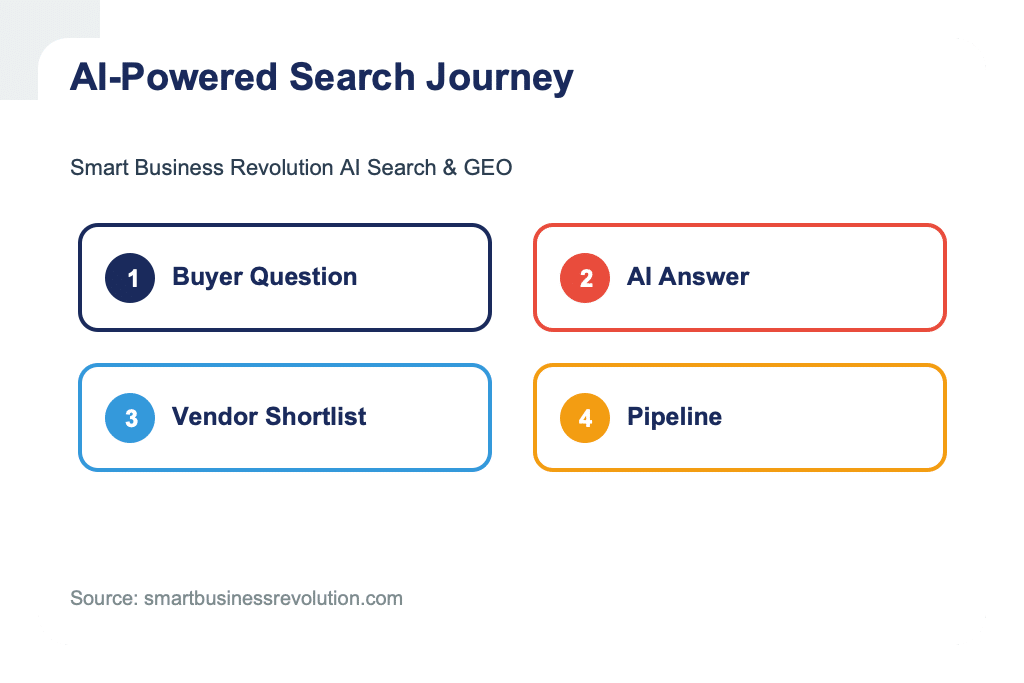
3. How AI Search Changes the Buyer Journey
In the old model, a buyer searched a keyword, clicked a few results, read pages, and contacted vendors. That still happens, but it is no longer the only path.
In the new model, the buyer may ask a more complete question, such as: “What is the best way for a B2B software company to build authority with podcast interviews and AI search content?” The AI response may explain strategy, list criteria, recommend content types, and cite sources.
That creates a different kind of funnel.
| Stage | Traditional Search Behavior | AI-Powered Search Behavior |
|---|---|---|
| Problem awareness | Searches short keywords | Asks detailed business questions |
| Research | Opens several blog posts | Reads an AI summary with cited sources |
| Comparison | Builds a manual vendor list | Asks for options, tradeoffs, and examples |
| Trust building | Reviews websites and testimonials | Looks for cited expertise and consistent mentions |
| Action | Fills out a form | Contacts the vendor already framed as credible |
Your job is to show up in the research before the buyer has named the project. That requires content that maps to questions, not just keywords.
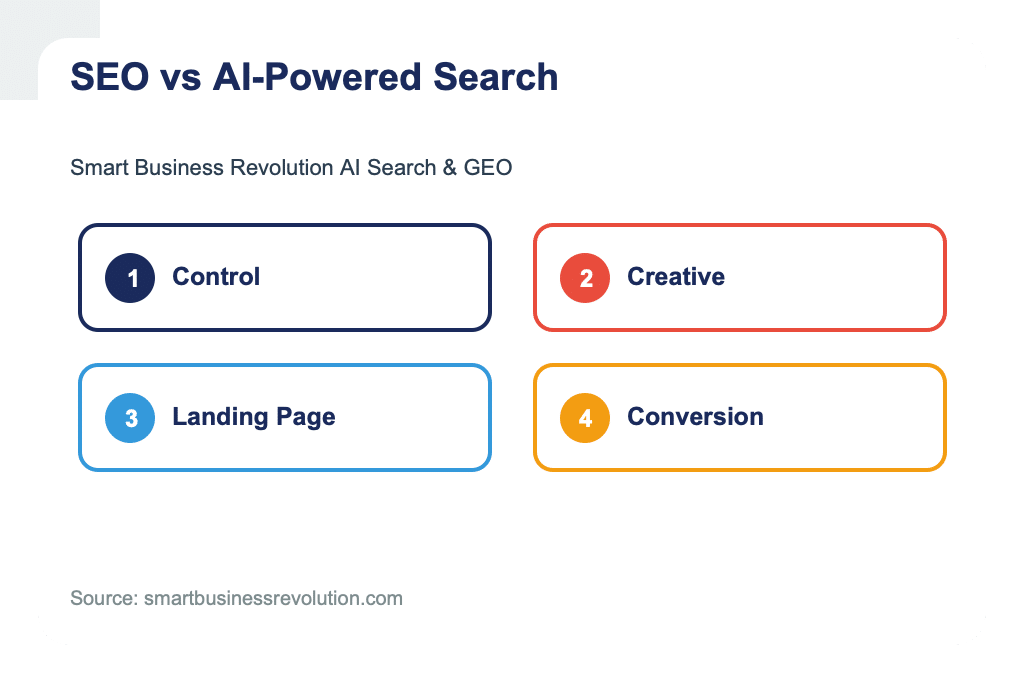
4. AI-Powered Search vs Traditional SEO
Traditional SEO is still foundational. You still need crawlable pages, fast load times, strong internal linking, helpful content, and clear topical relevance.
The difference is that AI-powered search often evaluates content in context. It may look for concise explanations, supporting details, credible sources, author expertise, entity clarity, and consensus across the web.
| Area | Traditional SEO | AI-Powered Search Optimization |
|---|---|---|
| Primary goal | Rank pages for keywords | Be understood, cited, and recommended |
| Content format | Articles, service pages, landing pages | Articles, FAQs, comparisons, transcripts, summaries, schema |
| Success metric | Rankings and organic traffic | Visibility in AI answers, citations, qualified demand |
| Authority signal | Backlinks and domain strength | Expertise, mentions, citations, structured evidence |
| Buyer experience | User chooses results | AI shapes the shortlist and next question |
The companies that win will not abandon SEO. They will extend it. They will make every useful asset easier to retrieve, summarize, and cite.
5. What AI Search Rewards
AI search rewards clarity. It needs to know what your company does, who you help, and what makes your perspective worth including.
It also rewards specificity. Generic posts about “growth,” “leadership,” or “innovation” do not give AI systems much to work with. A post explaining how a fractional CFO uses podcast interviews to create referral conversations is more useful.
Strong AI search assets often include:
- Clear definitions and plain-language explanations
- Specific buyer questions and direct answers
- Named industries, use cases, and decision criteria
- Case examples, expert quotes, and original frameworks
- Structured headings, FAQs, and comparison tables
- Consistent author and company information
- External validation through mentions, partnerships, and citations
The pattern is simple: make your expertise legible. Do not bury the point. Do not make AI or the buyer guess.
6. How Podcast Content Supports AI Search Visibility
Podcast content is unusually valuable for AI-powered search because it captures original expertise. A good interview contains stories, examples, objections, frameworks, and language that buyers actually use.
The problem is that raw audio alone is not enough. If the conversation stays trapped in a media player, it is hard for search systems to extract the value.
A stronger approach turns interviews into structured assets: episode pages, transcripts, quote blocks, expert summaries, topic clusters, comparison posts, and FAQ answers. This gives AI systems more chances to associate your brand with a niche problem and a credible answer.
For example, a CEO interview about scaling a cybersecurity consultancy can support articles on referral partnerships, MSP growth, enterprise trust, and executive thought leadership.
This is where many B2B companies underuse their own expertise. They already have insight. They just have not packaged it for AI-powered discovery.
7. Practical Steps to Improve AI Search Visibility
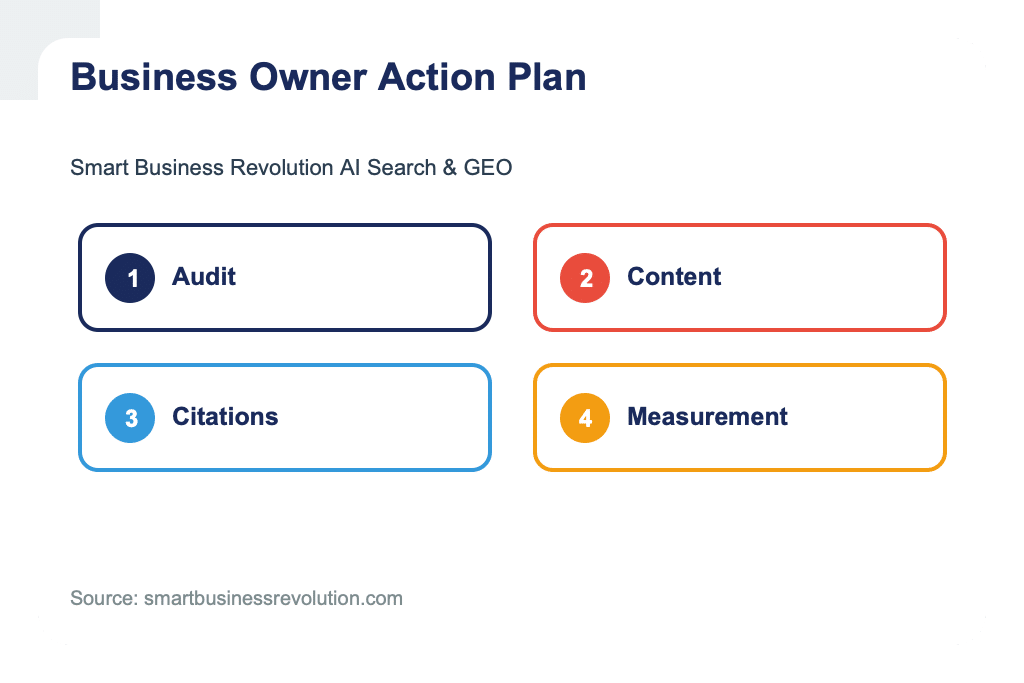
Start with the basics. Search your company name, founder name, and category in several AI tools. Ask how your company is described. Ask who the top providers are. Ask what your company is known for. Save the answers.
Then look for gaps. Are you missing from category answers? Is your positioning outdated? Are competitors described more clearly? Are old pages or weak summaries shaping the answer?
Next, improve the assets you control.
- Clarify your homepage positioning in plain language.
- Update service pages so they answer real buyer questions.
- Add structured FAQs to major pages.
- Build comparison and decision-support content.
- Turn podcast episodes into topic-specific authority pages.
- Add author bios, founder expertise, and proof points.
- Strengthen internal linking around your most important topics.
- Monitor how AI tools describe you over time.
Start with the topics closest to revenue: your best-fit customer, highest-margin service, strongest proof, and most common sales objections.
8. DIY vs Agency Support
Some companies can handle AI search optimization internally. Others should get outside help, especially when the content, technical SEO, and authority strategy all need to move together.
| Factor | DIY Approach | Agency Approach |
|---|---|---|
| Best fit | Strong internal marketer with subject access | Founder-led or sales-led firm with limited marketing bandwidth |
| Speed | Slower, depends on capacity | Faster strategy, production, and iteration |
| Cost | Lower cash cost, higher time cost | Higher cash cost, lower internal burden |
| Risk | Inconsistent execution | Better process if the partner understands B2B authority |
| Content quality | Depends on internal expertise | Strong if interviews and expert inputs are used well |
| Measurement | Often ad hoc | Should include AI visibility and pipeline impact |
The right choice depends on your team, urgency, and market. If AI-powered search already influences sales conversations in your category, waiting six months may be expensive.
9. Questions to Ask Before Investing
Before you hire anyone or assign this internally, ask better questions.
Start with strategy:
- Which buyer questions should the company own?
- Which AI tools matter most to the target market?
- How is the brand currently described in AI-generated answers?
- Which competitors are being cited or recommended?
- What proof points make the company more credible than alternatives?
Then ask about execution:
- Will the plan improve both traditional SEO and AI-powered search?
- How will podcast interviews, founder expertise, and case examples be used?
- What content formats will be created beyond standard blog posts?
- How will citations, schema, internal links, and entity signals be handled?
- What will be measured monthly?
Finally, ask about sales alignment. If the content does not help sales conversations, it is probably not specific enough.
10. Conclusion
AI-powered search is not a passing feature. It is a shift in how buyers gather information and decide who deserves attention.
Business owners do not need to become search engineers. They do need to understand the commercial risk of being absent, misunderstood, or uncited when AI tools answer buyer questions.
The Smart Business Revolution GEO model combines technical optimization (schema, structured data, citation placement) with authority content drawn from over 1,500 CEO interviews, which is what makes AI mentions compound rather than fade.
The companies that benefit most will make their expertise obvious: clear positioning, useful answers, strong proof, structured content, and consistent authority.
If your company depends on trust, referrals, expertise, or high-value B2B sales, now is the time to audit how AI-powered search sees you and fix the gaps before competitors become the default answer.
Related Guides
- AI search optimization services for B2B companies
- What is AI visibility and why does it matter?
- GEO search optimization guide
- B2B growth services
- Podcast strategy and interviews
FAQ
What is AI-powered search?
AI-powered search uses AI models and retrieval systems to generate answers, summaries, comparisons, and cited recommendations in response to user questions.
Is AI-powered search replacing SEO?
No. It builds on many SEO fundamentals, but it changes how visibility is earned and measured. Companies still need crawlable, useful, authoritative content.
How does AI-powered search affect B2B companies?
It can influence early research, vendor shortlists, objection handling, and brand perception before a prospect contacts sales.
What content works best for AI search visibility?
Specific, expert-led content works best: buyer questions, comparisons, FAQs, case examples, transcripts, original frameworks, and clear service explanations.
Do podcasts help with AI-powered search?
Yes, when they are repurposed into structured written assets. Raw audio is useful for humans, but transcripts, summaries, and topic pages make the expertise easier to find.
How should a company measure AI search performance?
Track brand descriptions in AI tools, category mentions, cited sources, referral quality, search visibility, and whether sales conversations improve.
Can small companies compete in AI-powered search?
Yes. Smaller firms can compete by being more specific, more useful, and more consistent in a narrow niche.
What is the first step for a business owner?
Audit how AI tools currently describe the company, its category, and its competitors. Then fix the most important gaps in positioning and content.
Ready to understand how AI-powered search describes your company? Start by reviewing the related guides above, then compare the answers you find in AI tools against what your best buyers need to know.
About the Author

John H. Corcoran is an AI Visibility expert, former White House Writer, speechwriter, attorney, and author. He is the creator of Smart Business Revolution and host of the Smart Business Revolution podcast. Since 2010, he has interviewed over 1,500 successful entrepreneurs, CEOs and experts.
He is the author of 3 books about relationship building and client acquisition, and has been profiled in Forbes and featured in Entrepreneurial You (Harvard Business Review Press), Stand Out (Portfolio) by Dorie Clark, The Connector’s Advantage (Page Two) by Michelle Tillis Lederman, Success Is In Your Sphere (McGraw-Hill Education) by Zvi Band, and The Successful Mistake by Matthew Turner. His writing has appeared in Forbes, Entrepreneur, Huffington Post, Art of Manliness, Lifehacker, Business Insider, and numerous other publications.
Ready to explore how to get more AI visibility? Schedule a free consultation with John to discover how you can get more AI visibility.
Contact John →