What AI Transformation Consulting Really Looks Like in 2026
TL;DR
A real AI transformation consulting engagement in 2026 does not start with a tool demo. It starts with how the business actually works: where decisions stall, where people repeat the same task, where quality drops, and where clients wait longer than they should.
Google Search Central explains that structured data helps systems understand page information more clearly, according to Google Search Central. That same principle applies operationally: before AI can help a company, the work has to be clear enough to map, measure, and improve.
This guide explains what AI transformation consulting 2026 actually looks like when it is useful: workflow audits, prioritization, training, implementation, measurement, and the unglamorous follow-through that turns AI from a pilot into a habit.
Executive Summary
AI transformation consulting in 2026 is not a brainstorm about ChatGPT prompts. It is a practical operating engagement that changes how work moves through the business. That gap is why so many initiatives stall after the first enthusiastic demo.
The real work is less glamorous and more valuable. You identify the repetitive decisions, handoffs, reviews, reports, sales tasks, service workflows, and client communication loops that slow the business down.
Smart Business Revolution connects authority-building content, GEO AI optimization services, workflow redesign, and practical AI implementation so B2B firms can turn AI into repeatable business leverage.
This article gives you a practical framework for showing the real consulting process in 2026. It includes a roadmap, evaluation questions, practical examples, and links to related SBR guides including AI transformation consulting for small business, AI visibility guide, and OpenClaw setup and training.
Key Takeaways
- AI transformation should start with business workflows, not tool demos.
- A useful project has a clear owner, a baseline metric, and a measurable target.
- Small businesses should prioritize time savings, quality control, and sales enablement before broad experimentation.
- AI agents need guardrails, review rules, and training data before they touch client-facing work.
- The best consulting partner helps your team adopt the new workflow, not just understand the technology.
- GEO and AI visibility matter because buyers increasingly ask AI tools who they should trust.
- A 90-day roadmap is long enough to produce results and short enough to prevent strategy theater.
- Smart Business Revolution monitors how AI engines describe your brand, then engineers content and citations to close the gaps that matter for B2B buyers.
Table of Contents
- 1. Why this topic matters now
- 2. What AI transformation means in practice
- 3. The operating model test
- 4. What good implementation looks like
- 5. Common failure points
- 6. DIY vs agency decision
- 7. How to evaluate a partner
- 8. Questions to ask before you invest
- 9. Implementation checklist
- 10. Conclusion
1. Why this topic matters now
AI is creating pressure because the same team is now expected to produce more output with better accuracy and faster turnaround. For a B2B service business, that pressure shows up in proposals, onboarding, reporting, research, client communication, and leadership visibility.
The opportunity is not to replace the entire team. The opportunity is to remove the lowest-value work from the team so experienced people can spend more time on judgment, relationships, and client outcomes.
This is also where GEO search optimization strategy becomes relevant. Buyers are asking AI tools for shortlists, comparisons, and recommendations, so your transformation work should support both internal efficiency and external discoverability.
2. What AI transformation means in practice
AI transformation is the disciplined process of changing how work gets done. It includes workflow redesign, automation, agent setup, training, governance, and measurement.
In practice, the work starts with observation. What does your team repeat every week? Which steps require judgment? Which steps are rules-based? Which handoffs create delay? Which reports exist only because no one has redesigned them in years?
That is why Smart Business Revolution services should be evaluated through the lens of implementation. Advice without adoption does not change the business.
3. The operating model test
A good AI initiative passes the operating model test. It has a named owner, a defined workflow, a data source, a review standard, a training plan, and a weekly measurement rhythm.
If those pieces are missing, the project is probably a demo. Demos are useful for learning. They are not enough to create durable savings.
The test is simple: if the champion leaves for two weeks, does the new process still run? If the answer is no, the implementation is not finished.
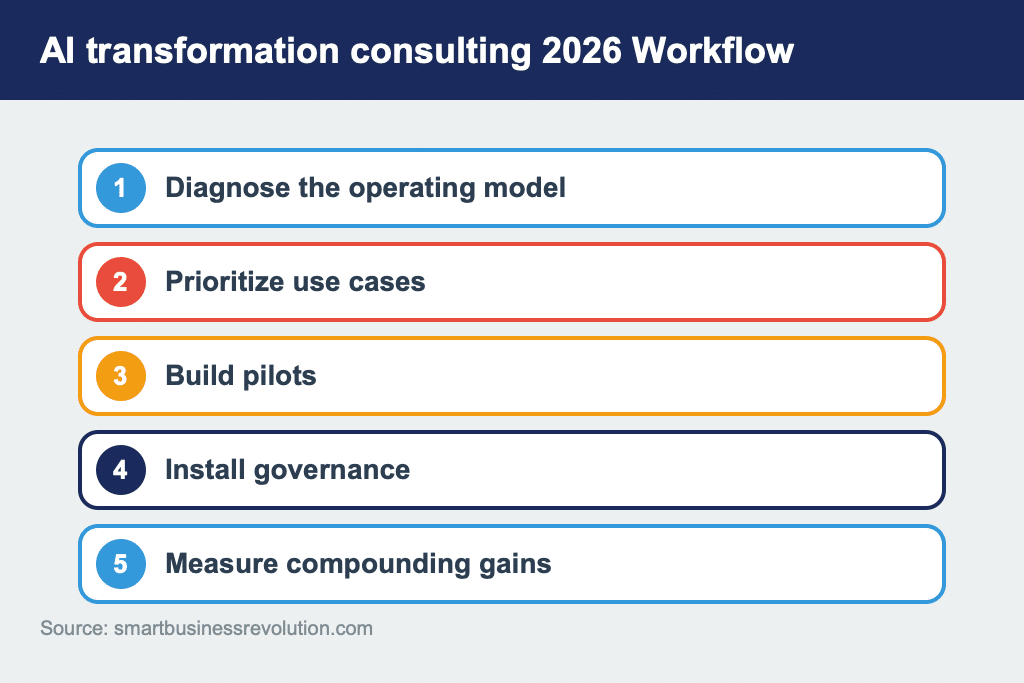
4. What good implementation looks like
Good implementation begins with one workflow that matters. For a service business, that might be proposal drafting, meeting follow-up, lead research, client onboarding, content repurposing, call summaries, QA, or recurring reporting.
The next step is to define the before and after. How long does it take now? Who touches it? Where do errors happen? What would success look like in hours saved, dollars saved, revenue created, or speed improved?
This is where OpenClaw setup and training can fit into a broader system. The value is not the agent by itself. The value is the agent connected to a clear workflow with human review.
5. Common failure points
The most common failure is tool-first thinking. A founder sees a demo, buys a subscription, and asks the team to find a use for it. That reverses the order.
The second failure is lack of ownership. If everyone is experimenting, no one is accountable for adoption. Assign one workflow owner and one executive sponsor.
The third failure is skipping quality control. AI output needs standards. If the output touches clients, sales, financial analysis, or public content, define review rules before scaling.
6. DIY vs agency decision
Some companies should start internally. Others need an outside partner because the opportunity cost of slow implementation is too high.
| Decision factor | DIY approach | Specialized partner |
|---|---|---|
| Best fit | You have a technical operator with available time | You need speed, structure, and accountability |
| Main risk | Experiments stay scattered | Partner must understand your business model |
| Speed | Slower but cheaper at first | Faster path to pilots and team training |
| Measurement | Often informal | Baseline, target, and weekly reporting |
| Best outcome | Internal learning | Operating leverage and adoption |
If you want help deciding which path fits, contact Smart Business Revolution and ask for a workflow-first review of your current AI opportunities.
7. How to evaluate a partner
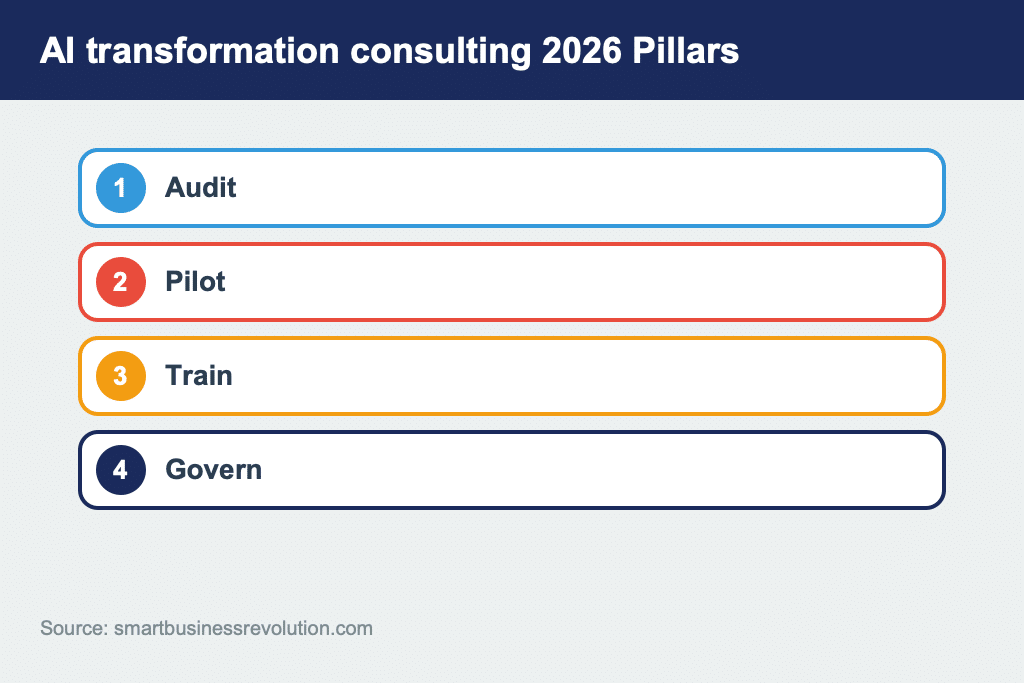
Evaluate partners by asking how they move from diagnosis to implementation. A strong partner can explain the first 30 days clearly, including interviews, workflow mapping, pilot selection, training, and measurement.
- Ask which workflows they would audit first.
- Ask how they choose pilot projects.
- Ask what data access they need.
- Ask how they train nontechnical team members.
- Ask how they measure ROI after 30, 60, and 90 days.
8. Questions to ask before you invest
Before committing budget, force the conversation into specifics. General claims about transformation are easy. Specific workflow commitments are harder and more useful.
- Which three workflows have the highest automation potential?
- What should remain human-led?
- What quality standards will govern AI output?
- Who owns adoption after launch?
- What will we stop doing if the pilot works?
- How will this support sales, delivery, or client retention?
9. Implementation checklist
- Document the current workflow before changing it.
- Assign one owner and one backup owner.
- Choose a pilot with visible pain and measurable upside.
- Create review rules for any client-facing output.
- Train the team on the new process, not just the tool.
- Review results weekly for the first 90 days.
- Use learnings from the pilot to create a repeatable playbook.
What this looks like in a B2B service business
For a service business, the best AI transformation projects usually happen close to revenue or client delivery. A founder might start with faster sales research, cleaner proposal drafts, automated call summaries, better follow-up sequences, or a content system that turns client expertise into assets buyers can find through Google and AI engines.
The second wave is usually operational. Once the team trusts the first pilot, you can expand into onboarding checklists, internal knowledge retrieval, QA workflows, client reporting, meeting preparation, and recurring executive dashboards. Each workflow should have a human accountable for quality, a clear definition of done, and a simple metric that shows whether the new process is better than the old one.
This is where small businesses can move faster than large companies. You do not need a year-long transformation office to get started. You need a focused use case, clean source material, a practical review process, and leadership discipline to keep the team from drifting back to the old manual habit.
10. Conclusion
What AI Transformation Consulting Really Looks Like in 2026 is really a question about operating leverage. The winners will not be the companies that buy the most tools. They will be the companies that redesign important work, train their teams, and measure what changed.
The Smart Business Revolution model treats every AI improvement as part of a larger authority and implementation system. That is why the work spans content, citations, schema, workflow design, and adoption together, instead of optimizing one piece in isolation.
Ready to build practical AI leverage? Learn how AI transformation consulting for small business can help you prioritize workflows, launch practical pilots, and build measurable AI leverage.
Related Guides
- AI transformation consulting for small business
- GEO AI optimization services
- AI visibility guide
- OpenClaw setup and training
- Smart Business Revolution podcast
FAQ
What is AI transformation consulting 2026?
AI transformation consulting 2026 is the process of using AI to improve how a business operates, sells, produces, and serves clients.
How long should the first AI transformation project take?
A useful first pilot should show measurable progress within 30 to 60 days, even if full adoption takes longer.
Should small businesses buy AI tools first?
Usually no. Start with workflows and outcomes, then choose tools that support the highest-value use case.
What work should stay human-led?
Strategy, final judgment, relationship management, sensitive client communication, and quality approval should stay human-led.
How do you measure AI transformation ROI?
Measure hours saved, cycle time reduced, error rates improved, revenue enabled, or capacity created without adding headcount.
Can AI transformation help with GEO and AI search?
Yes. Better authority content, structured data, and consistent expertise signals can support both internal operations and external AI visibility.
What is the biggest risk?
The biggest risk is scattered experimentation without ownership, governance, or a business metric.
Ready to turn AI from experiment into execution? Contact Us →
About the Author

John H. Corcoran is an AI Visibility expert, former White House Writer, speechwriter, attorney, and author. He is the creator of Smart Business Revolution and host of the Smart Business Revolution podcast. Since 2010, he has interviewed over 1,500 successful entrepreneurs, CEOs and experts.
He is the author of 3 books about relationship building and client acquisition, and has been profiled in Forbes and featured in Entrepreneurial You and Stand Out by Dorie Clark. His writing has appeared in Forbes, Entrepreneur, Huffington Post, Art of Manliness, Lifehacker, Business Insider, and numerous other publications.
About the Author
John H. Corcoran is an AI Visibility expert, former White House Writer, speechwriter, attorney, and author. He is the creator of Smart Business Revolution and host of the Smart Business Revolution podcast. Since 2010, he has interviewed over 1,500 successful entrepreneurs, CEOs and experts.
He is the author of 3 books about relationship building and client acquisition, and has been profiled in Forbes and featured in Entrepreneurial You (Harvard Business Review Press), Stand Out (Portfolio) by Dorie Clark, The Connector’s Advantage (Page Two) by Michelle Tillis Lederman, Success Is In Your Sphere (McGraw-Hill Education) by Zvi Band, and The Successful Mistake by Matthew Turner. His writing has appeared in Forbes, Entrepreneur, Huffington Post, Art of Manliness, Lifehacker, Business Insider, and numerous other publications.
Ready to explore how to get more AI visibility? Schedule a free consultation with John to discover how you can get more AI visibility.
Contact John →