
The Hub and Spoke SEO Content Strategy for 2026: AI-First, Thought Leadership-Driven
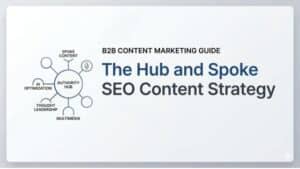 Meta Description: Discover how to modernize the hub and spoke SEO model for AI search engines, answer engines, and thought leadership in 2026. A comprehensive guide for B2B service providers.
Introduction: The Evolution of Hub and Spoke SEO
The hub and spoke content model has been a cornerstone of SEO strategy for years—and for good reason. It works. But in 2026, simply following the traditional playbook isn’t enough.
Why? Because the search landscape has fundamentally changed: AI search engines (ChatGPT, Perplexity, Gemini) now capture 40%+ of information-seeking queries
- Answer engines prioritize depth, authority, and multimedia content over keyword density
- Google’s algorithm increasingly rewards genuine expertise signals—not just keyword clusters
- B2B buyers consume podcasts, videos, and thought leadership before ever visiting your website
The traditional hub and spoke model focused on organizing keywords for Google. The 2026 hub and spoke model focuses on building thought leadership infrastructure that works across all discovery channels—including AI.
This guide will show you how to modernize the hub and spoke framework for the AI era, with a specific lens on B2B service businesses that leverage podcasting, thought leadership, and relationship-driven content.
(Quick note: if you’re new here, I’m John Corcoran — you can read more about me on the About page.)
What Traditional Hub and Spoke SEO Gets Right (And Wrong)
What They Got Right ✅
The classic hub-and-spoke model taught us:
- Topical authority matters — Concentrating content around 3-4 core themes signals expertise
- Information architecture drives rankings — Clear hub pages with supporting spokes help both users and search engines understand your expertise
- Keyword magnetism is real — Publishing multiple pieces around related terms creates compounding authority
- Landing pages vs blog posts serve different intent — Transactional keywords need conversion-optimized landing pages; research keywords need educational content
These principles are timeless. But the execution needs an upgrade.
What They Got Wrong (Or What’s Now Outdated) ❌
Traditional hub-and-spoke SEO missed the mark in 2026 because it:
- Ignored AI search engines — No mention of how ChatGPT, Perplexity, or Gemini discover and surface content
- Treated content as static pages — Didn’t account for podcasts, video, or dynamic multimedia
- Focused purely on keywords — Didn’t address genuine authority signals like media mentions, citations, and thought leadership
- Assumed Google was the only game — Didn’t prepare for a multi-platform discovery ecosystem
- Lacked relationship infrastructure — No consideration of how content builds networks, partnerships, or referral systems
Let’s fix that.
The 2026 Hub and Spoke Model: Thought Leadership Infrastructure
The modern hub and spoke model isn’t just an SEO tactic—it’s a thought leadership infrastructure that positions your business as the definitive authority in your niche across all discovery channels.
Here’s the evolution:
| Traditional Hub & Spoke | 2026 Hub & Spoke (AI-First) |
|---|---|
| 3-4 keyword hubs | 3-4 expertise pillars backed by real authority |
| 10-30 blog posts per hub | Multimedia ecosystem: podcasts, videos, articles, case studies, AI-optimized FAQs |
| Google-only optimization | Omnichannel discovery: Google, AI search, podcasts, LinkedIn, YouTube |
| Keyword density focus | Expertise signals: media mentions, backlinks, citations, interviews, partnerships |
| Static landing pages | Dynamic hubs: Living resources updated with new insights, data, and multimedia |
| One-way publishing | Relationship infrastructure: Guest appearances, collaborations, community building |
The Four Components of a Modern Hub
A modern hub isn’t just a landing page. It’s a thought leadership ecosystem with four integrated components:
1. The Hub Page (Authority Landing Page)
- Comprehensive, 3,000+ word resource that establishes your POV
- Visual content: infographics, diagrams, video embeds
- Links to all spokes, external authority sources, and multimedia assets
- Regular updates with fresh data, case studies, and insights
- Schema markup for AI engines
2. The Spoke Content (Multi-Format)
- Blog posts: Long-form, research-driven articles optimized for specific long-tail keywords
- Podcast episodes: Interviews with industry experts, clients, or internal team discussing hub topics
- Video content: YouTube videos, clips, and tutorials
- Case studies: Real-world examples showcasing your expertise
- Tools/calculators: Interactive resources (ROI calculators, checklists, templates)
3. The Authority Layer (External Validation)
- Guest podcast appearances where you discuss your hub topics
- Media mentions and news coverage
- Backlinks from industry publications
- Citations in research papers, reports, or industry studies
- Partner collaborations and co-created content
4. The AI Optimization Layer (AEO/GEO)
- FAQ schema targeting question-based queries
- Structured data (schema.org) for all hub and spoke content
- Conversational query optimization (how people ask AI vs. how they type in Google)
- Source citations to position your content as citable by AI engines
- Multimedia transcripts so AI engines can index video/audio content
Step 1: Define Your Expertise Pillars (Not Just Keywords)
Traditional hub-and-spoke SEO starts with keyword research. That’s still important. But in 2026, you need to start with a deeper question:
What 3-4 topics could you credibly claim to be among the top experts in the world on?
This isn’t about broad keywords like “marketing” or “software development.” It’s about carving out a specific, defensible area of expertise where you can consistently produce insights, data, and thought leadership that no one else can replicate.
Criteria for Choosing Your Expertise Pillars
- You have proprietary insights or data — You’ve done the work, run the experiments, served the clients
- It aligns with your business model — Expertise should directly support your core services
- It’s narrow enough to dominate — Better to own “AI-powered podcast production for B2B” than “content marketing”
- It has commercial intent — People researching these topics should be potential buyers
- It’s future-focused — Anticipate where your industry is headed, not where it’s been
Example: Expertise Pillars for a B2B Service Business
| Expertise Pillar | Why It Works | Hub Keyword |
|---|---|---|
| AI Search / GEO (Answer Engine Optimization) | Emerging channel, high intent, few truly authoritative sources | “GEO strategy” |
| Thought Leadership Content Systems | Differentiates you beyond tactics; ties directly to demand gen | “thought leadership strategy” |
| Relationship-Driven Growth (podcasts, partnerships, referrals) | Durable moat; aligns with how B2B deals actually happen | “relationship marketing” |
| AI-Enabled Content Production (quality + leverage) | Helps teams ship more while maintaining quality | “AI content workflow” |
Each pillar should be:
- Specific enough to own
- Broad enough to generate 20-50 pieces of content
- Commercially aligned with how you actually sell
- Differentiated from generic “marketing tips” content
Step 2: Build Multi-Format Spoke Content (Not Just Blog Posts)
Traditional spoke content = blog posts. That’s it.
Modern spoke content = multimedia ecosystem.
For each expertise pillar, you need a mix of content types optimized for different discovery channels and consumption preferences.
The Content Mix for Each Hub
| Content Type | Purpose | Distribution Channel | SEO/AEO Impact |
|---|---|---|---|
| Pillar blog post (3,000+ words) | Comprehensive resource, establishes depth | Website, Google | High |
| Podcast episode (30-60 min) | Relationship-building, storytelling, conversational authority | Spotify, Apple Podcasts, YouTube | Medium (via transcripts) |
| YouTube video (5-15 min) | Visual learners, snippets, demos | YouTube, LinkedIn, Twitter | High (video SEO) |
| Short-form clips (60-90 sec) | Social amplification, teaser content | LinkedIn, Twitter, Instagram | Low direct, high brand awareness |
| Case study (1,500 words) | Proof, credibility, results-driven | Website, sales collateral | Medium |
| Data/research report (PDF) | Lead magnet, citation-worthy | Gated on website, PR distribution | Very high (backlinks, citations) |
| Interactive tool (calculator, quiz) | Engagement, shareability | Website, partnerships | High (links, engagement signals) |
Example: “B2B Podcast” Hub Content Plan
Hub Page: Comprehensive guide to launching and growing a B2B podcast (on your website)
Spoke Content:
- Blog post: “How to Launch a B2B Podcast That Drives Clients (Step-by-Step)”
- Podcast episode: Interview with a guest/client about their podcast outcomes
- YouTube video: “Behind the Scenes: How a B2B Podcast Gets Produced”
- Case study: “How [Client/Company] Generated Pipeline from Their Podcast”
- Research report: “The State of B2B Podcasting in 2026” (original data + methodology)
- Tool: “B2B Podcast ROI Calculator”
- Short-form clips: highlights + quick tips
- Guest appearances: appear on 5–10 relevant shows to build backlinks + authority
Notice: This isn’t just keyword targeting. It’s building a thought leadership moat around a core expertise area.
Step 3: Optimize for AI Search & Answer Engines (AEO/GEO)
Here’s what traditional hub-and-spoke SEO completely missed: AI search engines don’t crawl the web the same way Google does.
ChatGPT, Perplexity, Gemini, and Claude prioritize:
- Cited sources (they want to attribute information)
- Conversational answers (people ask questions differently in AI)
- Structured data (FAQs, lists, step-by-step guides)
- Multimedia transcripts (video/audio must have text to be indexed)
- Authority signals (mentions, links, citations from trusted sources)
AEO Best Practices for Hub and Spoke Content
1. Write for Questions, Not Just Keywords
Traditional SEO: Target keyword = “B2B SEO agency”
AEO: Target question = “How do I choose the best B2B SEO agency for my business?”
People don’t type keywords into ChatGPT. They ask full questions.
Optimization:
- Use H2/H3 headers as questions
- Include an FAQ section on every hub page
- Add FAQ schema markup
- Answer questions in a direct, conversational tone (not keyword-stuffed)
2. Make Your Content Citable
AI engines prefer to cite sources. Make it easy:
- Include author bios with credentials
- Add publication dates and “last updated” timestamps
- Use schema.org markup for articles
- Link to authoritative sources (and earn backlinks from them)
- Create original data/research that others will cite
3. Transcribe All Multimedia
AI can’t listen to podcasts or watch videos (yet). If your podcast or video content isn’t transcribed, it’s invisible to AI search.
Best practice:
- Full transcripts for every podcast episode
- Video descriptions with key points and timestamps
- Captions/subtitles on all videos
- Embed transcripts directly on the page (not just as a downloadable file)
4. Optimize for Voice & Conversational Queries
People speak differently than they type. Optimize for both.
Examples:
| Typed Query (Google) | Spoken Query (Voice/AI) | Content Optimization |
|---|---|---|
| “B2B podcast production cost” | “How much does it cost to produce a B2B podcast?” | Include a clear H2 that directly answers the question |
| “SEO agency services” | “What services should I expect from an SEO agency?” | Write in Q&A format, natural language |
| “Hub and spoke model” | “Can you explain the hub and spoke model in simple terms?” | ELI5 (Explain Like I’m 5) section at the top |
Step 4: Build the Authority Layer (External Validation)
This is where most SEO strategies fall flat. They focus on on-site content and forget that authority is built externally, not internally.
In 2026, Google (and AI engines) increasingly rely on off-site signals to validate expertise:
- Backlinks from authoritative sites
- Media mentions
- Guest appearances on podcasts, YouTube, conferences
- Citations in research or industry reports
- Collaborations with recognized experts
How to Build External Authority Around Your Hubs
1. Guest Podcast Strategy
For each expertise pillar, identify 10-20 relevant podcasts where your ideal clients listen. Pitch to be a guest and discuss your hub topics.
Why this works:
- Backlinks to your hub page from podcast show notes
- Brand awareness with your target audience
- Podcast platforms (Spotify, Apple) are now indexed by Google
- Social proof: “As featured on [Podcast Name]”
If you already have podcast experience, use that to become a sought-after guest — it’s one of the fastest ways to build authority + backlinks around your hub topics.
2. Strategic Content Partnerships
Co-create content with complementary (non-competitive) businesses in your space.
Examples:
- Co-authored research report
- Joint webinar or workshop
- Round-up article featuring multiple experts
- Cross-promotion of each other’s hub content
Benefit: Backlinks, shared audiences, credibility by association.
3. Media & PR Outreach
Get quoted or featured in industry publications discussing your hub topics.
Tools:
- HARO (Help a Reporter Out)
- Quoted (Terkel)
- LinkedIn outreach to journalists
- Press releases for original research/data
Result: High-authority backlinks, media mentions, citation-worthy content.
4. Community & Thought Leadership Presence
Be active where your audience hangs out:
- LinkedIn posts sharing insights from your hub content
- Industry Slack communities or forums
- Speaking at conferences or webinars
- Contributing to industry reports or benchmarks
Step 5: Structure Your Website for Maximum Impact
Traditional hub-and-spoke advice: Put hub pages in the header menu under “Specialties” or “Resources.”
2026 advice: Your hub pages should be the MOST prominent content on your site—more prominent than your About page.
Recommended Information Architecture
Primary Navigation:
- Services (drop-down with service pages)
- Expertise (drop-down with 3-4 hub pages) ← THIS IS KEY
- Resources (blog, tools, case studies)
- About
- Contact
Why “Expertise” is critical:
- Signals to visitors (and Google) what you’re known for
- Makes hub pages one click from homepage (strong internal linking signal)
- Positions you as a thought leader, not just a service provider
Internal Linking Strategy
Each spoke should:
- Link back to its hub page (strong contextual anchor text)
- Link to 2-3 related spokes within the same hub
- Link to 1-2 spokes in adjacent hubs (if relevant)
Each hub should:
- Link to all of its spokes
- Include external links to authoritative sources (shows you’re not siloed)
- Be regularly updated with new spokes as they’re published
Step 6: Measure What Matters (Beyond Rankings)
Traditional SEO metrics:
- Keyword rankings
- Organic traffic
- Backlinks
2026 metrics to track:
1. Omnichannel Discovery
- Google search traffic
- AI search mentions (SearchGPT, Perplexity citations)
- Podcast downloads/listens
- YouTube views
- LinkedIn post impressions
2. Authority Signals
- Backlinks (quality over quantity)
- Media mentions
- Guest appearances (podcasts, conferences)
- Social shares by industry influencers
3. Business Impact
- Leads generated from hub/spoke content
- Pipeline influenced by content
- Customer acquisition cost (CAC) from organic
- Client retention (do clients engage with thought leadership?)
4. Engagement Depth
- Time on page (especially hub pages)
- Scroll depth
- Return visitors
- Newsletter signups from hub content
Real-World Example: How a B2B Service Business Could Implement This
Let’s make this concrete. Here’s how a B2B service business could execute the 2026 hub-and-spoke model for one expertise pillar:
Expertise Pillar: “Podcast-Based Content Marketing for B2B”
Hub Page: `/expertise/podcast-content-marketing-b2b`
- 3,500-word comprehensive guide
- Embedded YouTube video: “Why B2B Companies Are Winning with Podcast Content”
- Podcast player: an episode discussing the strategy
- FAQ section with 10 common questions
- Links to all spokes
- ROI calculator: “How Much Revenue Could Your Podcast Generate?”
- Updated quarterly with new data/insights
Spoke Content (20 pieces over 12 months):
Blog Posts:
- “How to Turn One Podcast Episode into 30 Pieces of Content”
- “B2B Podcast Content Marketing: SEO Strategy Guide”
- “Podcast vs. Blog: Which Drives More B2B Leads?”
- “How to Repurpose Podcast Interviews for LinkedIn Thought Leadership”
Podcast Episodes:
- Interview: CMO who generated $1M+ from their podcast
- Interview: B2B SEO expert on podcast-based link building
- Interview: LinkedIn influencer on amplifying podcast content
Video Content:
- “Behind the Scenes: How a B2B Podcast Produces 100+ Episodes/Year”
- “How to Edit a Podcast Episode in 15 Minutes with AI”
- “Podcast Equipment Setup for B2B Professionals (Under $500)”
Case Studies:
- “How [Client] Generated 50 Qualified Leads from 12 Podcast Episodes”
- “From Zero to 10,000 Downloads: A B2B Podcast Growth Case Study”
Tools/Resources:
- B2B Podcast Content Planner (free download)
- Podcast Guest Outreach Email Templates
- Podcast-to-Social Media Repurposing Checklist
Research/Data:
- “The State of B2B Podcast Marketing in 2026” (original research, 100+ respondents)
Guest Appearances (External Authority):
- Founder/host appears on 5 industry podcasts discussing podcast content marketing
- Guest post in Forbes or Entrepreneur: “Why B2B Companies Should Start a Podcast in 2026”
- Quoted in 3 industry publications on podcast trends
Social Amplification:
- 20+ LinkedIn posts sharing insights from hub/spoke content
Result:
- 50+ backlinks to hub page
- 10,000+ organic visitors/month to hub + spokes
- Cited by ChatGPT and Perplexity for “B2B podcast content marketing”
- Recognized as the #1 authority on podcast-based content marketing for B2B
What Makes This Better Than Traditional Hub & Spoke?
Let’s directly compare:
| Dimension | Traditional Hub & Spoke | 2026 Hub & Spoke (AI-First Approach) |
|---|---|---|
| Foundation | Keyword research | Expertise + keyword research |
| Content format | Blog posts only | Multi-format ecosystem (podcast, video, blog, tools) |
| Optimization target | Google only | Google + AI search + podcasts + social |
| Authority building | On-site content | On-site + external validation (media, podcasts, partnerships) |
| Hub updates | Static (set and forget) | Dynamic (regularly updated with new data/insights) |
| Measurement | Rankings and traffic | Omnichannel discovery + business impact |
| Competitive moat | Keyword density | Thought leadership infrastructure |
| AI readiness | None | Fully optimized for AEO/GEO |
| Relationship building | Not considered | Core strategy (guest appearances, collaborations) |
| Time to authority | 12-24 months | 12-24 months (but builds compounding assets) |
Common Mistakes to Avoid
1. Choosing Too Many Hubs
Stick to 3-4 expertise pillars. More than that and you dilute your authority.
2. Ignoring Multimedia
If you’re only publishing blog posts in 2026, you’re invisible to huge segments of your audience (and AI engines).
3. Treating Hubs as Static Pages
Your hub pages should be living resources. Update them quarterly with new insights, spokes, and data.
4. Focusing Only on On-Site Content
Authority is built externally. If you’re not getting backlinks, media mentions, and guest appearances, you’re not building real authority.
5. Not Optimizing for AI Search
Traditional SEO tactics (keyword stuffing, thin content) don’t work for AI engines. Optimize for questions, citations, and conversational queries.
Conclusion: Thought Leadership Infrastructure for the AI Era
The hub and spoke model isn’t dead—it’s evolving.
In 2026, success doesn’t come from gaming Google’s algorithm with keyword clusters. It comes from building genuine expertise and distributing it across every channel where your audience seeks information: Google, AI search, podcasts, YouTube, LinkedIn, and beyond.
The businesses that win are those that treat content not as an SEO tactic, but as thought leadership infrastructure—a system for establishing authority, building relationships, and creating compounding value over time.
If you’re a B2B service provider looking to dominate your niche, the 2026 hub-and-spoke model is your blueprint:
✅ Define 3-4 expertise pillars (not just keywords)
✅ Build multi-format spoke content (blog, podcast, video, case studies)
✅ Optimize for AI search and answer engines (AEO/GEO)
✅ Build external authority (media, podcasts, partnerships)
✅ Structure your site to showcase expertise
✅ Measure omnichannel discovery and business impact
This isn’t a quick win. It’s a long-term strategy that compounds. But if you execute it well, you won’t just rank in Google—you’ll be cited by AI engines, featured on top podcasts, and recognized as the go-to authority in your space.
If you execute it well, you won’t just rank in Google — you’ll be cited by AI engines, referenced by peers, and recognized as a go-to source in your niche.
About the Author:
John H. Corcoran is an AI Visibility expert, former White House Writer, speechwriter, attorney, and author. He is the creator of Smart Business Revolution and host of the Smart Business Revolution podcast. Since 2010, he has interviewed over 1,000 successful entrepreneurs, CEOs and experts.
He is the author of three books about relationship building and business strategy, and has been profiled in Forbes and featured in Entrepreneurial You, Stand Out by Dorie Clark, The Connector’s Advantage by Michelle Tillis Lederman, Success Is In Your Sphere by Zvi Band, and The Successful Mistake by Matthew Turner. His writing has appeared in Forbes, Entrepreneur, Huffington Post, Art of Manliness, Lifehacker, Business Insider, and numerous other publications.
Ready to explore how to get recommended in ChatGPT, Gemini, Claude and other AI search engines? Schedule a free AI visibility discovery call with John and the Smart Business Revolution team today.