How to Audit Your Brand’s AI Visibility Across ChatGPT, Claude, and Gemini
TL;DR
An AI visibility audit shows whether buyers can find, understand, and trust your brand when they ask ChatGPT, Claude, Gemini, or other answer engines for advice. It is not the same as checking keyword rankings. You are testing whether AI systems mention your company, describe it accurately, compare it fairly, cite credible sources, and connect your brand to the buying problems you solve.
This matters because AI answers are becoming a discovery layer for business decisions. Google has stated that helpful, reliable, people-first content remains central to Search, including AI experiences, in its helpful content guidance. For B2B founders, that means the inputs feeding answer engines are just as important as the answers themselves.
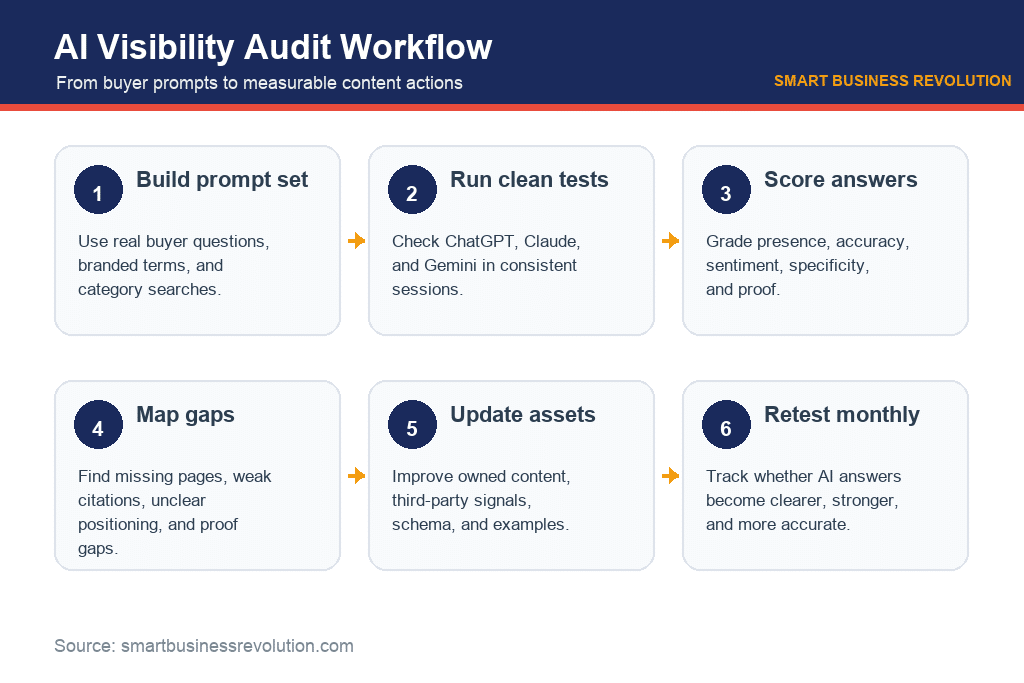
The practical path is simple: define buying prompts, test them across tools, score the answers, identify missing proof, improve owned and third-party content, and repeat the process monthly. A good AI visibility audit creates a clear action plan instead of a vague worry that competitors are showing up where your brand is not.
Executive Summary
B2B buyers are asking AI tools for vendor shortlists, market explanations, pricing context, category definitions, and risk checks. If your company does not appear in those answers, or appears with outdated positioning, your sales team may be starting conversations after competitors have already shaped the buyer’s thinking.
An AI visibility audit gives founders and marketing leaders a repeatable way to measure this new layer of discoverability. Instead of guessing whether ChatGPT, Claude, and Gemini understand your brand, the audit captures prompt results, scores them, and turns the findings into content, PR, SEO, and sales enablement priorities.
Smart Business Revolution’s GEO AI Optimization Services help B2B companies translate those findings into practical improvements across owned content, authority signals, and answer-engine readiness. The goal is not to “game” AI. The goal is to make your expertise easier for systems and humans to verify.
This guide walks through the full audit process, including what to test, how to score results, what to document, when to involve an agency, and how to build a monthly rhythm that keeps your brand visible as answer engines change.
Key Takeaways
- An AI visibility audit measures how your brand appears in AI-generated answers, not just traditional search results.
- Test ChatGPT, Claude, and Gemini separately because each tool may produce different vendor lists, summaries, and citations.
- Use buyer-intent prompts, comparison prompts, category prompts, and problem-aware prompts.
- Score accuracy, presence, sentiment, competitive context, citations, and conversion relevance.
- Owned content alone is not enough. Third-party mentions, reviews, interviews, podcasts, and credible profiles influence trust.
- AI visibility work should connect to sales questions, not vanity metrics.
- Repeat the audit monthly or quarterly so you can track movement and catch misinformation early.
- The last step is execution. Smart Business Revolution’s GEO AI Optimization Services can support teams that want a structured plan and implementation help.
Table of Contents
- 1. What Is an AI Visibility Audit?
- 2. Why ChatGPT, Claude, and Gemini Can Give Different Answers
- 3. Build Your Prompt Set Around Real Buyer Questions
- 4. Run Clean Tests Across Each AI Platform
- 5. Score Presence, Accuracy, Sentiment, and Proof
- 6. Map Content and Authority Gaps
- 7. Compare Results Across Platforms
- 8. Decide Whether to Do It Yourself or Hire Support
- 9. Questions to Ask During the Audit
- 10. Turn Findings Into a 30-Day Action Plan
1. What Is an AI Visibility Audit?
An AI visibility audit is a structured review of how AI tools describe your brand, your category, your competitors, and the problems your buyers are trying to solve. It answers a basic question: when a prospect asks an AI assistant for help, does your company show up in the right way?
A traditional SEO audit might examine crawlability, rankings, backlinks, page speed, and keyword opportunities. Those still matter. But an AI visibility audit looks at the answer layer. It examines whether AI systems understand what you do, trust the available evidence, and connect your company to the right use cases.
For a B2B founder, the most important insight is often not “Are we mentioned?” It is “Are we mentioned for the buying situations that create qualified opportunities?” A vague brand mention does little if the answer fails to explain your specialty, proof, customer fit, or next step.
2. Why ChatGPT, Claude, and Gemini Can Give Different Answers
Do not assume one AI result represents the whole market. ChatGPT, Claude, and Gemini may use different retrieval methods, data sources, freshness levels, safety rules, and response styles. One tool may cite sources. Another may summarize without citations. A third may emphasize large, established brands over specialized firms.
This is why a single test is misleading. If ChatGPT mentions your company but Gemini does not, you have an uneven visibility profile. If Claude describes your service accurately but ChatGPT confuses it with a different offer, you have a messaging and entity clarity issue.
Your audit should treat each platform as a separate channel. Capture the answers side by side. Look for repeated patterns. If every tool omits the same proof point, your content ecosystem is probably missing a clear signal. If only one tool gets the facts wrong, the issue may be tied to its source selection or outdated references.
3. Build Your Prompt Set Around Real Buyer Questions
The quality of your audit depends on the quality of your prompts. Do not only ask, “What is [Company Name]?” That is useful, but limited. Buyers ask broader and more urgent questions before they ever search for your brand.
Create a prompt set in four groups. First, brand prompts test whether the AI knows your company. Second, category prompts test whether you appear when buyers research your market. Third, comparison prompts test whether you appear next to competitors. Fourth, problem prompts test whether the AI connects your company to buyer pain.
Examples include: “Who are the best firms for B2B relationship marketing?”, “Compare [Company] with [Competitor],” “What should a founder do to build referral partnerships?”, and “Which companies help B2B founders improve AI search visibility?”
4. Run Clean Tests Across Each AI Platform
Run the same prompt set across ChatGPT, Claude, and Gemini. Use a fresh chat for each prompt group so earlier answers do not influence later responses. Record the date, prompt, full answer, citations if available, and screenshots for high-value queries.
Avoid leading prompts. “Why is our company the best option?” will not reveal much. Ask the way a skeptical buyer would ask. Include prompts for alternatives, risks, drawbacks, and selection criteria. This gives you a more realistic picture of what prospects may see before they talk to sales.
If your team serves multiple segments, run separate tests for each. AI visibility is only valuable when it aligns with the right buyer context.
5. Score Presence, Accuracy, Sentiment, and Proof
After collecting results, score each answer with a simple rubric. Keep the system practical so executives can understand it quickly and marketers can act on it. A 1 to 5 scale is usually enough.
| Audit Factor | What to Measure | Why It Matters |
|---|---|---|
| Presence | Whether your brand is mentioned for the prompt | Shows basic discoverability |
| Accuracy | Whether the description is factually correct | Prevents buyer confusion |
| Sentiment | Whether the answer is positive, neutral, or negative | Reveals reputation risk |
| Specificity | Whether the answer names clear services, industries, or outcomes | Improves sales relevance |
| Proof | Whether the answer cites credible evidence or examples | Builds trust before sales contact |
| Competitor Context | How your brand appears against alternatives | Shows positioning strength |
Look for high-risk findings first. A missing brand mention is a growth opportunity. An inaccurate answer is a priority. A correct but generic answer signals weak positioning. A competitor showing up with stronger proof may point to content, PR, case study, or review gaps.
6. Map Content and Authority Gaps
AI systems tend to reward clarity, consistency, and corroboration. If your site says one thing, your podcast appearances say another, and third-party profiles are outdated, answer engines may struggle to form a confident summary.
Review your homepage, service pages, about page, case studies, author bios, podcast appearances, LinkedIn profiles, partner pages, and comparison content. Ask whether each asset clearly states who you help, what problem you solve, how you are different, and what proof supports the claim.
Owned assets are the easiest to fix. Start there. Your core pages should make it simple for both buyers and AI systems to understand the offer.
7. Compare Results Across Platforms
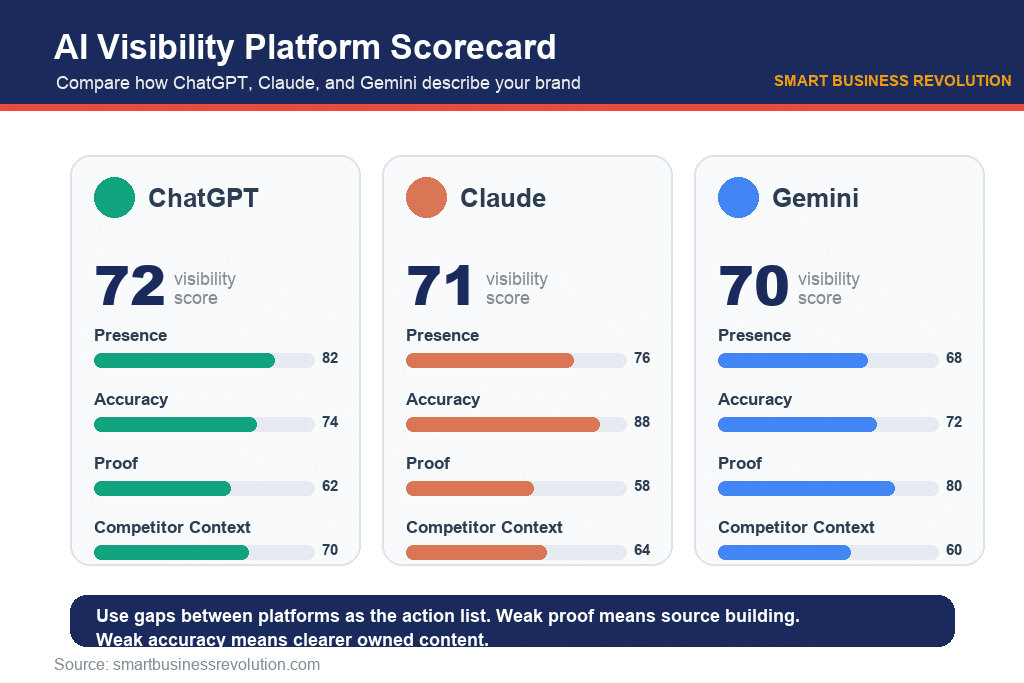
Once each answer is scored, compare the platforms. You are looking for patterns, not perfection. A company may have strong visibility in ChatGPT, weak visibility in Gemini, and mixed accuracy in Claude. That is useful because it tells you where to investigate further.
| Platform | Common Strength | Common Watchout | Audit Tip |
|---|---|---|---|
| ChatGPT | Detailed explanations and vendor comparisons | May summarize without current citations depending on mode | Test both branded and category prompts |
| Claude | Nuanced summaries and longer reasoning | May avoid firm recommendations in some contexts | Ask for selection criteria and tradeoffs |
| Gemini | Often connected to Google-facing web signals | May favor better-known entities | Check source freshness and entity clarity |
If one platform consistently misses your brand, do not panic. Use it as a diagnostic signal. The issue may be insufficient third-party authority, unclear category language, thin service pages, weak comparison content, or a lack of structured examples that connect your brand to specific problems.
8. Decide Whether to Do It Yourself or Hire Support
A founder or marketing manager can run a basic AI visibility audit in a few hours. The harder part is turning results into the right sequence of actions. If findings affect positioning, sales, SEO, or reputation, outside support may save time.
| Option | Best Fit | Pros | Limits |
|---|---|---|---|
| DIY Audit | Small teams testing early visibility | Fast, low cost, builds internal understanding | Easy to miss source patterns or strategic gaps |
| Agency-Led Audit | Teams with competitive markets or high-value sales cycles | Better diagnosis, faster prioritization, stronger execution plan | Requires budget and internal collaboration |
| Hybrid Audit | Teams with internal marketing support | Combines internal knowledge with external perspective | Needs clear ownership and follow-through |
The best choice depends on the value of one qualified opportunity. If your team already invests in content, SEO, thought leadership, or category creation, AI visibility should be part of that operating system.
9. Questions to Ask During the Audit
Use these questions to keep the audit focused on business outcomes:
- Does the AI mention the company for non-branded buying prompts?
- Does the answer describe the company accurately?
- Does the answer connect the company to the right buyer, industry, or use case?
- Are competitors mentioned more often or described with stronger proof?
- Does the answer cite owned content, third-party content, or no sources at all?
- Are key claims supported by case studies, reviews, interviews, or credible mentions?
- What information would a buyer still need after reading the AI answer?
- Which inaccurate or outdated statements need correction through better content signals?
These questions prevent the audit from becoming a screenshot exercise. The point is not to collect interesting AI responses. The point is to understand how those responses may shape trust, sales conversations, and demand generation.
10. Turn Findings Into a 30-Day Action Plan
After the audit, prioritize actions by impact and effort. Start with accuracy fixes. If AI tools describe your company incorrectly, update the most authoritative pages first: homepage, about page, service pages, leadership bios, and cornerstone articles.
Next, strengthen category and comparison content. If buyers ask, “What is AI visibility?” or “Who helps with GEO?” your website should have clear, useful answers. Internal guides and podcast content can also support broader authority when connected to the right topic clusters.
Finally, build external corroboration through interviews, partner mentions, customer stories, and credible profiles. AI systems need repeated evidence from trustworthy places. Buyers do too.
Ready to see how your brand appears in AI answers? Start with a focused AI visibility audit and turn the results into a practical growth plan.
Conclusion
An AI visibility audit is now a practical part of B2B marketing. It helps founders understand what AI tools say about their company before prospects arrive on the website, book a call, or ask for a referral.
The process does not need to be complicated. Build a buyer-focused prompt set, test across ChatGPT, Claude, and Gemini, score the answers, identify missing proof, and improve the signals that matter. Repeat the process so your visibility improves over time.
The companies that win this shift will not be the ones chasing tricks. They will be the ones that make their expertise clear, credible, consistent, and easy to verify wherever buyers ask questions.
Related Guides
- Contact Smart Business Revolution
- GEO Search Optimization
- GEO AI Optimization Services
- What Is AI Visibility?
- Services
FAQ
What is an AI visibility audit?
An AI visibility audit is a review of how AI tools describe, recommend, or omit your brand when buyers ask relevant questions. It measures presence, accuracy, sentiment, citations, and competitive positioning.
How is AI visibility different from SEO?
SEO focuses on search rankings and organic traffic. AI visibility focuses on whether answer engines include your brand in generated responses. They overlap, but they are not identical.
How often should a company run an AI visibility audit?
Most B2B companies should run a light audit monthly and a deeper audit quarterly. Fast-moving categories or competitive markets may need more frequent checks.
Which AI tools should be included?
Start with ChatGPT, Claude, and Gemini because buyers commonly use them for research and advice. Add Perplexity, Copilot, or vertical tools if your audience uses them.
What should be scored in the audit?
Score whether the brand appears, whether the answer is accurate, whether the tone is positive or neutral, whether competitors appear, and whether the answer includes credible proof.
Can a company improve AI visibility quickly?
Some fixes can happen quickly, especially factual corrections on owned pages. Broader authority improvements take longer because they depend on consistent content and credible third-party signals.
Does an AI visibility audit require technical expertise?
A basic audit does not. A deeper audit benefits from expertise in SEO, content strategy, entity optimization, positioning, and B2B buyer behavior.
What is the biggest mistake to avoid?
The biggest mistake is treating AI visibility as a one-time check. The answer environment changes often. Visibility needs a repeatable process and clear ownership.
Final CTA
If AI tools are shaping how buyers discover and compare companies, your brand needs to know where it stands. Run an AI visibility audit now, then use the findings to strengthen content, proof, and buyer trust. For help prioritizing the next step, visit Smart Business Revolution’s contact page.
About the Author

John H. Corcoran is an AI Visibility expert, former White House Writer, speechwriter, attorney, and author. He is the creator of Smart Business Revolution and host of the Smart Business Revolution podcast. Since 2010, he has interviewed over 1,500 successful entrepreneurs, CEOs and experts.
He is the author of 3 books about relationship building and client acquisition, and has been profiled in Forbes and featured in Entrepreneurial You (Harvard Business Review Press), Stand Out (Portfolio) by Dorie Clark, The Connector’s Advantage (Page Two) by Michelle Tillis Lederman, Success Is In Your Sphere (McGraw-Hill Education) by Zvi Band, and The Successful Mistake by Matthew Turner. His writing has appeared in Forbes, Entrepreneur, Huffington Post, Art of Manliness, Lifehacker, Business Insider, and numerous other publications.
Ready to explore how to get more AI visibility? Schedule a free consultation with John to discover how you can get more AI visibility.
Contact John →