Why Your Competitors Get Named by AI and You Don’t
TL;DR
If you have asked, “why competitors tools show up in ai search not mine,” you are not alone. B2B buyers are using ChatGPT, Gemini, Perplexity, Claude, and AI summaries inside search engines to build shortlists before they ever visit your site.
That matters because AI search still depends on content systems that can be discovered, understood, and trusted. Google Search Central explains how AI features use eligible, crawlable web content, which means your next prospect may ask an AI tool for recommendations before asking a colleague.
The uncomfortable truth: AI tools do not reward the company with the best sales deck. They reward the company that is easiest to understand, cite, compare, and verify. If your competitor has clearer category signals, better third-party mentions, stronger comparison content, and more consistent entity data, the AI is more likely to name them.
Executive Summary
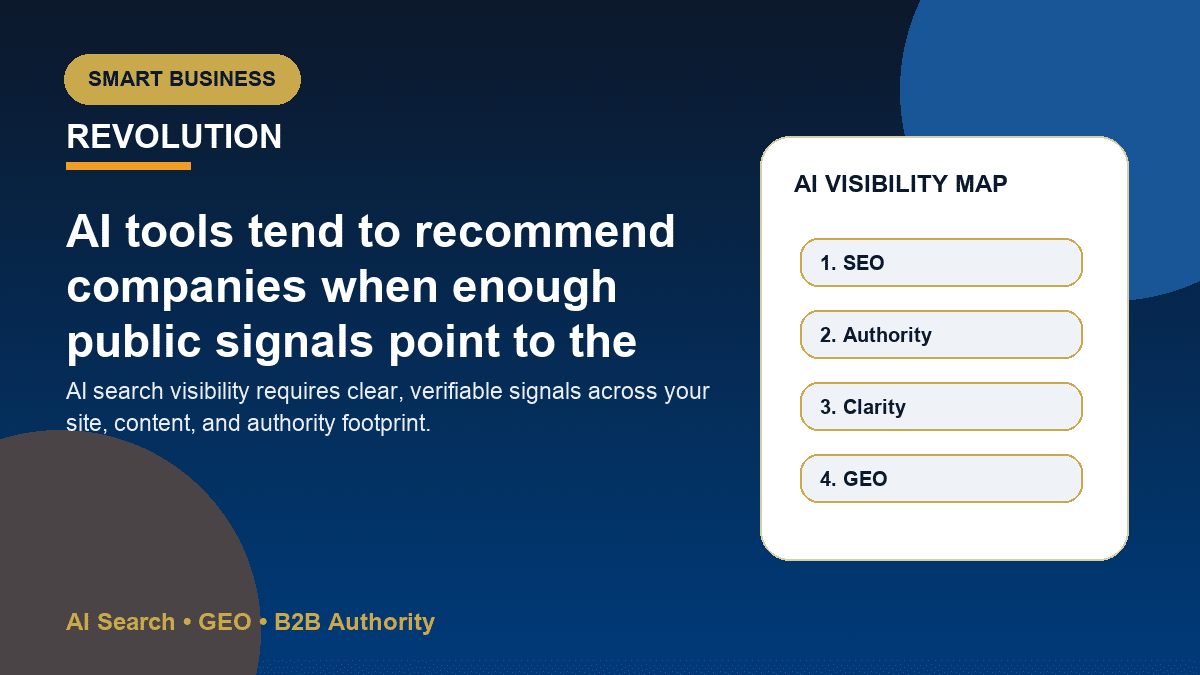
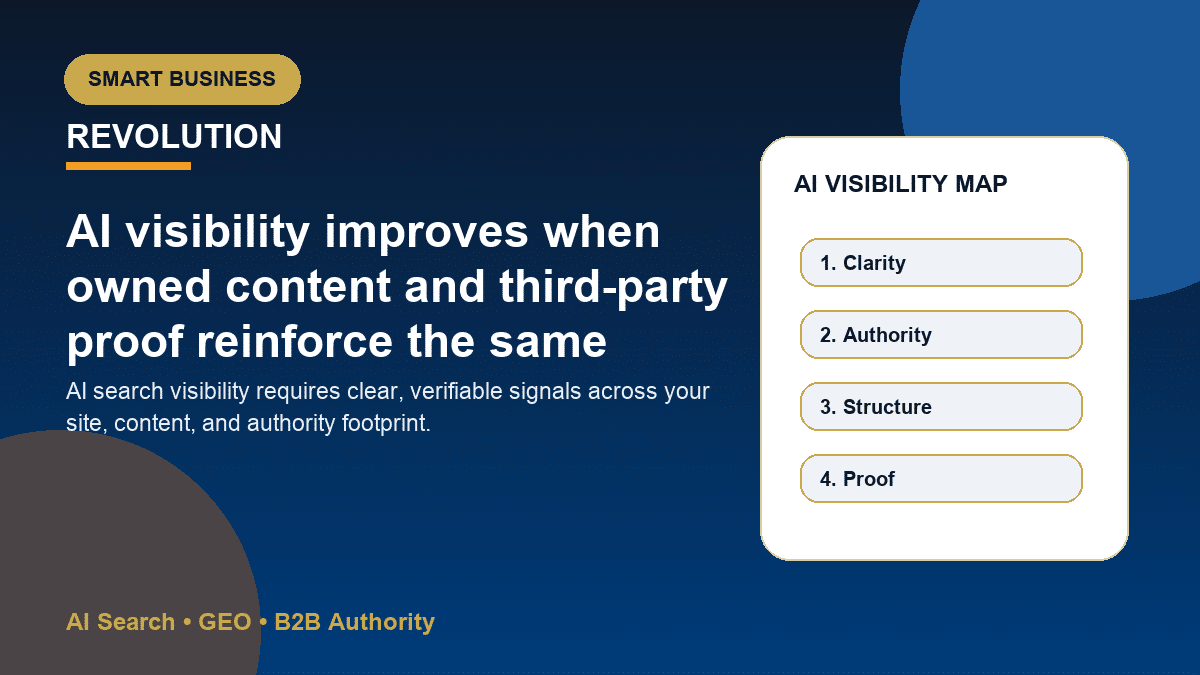
AI search visibility is not magic. It is the result of clear positioning, crawlable content, authority signals, and repetition across the places AI systems use to form answers. If your company is missing from AI answers, the problem is usually not one single ranking factor. It is a visibility system problem.
Traditional SEO still matters, but AI discovery adds a new layer. AI tools synthesize answers from search results, structured data, trusted publications, review sites, directories, social proof, and content that directly answers buyer questions. They often compress many sources into one response, so weak signals get ignored.
For B2B founders, the goal is not to game AI. The goal is to make your company the obvious, well-documented answer in your category. Smart Business Revolution’s GEO and AI visibility work helps founders identify why they are absent from AI answers and build the content, authority, and entity signals needed to compete.
Key Takeaways
- AI tools name brands they can confidently classify, verify, and compare.
- Your competitors may have stronger category language even if their product is not better.
- AI answers are influenced by third-party mentions, reviews, directories, and expert content.
- Generic service pages usually do not give AI enough evidence to recommend you.
- Comparison content, use-case pages, and FAQs help AI understand when to mention your company.
- Consistent entity data across your website and profiles reduces ambiguity.
- Traditional SEO supports AI visibility, but it is not the whole game.
- The fastest wins usually come from fixing unclear positioning and missing buyer-intent content.
- Smart Business Revolution’s GEO AI optimization services can help B2B companies build a practical visibility plan.
Table of Contents
- 1. How AI Decides Which Brands to Name
- 2. Why Your Competitors Have an AI Visibility Advantage
- 3. The Positioning Problem Most B2B Companies Miss
- 4. Create Content AI Can Actually Use
- 5. Build Authority Signals Beyond Your Website
- 6. Fix Technical and Entity Clarity
- 7. Compare Traditional SEO and AI Search Visibility
- 8. DIY vs Agency: Which Path Makes Sense?
- 9. Questions to Ask Before You Invest
- 10. Conclusion: Become the Obvious Answer
1. How AI Decides Which Brands to Name
When a buyer asks an AI tool for “best CRM for professional services firms” or “top fractional CFO platforms for startups,” the AI is not browsing like a human. It is predicting a useful answer based on patterns, retrieved information, and confidence. That confidence is everything.
AI systems are more likely to name companies that appear repeatedly in relevant contexts. If your brand shows up on your site only, but your competitor appears in comparison posts, podcast interviews, software directories, LinkedIn discussions, review sites, and category pages, the AI has more evidence about them.
This is why founders often feel confused. They know their company is credible. They know clients love them. But AI tools cannot infer that from a private sales process or a few vague web pages. They need visible proof.
Think of AI visibility as a trust graph. Every clear mention strengthens your position. Every vague page, inconsistent description, or missing profile weakens it.
2. Why Your Competitors Have an AI Visibility Advantage
Your competitor may not have a better product. They may simply have better public evidence. AI tools can only work with what they can access, retrieve, and interpret.
Common advantages include:
- They use plain category language on their homepage.
- They have pages for specific buyer problems and industries.
- They appear in “best of” and “alternatives” articles.
- They have more reviews on public platforms.
- They have founder interviews, podcasts, and guest articles.
- Their profiles use consistent descriptions across the web.
- Their site answers questions buyers actually ask AI tools.
Many B2B companies hide behind clever language. They say they “transform revenue operations” or “unlock strategic growth.” That may sound good in a pitch meeting, but it is hard for an AI system to connect with a practical buyer query.
If the buyer asks for “tools for customer onboarding automation,” and your site calls the same thing “activation enablement infrastructure,” your competitor has the advantage.
3. The Positioning Problem Most B2B Companies Miss
AI visibility starts with positioning. Not brand poetry. Not a tagline. Positioning means the market can quickly answer four questions:
- What are you?
- Who do you help?
- What problem do you solve?
- When should someone choose you instead of another option?
If those answers are unclear on your website, they will be unclear to AI tools. The first fix is usually not technical. It is editorial.
Your homepage should say what category you belong to. Your service pages should name the problems buyers recognize. Your about page should connect the founder, company, market, and proof points. Your case studies should spell out the before and after.
For a deeper primer on the topic, review the basics of AI visibility. If AI cannot explain you clearly, it will not recommend you confidently.
4. Create Content AI Can Actually Use
Most companies write content for three audiences: prospects, search engines, and internal stakeholders. AI adds a fourth audience. It needs structured, direct, evidence-rich content that maps to real questions.
Start with the questions your buyers ask before a sales call:
- What is the best solution for this specific use case?
- How does this compare with other options?
- Who is this best for?
- What are the tradeoffs?
- What does implementation require?
- What mistakes should I avoid?
Then build pages that answer those questions directly. Good AI visibility content often includes definitions, buyer scenarios, comparison tables, decision criteria, limitations, and FAQs. It does not bury the answer under five paragraphs of thought leadership throat clearing.
Useful page types include:
- “Best tools for X” pages where appropriate and honest.
- Alternatives and comparison pages.
- Industry-specific use-case pages.
- Problem-specific guides.
- Case studies with measurable outcomes.
- Founder-led expertise articles.
- Clear service pages connected to buyer intent.
This is also where internal linking matters. Related content should point to priority pages with natural, descriptive anchor text.
5. Build Authority Signals Beyond Your Website
Your website is necessary, but it is not enough. AI tools look for corroboration. If your company claims to be a leader but no one else seems to mention you, that claim is weak.
Authority signals can include podcast appearances, expert quotes, guest articles, directory profiles, speaking pages, review platforms, association listings, and partner pages. These do not need to be flashy. They need to be real, relevant, and consistent.
For B2B founders, founder-led visibility can be especially powerful. A founder who appears on credible podcasts, publishes practical articles, and is cited for a specific area of expertise creates more surface area for AI systems to understand the company.
A simple rule: if you want AI tools to describe you a certain way, the web needs to describe you that way repeatedly.
6. Fix Technical and Entity Clarity
Once your positioning and content are clear, technical clarity helps machines connect the dots. This includes schema markup, crawlability, fast pages, clean site architecture, accurate metadata, and consistent company information.
Entity clarity means your brand is easy to identify as one distinct thing. Your company name, founder name, address if relevant, social profiles, podcast appearances, and organization details should line up across platforms.
Here are practical checks:
- Can search engines crawl your important pages?
- Do your title tags describe the actual page topic?
- Do you use Organization, Person, Article, FAQ, and Breadcrumb schema where appropriate?
- Is your company description consistent across LinkedIn, directories, and review profiles?
- Do pages link logically from broad category pages to specific use cases?
- Are outdated pages confusing your category or offer?
Technical work will not save weak positioning. But strong positioning plus clean technical signals gives AI systems a much better chance of understanding and naming your company.
7. Compare Traditional SEO and AI Search Visibility
Traditional SEO and AI visibility overlap, but they are not identical. Founders should understand the difference so they do not keep optimizing for yesterday’s buyer journey.
The best strategy does both. SEO helps your content get discovered. AI visibility helps your brand get included when the answer is compressed into a few recommendations.
8. DIY vs Agency: Which Path Makes Sense?
Some companies can make meaningful progress internally. Others move faster with outside help. The right choice depends on your team, category, competition, and urgency.
If your internal team knows the customer deeply and can publish quickly, start with a focused audit. If your competitors are already being named and your pipeline depends on being discovered earlier, outside support may be worth it.
The key is to avoid random activity. Ten blog posts that do not clarify your category will not fix the problem. Three strong pages, five credible third-party mentions, and a cleaner entity footprint may do more.
9. Questions to Ask Before You Invest
Before you spend money on tools, agencies, or a large content program, ask better questions. AI visibility is still a young discipline, so disciplined thinking matters.
- Which AI tools are our buyers most likely to use?
- What exact prompts would a buyer ask before considering us?
- Which competitors get named today, and in what context?
- What sources appear to influence those answers?
- Does our homepage clearly state our category and ideal customer?
- Do we have content for comparisons, alternatives, industries, and use cases?
- Are third-party mentions reinforcing the same positioning?
- Can AI tools find proof that we solve the problem we claim to solve?
- How will we measure progress beyond traffic?
Run these questions quarterly. AI answers shift as models, retrieval systems, indexes, and web content change. A one-time fix is not enough in a competitive category.
If you want a practical starting point, review your homepage, three most important service pages, five competitor prompts, and ten third-party profiles. That small sample will usually reveal the biggest gaps.
10. Conclusion: Become the Obvious Answer
The reason your competitors get named by AI and you do not is usually simple: they have more visible, consistent, and useful evidence. AI systems are not judging your company the way a referral partner would. They are assembling answers from the public record.
That should be encouraging. You can improve the public record. You can clarify your positioning, publish better buyer-intent content, strengthen third-party proof, clean up entity data, and track whether AI tools start mentioning you more often.
Do not chase every AI trend. Build the fundamentals that make your company easier to understand and recommend. The companies that win will not be the loudest. They will be the clearest, most credible, and easiest to cite.
If your competitors are appearing in AI answers and you are not, start with a visibility audit before you publish another generic blog post.
Related Guides
FAQ
Why do my competitors show up in AI search but my company does not?
Usually because AI tools can find more clear and consistent evidence about your competitors. They may have stronger category pages, better third-party mentions, more reviews, or more content that matches buyer prompts.
Is AI visibility just SEO with a new name?
No. SEO is still important, but AI visibility also depends on entity clarity, answer structure, third-party corroboration, and whether your brand is useful inside a synthesized response.
What content helps a company get named by AI?
Comparison pages, alternatives pages, use-case guides, industry pages, case studies, FAQs, and expert articles all help when they answer real buyer questions clearly.
How long does it take to improve AI search visibility?
Some changes can show up quickly, especially in retrieval-based AI tools. Broader visibility usually takes months because it requires better content, more corroboration, and repeated signals across the web.
Do reviews matter for AI recommendations?
Yes, especially for software, services, and professional categories where public reviews help validate quality, use cases, and customer fit.
Should I create pages comparing my company to competitors?
Often, yes. Honest comparison content helps buyers and AI tools understand tradeoffs. Avoid cheap attacks. Focus on fit, use cases, strengths, limitations, and decision criteria.
What should I measure besides traffic?
Track AI mentions, citations, share of answer, competitor comparisons, branded demand, qualified leads, and whether prospects mention AI tools during sales conversations.
What is the first step if I am invisible in AI answers?
Run a prompt audit. Test buyer-intent prompts, capture which companies appear, identify cited sources, then compare those signals against your own website and third-party footprint.
Final CTA
If your team is asking “why competitors tools show up in ai search not mine,” it is time to stop guessing. Visit the contact page to discuss a practical AI visibility audit and roadmap.
About the Author

John H. Corcoran is an AI Visibility expert, former White House Writer, speechwriter, attorney, and author. He is the creator of Smart Business Revolution and host of the Smart Business Revolution podcast. Since 2010, he has interviewed over 1,500 successful entrepreneurs, CEOs and experts.
He is the author of 3 books about relationship building and client acquisition, and has been profiled in Forbes and featured in Entrepreneurial You (Harvard Business Review Press), Stand Out (Portfolio) by Dorie Clark, The Connector’s Advantage (Page Two) by Michelle Tillis Lederman, Success Is In Your Sphere (McGraw-Hill Education) by Zvi Band, and The Successful Mistake by Matthew Turner. His writing has appeared in Forbes, Entrepreneur, Huffington Post, Art of Manliness, Lifehacker, Business Insider, and numerous other publications.
Ready to explore how to get more AI visibility? Schedule a free consultation with John to discover how you can get more AI visibility.
Contact John →